2026 Commercial Lines Producer Onboarding Guide
Updated: 5 days ago
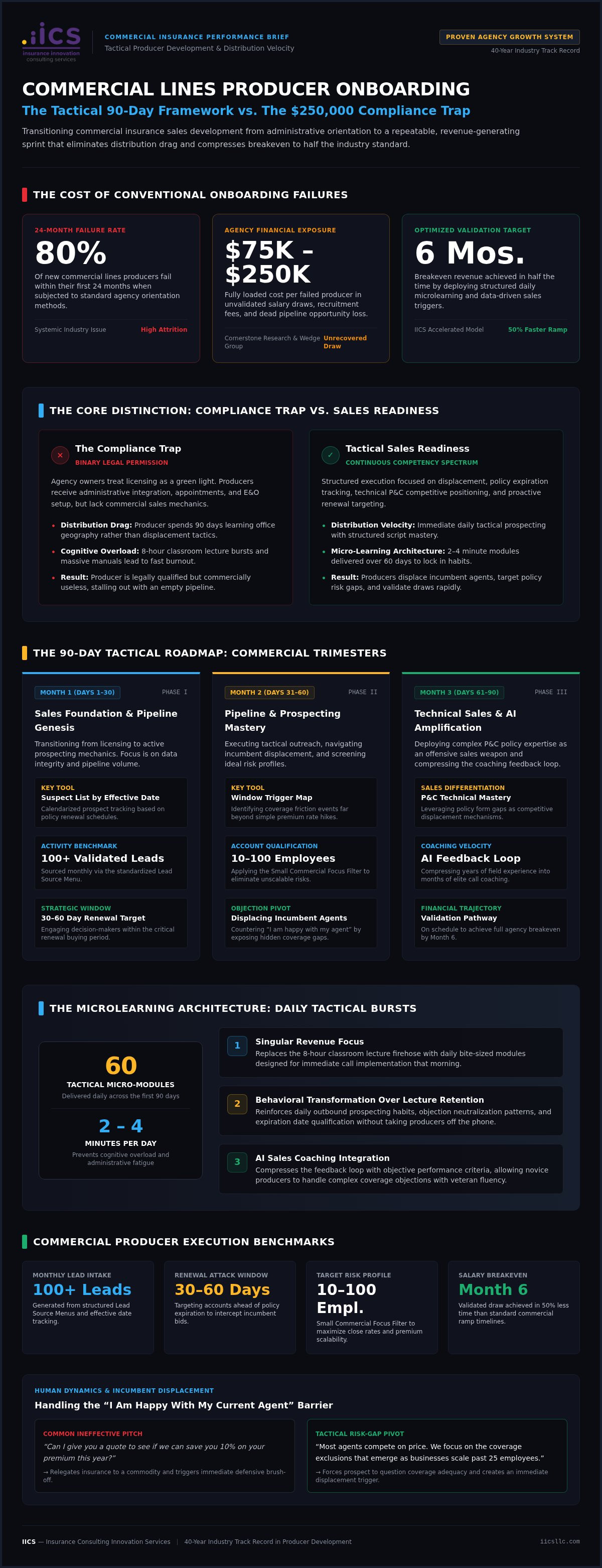
Did you know that 80% of new commercial lines producers fail within their first 24 months, costing your agency up to $250,000 in unvalidated salary and lost opportunities? It's a staggering figure that highlights a systemic flaw in the insurance industry. Most agencies treat onboarding commercial lines producers as an HR formality or a week-long administrative firehose. This approach doesn't build producers; it builds burnout. You know the frustration of watching a high-potential hire struggle to bridge the gap between getting licensed and actually writing premium. It's a waste of talent and capital that your agency cannot afford in a softening market.
It's time to stop gambling on your agency's growth. We're providing the tactical 90-day framework you need to ramp up producers faster and achieve breakeven revenue in half the time. This system replaces guesswork with data-driven feedback and micro-learning modules that actually stick. You'll learn how to transform your onboarding from a chaotic orientation into a repeatable, high-performance sprint. We will cover the specific trimester milestones, the critical 60-day renewal window, and how AI-powered coaching can compress years of experience into months of elite production.
Table of Contents
The Strategic Shift: Why Compliance-Only Onboarding Fails
Most agency owners mistake a license for a green light. They celebrate when a new hire passes their exam, file the paperwork, and then wonder why that same individual is struggling to fill a pipeline six months later. This is the Compliance Trap. It's a dangerous assumption that legal permission to sell is the same as tactical sales ability. Without a better approach to onboarding commercial lines producers, you are essentially funding a very expensive hobby for your new hires.
Defining Sales Readiness vs. Compliance Readiness
Compliance is binary; you either have the license or you don't. Sales readiness is a spectrum of competency. While standard organizational onboarding principles focus on role clarity and administrative integration, they often ignore the specific mechanics of the commercial sale. Compliance involves appointments and E&O requirements. Sales readiness requires mastering expiration date tracking, objection handling, and deep technical P&C knowledge. Most agencies stop after the paperwork is filed, leaving their producers legally ready but commercially useless.
Failing to bridge this gap creates "Distribution Drag." It's the friction that occurs when a producer spends their first 90 days learning where the coffee is instead of how to displace an incumbent agent. When you fail to prioritize sales competency from day one, you aren't just delaying revenue; you're actively inviting turnover. High-potential talent won't wait twelve months to feel successful. If they don't see a path to validation, they'll find a new career.
The Real Cost of a Failed Producer Onboarding
A non-producing hire is a drain on more than just your payroll. According to research from Cornerstone Research and The Wedge Group, the fully loaded cost of a single failed commercial producer can range from $75,000 to $250,000. This includes unvalidated salary draws, recruitment fees, and the massive opportunity cost of a cold pipeline. Beyond the balance sheet, a failed hire poisons agency morale. Your top performers see the stagnation and wonder why the standards have slipped.
Achieving true distribution velocity requires a shift in mindset. You don't hire people and hope they figure it out; you deploy a system that guarantees they will. Learn more about IICS's 40-year track record in developing producers who break even in half the industry standard time. Implementing a structured system for onboarding commercial lines producers allows you to move from a "wait and see" culture to one of elite, data-driven performance. Success isn't about the license; it's about the execution.
The 90-Day Roadmap: Structuring the Commercial Lines Trimesters
The 90-day sprint is not a suggestion; it's a requirement for survival. Most agencies fail because they overwhelm new hires with a manual the size of a phone book. Why do we expect a producer to retain eight hours of lecture? Our MicroLearning philosophy flips the script. By delivering 60 tactical modules in 2-4 minute daily bursts, we build habits that stick. This structured approach to onboarding commercial lines producers ensures that every day has a singular, revenue-focused objective. We don't just teach; we transform behavior.
Month 1: Building the Sales Foundation
Success in the first 30 days is about activity, not just knowledge. The "Suspect List By Effective Date" isn't just a spreadsheet; it's the producer's lifeblood. We teach them to navigate the "Lead Source Menu" to generate at least 100 validated leads every month. According to the U.S. Bureau of Labor Statistics occupational guide for insurance sales agents, mastering core competencies like prospecting is what separates top earners from the median. A critical realization in this phase is that the Renewal Buying Window is the 30-60 day period before a policy's expiration date.
Month 2: Pipeline and Prospecting Mastery
Month 3: Closing and Scaling the Book
The final trimester refines the technical edge. Producers dive into the nuances of ISO Form CG 00 01 versus proprietary carrier endorsements. This isn't just back-office trivia; it's a weapon in the field. By focusing on SME commercial accounts, they learn to navigate complex risks with the confidence of a veteran. This is where the "hired agent" dies and the "elite producer" is born. Ready to see the curriculum in action? You can see exactly what's inside the academy and how it transforms your distribution velocity. We move your producers from licensing to writing premium in half the industry standard time.
Bridging the Technical Gap: P&C Skills for Elite Producers
The standard ISO CG 00 01 form is your baseline, but it's rarely the final word. Elite producers win by identifying the gaps between standard language and custom carrier endorsements. Can your new hire highlight three specific wording differences that leave a client exposed? If not, they're leaving the door open for a more disciplined competitor. Mastering these nuances is a core pillar of Advanced Commercial Insurance Sales Techniques. This isn't about being a technician; it's about being a risk advisor who displaces the incumbent through superior insight. You don't win on price; you win on the realization that the incumbent agent missed a critical exclusion.
Risk Insights and Industry Nuance
Jargon kills deals. SME owners don't care about "indemnification clauses" in the abstract; they care about what happens when a subcontractor's mistake leads to a structural failure. Our "Risk and Coverage Deep Dive" methodology teaches producers to use simple loss examples to illustrate complex exposures. Gallup research on onboarding effectiveness shows that only 12% of employees feel their organization onboards well, largely because training stays at the surface level. We go deeper. We use AI-assisted prompts to shorten research time on industry-specific risks, such as worker classification or municipal equipment laws. This allows the producer to walk into a meeting with the authority of a twenty-year veteran.
The traditional "ride-along" is dead. It's a relic of a slower era that relies on the subjective memory of a busy sales manager. If you want to scale, you can't rely on ad-hoc feedback. Onboarding commercial lines producers in 2026 requires a precision instrument. AI Sales Coaching provides that edge by analyzing every call and scoring it against 9 specific performance criteria. This isn't just about recording conversations; it's about objective, data-driven feedback that identifies exactly where a producer lost the deal. Did they fail to ask for the X-date? Did they stumble on the "happy with my agent" objection? The data doesn't lie.
Real-Time Feedback: The End of the 'Ride-Along'
Waiting for a weekly 1:1 to discuss a call from Monday is a recipe for stagnation. By then, the nuances of the conversation are forgotten. AI coaching delivers next-step guidance immediately after the receiver hits the cradle. This removes the "manager's bias" and provides a clear, actionable roadmap for the next prospect. For a deeper look at how this technology is changing the industry, see our guide on AI Sales Coaching for Insurance. It's the difference between a vague "good job" and a tactical breakdown of sales mechanics.
MicroLearning: Training That Sticks
We don't just leave producers to an algorithm. We combine this high-tech feedback with weekly live workshops and 1:1 mentoring from veteran sales experts. This hybrid model ensures that producers stay on track throughout their 90-day roadmap. It’s a battle-tested system that has helped agencies achieve a 31% increase in new clients. If you are ready to stop the "wait and see" hiring cycle, you can see the Sales Academy tools in action. Don't let your next hire become another statistic in the industry failure rate.
Implementing the Elite Producer Framework at Your Agency
Building an in-house training program is a distraction you can't afford. You're an agency principal, not a dean of students. Outsourced producer development isn't just a convenience; it's a strategic necessity for those serious about scaling. By offloading the tactical heavy lifting to experts, you move from being a micro-managing supervisor to a high-level mentor. This shift is critical for onboarding commercial lines producers who can actually move the needle on your agency's revenue. Why waste your time teaching the basics when you should be coaching the close?
Setting the Standard for Performance
Elite performance isn't an accident. It's the result of non-negotiable benchmarks. We demand 100+ validated leads and 3-5 new accounts every single month. Anything less is just activity, not production. To hit these numbers, producers must commit to three basic sales habits every week for the full 90-day sprint. We provide the effectiveness tools and workbooks to ensure they own every step of the process. You can explore the Sales Academy curriculum to see how we track these metrics with surgical precision. If they aren't hitting the numbers, the data will tell you why long before the draw period expires.
The IICS Sales Academy: Your Turnkey Onboarding Engine
Why settle for the industry average failure rate? Producers who undergo formal, structured training achieve a 52% higher sales rate and a 31% increase in new clients. The Sales Academy isn't just a course; it's a turnkey onboarding engine. Our 3-month system doubles the likelihood of a hire reaching top-producer status. This includes monthly 1:1 coaching with industry veterans like Ralph Blust, providing a level of mentorship that most agencies simply can't replicate internally. It's about bridging the gap between licensing and elite production without the typical 12-month lag.
The market is softening, and the "rate-increase" tailwinds are gone. This is your window to dominate while your competitors are still relying on hope as a strategy. Implementing a repeatable system for onboarding commercial lines producers ensures that your growth is predictable, not accidental. Invited agencies can leverage the "Summer2026" discount to secure this elite development for their team. Stop hoping your next hire works out. Build an elite team that is battle-tested for the 2026 market. The choice is simple: invest in development now or pay for failure later.
Securing Your Agency's Distribution Velocity
Stop settling for the industry's 80% failure rate. By shifting from a compliance-only orientation to a tactical 90-day sprint, you transform your recruitment risk into a predictable asset. We've detailed how technical P&C mastery and data-driven feedback are the essential pillars of a self-sustaining book. The era of the "ride-along" is over; the era of precision execution has arrived. Master the discipline of onboarding commercial lines producers by replacing administrative firehoses with structured, micro-learning habits that actually stick.
Is your agency prepared to dominate a softening market? Your next hire doesn't have to be a gamble. Backed by a 40-year track record of elite growth, our system provides the stability of a battle-tested methodology. This includes unlimited AI call coaching and a proven 90-day tactical roadmap designed to achieve breakeven in half the industry standard time. Enroll your next hire in the IICS Sales Academy and double their success rate. Take command of your sales development today and build the elite team your market demands. You have the framework; now it's time to execute.
Frequently Asked Questions
How long does it typically take to onboard a commercial lines producer?
The industry standard for onboarding commercial lines producers to reach self-sustaining production is 12 to 18 months for new-to-industry hires. However, a structured 90-day tactical roadmap can compress this timeline significantly. By focusing on revenue-generating activities from day one, producers can achieve breakeven revenue in half the industry standard time. This accelerated ramp-up requires moving beyond administrative orientation and into a disciplined, daily sales framework that prioritizes pipeline development.
What is the difference between an insurance producer academy and standard sales training?
Standard sales training often focuses on generic communication skills that fail to address the technical complexities of P&C insurance. The Sales Academy bridges this gap by integrating technical expertise as a sales tool. It covers industry-specific mechanics like carrier appetite, ISO form nuances, and the 60-90 day renewal outreach window. Unlike generic programs, an academy provides a battle-tested system designed specifically for the high-stakes environment of commercial insurance sales.
Can AI really help train insurance producers on sales calls?
AI coaching is a transformative tool that provides objective, data-driven feedback immediately after a call. It analyzes conversations and scores them against 9 specific communication criteria, removing the subjectivity of traditional manager evaluations. This technology provides producers with next-step guidance and actionable objection responses. It allows for a continuous feedback loop that compresses the learning curve, helping producers master complex sales scenarios in weeks rather than years of trial and error.
What are the most common reasons new insurance producers fail in their first year?
Approximately 70% to 80% of new producers fail because of the "Compliance Trap." Agencies often front-load onboarding with licensing and administrative tasks while neglecting a tactical outbound sales framework. This "firehose" approach leads to cognitive overload and early burnout. Without a repeatable system for generating 100+ validated leads per month, producers fail to build a sustainable pipeline before their draw period expires, leading to a high cost of non-producing hires.
Is MicroLearning effective for complex topics like P&C insurance?
MicroLearning is exceptionally effective for complex topics because it aligns with how the human brain retains information. Instead of 8-hour seminar days that lead to a 90% loss of material within a week, MicroLearning utilizes 2-4 minute daily lessons. This method focuses on habit formation and incremental skill building. It ensures that complex concepts, such as worker classification or municipal law impacts, are reinforced through daily application rather than one-time lectures.
How much does a formal commercial lines producer training program cost?
The cost of a formal training program should be viewed as an investment against the $75,000 to $250,000 loss associated with a failed producer hire. While pricing varies based on the level of mentorship and technology provided, elite programs offer a turnkey development engine without hidden fees. Investing in a structured system ensures your agency avoids the massive opportunity cost of a cold pipeline and the drain of unvalidated salary draws on your agency's capital.
What metrics should I track during a producer's first 90 days?
You must track leading indicators that predict future revenue rather than just trailing premium numbers. Essential metrics include generating at least 100 validated leads per month and hitting a target of 3-5 new accounts monthly. Focus on the producer's activity within the 60-90 day renewal outreach window. Using effectiveness tools to monitor these producer-owned steps ensures that onboarding commercial lines producers remains a data-driven process rather than a "wait and see" gamble.
How do I help my producers reach breakeven revenue faster?
Helping producers reach breakeven faster requires a shift from being a manager to becoming a high-stakes coach. Implement a repeatable 90-day roadmap that emphasizes daily prospecting habits and technical sales edge. Research shows that producers who attend formal, structured training achieve 52% higher sales and a 31% increase in new clients. By leveraging outsourced development and AI coaching, you can double the likelihood of your next hire becoming a top-tier producer for your agency.