Agency Growth Strategies for P&C Insurance: A Practical 2026 Framework
What if the reason your P&C agency isn’t growing faster is not a shortage of initiatives, but a constraint those initiatives never address? Agency growth strategies for P&C insurance work best when leaders identify what’s holding results back before adding another target, tool, or campaign.
Growth needs to be profitable and sustainable. New business alone won’t deliver it if retention slips, account quality weakens, or producers lack the capacity and habits to execute consistently. Rather than pursuing every opportunity at once, focus on the issue that is limiting results now.
This practical 2026 framework will help you pinpoint your agency’s most important growth constraint, select measurable levers, and turn priorities into accountable action. It also shows how producer development can build consistent capability over time, while leadership keeps the team focused on the right outcomes. The goal is straightforward: connect what your team does each week to the growth your agency needs.
Table of Contents
What sustainable growth means for a P&C insurance agency
More policies sold doesn’t automatically mean a stronger agency. Sustainable growth is durable, intentional progress that supports the agency’s goals without outpacing its ability to serve clients, retain business, and execute consistently. In property and casualty, assess the quality and fit of accounts alongside production. Casualty insurance is a core part of P&C, but agency growth should be judged across the business profile the agency chooses to serve, not by one line or sales activity alone.
Agency growth is lasting improvement in the value, quality, and resilience of the business; producer activity is the work intended to create that improvement. Calls, meetings, submissions, and proposals are useful leading indicators. They are not proof of growth unless they contribute to durable agency outcomes.
Organic growth develops the agency’s existing business through new accounts, stronger retention, and deeper client relationships. Acquisition-led expansion adds an existing book or operation. Both can support growth, but they require different plans and resources. This framework focuses on organic progress and the execution discipline behind it, not transaction mechanics. Either way, growth loses value if the agency takes on accounts that don’t fit its appetite or lacks the capacity to service them well.
Which outcomes show whether a P&C agency is growing well?
Use a compact set of measures that separates volume from business health. Written premium or revenue can show whether the book is expanding, but neither reveals profitability, account fit, or the effort required to support that business. Pair them with retention and client-development indicators to assess whether growth is durable.
New business: Track written premium or revenue alongside new accounts, using the same reporting period and definitions.
Retention: Review retained clients or business against the agency’s chosen baseline.
Client development: Measure meaningful coverage reviews, account rounding, or other planned actions with existing clients.
Quality and capacity: Review whether new accounts fit the agency’s target profile and can be serviced with current resources.
Define each measure before comparing periods. For example, decide whether retention counts clients, policies, or revenue, then use that definition consistently. Otherwise, a change in reporting method can look like a change in performance.
How to diagnose the constraint behind stalled growth
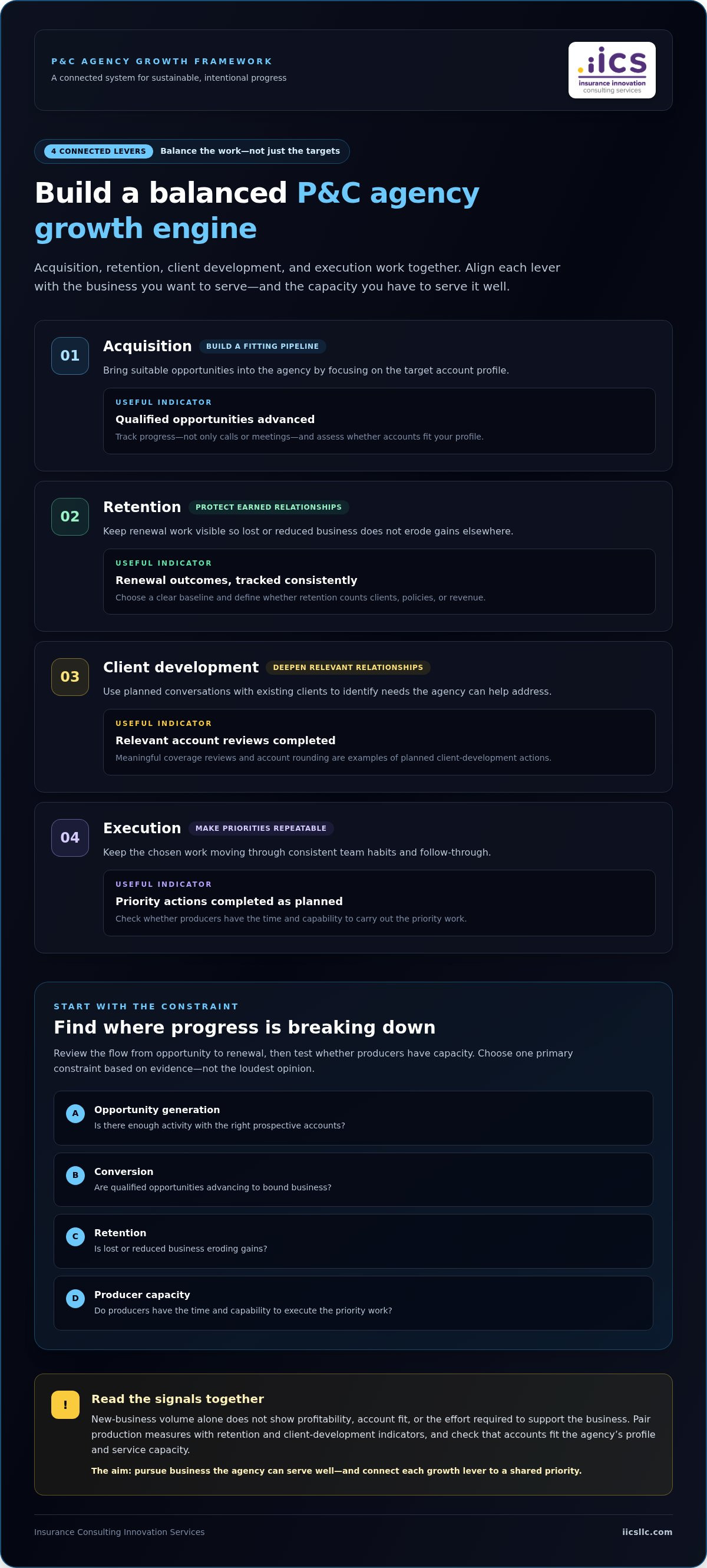
Don’t default to “we need more leads” or “we need more producers.” First identify where progress is breaking down. Review the flow from opportunity to renewal, then test capacity:
Opportunity generation: Is there enough activity with the right prospective accounts?
Conversion: Are qualified opportunities advancing to bound business?
Retention: Is lost or reduced business eroding gains?
Producer capacity: Do producers have time and capability to execute the priority work?
Choose one primary constraint based on evidence, not the loudest opinion in the room. That focus gives leaders a clear starting point for selecting agency growth strategies for P&C insurance, instead of scattering effort across problems the agency may not have.
Build a balanced P&C agency growth engine
A strong growth plan isn’t a stack of disconnected targets. It’s a system: acquisition brings suitable opportunities into the agency, retention protects relationships already earned, client development identifies relevant ways to serve existing accounts, and disciplined execution keeps those efforts moving. If one lever is ignored, progress elsewhere can be harder to sustain.
The right balance depends on the agency’s chosen business profile and capacity to deliver. An agency focused on commercial contractors, for example, might prioritize prospects that fit its expertise and service model, while making room for timely renewal conversations and appropriate coverage reviews with current clients. That doesn’t mean every agency should target contractors or adopt the same production goals. The objective is alignment: pursue business the agency can serve well.
These indicators are signals, not guarantees. Read them together: a busy pipeline may still contain poor-fit accounts, while strong activity can be undermined if renewal work slips or producers lack time to follow through. A balanced set of agency growth strategies for P&C insurance connects each lever to a shared business priority and a realistic capacity plan.
Strengthen new-business production without neglecting fit
Start with the account profile, then shape prospecting around it. Define which client characteristics, coverage needs, and service demands make an opportunity worth pursuing. For agencies seeking to reach niche commercial accounts through targeted digital acquisition, specialized B2B marketing agencies like Arokia IT LLC can assist in designing account-based marketing strategies that attract ideal clients. Track qualified opportunities and their progress, not just calls or meetings. Producers control preparation, follow-up, and the quality of conversations; they don’t control every market condition or prospect decision. Separate those factors in performance reviews so coaching stays focused on actions the team can influence.
Protect and expand the value of existing relationships
Retention deserves deliberate attention, not whatever time remains after new-business work. Establish a consistent rhythm for renewal discussions and account reviews, then look for client needs the agency is equipped to address. Cross-selling should follow fit and relevance, not a blanket quota. Reliable communication and follow-through can support a stronger client experience, but no single service practice guarantees retention.
When stronger producer habits are needed, structured producer development can connect practice, coaching, and leadership priorities to the agency’s chosen growth levers.
Match P&C agency growth strategies to the constraint
A strategy can be sound and still be the wrong first move. If opportunities are entering the pipeline but producers aren’t advancing them, adding prospecting activity may create more backlog, not more growth. Match the response to the point where progress is breaking down, then sequence other improvements around that priority.
Use this table to turn the diagnosis into a practical first action. The indicators are starting points; define them consistently and interpret them in the context of your target accounts and service capacity.
When the primary constraint is an inconsistent pipeline
Start with focus, not a hunt for a magic lead source. Define the account profile the agency is prepared to serve, then set a consistent prospecting and pipeline-review rhythm around it. Track qualified opportunities and whether agreed follow-up is completed; raw activity counts can disguise a pipeline full of poor-fit prospects or neglected next steps. For commercial P&C prospecting, organizing prospects by policy effective date can help producers plan outreach around renewal timing. IICS’s producer-development materials use outreach 60 to 90 days before expiration and identify a 30 to 60-day renewal buying window. Producers control preparation and follow-through, not every market condition or prospect decision.
When the primary constraint is producer execution
Find out what’s behind the gap before prescribing training. A knowledge gap may call for clearer guidance; a practice need may require observation, feedback, and coaching; an accountability gap may point to unclear expectations or an inconsistent management rhythm. Match the intervention to the cause. A repeatable sales process can clarify next actions, while regular reviews can make ownership visible without treating every shortfall as a skill problem.
Retention pressure calls for a different first response than weak conversion. Look at renewal timing, communication, and recurring reasons accounts are lost or reduced. For capacity constraints, examine which work is consuming producer time and whether responsibilities or priorities are clear. Don’t assume every agency needs more leads or more producers. A hiring or prospecting push won’t fix a process that is already failing at follow-through.
Agencies can work on several levers over time, but simultaneous initiatives compete for attention. Choose one primary constraint, assign a first response, and watch for evidence that it’s improving before layering on another major effort. For a deeper look at producer-level measures and execution, explore the insurance agency sales performance framework. The strongest agency growth strategies for P&C insurance connect that performance view to the agency’s actual bottleneck, rather than treating producer activity as the objective.
Turn the selected growth strategy into a 90-day operating plan
A priority only becomes strategy when people know what to do, who owns it, and how leaders will judge progress. A 90-day operating plan creates a defined period for execution and review without assuming every agency needs the same activity targets or meeting schedule. Build the plan around the constraint you selected, then keep its measures visible and consistent.
Use four stages to move from diagnosis to evidence:
Diagnose. Document the constraint and the evidence behind it, such as pipeline movement, renewal patterns, or delayed producer actions.
Choose a priority. Select one strategic response for the 90-day period. State what the agency will focus on and what it will defer, so competing initiatives don’t dilute attention.
Assign ownership. Name an accountable leader and the people responsible for observable actions. Clarify decision rights and how barriers should be raised.
Review evidence. Compare leading actions with business outcomes, identify execution barriers, and decide whether to continue, adjust, or investigate further.
Set a baseline and define ownership
Before work begins, record the starting point for each measure, its definition, where the data comes from, and who maintains it. If “qualified opportunity” means something different to each producer, a pipeline comparison won’t guide decisions. Keep the scorecard small enough to use consistently: pair a few leading indicators, such as completed follow-ups or planned account reviews, with lagging outcomes like bound business or renewal results.
Translate the priority into weekly actions people can observe. If conversion is the focus, for example, a producer might record the next step and follow-up date for each active opportunity. That action is within the producer’s control; whether the account binds is an outcome affected by factors beyond that activity. Make both visible, but don’t confuse them.
Review results and adjust without changing direction too quickly
Set review frequency to fit the work and the agency’s operating rhythm. The goal is enough visibility to address missed actions promptly, without turning reporting into a burden. Early reviews should test whether agreed actions are happening and uncover obstacles. Business outcomes may take longer to show a meaningful pattern, so avoid abandoning a priority because one short reporting period is inconclusive.
Use coaching and reporting conversations to ask what blocked execution, what changed, and what support or decision is needed. Adjust an action when evidence points to a practical problem, but keep the strategic priority stable unless the diagnosis proves wrong. That discipline separates a useful course correction from another cycle of starting over.
If producer development is the chosen lever, connect practice and feedback to the agency’s measurable priority. The elite insurance producer development plan offers a deeper look at building producer capability. For leaders who need help aligning priorities with execution, explore IICS growth support. A focused operating plan makes agency growth strategies for P&C insurance accountable, practical, and responsive to evidence.
Make producer capability part of the P&C growth strategy
Once leaders choose a growth priority, producer capability becomes an execution lever. It can help turn that priority into repeatable behaviors, but it isn’t a substitute for sound leadership, retention, service, or a pipeline strategy. Training without a clear agency objective risks improving activity that doesn’t address the real constraint. Start with the outcome the agency wants, then decide what producers need to do consistently to support it.
For example, if the priority is improving conversion, leaders might reinforce stronger discovery, clearer next steps, and timely follow-up. If the priority is client development, expectations might focus on preparing for account reviews and identifying relevant coverage needs. These are examples, not universal targets. The right behaviors depend on the agency’s strategy, its clients, and the producer’s role.
Connect development to the agency’s chosen growth outcome
Make the connection explicit: name the agency priority, identify the producer behaviors that support it, and agree on how managers will observe and discuss those behaviors. Coaching should focus on specific work, such as a sales conversation or an opportunity’s next step, rather than vague calls to “sell more.” Track progress against the agency’s defined measures, and treat results as goals to assess, not guaranteed effects of training.
Leadership accountability matters. Managers need to reinforce expectations, make time for feedback, and address obstacles that prevent follow-through. Producers, in turn, need a clear understanding of the actions they own. That shared discipline keeps development tied to the strategy instead of turning it into a separate initiative with no visible connection to agency performance.
Use structured development to reinforce consistent execution
For agencies choosing producer development as a priority, IICS’s Sales Academy is a 90-day program designed specifically for commercial P&C producers. It combines daily microlearning, AI call coaching, one-to-one mentoring, and weekly workshops. These elements provide structure for practice and feedback while agency leaders connect development to the behaviors and outcomes they’ve selected. The program supports the priority; it doesn’t decide what that priority should be.
Relevant experience also matters in producer development. Ralph Blust brings more than 40 years of insurance industry leadership. That experience informs a practical focus on developing individuals and strengthening execution over time, without suggesting that any single program can resolve every agency growth challenge.
Keep the test straightforward: can producers explain the priority, demonstrate the related behaviors, and receive useful feedback on their execution? If not, clarify expectations and the coaching rhythm before adding more activity. That’s how agency growth strategies for P&C insurance become visible in day-to-day producer work and remain accountable to broader agency goals.
If producer development aligns with your agency’s chosen priority, explore IICS’s Sales Academy and producer development services to build producer capability around that direction.
Make your next growth move deliberate
The next step isn’t another initiative. It’s a leadership decision: choose what deserves focused attention now, make ownership visible, and protect time to review whether the work is advancing the agency’s priorities. That discipline helps prevent urgent day-to-day demands from quietly displacing the strategy.
Use your first review to test execution, not to demand instant results. Are the agreed actions happening? What’s getting in the way? What evidence would justify adjusting course? Clear answers help leaders stay committed without becoming rigid. They also give producers a practical standard for what progress looks like.
The strongest agency growth strategies for P&C insurance evolve through deliberate choices, consistent follow-through, and honest assessment. You don’t need to solve every growth challenge at once. Start with the priority that matters most, then build the capability to execute it well.
Explore IICS’s Sales Academy and producer development services to connect structured producer development with your agency’s growth priorities. Start with a focused decision, then give your team the tools, coaching, and accountability to act on it.
Frequently Asked Questions
What are the most effective growth strategies for a P&C insurance agency?
The most effective strategies address a specific agency need and fit the business it wants to write. For example, an agency seeking more middle-market accounts might refine its ideal-client criteria, review how existing relationships could be better served, and assess whether producers have the expertise and time to pursue that profile. The best choice isn’t the trendiest tactic. It’s the one leaders can execute and evaluate with available resources.
How can an independent insurance agency grow without sacrificing retention?
Protect service capacity as you pursue new business. Before expanding prospecting commitments, consider how new accounts will affect account-management workloads, renewal preparation, and responsiveness to current clients. Track retention alongside new-business volume, and look for patterns such as losses concentrated in a particular account segment or handoff. That information can help leaders adjust workflows or growth priorities before service demands outstrip the team’s ability to deliver.
How do you measure growth in a commercial P&C agency?
Measure growth with a combination of book expansion, business health, and client outcomes. Review changes in written premium or revenue, but interpret them alongside retention, account mix, and new-client results. For a fuller picture, separate new business from changes to existing accounts and apply the same reporting definitions each period. A dashboard is useful only if leaders can trace each measure to a clear data source and decision.
Can producer training improve an insurance agency’s growth?
Producer training can support growth when it develops skills tied to the agency’s current priorities and managers reinforce those skills in daily work. For example, an agency focused on improving proposal follow-through could coach producers on setting clear next steps and review whether those steps happen. Training alone doesn’t guarantee stronger sales or retention. Assess it through observable behavior and relevant business outcomes, while accounting for other factors that affect results.
How long does it take to see results from an agency growth strategy?
There’s no universal timeline. Changes in controllable behaviors, such as completing planned follow-ups, may be visible sooner than outcomes tied to longer sales or renewal cycles. Set expectations by separating early execution signals from results that need time to develop. If actions aren’t happening, address the barrier promptly. If actions are consistent but business outcomes haven’t shifted, review the evidence before deciding whether the strategy needs adjustment.
What should an insurance agency include in a 90-day growth plan?
Include the business issue being addressed, the intended outcome, key actions, an accountable owner, and the information leaders will use to assess progress. Also record dependencies, such as service-team capacity or access to relevant account data, that could affect execution. Keep the plan practical: producers and managers should be able to explain what they’re responsible for and how their work connects to the agency’s priority.
How can a P&C agency identify what is holding back its growth?
Trace recent opportunities and existing accounts through the agency’s sales and service processes. Look for recurring friction: prospects not advancing, clients leaving, account-development work not occurring, or producers unable to complete planned actions. Compare patterns across stages, account types, and teams rather than relying on a single anecdote. Then test the most plausible explanation against available records and staff feedback before committing resources to a fix.