AI Sales Coaching for Insurance Agents: 2026 Guide
Updated: 10 hours ago
What if producers could practice prospecting, discovery, and objection handling more often without asking a manager to coach every conversation? That’s the promise of ai sales coaching for insurance agents: more opportunities to rehearse and get feedback. But commercial P&C conversations involve coverage questions, risk details, and renewal timing that generic sales advice may not address.
Producers need consistent practice and feedback grounded in insurance expertise. AI can help build repeatable communication skills, but it can’t replace an experienced mentor’s judgment in complex client conversations. More practice is valuable when it helps producers build the right habits.
This 2026 guide explains where AI coaching can support agents, where its limits show, and how to assess its value beyond a polished software demonstration. Compare AI practice with human coaching, then consider how a structured development approach can combine both to build skills, consistency, and accountability.
Table of Contents
What AI Sales Coaching for Insurance Agents Actually Does
AI sales coaching uses software to help sellers practice, review, or guide sales conversations. For commercial P&C producers, it can provide a repeatable way to rehearse communication skills and receive feedback between manager observations. Its value depends on three things: whether scenarios match the producer’s work, whether the feedback suggests a useful adjustment, and whether the producer applies that adjustment in real conversations.
For commercial P&C agents, AI sales coaching is software-supported practice and feedback for prospect, client, and renewal conversations, not a substitute for insurance expertise or human judgment. It differs from a CRM, which organizes client and opportunity information, and lead generation, which identifies potential prospects. It is also not insurance product education. Conversation coaching may address how to ask a question, but it does not teach or determine what coverage applies.
Which insurance sales tasks can AI coaching support?
Depending on the tool, agents may rehearse opening a prospecting conversation, asking discovery questions, responding to an objection, or preparing for a client meeting. For example, a producer can practice asking a business owner to describe their operations or responding calmly when a prospect says they already have an agent. The aim is to improve clarity, listening, and question flow before the real conversation. Coaching can help an agent communicate, but it should not make coverage decisions.
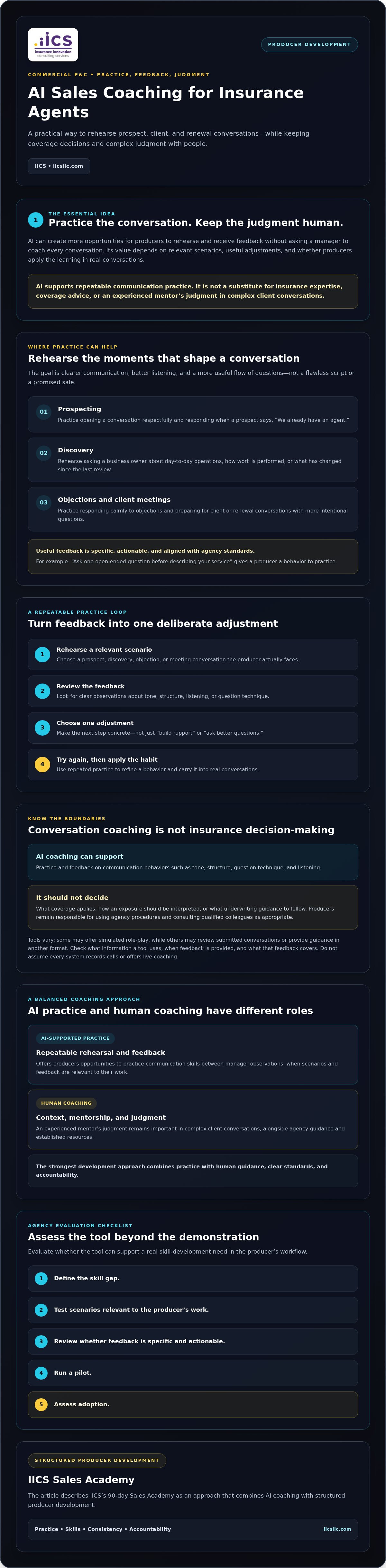
A useful practice cycle is simple: rehearse a scenario, review the feedback, choose one specific adjustment, and try again. That makes development more concrete than general advice such as “build rapport” or “ask better questions.” Generic scenarios and vague feedback, however, will not build commercial P&C skill. Check that the practice reflects the producer’s actual conversations and that the advice identifies a behavior they can change.
What AI coaching is not, and what it cannot decide
AI feedback about tone, structure, or question technique is not authoritative coverage interpretation or underwriting guidance. A tool’s comments do not replace carrier appetite research, agency procedures, or consultation with qualified colleagues. Producers remain responsible for following the appropriate process when a conversation turns to coverage or underwriting.
Tools also differ. Some may use simulated role-play; others may review submitted conversations or provide guidance in another format. Do not assume every system records calls or offers live, real-time coaching. Before adding a tool to a producer’s workflow, check what information it uses, when it provides feedback, and what that feedback covers.
Traditional sales coaching provides a useful baseline: development depends on guidance and practice, not software alone. Strong ai sales coaching for insurance agents should sharpen repeatable conversation skills while leaving insurance judgment with the producer and the agency’s established resources.
How AI Coaching Can Improve Commercial P&C Sales Conversations
The advantage of ai sales coaching for insurance agents is not a flawless script. It is the chance to rehearse a specific conversation, receive feedback, make one deliberate adjustment, and try again. That cycle can help producers prepare for demanding interactions without promising a sale or replacing their judgment.
Practice prospecting, discovery, and common objections
Consider a prospect who says, “We already have an agent.” A producer can practice acknowledging the relationship, asking permission to learn about the business, and keeping the conversation respectful rather than forcing a pitch. Feedback is most useful when it identifies a specific behavior, such as interrupting, making a sales claim too soon, or failing to ask a follow-up question.
Discovery practice should sound like a real conversation, not an insurance questionnaire delivered at speed. An agent might rehearse asking a business owner to describe day-to-day operations, how work is performed, or what has changed since the last review. These prompts help the producer gather information and listen for areas that merit further discussion through the agency’s normal process. They do not authorize AI to interpret exposures or recommend coverage.
Before adopting a tool, check whether its feedback is specific, actionable, and aligned with agency standards. “Build rapport” gives little direction. “Ask one open-ended question before describing your service” gives a producer a clear behavior to practice and review.
Turn conversation feedback into a repeatable improvement loop
More scores do not automatically mean better coaching. Choose one behavior to improve, such as asking a follow-up after an initial answer or pausing before responding to an objection. Have the agent practice again, then compare attempts using the same criteria. This keeps attention on a skill the producer can control instead of encouraging them to chase an overall score.
Set a target: Define the behavior in observable terms, such as asking a follow-up question after the prospect describes an operational change.
Practice: Use a scenario tied to prospecting, discovery, or a renewal conversation.
Review and repeat: Identify one useful adjustment, make another attempt, and track whether the target behavior becomes more consistent.
Conversation coaching can sharpen how an agent asks, listens, and responds; it cannot decide what coverage a client needs. Keep coverage interpretation and underwriting questions within agency procedures and appropriate expert review. Repetition builds preparation, not guaranteed sales results.
For agencies building a broader development routine, IICS’s commercial producer Sales Academy combines AI coaching with other development elements. The key is to connect practice to expert feedback and clear expectations, so producers know what to work on next.
AI Sales Coaching vs. Human Coaching: What Insurance Agents Need
AI and human coaching address different development needs. Software may give producers another chance to practice between manager conversations. An experienced coach can help them interpret what happened, apply sound judgment, and commit to a next step. The right balance depends on the skill, the scenario, and how much context it requires.
Where AI coaching can add useful repetition
Self-paced practice can help an agent prepare between mentor or manager conversations, especially when a skill needs repetition rather than a single explanation. Test the scenarios: Do they reflect commercial P&C language, the agency’s workflow, and the kinds of producer conversations the tool is meant to support? A generic role-play may build confidence in a script without preparing someone for the actual work.
Automated scores are signals, not proof of mastery. An agent may score well in a simulation and still need support applying the skill with a real prospect. Treat results as a prompt for review, not as a performance verdict.
Where an experienced insurance coach still matters
A mentor can consider factors a simulation may not capture, such as the prospect’s circumstances, a renewal’s history, the producer’s experience, or whether a risk discussion calls for escalation. That matters when a conversation is nuanced or the agent’s next step requires judgment. Review AI feedback when accuracy, context, or consequences matter.
Human coaching also turns observations into accountable action. A coach and producer can agree on one behavior to practice, decide how to apply it in upcoming conversations, and revisit what happened. That makes ai sales coaching for insurance agents most useful as a complement to experienced guidance, not a universal replacement for it. The goal is to match each coaching method to the work it can do well.
How to Evaluate and Introduce AI Sales Coaching at an Agency
Do not select a tool because its demonstration looks impressive. Assess whether it can address a real producer skill gap, deliver feedback your team trusts, and fit agency workflows. Use a staged process for ai sales coaching for insurance agents, with clear criteria at each step.
Define the skill gap. Identify an observable behavior to develop, such as asking follow-up questions during discovery or responding clearly to a common objection.
Test relevant scenarios. Check whether practice reflects commercial P&C conversations, agency-approved language, and your producers’ actual workflows.
Review the feedback. Have experienced staff assess whether recommendations are specific, actionable, and appropriate. Confirm managers can review feedback and flag unsuitable suggestions.
Run a focused pilot. Set a baseline, then test a small number of skills with a group of producers.
Assess adoption and usefulness. Review practice completion, user and manager feedback, and agreed skill indicators before deciding what to change or expand.
Questions to ask before selecting an AI coaching tool
A focused pilot that tests usefulness, not hype
Choose a narrow set of conversation skills and document the current baseline before the pilot begins. Then gather producer and manager feedback on relevance, usability, and trust. Compare participation and observed skill indicators against the baseline, but do not treat a small pilot as proof that the tool caused a business result.
Evaluation should lead to a development decision, not just a software decision. If your agency is considering a structured approach that combines AI coaching with producer development, compare the Sales Academy’s development approach with the needs you identified.
How IICS Connects AI Sales Coaching with Insurance Producer Development
For agencies that want more than isolated practice sessions, the key question is whether coaching fits into a development system with structure, expert guidance, and follow-through. IICS’s Sales Academy brings those elements together for commercial P&C producers. It is a 90-day development system, not standalone AI software, designed to connect skill practice with broader producer development.
What the IICS Sales Academy combines
The Academy includes 60 tactical modules, with daily video lessons lasting 2 to 4 minutes. AI call coaching provides feedback scored against 9 criteria, along with next-step guidance. Producers can use that feedback to identify a skill to work on, while individual mentoring and weekly group workshops provide opportunities for human perspective and discussion.
The structure pairs frequent practice with scheduled development. Monthly coaching, including monthly 1:1 coaching with the academy founder, adds another point for review and guidance. Software can make feedback repeatable, while an experienced coach can help a producer interpret it in context and decide how to apply it. Explore what’s included inside the 90-day Sales Academy.
Decide whether a structured development system fits
Consider what your producers need most. Is practice inconsistent because managers have limited time? Do agents need clearer accountability, experienced mentoring, or development grounded in commercial P&C conversations? A structured program may be worth evaluating when those needs belong together. If your team needs a narrow tool for a specific practice task, assess it against a broader development approach rather than assuming one format fits every agency.
IICS’s approach combines consistent practice and feedback with lessons, mentoring, and workshops. Its development model is informed by its industry leadership experience. Learn more about IICS leadership experience as part of your evaluation.
Compare the Academy’s structure with your producers’ development needs: practice frequency, accountability, mentor involvement, and commercial P&C relevance. Then review the program details and decide whether that combination merits a closer look. AI sales coaching for insurance agents can support a repeatable practice routine, but progress still depends on producers applying feedback and receiving appropriate human guidance.
Build Producer Skills with Practice and Expert Guidance
AI can give producers more opportunities to practice, refine a response, and receive structured feedback. Software scores are not proof of mastery, and they cannot replace experienced judgment in nuanced commercial P&C conversations. The strongest approach pairs deliberate practice with human coaching and clear accountability.
That is the principle behind the IICS Sales Academy, a 90-day development system designed specifically for commercial P&C producers. It combines AI coaching, short daily lessons, mentoring, and weekly workshops. The program also draws on Ralph J. Blust’s 40+ years of insurance industry leadership experience. That is an individual track record, not a claim about the company’s age.
For agency leaders weighing ai sales coaching for insurance agents, focus on fit: relevant practice, useful feedback, and expert development that helps producers apply what they learn. Explore how the Academy approaches producer growth through the IICS Sales Academy.
Consistent improvement starts with a clear skill to build and a commitment to practice. Explore the IICS Sales Academy to see whether its structure and guidance fit your producers’ development needs.
Frequently Asked Questions
Can AI coach insurance agents on real sales calls?
Some AI coaching tools can review real calls or provide guidance during a live conversation, while others focus on simulated practice. Capabilities vary, so confirm what the specific tool supports before adopting it. Ask what audio or transcript data it uses, whether calls are recorded, and how feedback is produced. Regardless of format, treat the output as coaching feedback, not authoritative insurance or coverage guidance.
Is AI sales coaching useful for commercial insurance agents?
Yes, ai sales coaching for insurance agents can be useful when practice scenarios reflect commercial P&C conversations and feedback points to behaviors producers can improve. Agents might rehearse discovery questions, meeting preparation, or a response to a common objection. Usefulness depends on scenario quality, alignment with agency standards, and follow-through. AI can support communication practice, but it should not interpret coverage or make decisions for the producer.
Can AI replace a sales manager or insurance mentor?
No. AI can provide additional practice and structured feedback, but an experienced manager or mentor brings context, business judgment, and accountability that software may not provide. A coach can help an agent interpret feedback, discuss a nuanced renewal conversation, or decide when to consult an appropriate expert. Use AI to support the development process, not to remove human review where judgment or agency procedures matter.
How does AI sales coaching evaluate an insurance sales conversation?
Methods vary by tool. A system may assess a practice session or a submitted conversation against criteria such as question quality, listening, clarity, or response structure, then suggest areas to work on. Scores are useful only when the criteria are clear and relevant to agency expectations. For example, IICS states that its AI call coaching scores feedback against 9 criteria and provides next-step guidance.
Is AI call coaching safe for customer or prospect information?
Safety depends on the tool’s data practices and your agency’s requirements, so do not assume customer or prospect information is protected in a particular way. Before use, establish what data is collected, how it is stored and retained, who can access it, and whether it is used for other purposes. Ask qualified advisors to review applicable requirements and agency procedures. Consider whether practice can use fictional or de-identified information.
How should an agency measure whether AI sales coaching is working?
Start with a defined skill gap and baseline, then track whether agents complete practice and demonstrate agreed behaviors in reviews or conversations. Use consistent criteria and collect feedback from producers and managers about relevance and usability. Scores alone do not prove skill mastery or business impact. For ai sales coaching for insurance agents, separate measures of participation and skill development from broader sales outcomes, which may have many contributing factors.
What does IICS include in its AI sales coaching approach?
IICS incorporates AI coaching into its 90-day Sales Academy for commercial P&C producers. The program combines 60 tactical modules, daily video lessons lasting 2 to 4 minutes, AI call coaching, individual mentoring, and weekly group workshops. IICS states that its AI coaching provides feedback scored against 9 criteria with next-step guidance. The Academy is a structured producer development system, not standalone AI software.