Assessing Insurance Producer Potential: The Elite Agency’s Guide to Hiring High-Performers
- Aug 9
- 12 min read
How much capital are you willing to incinerate on a "good talker" who lacks the internal discipline to close? For many agency owners, the cost of a non-producing hire exceeds $100,000 when you factor in salary, benefits, and the massive opportunity cost of lost accounts. If you are tired of waiting eighteen months for a new hire to finally validate, you are not alone. Assessing insurance producer potential is the most critical skill for any leader aiming for predictable revenue growth, yet it remains the most misunderstood process in the industry.
You likely agree that the traditional interview is a broken filter. It rewards charisma over competence and leaves your agency's future to chance. This article provides the battle-tested framework you need to identify elite sales DNA before the first paycheck is cut. We'll show you how to implement a repeatable hiring system that slashes ramp-up time and ensures your producers reach breakeven in half the industry norm time. From isolating "traction revenue" to leveraging AI-driven coaching tools, you're about to learn how the top one percent of agencies build their rosters.
Table of Contents
The High Cost of Misjudging Producer Potential
Hiring the wrong producer is not a minor setback. It is a financial catastrophe that bleeds your agency dry through salary, benefits, and the invisible weight of opportunity cost. While the industry norm suggests a producer should validate within three years, elite agencies know that timeline is a recipe for mediocrity. Relying on a "gut feeling" during the hiring process is why most agencies remain stagnant. You cannot build a high-growth firm on a hunch. Mastering the art of assessing insurance producer potential is the difference between a growing book and a stagnant office.
Most agency owners mistake an "Administrative Agent" for an "Elite Producer." The former is excellent at service, follows instructions, and keeps current clients happy. The latter is a hunter. They possess a specific sales DNA that drives them to displace incumbents and secure high-value middle market accounts. If your hiring process does not distinguish between these two archetypes, you will end up with a staff full of expensive account managers who cannot close a door, let alone a $250,000 premium account.
Calculating the Real ROI of Accurate Assessment
The cost of a non-producing hire in the first 90 days is staggering. Beyond the base salary and the $188 licensing fees, you are burning the time of your best mentors. When a hire fails to gain traction, the psychological toll on your existing sales team is immense. High turnover creates a culture of doubt. Conversely, faster ramp-up times compound your agency valuation. Every month shaved off the validation timeline adds directly to your bottom line and increases the predictability of your revenue growth. If your graduates reach breakeven in half the industry norm time, your agency's scale becomes inevitable.
The Failure of Traditional Interviewing
Traditional interviews are theatre. Likability is often a mask for a total lack of sales discipline. A candidate might be a "good talker," but can they execute a rigorous business plan? Many owners get seduced by a "book of business" that won't actually transfer because the relationships were tied to the previous carrier's brand, not the producer's skill. Even high licensing exam scores are poor predictors of success; knowing the law is not the same as knowing how to win a broker selection process. Effective Sales management requires a shift from subjective impressions to data-backed assessment. When you fail at assessing insurance producer potential, you aren't just losing a salary; you are losing market share to competitors who actually know how to spot a closer.
Identifying Elite Sales DNA: What to Look For
Stop looking at resumes. The paper trail tells you where someone has been, not where they are capable of going. When assessing insurance producer potential, you must look for the unteachable traits that separate the top one percent from the rest of the pack. Elite DNA starts with an internal locus of control. Does the candidate blame the "soft market" or "bad leads" for a missed quota? If they do, show them the door. High-performers believe they are the primary drivers of their success, regardless of external conditions. Understanding how these internal traits translate into actual sales performance metrics is vital for long-term agency growth.
Cognitive speed is another non-negotiable factor. Commercial P&C is complex. It's dense. A top-tier producer must have the mental agility to digest technical policy language and simplify it into a compelling value proposition for a CEO. If a candidate cannot explain a complex concept simply during the interview, they'll never survive a high-stakes broker selection process. They'll get bogged down in the weeds, and your prospects will lose interest.
The Coachability Metric
Coachability is the single greatest predictor of long-term growth. To test this, give the candidate direct, slightly blunt feedback on their performance during the interview. Do they get defensive? Do they make excuses? Or do they listen, internalize, and immediately attempt to adjust their approach? Even a veteran with a massive track record will fail in a new environment if they've lost the willingness to adapt. In a modern agency, this trait is essential for the effective use of AI Sales Coaching tools. If they won't take feedback from a mentor, they certainly won't take it from an algorithm. Developing this raw talent into a consistent closer is exactly what we do at The Sales Academy.
Behavioral Traits of Top 1% Producers
It's about grit. Commercial sales cycles are long. They are brutal. A producer needs the resilience to handle fifty "no's" to get to the one "yes" that changes the agency's trajectory. This requires a unique balance of empathy and ego. They must have enough empathy to understand the prospect's pain points, but enough ego to believe they are the only person capable of solving them. Finally, look for self-discipline. Elite producers don't need a manager to tell them to pick up the phone. They treat their book of business like a franchise. They own the grind. When you are assessing insurance producer potential, look for the person who views every "no" as a data point, not a personal rejection.
Modern Assessment Methods: Beyond the Resume
Resumes are fiction. They are carefully curated narratives designed to hide flaws and amplify minor wins. If you rely on a CV to build your agency, you are gambling with your firm's future. With 400,000 insurance agents projected to retire by 2026, the talent gap is widening, and the competition for elite producers is becoming a street fight. Assessing insurance producer potential requires a shift from subjective impressions to a rigorous, multi-stage evaluation process that prioritizes data over charm. Licensing is merely a legal floor; it is never a performance ceiling.
Psychometric testing is your first line of defense. Tools like Hogan or Omnia assessments help you strip away the candidate's interview persona to see the raw machinery underneath. These tests validate whether a person actually possesses the high-stakes "Hunter" mentality or if they are simply a service-oriented individual who knows how to sound persuasive. You need to know if they have the ego-drive to handle rejection before you invest a single dollar in their training.
Leveraging AI in the Assessment Process
Subjective bias is the silent killer of agency growth. You might like a candidate because they went to the same university or share a hobby, but those factors have zero correlation with their ability to close a $100k premium account. By integrating AI sales coaching for insurance into your assessment phase, you can analyze role-play simulations with surgical precision. AI identifies speech patterns, calculates talk-to-listen ratios, and evaluates objection-handling techniques with complete objectivity. This technology doesn't just predict performance; it provides a baseline for future development, ensuring you only hire candidates who are genuinely coachable.
Behavioral Interviewing Techniques
Stop asking "What" they did and start asking "How" they did it. If a candidate claims they built a $1 million book of business, demand a step-by-step breakdown of their prospecting process. Elite producers can articulate their methodology because they repeat it every day. The "Simulation" interview is another essential tool. Put the candidate in the hot seat with a difficult role-play scenario and watch how they react to pressure. Look for these specific indicators during the simulation:
Mental Agility: Can they pivot when a prospect throws an unexpected objection?
Process Adherence: Do they follow a logical sales framework or just "wing it"?
Resilience: How do they recover after a simulated "hard no"?
When you master the art of assessing insurance producer potential through these modern lenses, you stop hiring resumes and start hiring results. You move from a culture of hope to a culture of predictable performance.
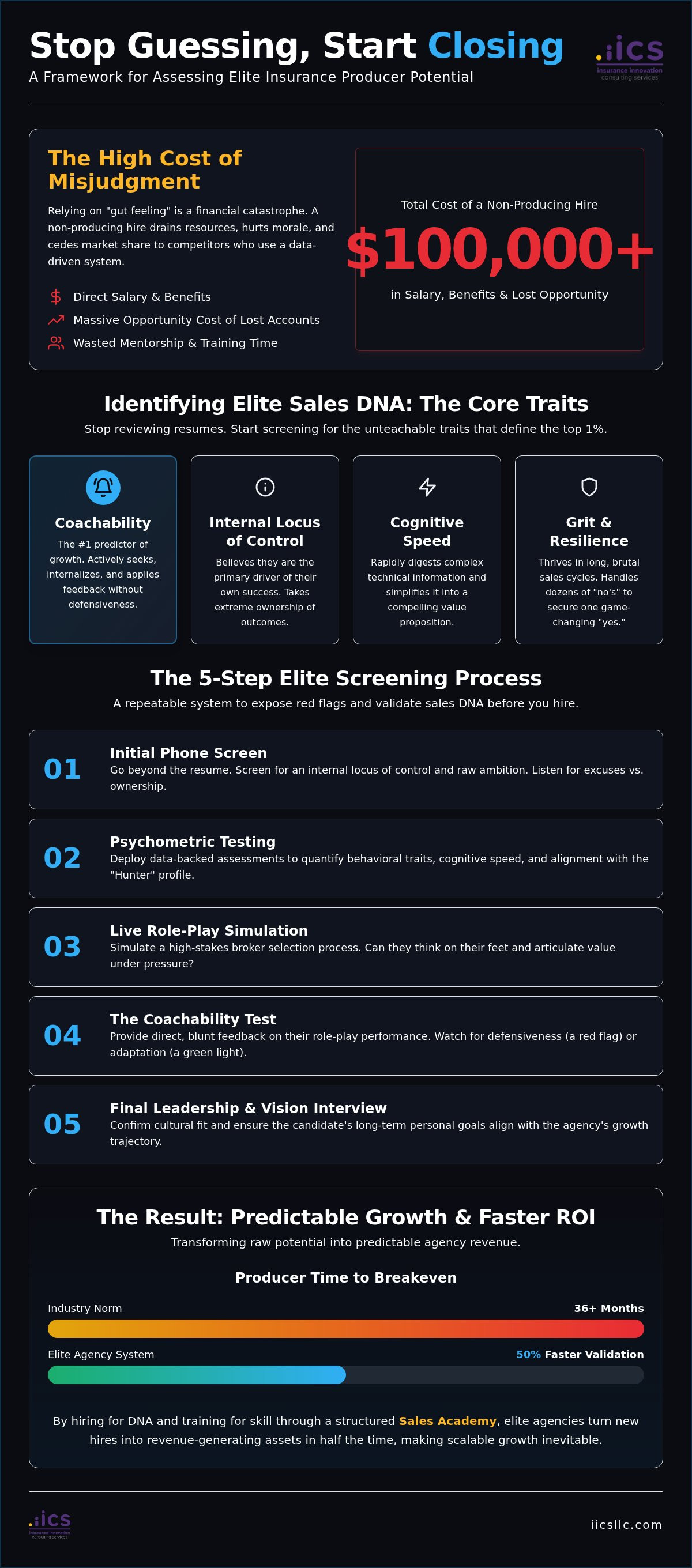
How to Assess Insurance Producer Potential in 5 Steps
Stop guessing. A structured approach removes the emotional bias that leads to expensive hiring mistakes. If you want a top-tier roster, you need a top-tier filter. Assessing insurance producer potential is a systematic exercise in risk mitigation. You aren't just looking for a "good fit"; you're looking for a specific engine that can drive your agency's revenue for the next decade. Success in this industry is rarely about who you hire; it is about who you have the discipline to reject.
Step 1-3: Filtering for the Top Tier
Start by defining your "Elite Profile" with surgical precision. If your agency specializes in high-stakes middle market P&C, a producer who excels at high-volume, low-complexity personal lines won't survive the transition. Craft job descriptions that explicitly target hunters and displace agents. During the initial screening, look for red flags such as a reliance on inbound leads or a history of blaming carrier appetite for lost deals. The "First Call" test is your first real filter. If a candidate doesn't project authority and confidence on a scheduled phone screen, they'll never command the attention of a sophisticated decision-maker. Follow this with a role-play scenario modeled after your agency's hardest-to-close accounts. Watch how they handle a prospect who is perfectly happy with their current broker; do they crumble, or do they find a wedge?
Step 4-5: Final Validation and Onboarding
Utilize third-party effectiveness tools to provide objective data that supplements your intuition. These tools reveal behavioral nuances and sales competencies that a standard interview simply cannot reach. Once the candidate passes these hurdles, you must transition from assessment to a rigorous new insurance producer training framework. Set non-negotiable 30, 60, and 90-day performance milestones. In the first 30 days, focus entirely on activity-based metrics: cold calls, LinkedIn touches, and initial discovery appointments. By day 90, the focus shifts to results-based metrics such as qualified submissions and quotes. This 90-day "Go/No-Go" decision point is your final safeguard against agency stagnation. If they aren't hitting the activity benchmarks by month three, they'll never hit the revenue benchmarks by year three. Don't let a non-producer linger in your office. If you're ready to stop the hiring guesswork and start building a high-performance team, explore our Effectiveness Tools today.
From Potential to Performance: The Sales Academy Solution
Identifying elite talent is a prerequisite for growth, but it isn't the finish line. Assessing insurance producer potential merely provides you with the raw materials. Without a rigorous, systematic development plan, even the most promising "Hunter" will eventually stall or seek opportunities elsewhere. Elite producers crave environments that match their ambition. If your agency lacks a structured path to mastery, you aren't just losing revenue; you are actively repelling the high-performers you worked so hard to recruit. You must provide a platform where potential is forged into performance.
The IICS Sales Academy Advantage
Our Sales Academy is designed to bridge the gap between raw talent and consistent closing. Over a 40-year track record of continuous growth, we have refined a methodology that doubles the likelihood of a new hire becoming a top producer. This three-month intensive program utilizes MicroLearning and 1:1 Call Coaching to cement high-performance habits before bad ones can take root. By focusing on advanced commercial insurance sales techniques, we enable your graduates to reach breakeven in half the industry norm time. Weekly Live Workshops ensure that momentum never fades. We keep producers sharp within a competitive market where the talent gap continues to widen. Our AI Sales Coaching tools provide real-time feedback, ensuring every call is an opportunity for growth rather than a wasted lead.
Scaling Your Agency with Fractional Leadership
Many agency owners are excellent at sales but lack the bandwidth to manage a full-scale development department. This is where our Fractional CRO and CGO services become a strategic lever for growth. Instead of letting your hiring investments wither, you can outsource the "Heavy Lifting" of producer development to industry veterans who have been in the trenches for decades. This ensures that the process of assessing insurance producer potential is followed by world-class execution. It allows you to focus on high-level agency strategy while we handle the discipline of the daily grind. Don't let your agency's growth be limited by your own calendar. You need a repeatable system that produces predictable revenue regardless of who is in the corner office.
Ready to stop guessing? Discover how our Sales Academy builds elite producers and start scaling your agency with predictable, data-backed results. The difference between a stagnant firm and an elite agency is the courage to implement a battle-tested framework.
Master the Art of the Elite Hire
Every day you delay implementing a rigorous system for assessing insurance producer potential is a day you risk losing six figures to a "good talker" who can't close. Stop playing defense with your agency's growth. We have shown that success requires moving beyond the resume to isolate the specific behavioral traits, like grit and coachability, that define the top one percent. You need a partner with the expertise to turn raw talent into revenue.
With a 40-year track record of elite producer development, our Sales Academy uses proprietary AI Sales Coaching and MicroLearning modules to ensure your graduates reach breakeven in half the industry norm time. Don't leave your legacy to chance. Stop hiring on a gut feeling. Accelerate your agency growth with our Sales Academy. The path to a high-performance firm starts with the discipline to demand more from your hiring process. You have the framework; now it's time to execute.
Frequently Asked Questions
How long does it typically take to accurately assess a producer’s potential?
You should have a clear indication of potential within the first 90 days of employment. While the industry often waits years for a producer to validate, an elite agency sets firm milestones at 30, 60, and 90 days. If the "Hunter" activity isn't present by the end of the first quarter, it won't magically appear later. Assessing insurance producer potential isn't a long-term mystery; it's a short-term observation of disciplined activity and coachability.
What are the biggest red flags to look for when hiring a P&C producer?
Watch for candidates who blame external market conditions or carrier appetite for their lack of success. This indicates an external locus of control, which is fatal in high-stakes sales. Other red flags include a polished resume with no clear prospecting methodology and a "service-first" attitude that shies away from displacement conversations. If they can't articulate exactly how they win, they won't win for you. Demand a process, not just a personality.
Is previous insurance experience necessary for a high-potential producer?
No, product knowledge can be taught, but sales DNA cannot. High-potential producers often come from other high-pressure sales environments like medical device sales or payroll services. These individuals already possess the grit and resilience required for commercial P&C. We focus on assessing insurance producer potential based on their ability to handle rejection and simplify complex value propositions rather than their familiarity with specific policy forms or industry jargon.
How does AI sales coaching improve the assessment of new candidates?
AI sales coaching removes the subjective "gut feeling" that often leads to expensive hiring errors. By analyzing role-play simulations, the technology provides objective metrics on talk-to-listen ratios, objection handling, and vocal tone. This data allows you to see how a candidate actually performs under pressure rather than how well they interview. It provides a baseline for development that is entirely independent of personal bias, likability, or shared hobbies.
What is the industry average for insurance producer turnover, and how can I beat it?
Industry data suggests that a staggering number of producers fail to validate within their first three years, with failure rates often cited as high as 80% to 90%. You beat this statistic by implementing a rigorous assessment filter and a structured development plan. High turnover is usually a symptom of hiring for charisma instead of competence. Elite agencies focus on identifying coachable hunters and putting them through a battle-tested training system immediately.
Can a "service-oriented" agent be trained to have a "hunter" mentality?
Rarely. A "service-oriented" mindset is fundamentally different from a "hunter" mentality. While you can teach a hunter to provide better service, it is nearly impossible to train a service agent to enjoy the displacement and rejection inherent in high-level commercial sales. Don't waste your agency's capital trying to change someone's core personality. Hire for the hunter DNA and use your training resources to refine their technical skills and product knowledge instead.
What specific metrics should I track during a new producer’s first 90 days?
Focus entirely on activity-based metrics in the early stages. Track the number of cold calls, LinkedIn touches, and first-time discovery appointments. By the 60-day mark, you should see a steady pipeline of qualified submissions. If the activity is high but the results are low, you have a training issue. If the activity is low, you have a hiring issue that requires an immediate "Go/No-Go" decision to protect your firm's capital.
How does the IICS Sales Academy help in assessing and developing talent?
The Sales Academy acts as the ultimate validation tool for your hiring decisions. Our 40-year track record proves that structured development, including MicroLearning and weekly live workshops, can bring producers to breakeven in half the industry norm time. We provide the 1:1 call coaching and effectiveness tools necessary to turn raw potential into a predictable revenue engine. It's the difference between hoping for success and engineering it through a proven framework.