Building a Commercial Lines Sales Pipeline: The Elite P&C Producer’s System
Updated: Oct 4
Why are you still treating your career like a lottery when the 2026 commercial P&C market demands surgical precision? Most producers operate on hope, yet hope is not a strategy when property premiums are sliding 5.5 percent and casualty lines continue to harden. Building a commercial lines sales pipeline requires more than just a list of names and a phone; it requires a battle-tested system that turns volatility into a competitive advantage.
You've likely felt the exhaustion of the information firehose or the anxiety of a lead flow that's as unpredictable as the weather. It's a common struggle, but it's one that elite performers have already solved. We're going to show you how to master a systematic 90-day framework designed to double your lead-to-prospect conversion and reach breakeven revenue faster than you thought possible. This isn't about working harder; it's about deploying a high-velocity methodology that replaces luck with a predictable 90-day sales cycle. We'll explore the micro-habits of elite producers, the mechanics of high-stakes risk engagement, and the specific steps to scale your production without burning out.
Table of Contents
The Anatomy of a Stagnant Pipeline: Why P&C Producers Struggle
A stagnant pipeline is a silent killer for P&C agencies. It isn't defined by a total lack of activity, but by a lack of predictable, expiration-date-driven opportunities. Most producers mistake "busy work" for progress. They chase names without understanding the lead generation mechanics required to secure a firm commitment. If your pipeline doesn't have a clear timeline based on policy renewals, it's just a list of names. It lacks the velocity needed to survive a shifting market.
Traditional training often exacerbates this issue. The industry loves the 3-day bootcamp model, but these sessions suffer from the "firehose" problem. Producers are blasted with information for 72 hours and then sent back to their desks with zero retention. It's an inefficient model that fails to produce long-term results. When a new hire fails to produce, the cost is staggering. It isn't just the lost salary; it's the toxic impact on agency morale and the wasted opportunity cost of uncaptured market share. Agencies cannot afford to gamble on unproven talent without a system to back them up.
The biggest misconception in the industry is thinking that more leads automatically equals more revenue. Without a conversion system, you're just pouring water into a bucket full of holes. Building a commercial lines sales pipeline requires a disciplined framework, not just a higher volume of cold calls. You don't need more prospects. You need a better process for moving them from "suspect" to "client."
The 90-Day Failure Cycle
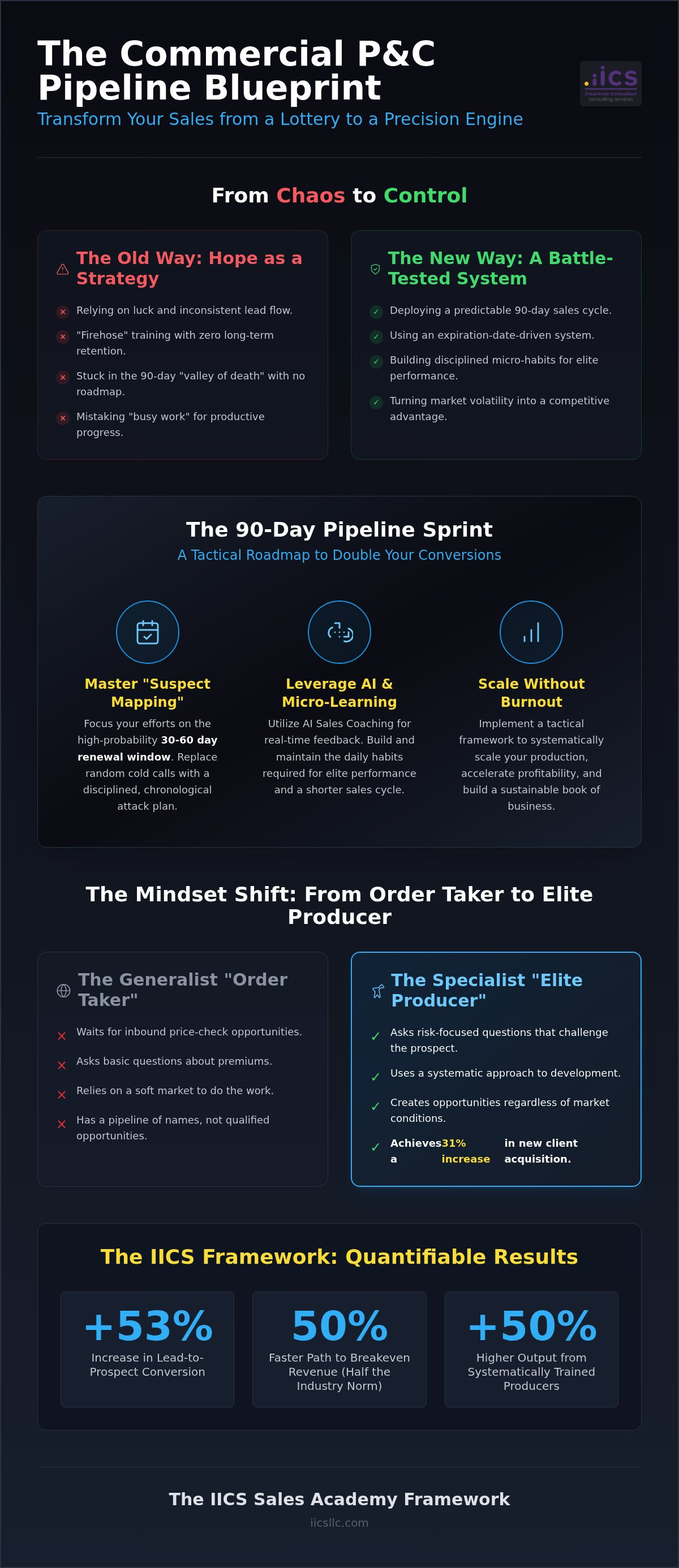
Most producers lose momentum after their first three months. The initial excitement fades, replaced by the psychological toll of "empty" pipelines and dismal conversion rates. Without a structured onboarding system, new producers often see a 50 percent lower output compared to those trained in a systematic environment. They get stuck in the "valley of death" where the effort is high, but the revenue hasn't yet hit. This stagnation is rarely a lack of talent. It's a lack of a roadmap.
From Generalist to Elite Producer
The gap between an "order taker" and an elite producer is massive. Order takers wait for a price-check opportunity. They ask about premiums and wait for a soft market to do the work for them. Elite producers focus on risk-focused questions that challenge the prospect’s current coverage gaps. They use a systematic approach to development, which can lead to a 31 percent increase in new client acquisition. Success in this field is about shifting from a generalist mindset to a specialist who masters building a commercial lines sales pipeline through disciplined micro-habits. It's about being the expert your clients actually need in a complex risk environment.
The Science of Suspect Mapping: Building Your Foundation
Data is cheap. Discipline is expensive. Most producers fail because they treat every lead as an immediate opportunity, ignoring the chronological reality of the insurance cycle. Elite producers know better. They use a "Suspect List By Effective Date" as their primary navigation tool. This system ensures you aren't just cold calling; you're attacking a specific 30-60 day renewal buying window where the prospect is actually primed to move. Building a commercial lines sales pipeline isn't about buying a list; it's about building a chronological attack plan that respects the expiration date.
You need a target of 100 new leads every month to stay ahead of natural pipeline attrition. Use state filings and industry insights to fuel this engine with data that your competitors are too lazy to dig for. Don't ignore the power of proximity. The 5-circle networking strategy involves mapping your social, professional, and community circles to find warm entries that bypass the gatekeeper. Apply a "Small Commercial Focus Filter" to prioritize wins that build your confidence and your commissions simultaneously. If you want to see how this looks in practice, you can see what's happening inside the academy to master these micro-habits.
The Window Trigger Map
Leveraging AI and Micro-Learning to Shorten the Sales Cycle
The industry is obsessed with data acquisition, but data doesn't close deals. Habits do. While competitors use AI to merely scrape more leads, elite producers use it to refine their actual performance. Shortening the sales cycle isn't about working faster; it's about being more precise. By integrating AI-driven feedback and micro-learning, you replace the guesswork of sales with a data-backed methodology. This is a critical evolution in how to build a successful sales pipeline that actually converts suspect interest into signed contracts.
Success in modern P&C production requires a transition from generalist to specialist. You can't afford to wait for a manager to review your calls once a month. You need immediate, actionable insights that allow you to pivot in real-time. This is where high-velocity training creates a massive competitive advantage. When you move beyond the "firehose" of traditional seminars and embrace daily, tactical training, your retention and conversion rates skyrocket.
Mastering the AI Coaching Loop
AI Sales Coaching provides a real-time feedback loop that traditional managers simply can't offer. It scores every call against 9 elite criteria to ensure you are hitting the high-stakes benchmarks of a professional risk advisor. This isn't just about recording conversations; it's about identifying the exact moment you lost control of the risk narrative. When you combine this automated scoring with 1:1 call coaching, you can double your lead-to-prospect conversion. AI also helps you generate plain-language risk summaries for complex ISO forms, allowing you to explain exposures to clients without getting bogged down in legal jargon.
Habit Formation through Micro-Learning
The firehose of a weekend seminar is where retention goes to die. Micro-learning solves this by delivering 2-4 minute daily lessons that are easy to digest and even easier to implement. These 60 tactical modules are superior to one-off workshops because they focus on long-term mastery rather than short-term hype. You don't need a three-hour lecture on general liability. You need a three-minute breakdown of how to use a specific risk-focused question to uncover a coverage gap. Building a commercial lines sales pipeline requires this level of daily, incremental progress. It's the difference between a one-off win and a lifetime of elite production. You can see how these tools work inside the academy to start building your own repeatable sales habits.
Executing the 90-Day Pipeline Sprint: A Tactical Roadmap
Execution is where the amateur and the elite diverge. You don't build a book by accident. You build it through a relentless 90-day sprint that replaces "hope" with a calendar of high-probability events. Building a commercial lines sales pipeline requires a chronological roadmap that dictates exactly what you do from the moment you sit at your desk on Monday morning until you close the week on Friday afternoon.
Month 1: Foundations and Mapping. This is the construction phase. You must map your first 100 suspects based on their effective dates. You aren't selling yet; you're organizing your theater of operations and refining the core skills required to navigate the 2026 market.
Month 2: Engagement and Momentum. You're now entering the 60-day renewal window for your first batch of suspects. Your first calls are diagnostic. You're identifying the pain points that the incumbent agent has ignored during this current soft market in property lines.
Month 3: Conversion and Closing. This is the payoff. You're navigating complex selling scenarios, securing the commitments, and closing the gap to breakeven. You're no longer a trainee; you're a producer with a predictable revenue engine.
To sustain this velocity, you must commit to three basic habits every week: identify 25 new suspects, conduct 10 first-call meetings, and secure at least 3 quote commitments. Consistency in these micro-habits is the only way to ensure long-term production. If you are ready to stop guessing and start growing, you can see the full system inside the academy to master this roadmap.
Handling Objections with Precision
"I'm happy with my current agent" is the most common lie in the business. It's a reflex, not a reality. Elite producers respond with six thematic approaches that pivot the conversation from "satisfaction" to "risk exposure." You need scripted responses for the eight most common commercial insurance objections to keep the conversation moving when a prospect tries to shut you down. Whether you are in a virtual meeting or sitting across a boardroom table, you must frame the agenda to maintain control. If you lose control of the agenda, you lose the account.
Technical Mastery as a Sales Tool
Many agencies lack the internal bandwidth to provide the constant, high-stakes coaching required to transform a generalist into an elite performer. This is where fractional CRO and CGO services become a force multiplier. We don't just offer advice; we provide the leadership and accountability structures that define world-class organizations. Through weekly live workshops and peer accountability, we integrate a culture of performance that persists long after the initial sprint ends. If you want to accelerate your growth before the year closes, use the discount code Summer2026 when you register for the next trimester.
The ROI of Elite Development
The data is clear. Agents who commit to formal, systematic training achieve 52 percent higher sales than those left to figure it out on their own. This isn't a coincidence. It's the result of replacing the firehose effect with a structured 90-day system that creates a repeatable growth engine. You can see the specific mechanics Inside the IICS Sales Academy. When every producer in your office follows the same battle-tested roadmap, your agency's revenue becomes predictable rather than speculative. Efficiency isn't just about saving time; it's about maximizing the return on every lead in your database.
The Path to Mastery Starts Day One
Mastery is not a destination; it's a discipline. By joining the premier Sales Academy built exclusively for Commercial P&C, you're leveraging a 40-year track record of continuous growth. We've already identified the pitfalls, the dead ends, and the lottery mentalities that kill careers. We provide the effectiveness tools and the 1:1 mentorship required to bypass those mistakes and reach the top tier of the profession. Don't let another quarter slip away with a stagnant pipeline. Register for the next trimester and transform your pipeline. It's time to stop playing the lottery and start running a system that delivers results.
Master Your Pipeline Velocity
Success in commercial P&C isn't a matter of luck. It's a matter of architecture. You've seen how the shift from a "firehose" approach to a disciplined 90-day sprint can transform stagnant activity into a high-velocity revenue engine. By focusing on suspect mapping and leveraging AI-driven feedback, you're no longer just chasing leads; you're dominating a systematic sales cycle. Building a commercial lines sales pipeline is the foundation of an elite career, but you don't have to build it alone.
With a 40-year track record of growth, our graduates double their likelihood of becoming top producers. We combine high-stakes AI coaching with 1:1 veteran mentorship to ensure every habit you form is a winning one. The market won't wait for you to find your rhythm, so take control of your production today. There is no reason to settle for inconsistent results when a battle-tested framework is within reach. Apply to the IICS Sales Academy and use code Summer2026 for 50% off. Your path to mastery is ready. It's time to execute.
Frequently Asked Questions
How long does it typically take to see results in a commercial lines pipeline?
Results typically begin to materialize within the first 90 days of a structured sprint. While the industry average for breakeven is often measured in years, our systematic approach allows producers to hit profitability benchmarks in half that time. The initial phase focuses on foundation and mapping, with conversion momentum typically accelerating in the third month as the 60-day renewal windows close and suspects transition into active clients.
What is the difference between a suspect and a prospect in commercial insurance?
A suspect is simply a business name with a known policy expiration date, whereas a prospect is a qualified lead that has engaged in a diagnostic conversation. The transition occurs when you move from identifying a target to uncovering specific risk exposures. Elite producers use a "Suspect List By Effective Date" to ensure their prospecting is chronologically relevant to the 30-60 day renewal buying window where decisions are actually made.
How many leads should a new commercial producer generate each month?
A new producer should generate at least 100 leads per month based on specific policy expiration dates. This volume is necessary to feed a pipeline that targets 3-5 new accounts monthly. By pulling 25 new names from state filings or social circles every week, you ensure the high-velocity activity required for building a commercial lines sales pipeline. Consistency in these micro-habits prevents the lottery mentality that kills most early careers.
What are the most common reasons commercial insurance pipelines fail?
Pipelines fail primarily due to a lack of predictable, expiration-date-driven opportunities and the "firehose" effect of disorganized training. Most producers focus on price-checking rather than risk-focused questions, leading to inconsistent conversion. Without a disciplined 90-day framework, the psychological toll of empty pipelines often causes producers to lose momentum. Building a commercial lines sales pipeline requires shifting from a generalist mindset to a specialist who masters chronological attack plans and disciplined follow-up.
How can AI help an insurance producer build a pipeline faster?
AI accelerates pipeline building by providing real-time call coaching and plain-language risk summaries for complex ISO forms. It scores calls against nine elite criteria, allowing for immediate course correction rather than waiting for monthly manager reviews. This technology turns raw data into actionable insights, helping producers identify coverage gaps faster and position themselves as authoritative risk consultants. It removes the guesswork from sales, allowing you to focus entirely on high-probability conversion events.
What is the best way to handle the 'I already have an agent' objection?
The best way to handle the "I already have an agent" objection is to pivot the conversation from satisfaction to risk exposure. Use one of six thematic response approaches designed to challenge the status quo without being confrontational. Instead of attacking the incumbent, ask diagnostic questions about specific wording differences in ISO versus custom forms. This exposes potential uncovered losses that the current agent may have missed during a standard, surface-level renewal meeting.
How does micro-learning improve sales performance compared to traditional training?
Micro-learning improves performance by delivering tactical 2-4 minute lessons daily, which promotes habit formation and long-term retention. Traditional 3-day bootcamps often fail because they overload the brain with information that is forgotten within 72 hours. Daily lessons ensure that producers implement one specific skill at a time, leading to a 53 percent increase in lead-to-prospect conversion. It replaces the overwhelming firehose of information with a manageable, repeatable path to mastery.
Is there a discount available for the IICS Sales Academy in 2026?
Yes, invited agencies can use the discount code Summer2026 to receive a 50 percent discount on the IICS Sales Academy tuition. This code applies to our 90-day development system, providing full access to AI coaching, 1:1 veteran mentorship, and weekly live workshops. Trimesters start on the first of every month, making it easy to integrate elite training into your agency's growth strategy without the burden of hidden fees or upsells.