Building an Insurance Producer Development Plan: The 90-Day High-Performance Framework
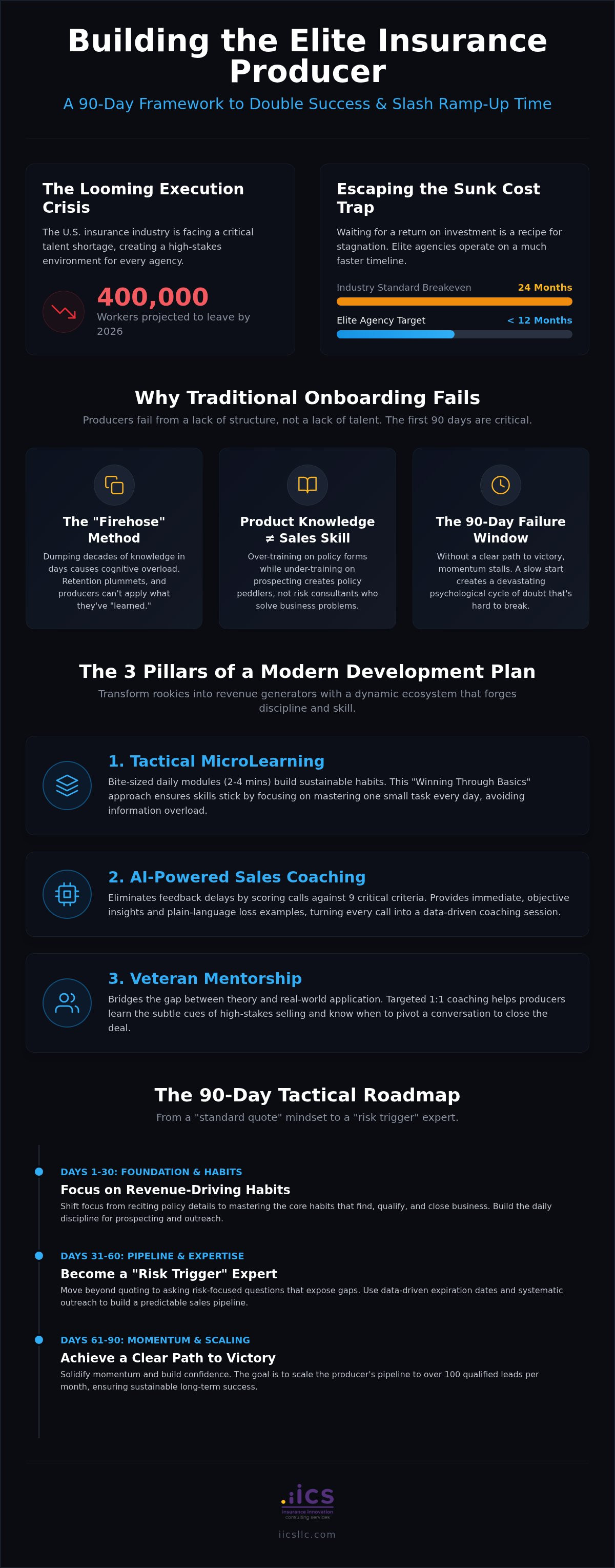
The U.S. insurance industry is on track to lose 400,000 workers by 2026. This isn't just a talent gap; it's a looming execution crisis for every agency principal. Most firms respond by hiring fast and hoping for the best, only to watch thousands in salary draw disappear into potential that never pays off. Building an insurance producer development plan is no longer a luxury for the top 1 percent. It's the only way to protect your investment and ensure your agency doesn't become another casualty of the talent shortage.
You've likely felt the sting of a non-producing hire who drained your time and your bank account. It's exhausting to play part-time mentor when you should be focused on high-level strategy. This article provides a battle-tested 90-day framework that slashes ramp-up time and doubles the likelihood of creating an elite P&C producer. You'll discover how to achieve breakeven revenue in half the industry average time. We'll preview the mechanics of a predictable sales pipeline and show you how to implement a scalable training system that works even when you're not in the room.
Table of Contents
The High Cost of Vague Insurance Producer Development
The industry standard for producer breakeven is 24 months. Elite agencies refuse to accept this timeline. Waiting two years for a return on investment is a recipe for stagnation. Building an insurance producer development plan is the only way to avoid the "Sunk Cost Trap." When you hire a producer, you aren't just paying a salary. You're funding benefits, overhead, and the invisible cost of missed revenue. A non-producer is a liability that compounds daily. If your new hire isn't generating momentum by month three, you're effectively subsidizing their failure.
Traditional training often relies on the "firehose" method. You dump decades of technical knowledge onto a new hire in thirty days and expect them to swim. This causes immediate cognitive overload. The brain reaches its limit, and retention plummets. The goal of your initial training must shift. You aren't trying to create a "knowledgeable agent" who can recite policy exclusions. You are building a revenue-generating producer who can find, qualify, and close business. Focus on the habits that drive dollars, not just the facts that fill binders.
The 90-Day Failure Window
Producers don't usually fail because they lack talent. They fail because they lack structure. The first 90 days are critical. If a new hire doesn't see a clear path to victory, their momentum stalls. This slow start has a devastating psychological impact. It creates a cycle of doubt that is hard to break. You must transition from a passive onboarding checklist to an active development system like the one found inside the Academy. A checklist tells them what to read; a system tells them how to win.
Why Product Knowledge Isn't Sales Skill
Many agencies over-train on policy forms while under-training on prospecting. While understanding continuing education requirements is necessary for licensing, it doesn't help a producer open a door. Elite producers don't win by explaining the fine print of a CGL policy. They win by asking risk-focused questions that expose gaps in a prospect's current program. They look for "risk triggers" rather than "standard quote" opportunities. An Elite Producer is a sophisticated risk consultant who solves business problems, not a policy peddler who competes on price.
Three Pillars of a Modern Producer Development Plan
A development plan isn't a thick binder of policy forms. It's a dynamic ecosystem. When building an insurance producer development plan, you must move beyond the static classroom model. Elite agencies rely on three interconnected pillars to transform rookies into revenue generators. These pillars don't just provide information; they forge the discipline required to win in a softening market. By combining daily habits, technological precision, and veteran wisdom, you double the likelihood of your hire becoming a top-tier producer.
The Power of MicroLearning in Sales
Seminars are where knowledge goes to die. A week-long intensive creates a "firehose" effect that leads to a massive loss of information within days. Tactical MicroLearning solves this by delivering 60 modules of 2-4 minutes each. This approach respects the producer's time while building sustainable habits. It centers on the "Winning Through Basics" commitment: mastering one small skill every single day. You can see how this curriculum is structured Inside the Academy. This method aligns with the most effective professional development offerings in the industry today. Building an insurance producer development plan around micro-habits ensures that skills stick long after the initial onboarding phase ends.
AI Sales Coaching: The Modern Advantage
The biggest bottleneck in producer development is the feedback loop. Principals don't have time to sit on every call, and bad habits solidify quickly. AI Sales Coaching for Insurance eliminates this delay. It scores calls against nine critical criteria, providing immediate, objective feedback. AI also generates industry-specific risk insights and plain-language loss examples. This allows producers to speak with authority about complex exposures without waiting for a senior mentor to chime in. It turns every prospecting call into a data-driven coaching session.
Tech and modules provide the foundation, but high-stakes selling requires human nuance. Veteran mentorship bridges the gap between theory and the "street." It's about learning the subtle cues of a prospect and knowing when to pivot a conversation. This isn't just about "shadowing." It's about targeted 1:1 coaching that refines a producer's instinct. When these three pillars converge, you aren't just training an employee. You're engineering an elite producer. If you're ready to stop guessing and start scaling, explore our outsourced producer development tools.
The 90-Day Tactical Roadmap: Monthly Milestones
Execution isn't accidental. It's engineered. Building an insurance producer development plan requires more than a list of goals; it demands a chronological execution strategy that prioritizes high-impact activities over busy work. Most agencies fail because they expect a rookie to "figure it out" by osmosis. Elite agencies provide a map. This 90-day framework moves a producer from total dependency to a self-sustaining revenue engine by hitting specific, non-negotiable milestones every thirty days.
Month 1: Building the Foundation
The first thirty days are about deprogramming the "standard quote" mindset. New producers often default to asking for a copy of the current policy to "see if they can beat the price." This is a race to the bottom. Instead, Month 1 focuses on identifying "Risk Triggers." Producers must master the first call basics, specifically learning to navigate the common "I am happy with my current agent" rebuttal. We utilize Effectiveness Tools to map local networking social circles, ensuring every outreach attempt is strategic rather than random. The goal is simple: secure 3-5 new accounts by the end of the first trimester to prove the system works.
Month 2: Aggressive Pipeline Growth
In month two, the focus shifts to volume and timing. A producer without a pipeline is just an expensive spectator. We implement the "Suspect List By Effective Date" system to ensure they are always working the "Golden Window." This is the period 60-90 days before a policy expiration when the incumbent agent is often most vulnerable. To fuel this, producers must generate 100+ leads per month. They should pull 10 new names from state filings every Monday morning and define three concrete actions for five different social circles. This creates a Lead Source Menu that keeps the calendar full and the momentum high.
Month 3: Closing and Client Management
By day sixty, the producer should be in the thick of selling scenarios. Month 3 is about mastery and the "Small Commercial Focus Filter." We stop chasing every lead and start prioritizing high-probability suspects. Producers must be able to handle eight typical objections with scripted, battle-tested responses that pivot back to risk management. Understanding the difference between ISO and Custom forms is vital here; it allows the producer to provide superior risk consulting that an order-taker can't match. This is where they stop being a policy peddler and start building a personal brand as a sophisticated advisor. If you're building an insurance producer development plan, these milestones are your yardstick for success.
Accountability: Coaching the Producer to Elite Status
Most agency owners act as managers when they need to be coaches. A manager checks if you made 50 calls today. A coach analyzes why 48 of those conversations ended in a hang-up. When building an insurance producer development plan, this distinction determines whether your new hire becomes a long-term asset or a temporary tax write-off. Elite status isn't something you hire for; it's something you engineer through relentless, high-stakes accountability.
Stop obsessing over raw call volume as the primary indicator of success. It's a lazy metric that masks incompetence. Instead, focus on the lead-to-prospect conversion rate. If a producer makes 200 calls but only secures one meeting, they don't have an activity problem. They have a skill problem. High-performance agencies use data to identify exactly where the sales process is breaking down, allowing for surgical coaching instead of generic lectures.
Implementing Weekly Live Workshops
Weekly live workshops are the heartbeat of an elite development system. These sessions create a "safe to fail" environment where producers role-play the most brutal objections they encountered during the week. This isn't just about practice. It's about peer accountability. Peer pressure is a powerful psychological tool that prevents the common "mid-month slump" where activity levels naturally dip. You can find the latest sales workshop insights on the IICS Blog to see how these dynamics drive consistent results across the country.
Mentoring for Commercial P&C Success
True mentorship requires a veteran perspective that most agency principals simply don't have the time to provide. At IICS, we leverage a 40 year track record of continuous growth and development to guide new talent through the complexities of the commercial market. We've documented how the Elite Producer Framework transforms average hires into high-performing risk consultants. Veteran-led coaching directly correlates with a 53% increase in lead-to-prospect conversion rates. Monthly founder-level sessions bridge the gap between technical knowledge and the high-stakes reality of commercial P&C sales.
If you're tired of playing the role of a part-time trainer with no results, it's time to outsource your producer development to a system that guarantees elite performance.
Scaling Your Agency with the IICS Sales Academy
High-growth agencies are shifting away from the DIY model of training. Why? Because a principal's time is better spent on carrier relationships and high-level strategy than on basic prospecting drills. Building an insurance producer development plan internally is a massive resource drain that most firms simply can't sustain. By outsourcing this critical function, you ensure that every new hire receives elite-level training, regardless of how busy the office gets. This systematic approach reduces the time to breakeven revenue by 50 percent, turning a potential liability into a profit center in record time.
The Outsourced Advantage
The math is simple. If a producer takes 24 months to break even under your personal supervision, you've failed as a strategist. You've spent hundreds of hours acting as a trainer instead of a CEO. Outsourcing allows you to reclaim that time. It provides a standardized, battle-tested curriculum that removes the "personality dependency" of your onboarding process. Every producer gets the same high-stakes coaching, the same AI-driven feedback, and the same veteran insights. This consistency is the only way to scale an agency without burning out the leadership team.
Your Next Step Toward an Elite Sales Team
The Sales Academy is a 3-month system specifically engineered for Property and Casualty producers. It features 60 tactical modules that focus on the daily habits of the top 1 percent. These modules cover everything from the nuances of commercial risk to the psychological triggers of a successful close. You can learn more About IICS and our 40-year track record of developing elite talent across the country. Integrating this system into your current hiring process is seamless. It starts by setting the expectation that performance is the only metric that matters. For invited agencies, we offer a significant incentive to start building an insurance producer development plan that actually works. Use code Summer2026 to access the $1,500/month invited-agency discount. Stop gambling on "potential" and start investing in a proven framework. Apply for the next trimester of the Sales Academy today and secure your agency's future.
Engineer Your Agency's Future
The 24-month breakeven industry standard is a choice, not a law of nature. You can continue to subsidize slow growth, or you can commit to a systematic approach that demands elite performance from day one. Building an insurance producer development plan is about more than just surviving the first quarter. It's about installing a permanent infrastructure for growth. By leveraging tactical micro-learning and unlimited AI Call Coaching, you remove the guesswork from the onboarding process.
Our graduates achieve 52% higher sales than their untrained peers because we leverage 40 years of Commercial P&C leadership experience to forge their skills. Stop wasting time on passive training and start building a high-performance engine. Enroll your next producer in the IICS Sales Academy and save 50% with code Summer2026. The path to a top-tier sales team is clear. Take the first step toward the elite status your agency deserves today.
Frequently Asked Questions
What should be included in an insurance producer development plan?
A high-performance plan must include daily tactical modules, unlimited AI call coaching, and direct access to veteran mentors. Building an insurance producer development plan requires a shift from simple policy knowledge to aggressive sales execution. You need structured worksheets like the "Suspect List By Effective Date" and the "Small Commercial Focus Filter" to ensure consistency. These tools help rookies move from passive learners to revenue generators within their first 90 days.
How long does it typically take to ramp up a new insurance producer?
The industry standard for a producer to reach breakeven revenue is typically 24 months. Elite agencies refuse to wait two years for a return on investment. By using a structured 90-day framework, you can cut this ramp-up time in half. This acceleration happens because the focus remains on high-impact sales habits rather than technical policy forms. Graduates of formal systems are twice as likely to become top producers.
What are the most important KPIs to track for new producers?
Stop focusing on raw call volume as your primary metric. You should track lead-to-prospect conversion rates and the timing of initial outreach. Producers must generate at least 100 leads per month based on specific policy expiration dates. Focus on the "Golden Window" of 60 to 90 days before a policy expires. Tracking these specific data points allows for surgical coaching and ensures your new hire builds a predictable pipeline.
Can AI really help in training insurance producers?
AI is a force multiplier in modern sales development. It provides unlimited call coaching by scoring conversations against nine critical criteria in real-time. This technology generates industry risk insights and plain-language loss examples that help producers speak with authority. Instead of waiting for a manager's weekly review, the producer receives immediate feedback. This allows them to correct mistakes instantly and master the nuances of high-stakes commercial P&C selling.
How much does professional insurance producer training cost?
Retail tuition for an elite 90-day program like the Sales Academy is $3,000 per month. However, invited agencies can access this comprehensive system for $1,500 per month per student. This investment covers the entire curriculum, including 60 tactical modules and unlimited AI call coaching. There are no hidden fees or upsells. When you consider the high cost of a non-producing hire, this professional development pays for itself by accelerating revenue.
What is the difference between a training program and a development plan?
A training program is usually a one-time event that often leads to cognitive overload. A development plan is a continuous, 90-day system designed to build sustainable habits. Building an insurance producer development plan involves daily MicroLearning and weekly accountability workshops. While training provides temporary knowledge, a development plan engineers a repeatable sales process. It bridges the gap between understanding a policy and successfully closing a complex commercial account.
Why do most new insurance producers fail within their first year?
Producers fail because they lack a structured roadmap for success. Most agencies rely on "shadowing" or a week-long "firehose" of information that rookie agents simply can't retain. This leads to a slow start and a crushing lack of momentum. Without a clear system for pipeline development and objection handling, the producer becomes discouraged. Success in the first year requires a tactical framework that prioritizes revenue-generating activities over administrative tasks.
How do I use the Summer2026 discount code for the IICS Sales Academy?
You can apply the Summer2026 discount code during the application process for the next trimester. This code reduces the monthly tuition to $1,500 for invited agencies. The academy begins on the first of every month and runs for three consecutive months. This price includes full access to the 60 tactical modules, weekly workshops, and 1:1 mentoring sessions. It's the most efficient way to install a battle-tested development system in your agency.