Building Rapport With Insurance Clients: Producer Guide
What if your next quote is the least persuasive part of the conversation? When every discussion centers on price and proposals, clients can feel like transactions rather than businesses with distinct risks. Learning how to build rapport with insurance clients starts with shifting the focus from selling a policy to understanding what matters to them.
That shift takes more than being personable. A prospect may already trust another agent, and generic check-ins can make follow-up feel like a sales push instead of useful guidance. Strong rapport depends on thoughtful discovery, clear explanations, and follow-through clients can count on.
This guide covers how to ask better questions, learn about business risks, explain coverage and next steps in plain language, and make follow-up relevant. The goal is a more valuable conversation, whether you’re meeting a new prospect or strengthening an established relationship. Trust grows through insight and reliability, not just a competitive quote.
Table of Contents
How to Build Rapport With Insurance Clients Before You Discuss Coverage
A quote can answer a coverage question, but it can’t prove you understand the business behind it. Learning how to build rapport with insurance clients begins before limits, forms, or carrier options enter the conversation. Clients need to feel heard, not processed through a sales sequence. Prepare for the meeting, listen without rushing to pitch, and connect your questions to the client’s actual operations.
Client rapport is professional trust earned through attentive listening, relevant insight, and dependable action. It isn’t forced small talk, instant friendship, or constant contact. A personal connection may develop, but your responsibility as a producer is to understand the client’s context and make each conversation useful. The broader concept of Building Rapport also emphasizes mutual attentiveness and coordination, qualities that matter when discussing business risks.
What does rapport mean in a commercial insurance relationship?
In commercial insurance, rapport means a client is willing to share relevant details because your questions have a clear purpose and your responses demonstrate credibility. You earn permission to discuss risk by learning how the business operates, what has changed, and what the client wants to protect. That permission comes from respect, not a clever opening line. You don’t need to become a friend or check in constantly. You do need to listen carefully and respond with relevance.
Why do clients trust one insurance producer over another?
Trust takes shape in small, observable moments. Preparation shows respect for the client’s time; specific questions show interest in the business, not just the submission. When coverage becomes complex, plain-language explanations help clients understand the choices and tradeoffs in front of them. Then comes the test: do your actions match your commitments? If you promise to send a summary or clarify a question, follow through when you said you would.
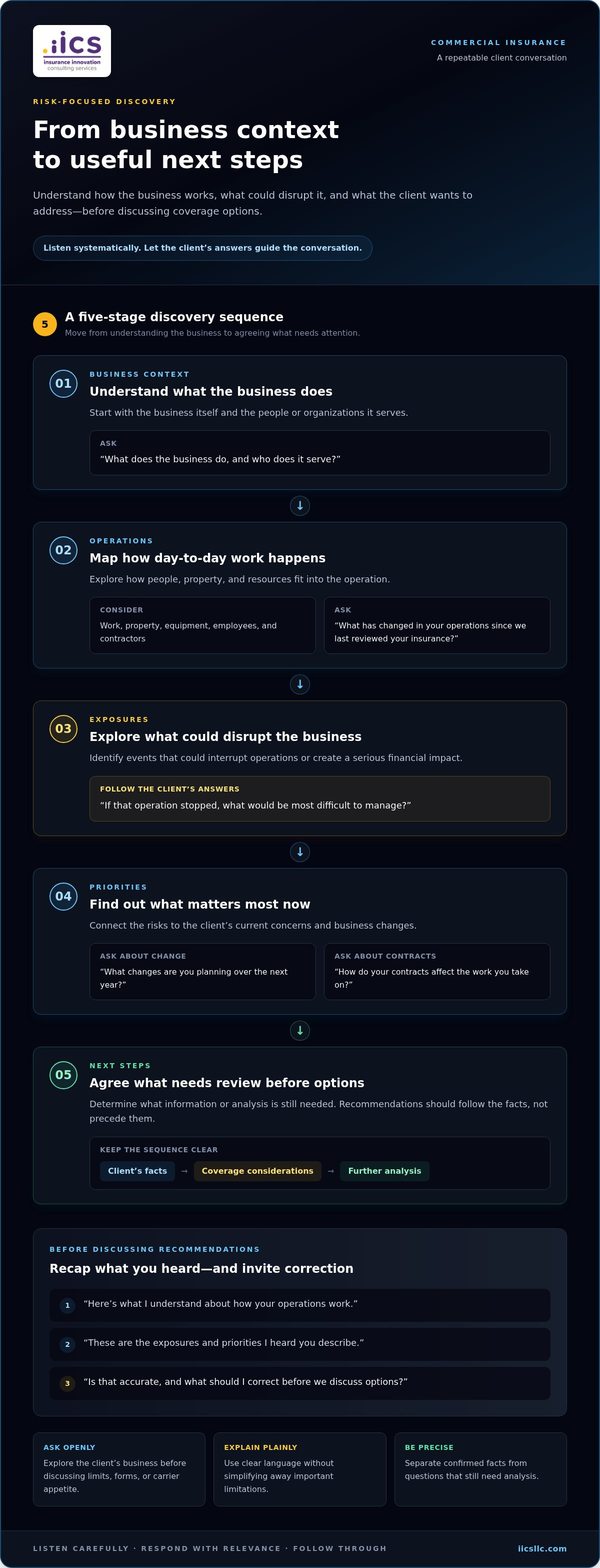
Before discussing product recommendations, check that you understand the client’s priorities. A brief recap can keep the conversation grounded:
“Here’s what I understand about how your operations work.”
“These are the exposures and priorities I heard you describe.”
“Is that accurate, and what should I correct before we discuss options?”
That final question gives the client room to correct assumptions before they shape a coverage discussion. Rapport isn’t a performance that ends when the meeting does. Set the same standard for every interaction: pay attention, offer relevant insight, and do what you said you’d do.
Use Risk-Focused Discovery to Build Trust With Insurance Clients
A strong commercial insurance conversation follows the client’s business reality, not a preset pitch. Risk-focused discovery means listening systematically to understand a client’s operations, exposures, and priorities before proposing coverage. Full-service agencies like si-insurance.com illustrate this approach by evaluating individual operational risks before recommending business coverage solutions. A repeatable process helps you identify what deserves further attention. It doesn’t mean one meeting will uncover every exposure or resolve every coverage question.
Use a clear sequence, and let the client’s answers guide the depth of each discussion:
Business context: What does the business do, and who does it serve?
Operations: How do work, property, equipment, employees, and contractors fit into day-to-day operations?
Exposures: What could interrupt operations or create a serious financial impact?
Priorities: Which risks or business changes matter most to address now?
Next steps: What information or analysis is needed before discussing options?
Which questions help uncover a commercial client’s real concerns?
Ask open-ended questions before discussing limits, forms, or carrier appetite. Try: “What has changed in your operations since we last reviewed your insurance?” “How do your contracts affect the work you take on?” “What property or equipment is most critical to keeping the business running?” “What changes are you planning over the next year?” Follow the client’s answers with, “If that operation stopped, what would be most difficult to manage?” These questions help reveal context, but they don’t replace a thorough account review.
How can producers explain coverage without overwhelming clients?
Translate policy language into plain English without simplifying away important limitations. Organize the conversation into three parts: what the client has told you, which coverage considerations may relate to those facts, and what still needs analysis. For instance, distinguish a confirmed operational detail from a question about how policy wording may apply. Be precise about uncertainty. Clear boundaries build confidence more effectively than an assured answer that goes beyond the information available.
Reflect the client’s priorities and confirm your understanding before recommending action. You might say, “You’ve described a new service, a contract requirement, and concern about downtime. I’ll review the relevant details and come back with the options and questions that need attention.” Ask whether your recap is accurate. This is how to build rapport with insurance clients through disciplined discovery: show that recommendations will follow the facts, not precede them.
IICS develops commercial P&C producers through a Sales Academy that combines focused lessons, coaching, and mentoring. The same conversation skills can be practiced through structured producer development rather than left to trial and error.
Is Building Rapport Just Being Friendly? Trust Versus Sales Pressure
Friendliness can make a conversation more comfortable, but it can’t replace evidence that you understand the client’s priorities and respect their decisions. If every call leads to a quote request, meeting push, or generic check-in, the client may hear the sales agenda more clearly than your advice. Learning how to build rapport with insurance clients means making contact useful, being candid about what you know, and giving the client room to decide.
Use this distinction as a practical test for your next interaction:
What is the difference between helpful follow-up and pushy sales behavior?
Helpful follow-up has a reason the client can recognize. If a client mentioned a contract question, send a concise note addressing it or explaining what you’re reviewing. If you have a relevant resource, ask, “Would it be useful if I sent a short summary?” Before booking another conversation, explain its purpose and let the client decide whether to proceed. Keep the message brief, specific, and easy to answer.
Generic persistence is different. Repeated messages that ask for a decision without adding context serve the producer’s timeline, not the client’s need. A useful contact makes clear why you’re reaching out and what, if anything, you’re asking the client to do.
How should an insurance producer respond when they do not know?
Don’t guess about policy language, underwriting decisions, or claims outcomes. When commercial clients face extensive property damage or complex settlement questions, pointing them toward dedicated claim specialists like Apex Adjusting Group provides tangible support while keeping your own advice grounded. Separate what you know from what requires review, then take ownership of the next step. For example: “I can’t confirm how that wording applies from memory. I’ll review the relevant language and follow up with what it says and what questions remain.” Make the follow-up commitment clear, then keep it.
That honesty is more credible than an overconfident promise. The same standard applies when a prospect is happy with their current agent. Acknowledge the relationship rather than attacking it: “It sounds like you have a process that’s working for you. If you’d find it useful, I can offer another perspective on the specific risk you raised.” Let the client decide. Trust grows when your actions demonstrate value without demanding an immediate switch.
Build an Insurance Client Relationship Rhythm From First Meeting to Renewal
Rapport isn’t built in one meeting and maintained by chance. Producers strengthen it through purposeful contact at each stage of the relationship. A simple rhythm gives every interaction a reason and helps you follow through without overwhelming the client. That’s a practical part of how to build rapport with insurance clients over time.
Prospecting: Make outreach specific to the business or a relevant change, and explain why you’re getting in touch.
Discovery: Record the client’s priorities, agreed actions, owners, and deadlines.
Onboarding: Clarify what happens next, who is responsible, and where the client can direct questions.
Service: Share updates when they relate to the client’s stated risks or plans. Ask what has changed rather than manufacturing a sales reason to check in.
Renewal: Begin planning 60 to 90 days before expiration as a client-specific benchmark, adjusting the timing to the account’s needs and the information required.
Dependable follow-through turns a producer’s promises into evidence a client can trust. After every conversation, record the commitment, the person responsible, and the target date. Then close the loop, even if the update is simply that a question is still being reviewed. Consistency matters more than a high volume of messages.
What should producers do between client meetings?
Make each contact earn its place. Send an update if it connects to a risk or business plan the client raised. Confirm a decision or action when it helps move agreed work forward. If there’s no meaningful update, a concise check-in can still be useful: “Has anything changed in your operations or priorities since we last spoke?” Keep the purpose clear and respect the client’s time.
How can producers make renewal conversations feel consultative?
Don’t open with paperwork. Begin by asking what has changed in the client’s operations, property, contracts, or priorities since the last review. Revisit open questions and explain what information is needed to assess next steps. This makes renewal a structured review of the account, not a routine request to repeat last year’s details. Avoid promising a particular outcome. Focus on what you can investigate, clarify, and communicate.
IICS’s producer development program supports consistent client conversations with daily microlearning, coaching, mentoring, and weekly live workshops.
Turn Rapport-Building Into a Repeatable Producer Skill
Strong client conversations aren’t a matter of personality alone. Producers can improve them through deliberate review and focused practice. To learn how to build rapport with insurance clients consistently, look for observable behaviors: Did you listen without interrupting? Did your questions uncover the client’s priorities? Did you explain the next step clearly, make a specific commitment, and follow through?
How can producers measure progress without reducing rapport to a score?
Use conversation reviews to spot patterns, not to label someone as “good” or “bad” with clients. Track whether discovery covered relevant business context, whether agreed actions had clear owners and deadlines, and whether promised follow-up happened. Client feedback adds another perspective: ask whether the conversation clarified their options or left questions unanswered. No single measure proves trust or guarantees retention. The goal is to identify one behavior that would make the next conversation more useful.
How can coaching help producers build stronger client conversations?
Keep practice specific. After reviewing a call, choose one behavior to work on, such as asking a follow-up question before offering a solution. Rehearse it, apply it in a client conversation, then review what happened. Short lessons can introduce a technique; call feedback, mentoring, and workshops give producers opportunities to apply and refine it. This cycle turns broad advice into a skill producers can use in commercial P&C conversations.
IICS’s 90-day Sales Academy brings together 60 tactical microlearning modules, AI call coaching that scores conversations against nine criteria and provides next-step guidance, 1:1 mentoring, and weekly group workshops. This structure supports deliberate practice without treating rapport as a script. It gives producers a practical way to strengthen their client conversations through repeated learning and feedback.
Keep the standard simple: review the conversation, select one improvement, and practice it deliberately. A producer who listens well, communicates clearly, and honors commitments makes rapport more than an intention. They make it part of how they work.
Make Trust a Practice, Not a Pitch
Strong client relationships don’t come from charm or a well-timed quote alone. They grow when producers prepare thoughtfully, ask questions that reveal business risks, explain coverage clearly, and follow through on commitments. A consistent relationship rhythm carries those habits from the first conversation through renewal. That’s the practical foundation of how to build rapport with insurance clients.
Rapport is a skill you can strengthen. Review conversations for listening, discovery, clarity, and agreed next steps. Choose one behavior to practice, seek specific feedback, and apply what you learn in the next client discussion.
IICS brings more than 40 years of insurance industry leadership experience through founder Ralph J. Blust. Its 90-day Sales Academy combines 60 tactical modules, AI call coaching, mentoring, and weekly workshops to support deliberate development for commercial P&C producers.
Explore IICS’s Sales Academy and producer development services to build a more consistent approach to stronger client conversations.
Frequently Asked Questions
How do you build rapport with an insurance client?
Build rapport by preparing for the conversation, asking open questions about the client’s business, and listening for priorities before discussing coverage. To understand how to build rapport with insurance clients, focus on what happens after the questions, too: reflect back what you heard, explain insurance concepts in plain language, and agree on specific next steps. Then follow through when promised. Trust develops through repeated evidence that you understand the client and act reliably.
Why is rapport important in insurance sales?
Rapport gives clients a stronger foundation for informed insurance decisions. Coverage discussions can involve unfamiliar terms and business risks, so clients need room to explain their concerns and ask questions. When they feel heard, producers can better understand relevant business details and clarify options and expectations. Rapport doesn’t guarantee a sale or renewal. It supports a professional relationship where the client can participate in the discussion with greater clarity.
What questions should an insurance agent ask to build trust?
Ask open questions about operations, contracts, property, employees, upcoming plans, and possible business interruptions. For example, ask, “What has changed since your last review?” or “What risks are you most concerned about right now?” Follow the client’s answers with relevant questions rather than rushing to a quote. These prompts help uncover priorities, but they don’t identify every exposure. Understand the client’s situation before discussing coverage recommendations.
How often should an insurance agent contact clients?
Contact clients according to their needs, agreed follow-up, and relevant changes, not an arbitrary message quota. Confirm when and how you’ll follow up, send promised information, and keep each interaction useful. IICS’s development materials use outreach 60 to 90 days before policy expiration as a planning benchmark. Adapt that timing to the account and circumstances so there’s room to review changes and outstanding questions without implying a particular renewal outcome.
How do you build trust with a client who already has an insurance agent?
Respect the existing relationship and don’t criticize the client’s current agent. Ask what they value about the arrangement and whether a business change or unanswered question deserves attention. If you can offer a relevant perspective, explain its purpose and let the client decide whether a conversation would help. Avoid creating pressure to switch. Credibility comes from listening and serving the client’s interests, even when the immediate next step isn’t a change in agent.
Can insurance agents build rapport with clients virtually?
Yes. A virtual meeting can support rapport when the producer prepares, limits distractions, speaks clearly, and gives the client room to explain their concerns. State the meeting’s purpose, listen without rushing, and summarize decisions and open questions before ending the call. Afterward, send concise notes that capture agreed actions and responsibilities. The format matters less than the quality of attention, clarity, and follow-through the client experiences.
What should an insurance agent do after making a mistake?
Acknowledge the mistake promptly, take responsibility for the next action, and explain what’s known without guessing. Identify what needs review, who will handle it, and when the client can expect an update. Don’t minimize the issue or promise an outcome outside your control. For example, clarify that a policy wording question needs review before you give an answer. Then meet the follow-up commitment. Clear ownership helps maintain professional trust during a difficult moment.