Business Development Skills for Insurance Agents
Updated: 2 days ago
A strong commercial P&C pipeline isn’t built by occasional bursts of prospecting. It grows through repeatable habits. The business development skills for insurance agents that matter most help producers identify suitable prospects, uncover meaningful risks, and follow through even when service work competes for the day.
If prospecting feels inconsistent, product knowledge isn’t turning into useful opportunities, or follow-up keeps slipping, the issue may not be effort. It may be the absence of a clear process. Strong producers don’t rely on motivation alone. They make business development a manageable part of the week.
This article breaks down practical skills that help insurance agents find, win, and retain commercial clients. You’ll learn how to prioritize prospects, lead focused discovery conversations, connect coverage expertise to client risks, and manage follow-through without letting your pipeline disappear behind daily demands.
Consistent growth comes from practice, not isolated sales tricks. With a structured approach, you can turn business development into a disciplined routine that builds stronger opportunities over time.
Table of Contents
Key Business Development Skills for Insurance Agents
Business development is the repeatable work of identifying suitable prospects, engaging them in relevant conversations, and earning the opportunity to build a client relationship. It’s broader than asking for referrals. Business development is the disciplined process of creating client relationships that can deliver lasting value, not simply requesting an introduction.
The broader concept of Business development centers on creating long-term value through customers, markets, and relationships. For commercial P&C producers, that means connecting an organization’s needs and risks with useful conversations, then following through consistently. Trust matters, as do relevance and timing. Without disciplined follow-through, even a strong first meeting can lead nowhere.
How business development differs from insurance sales activity
Quoting, policy administration, and servicing are essential parts of an insurance relationship, but they aren’t the same as creating new opportunities. Product knowledge helps an agent explain coverage and options. Business development helps the agent identify whom to speak with, understand what matters to them, and earn the next conversation.
Consider a producer who learns that a manufacturing business is adding equipment and expanding its operations. A quote may eventually be appropriate, but the first business-development steps are to prepare, ask focused questions about the change, understand the business’s priorities, and agree on a useful next step. If the producer serves the account well, retention may create future opportunities, and the client may choose to make an introduction. Neither is automatic. Both are supported by relevance and trust, not assumed as a reward.
Who benefits from strengthening these skills?
Newer producers benefit from a clear foundation: how to select prospects, start conversations, listen for business needs, and maintain momentum. Experienced agents can use the same discipline to make growth more consistent instead of relying only on established relationships or bursts of activity.
Agency leaders benefit, too. A shared standard gives managers a practical basis for coaching and development, while leaving room to adapt to an individual producer’s strengths and the needs of different commercial accounts. No single script fits every prospect. The goal is a repeatable process that helps agents make sound choices and improve through practice.
That’s the purpose of business development skills for insurance agents: not to replace sound coverage knowledge or strong service, but to connect those capabilities to a healthier pipeline of suitable client relationships.
Five Core Business Development Skills for Commercial Insurance Agents
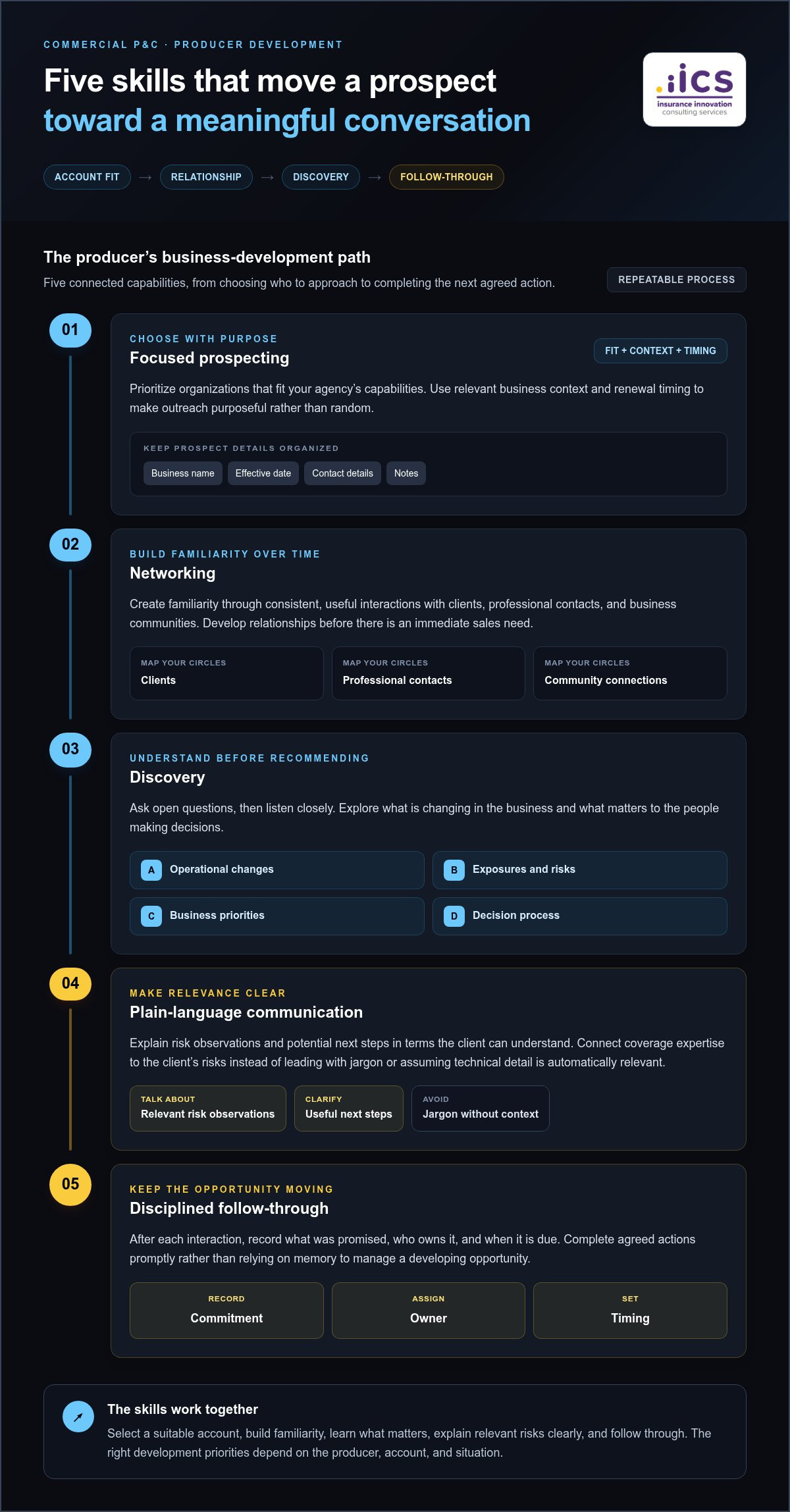
Strong commercial producers don’t depend on one standout trait. They combine practical skills across the full path from selecting an account to earning a meaningful next conversation. These business development skills for insurance agents work together, and each gets sharper through deliberate use.
Focused prospecting: Prioritize organizations that fit your agency’s capabilities. Use relevant business context and renewal timing to make outreach purposeful rather than random.
Networking: Build familiarity through consistent, useful interactions with clients, professional contacts, and business communities. The aim is to develop relationships before there’s an immediate sales need.
Discovery: Ask open questions, then listen closely. Questions about operational changes, exposures, business priorities, and decision processes can reveal what deserves a closer conversation.
Plain-language communication: Explain risk observations and potential next steps in terms the client can understand. Avoid leading with jargon or assuming a technical explanation is automatically relevant.
Disciplined follow-through: Record commitments, owners, and timing after each interaction. Complete agreed actions promptly rather than trusting memory to manage a developing opportunity.
These capabilities align with broad producer learning needs, including sales, marketing, and risk management. The Independent Insurance Agents & Brokers of America provides Key Business Development Skills resources for insurance professionals. The right development priorities still depend on the producer, account, and situation.
Prospect and build relationships with purpose
Start with account fit: consider the type of business you can serve, what you know about its current context, and when a conversation could be useful. An approaching renewal may provide a natural reason to reach out and learn whether the organization has changed. Organize prospects by business name, effective date, contact details, and notes so you can see who needs attention and why. The IICS Suspect List By Effective Date provides a practical way to track that information and focus outreach instead of relying on scattered reminders.
Turn discovery into clear next steps
Ask questions such as, “What’s changed in your operations since your last review?” or “What risks are taking the most attention right now?” Then reflect the key points in direct language: “You’ve expanded the operation, and you want to understand how that affects your current risk picture.” Confirm what should happen next, who is responsible, and when you’ll reconnect. This small discipline keeps a useful conversation from fading into an untracked intention.
Skills improve through deliberate practice and specific feedback, not intention alone. IICS’s Sales Academy develops commercial P&C producers through daily microlearning, AI call coaching, 1:1 mentoring, and weekly workshops.
Why Generic Sales Advice Falls Short for Commercial P&C Producers
Confidence helps, and product knowledge matters. Neither guarantees a durable pipeline. A polished script can start a conversation, but commercial accounts aren’t interchangeable: their operations, exposures, priorities, and timing differ. Effective business development skills for insurance agents require more than delivering a pitch. Producers need to understand the business first and make the discussion relevant to its circumstances.
Commercial conversations also involve coverage context and carrier appetite. A producer can explore a prospect’s operations and explain why those details may matter when discussing insurance options, while avoiding assumptions about what coverage applies or what a carrier will accept. Specific terms and fit depend on the account and the insurer’s underwriting approach.
Move from pitching a policy to understanding a business risk
Start with the operation, not a coverage solution. Suppose a professional services firm begins handling more sensitive customer information. A useful conversation explores what changed, how the firm manages that information, and what concerns its leaders have. Those details may inform a later discussion about insurance considerations, but they don’t automatically establish that a specific policy or form applies. The producer’s job is to clarify the situation, not jump to a conclusion.
Respond to objections without forcing the conversation
When a prospect says, “I am happy with our current agent,” don’t criticize the incumbent or push harder. Try: “That’s good to hear. What do you value most about the relationship?” If the prospect is open to continuing, ask whether any business changes or priorities have prompted new questions. If not, respect that answer and ask whether a brief follow-up at a more suitable time would be welcome.
Curiosity keeps the exchange professional and permission-based. It can reveal what matters without turning the conversation into a contest. In commercial P&C, the stronger approach is rarely the loudest pitch. It’s the one grounded in the prospect’s reality, clear about what’s known, and careful about what still needs to be explored.
How Insurance Agents Can Practise Business Development Skills Every Week
Business development gets crowded out when it has no place on the calendar. A repeatable weekly routine gives prospecting, conversations, and follow-through a defined slot, so pipeline work doesn’t depend on finding spare time. Treat the routine as a working system, then adjust it to your accounts, capacity, and market.
Turn prospecting into a consistent weekly routine
Set recurring time for four actions: research and prioritize accounts, prepare relevant outreach, hold conversations, and follow up on commitments. Use policy effective dates alongside business changes or other relevant triggers to decide where to focus. IICS guidance recommends beginning outreach 60-90 days before policy expiration. A 30-60 day renewal buying window can help with planning, but it’s a consideration, not a guaranteed timeline for every prospect or decision.
Research: Review effective dates and relevant account context before choosing whom to contact.
Prepare: Identify a clear reason for outreach and a useful question to open the conversation.
Engage: Hold discovery conversations and agree on a specific next step when appropriate.
Follow through: Complete promised actions and record the next contact date.
IICS guidance also uses a target of at least 100 monthly leads and 3-5 new accounts. Treat those figures as planning targets, not universal benchmarks or promised results. Organize leads by effective date and track the next action for each. Then review whether planned activity is happening and what it’s producing: replies, conversations, identified needs, agreed next steps, and reasons an opportunity did or didn’t progress.
Review conversations and choose one skill to improve
After a call, capture the prospect’s stated needs, questions or objections, agreed actions, and your next step. Then review what you could improve. Did you ask a question that uncovered useful context? Did you explain a risk consideration clearly? Did you confirm who would do what next?
Use coaching or call feedback to select one behavior to practise in your next conversation. Keep the goal specific, such as pausing after an open question or summarizing the prospect’s concern before responding. For additional ideas on refining producer conversations, read Advanced Commercial Insurance Sales Techniques: The Elite Producer Blueprint for 2026.
Consistency comes from a routine you can repeat and refine, not from chasing a fixed conversion number. IICS’s Sales Academy supports commercial P&C producers with structured practice, call feedback, mentoring, and workshops.
How Structured Producer Development Builds Skills That Last
Knowing what to do is only the starting point. Commercial producers build reliable habits when clear instruction is followed by practice, feedback, and accountability. Isolated tips can offer a useful idea, but they don’t create a learning loop: try a skill, see how it works in a real conversation, identify what to adjust, and practise again.
What a focused commercial P&C development system can include
IICS’s 90-day Sales Academy is designed specifically for commercial P&C producers. Its curriculum includes 60 tactical modules delivered as short daily microlearning lessons. Producers can apply a focused lesson to their work, then use feedback to refine how they prospect, discover needs, communicate, or follow through. Short lessons make it easier to practise one skill at a time instead of trying to absorb too much at once.
Different forms of feedback serve different purposes. AI call coaching provides real-time feedback, scores calls against nine criteria, and offers guidance on next steps. 1:1 mentoring with veteran sales experts, including monthly coaching with the academy founder, adds experienced guidance and perspective. Weekly group workshops provide a setting to reinforce lessons, learn with peers, and maintain accountability. Together, these elements connect instruction to application rather than leaving development at the level of good intentions.
A useful insurance producer development plan can support that process by setting clear practice priorities and making progress easier to review. For example, a producer could focus on improving prospect research, asking stronger discovery questions, or recording specific follow-up commitments. The plan should focus on behaviors a producer can work on, while allowing goals and coaching to reflect the producer’s role and development needs.
Explore a structured path to stronger producer habits
IICS brings a 40+ year insurance leadership track record to its producer development work. The Sales Academy combines microlearning, AI call coaching, 1:1 mentoring, and weekly workshops to help commercial P&C producers practise consistently and learn from feedback.
For commercial P&C producers who want a focused development system, IICS’s 90-day Sales Academy connects modules, AI call coaching, mentoring, and workshops in a single program. A structured approach can help turn business development skills for insurance agents into repeatable habits, one conversation and one adjustment at a time.
Build a Pipeline Through Consistent Practice
Commercial growth rarely comes from one perfect pitch. It comes from choosing prospects thoughtfully, asking better risk-focused questions, and following through on agreed next steps. Business development skills for insurance agents become more reliable when producers practise them consistently and use feedback to improve.
For agencies and producers ready to make development more structured, IICS offers a 90-day Sales Academy built specifically for commercial P&C producers. Its 60 tactical modules are supported by AI call coaching, mentoring, and weekly workshops, creating a framework for repeated learning and application. IICS also brings a 40+ year insurance leadership track record to producer development.
Make the next step manageable: identify one skill to strengthen and put time on the calendar to practise it. To explore a structured development path, explore the IICS Sales Academy.
Frequently Asked Questions
What are the most important business development skills for insurance agents?
The core business development skills for insurance agents include focused prospecting, relationship-building, discovery, clear communication, objection handling, and consistent follow-up. For commercial P&C producers, these skills work as a sequence: prospecting opens relevant conversations, discovery uncovers business priorities, and follow-through keeps agreed next steps moving. Practise them repeatedly instead of relying on occasional motivation. For example, review a client conversation and choose one specific behavior to improve in your next call.
How can an insurance agent get better at prospecting?
Get better at prospecting by defining which businesses and decision-makers fit your agency’s focus, then organizing prospects so you can plan relevant outreach. Track practical details such as the business name, contact information, policy effective date, notes, and next action. Set recurring time for prospect research and conversations. Afterward, review which messages led to useful responses and adjust your approach. A script can support preparation, but it can’t guarantee a prospect’s interest or a particular outcome.
Why is business development important for insurance agents?
Business development gives agents a deliberate way to create future client conversations rather than depending only on referrals or sporadic outreach. A consistent process helps producers identify suitable prospects, learn about changing business needs, and follow through on commitments. In commercial P&C, it can also support more relevant risk discussions and stronger working relationships. Business development complements technical insurance knowledge and attentive service; it doesn’t replace accurate coverage expertise or good client care.
How should insurance agents respond when a prospect says they are happy with their current agent?
Acknowledge the prospect’s relationship instead of challenging it. You might say, “That’s good to hear. What do you value most about the service you receive?” If they’re open to talking, ask whether any business changes have raised new questions or priorities. Don’t criticize their current agent or push for an immediate switch. If there’s no current need, respect the answer and ask whether a follow-up at a more suitable time would be welcome.
How far in advance should an insurance agent contact a business before renewal?
IICS guidance recommends starting outreach 60-90 days before policy expiration, while treating the 30-60 day renewal buying window as a planning consideration. These are not guaranteed decision timelines: each business may have a different process. Consider account complexity, who participates in decisions, and whether operations have changed. Use the first conversation to understand what timing is useful, then agree on an appropriate follow-up cadence instead of assuming every prospect will decide on the same schedule.
Can business development skills be learned, or are they natural talents?
Business development skills can be developed through instruction, deliberate practice, feedback, and consistent review. A producer may already be a strong listener but still need to improve prospect research, call structure, or follow-up discipline. Choose one observable behavior to practise, then review how it worked in real conversations and adjust. For commercial P&C agents, training is especially useful when practice reflects business accounts, risk-focused discussions, and the day-to-day demands of producer work.