Calculating New Insurance Producer Ramp Up Time: A Framework for Elite Performance
- Jul 29
- 12 min read
Why are you still treating a $250,000 investment like a roll of the dice? Most agency owners accept the grueling 18 month industry standard for validation as an unchangeable law of nature. They sit back and watch unvalidated payroll drain their margins while hoping a new hire eventually finds their footing. It's a passive approach that costs you hundreds of thousands in sunk capital and missed opportunities. You deserve a predictable model for growth rather than a prayer for profitability. Mastering the science of calculating new insurance producer ramp up time is the first step toward reclaiming your agency's trajectory.
We understand the frustration of sinking massive resources into a producer who fails to launch. You need more than just a gut feeling; you need a battle-tested framework. This guide will show you how to accurately predict, calculate, and ultimately halve the time it takes for new hires to reach breakeven. We'll examine the specific variables that dictate success and provide a clear path to revenue through structured milestones and high-frequency feedback. It's time to stop guessing and start scaling with precision.
Table of Contents
The Anatomy of Producer Ramp-Up: Beyond the 18-Month Myth
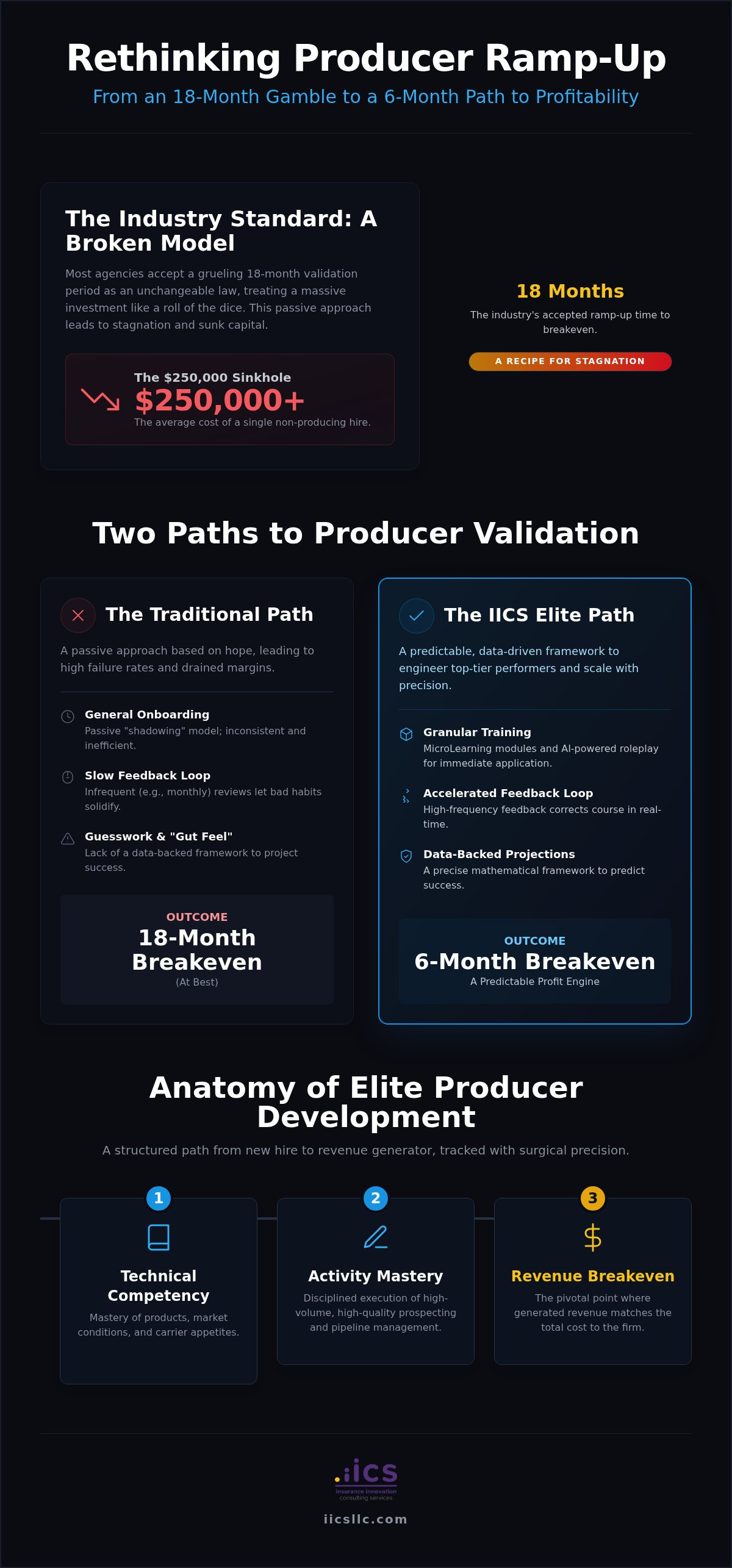
Ramp-up time isn't just a waiting period. It's a high-stakes race against your agency’s capital reserves. In the world of Property and Casualty, we define ramp-up as the duration from a hire's start date to the point where their generated revenue matches their total cost to the firm. Most agencies sleepwalk through this. They accept an 18 month timeline as an inevitability. Why? Because the industry has lowered the bar. This 'standard' is a recipe for stagnation. It assumes your new Insurance broker needs a year and a half just to stop costing you money. That's a failure of leadership and process, not a limitation of talent.
True development happens in three distinct stages. First is Technical Competency, where the hire learns the products and the market. Second is Activity Mastery, where the focus shifts to the volume of prospects and pipeline discipline. Finally, there's Revenue Breakeven. This is where the math finally flips. When you are calculating new insurance producer ramp up time, you must track these phases with surgical precision. There is a massive chasm between a producer who is merely surviving and an Elite Insurance Producer who dominates their niche within six months.
The Financial Stakes of Miscalculation
Misjudging this timeline creates a 'sinkhole' effect. You aren't just losing a salary. You're losing overhead, benefits, and the opportunity cost of the business they didn't close. We call this the cost of non-producing insurance hires, and it often exceeds $250,000 per failed attempt. This hemorrhage erodes your agency's valuation and drags down your EBITDA. Beyond the balance sheet, slow ramp times destroy morale. High-potential talent doesn't want to wait 18 months to feel successful. They want results, and they want them fast.
The 'Elite' Benchmark
Aiming for average production is a strategic error. Average is safe. Average is slow. Elite producers don't possess a secret talent; they follow a superior system. While calculating new insurance producer ramp up time, look for the traits of the six-month validator: relentless activity, immediate application of feedback, and a refusal to accept the 18-month myth. You must set the expectation for elite performance from the first hour of day one. If you treat them like a slow learner, they will become one. The goal isn't to get them to 'survive' the first year. The goal is to make them a profit engine before the second quarter ends.
The Variables: What Actually Dictates Your Producer's Speed?
Why does one hire hit their numbers in six months while another is still underwater at eighteen? It isn't just "grit" or natural talent. It's the variables you control during their development. When you are calculating new insurance producer ramp up time, you have to look beyond the calendar. You must evaluate the quality of the training and the frequency of the feedback. Many agency owners fall into the "Activity vs. Results" trap. They see a producer making fifty calls a day and assume they're on track. But if those calls are low-skill and low-quality, they're just practicing failure. You are paying them to fail faster, not succeed sooner.
The Best Practices Study benchmarks from the Big "I" highlight that the most successful agencies maintain a disciplined approach to their Net Unvalidated Producer Payroll. They don't just throw money at a hire; they invest in the variables that shorten the learning curve. If you're ready to stop gambling on your hires, you can explore how our Sales Academy for P&C producers optimizes these variables for you.
Granular Training vs. General Onboarding
The traditional "shadowing" model is a relic. It forces a new hire to sit in the back of the room, passively absorbing whatever the senior producer happens to do that day. It's inconsistent and inefficient. Elite agencies use MicroLearning modules instead. These bite-sized lessons allow for immediate application. A producer learns a specific objection-handling technique in the morning and uses it in the afternoon. This focuses their energy on High-Value Activities from day one. Why wait months for a classroom session when they can learn and earn today?
The Feedback Loop Acceleration
If you're only reviewing your producers' performance once a month, you've already lost. Modern sales move too fast for that. You need to move from "What happened last month?" to "What will you do on your next call?" This is where AI sales coaching for insurance changes the game. It provides objective, data-driven analysis of every conversation. Combined with weekly workshops and 1:1 mentoring, it creates a feedback loop that reinforces skills in days rather than years. Speed of feedback is the ultimate competitive advantage. How much faster could your team grow if they knew exactly where they went wrong ten minutes after a call?
The Ramp-Up Formula: A Step-by-Step Calculation Guide
Stop treating your agency's payroll like a charity. If you aren't using a mathematical framework to track development, you aren't managing; you're gambling. Most agency owners rely on "gut feelings" to decide if a new hire is working out. This lack of precision is why so many producers fail to launch. Calculating new insurance producer ramp up time requires a cold, hard look at the numbers. You need to know exactly when the red ink turns to black. By mastering four key metrics, you can transform a vague timeline into a predictable trajectory for elite performance.
The calculation starts with the Breakeven Point. This is the total revenue needed to cover the producer's seat. Next, you must determine the Activity Multiple. This tells you the volume of prospects required to hit your revenue targets based on current skill levels. From there, you track Skill Velocity, which is the rate of improvement in close ratios month-over-month. Finally, you apply the Training Catalyst. This is the significant time reduction provided by outsourced development. When these variables align, the 18-month industry standard begins to look like a relic of the past.
Step 1: Establishing the Breakeven Baseline
What does that producer's seat actually cost? It’s more than just a salary. You must factor in benefits, taxes, and overhead. Industry data suggests that most agencies underestimate their true overhead by 15-20%. Are you accounting for the cost of the desk, the software licenses, and the management time spent on training? Once you have the total annual cost, divide it by your average commission per account. This number is your target. It represents the absolute minimum production required to stop the bleeding. Setting this baseline on day one removes any ambiguity about what success looks like.
Step 2: Mapping the Production Trajectory
A producer doesn't hit their full stride overnight. You must project 30, 60, and 90-day milestones that lead toward that breakeven point. This trajectory must account for the reality of Commercial P&C sales cycles, which are significantly longer than personal lines. Focus on Leading Indicators first. Are they making the calls? Are they booking the meetings? These activities are the engine. Lagging Indicators, like signed policies, will follow if the engine is running. If the Skill Velocity isn't increasing, the Activity Multiple must go up. It’s a simple lever. If they can’t close at a high rate yet, they must talk to more people. There is no middle ground in an elite agency.
How to Halve Your Producer Ramp-Up Time
The 18 month validation cycle is a choice, not a law. You can continue to bleed capital while your new hire "figures it out," or you can engineer a faster path to profit. Halving this timeline requires a shift from passive observation to aggressive, structured development. When you are calculating new insurance producer ramp up time, you're usually looking at a calendar. We want you to look at a stopwatch. By compressing the learning curve through high-intensity training and technological leverage, you can move a producer from a liability to an asset in a fraction of the time. This isn't about working harder. It's about working with a superior framework.
Execution begins with a rigorous onboarding new insurance producers checklist that leaves nothing to chance. You must front-load the experience that typically takes years to acquire. This means moving beyond basic product knowledge and diving into advanced commercial insurance sales techniques within the first ninety days. Why wait for a producer to stumble into a complex mid-market deal when you can train them to hunt for one immediately? Precision in the first three months dictates the trajectory of the next three years.
The Power of Outsourced Development
Most agency principals are phenomenal at sales but mediocre at training. It’s a classic time versus talent conflict. Every hour you spend teaching the basics is an hour you aren't growing the agency's footprint. Outsourcing this development to a specialized Sales Academy allows you to leverage a 40 year track record of success without sacrificing your own production. A 3-month intensive program beats 12 months of "learning by doing" every single time. It provides a level of consistency and fractional leadership that internal programs simply cannot match. If you want elite results, you need an elite engine to build them. You can accelerate your agency's growth today by enrolling your next hire in our Sales Academy for P&C producers.
Leveraging AI for Real-Time Mastery
Stop burning your best leads on untrained producers. It's a waste of high-value opportunities. Use AI-driven roleplay to simulate high-stakes conversations before they ever pick up the phone. This technology allows you to analyze call sentiment and objection handling with surgical precision. When calculating new insurance producer ramp up time, factor in the "feedback frequency" lever. AI provides real-time coaching that scales across your entire team without adding a single person to your headcount. Research from May 2026 indicates that AI-powered training can lead to a threefold faster time-to-revenue. It’s time to stop guessing and start using data to drive your producers toward breakeven.
The IICS Method: Engineering the 6-Month Breakeven
The 18 month industry standard is a safety net for mediocrity. It's a timeline designed by agencies that lack a structured engine for growth. While calculating new insurance producer ramp up time using traditional models might suggest a two year horizon, the IICS method is engineered to disrupt that trajectory. We don't just aim for validation. We aim for elite performance. By leveraging a 40 year track record of continuous development, we've built a system that brings P&C producers to breakeven in half the industry norm time. This isn't a theory; it's a proven reality for agencies across the country.
The power lies in the synergy of our core tools. We combine the immediate feedback of AI Sales Coaching with the focused discipline of MicroLearning and the high stakes guidance of 1:1 Call Coaching. This trifecta ensures every lesson is applied, every mistake is corrected, and every win is replicated. It moves the producer from the classroom to the field with a level of confidence that usually takes years to develop. How much would your agency's valuation increase if every new hire followed this path? It's time to stop calculating new insurance producer ramp up time in years and start measuring it in milestones.
The Sales Academy Advantage
Our 3 month Sales Academy for property and casualty Insurance Producers is the engine that drives this acceleration. It's an intensive curriculum designed specifically for P&C excellence, stripping away the fluff and focusing entirely on production. Because of this focus, IICS graduates are twice as likely to become top producers compared to those following traditional onboarding paths. The development doesn't stop at the three month mark, either. We provide long term fractional CRO and CGO support to ensure the trajectory remains upward. We don't just build producers; we build the future leaders of your agency.
Taking the First Step Toward Elite Production
Your next move is to look inward. You must assess your current onboarding process for hidden time leaks that are draining your EBITDA. Is your leadership structure actually supporting growth, or is it a bottleneck? A professional audit of your sales leadership can reveal exactly where your capital is being wasted. Don't let another six months pass with underperforming hires. It's time to demand more from your investment. Audit your producer development process with IICS and start engineering your path to elite performance today.
Reclaim Your Agency’s Profitability Timeline
Accepting the industry standard is a choice to remain average. You now possess the tactical framework to move beyond the 18-month myth and start engineering elite performance. By applying the breakeven formula and prioritizing high-frequency feedback, you replace hope with a predictable model for revenue growth. Precision in calculating new insurance producer ramp up time is the difference between a thriving agency and one stuck in a cycle of failed hires. Why settle for a timeline that drains your capital when you can compress the learning curve with a proven system?
It's time to demand more from your investment. Our elite AI-driven coaching methodology and 40-year track record of success are specifically designed to help your producers reach breakeven in 50% less time than the industry norm. Don't leave your agency's future to chance or allow unvalidated payroll to erode your margins. Double your producer's likelihood of success with the IICS Sales Academy. You have the roadmap. Now take the first step toward building a team of elite producers who dominate the market and secure your agency's legacy.
Frequently Asked Questions
What is the average ramp-up time for a new commercial insurance producer?
The industry average for new-to-industry producers is 12 to 18 months, while those with prior experience typically take 7 to 9 months to become independently productive. These timelines are often accepted as inevitable, but they represent a massive drain on agency capital. Our methodology focuses on calculating new insurance producer ramp up time to compress this window and reach profitability in half the time.
How do you calculate the breakeven point for a new producer hire?
You calculate the breakeven point by dividing the total annual cost of the producer, including salary, benefits, and overhead, by your average commission per account. Many agencies fail because they only look at salary and ignore the "unvalidated payroll" costs. This investment often reaches between $80,000 and $120,000 before the producer ever pays for themselves through closed business.
Why do 20% of new insurance producers quit within the first 45 days?
Twenty percent of new hires leave within 45 days primarily due to inadequate onboarding and a lack of clear performance milestones. When a producer doesn't see a clear path to success, burnout sets in quickly. Formalized training improves retention by 82% because it provides the structure and psychological safety necessary to survive the high-pressure early phase of insurance sales.
Can AI sales coaching really reduce the time it takes to train a producer?
AI sales coaching significantly reduces training time by providing real-time feedback that traditional mentoring cannot match. Research from May 2026 indicates that organizations using AI tools see a threefold faster time-to-revenue. By simulating high-stakes calls and analyzing sentiment, producers build muscle memory and objection-handling skills without burning through your agency's best leads or wasting principal time.
What are the key performance indicators (KPIs) to track during the first 90 days?
During the first 90 days, you must track leading indicators such as outbound dials, meetings booked, and new pipeline opportunities. Lagging indicators like signed policies are important, but they don't tell you if the producer's daily activity is sufficient to hit long-term goals. Focus on the "Activity Multiple," which is the volume of prospects needed to satisfy your specific revenue targets.
How much does it cost an agency when a new producer fails to ramp up?
A failed producer hire can cost an agency upwards of $250,000 in sunk capital and lost opportunity. This figure includes more than just the base salary; it accounts for management time, marketing resources, and the business that a top producer would have otherwise closed. It is a massive financial sinkhole that erodes agency valuation and drags down your total EBITDA over time.
What is the difference between a standard onboarding program and a Sales Academy?
Standard onboarding typically focuses on administrative tasks like licensing and software training, while a Sales Academy is a tactical engine for production. A Sales Academy provides the specialized sales techniques and psychological training required to win mid-market commercial deals. It transforms a new hire into a profit-generating asset through a structured, high-intensity curriculum that focuses on results over theory.
Should I use an internal or outsourced program for producer development?
Outsourcing producer development is often the superior choice for agencies looking to scale without distracting their best producers from selling. Internal training is frequently inconsistent and relies on "shadowing," which lacks a data-backed curriculum or objective feedback loops. An outsourced Sales Academy provides the fractional leadership and 40-year track record needed to ensure calculating new insurance producer ramp up time leads to predictable results.