Characteristics of a Top Insurance Producer: 7 Traits That Drive Results
Top insurance producers aren’t defined by a sales gene. They build results through repeatable habits. The characteristics of a top insurance producer show up in daily choices: how consistently they prepare, ask questions, follow through, and respond to feedback. In commercial P&C, where each account brings distinct risks and underwriting demands, generic advice like “be confident” doesn’t give producers or their managers much to work with.
It’s reasonable to want a clear answer to what separates a high performer from an average one. The difference isn’t simply personality or natural talent. It’s behavior you can observe, practice, and strengthen. Are client conversations purposeful? Are submissions organized? Does follow-up happen when promised?
Table of Contents
What Defines the Characteristics of a Top Insurance Producer?
Seven Characteristics of a Top Insurance Producer in Commercial P&C
Top Insurance Producer vs. Average Producer: Compare Behaviors, Not Personality
How to Assess and Strengthen Your Insurance Producer Characteristics
How Structured Development Builds the Characteristics of a Top Insurance Producer
What Defines the Characteristics of a Top Insurance Producer?
Charisma can help open a conversation. An inherited book can create an early advantage. Neither, by itself, explains sustained performance in commercial property and casualty insurance. The characteristics of a top insurance producer are visible in the work: how a producer builds relationships, investigates exposures, communicates options, and follows through when an account becomes complex.
A top insurance producer consistently creates suitable client value through ethical, repeatable commercial P&C sales behaviors.
Production results matter, but they’re outcomes, not characteristics. A strong sales total shows what happened; repeatable habits help explain how a producer builds and maintains performance. That distinction matters for individual development and agency coaching. Focus on the producer’s actions rather than assumptions about natural talent.
What does top-producer performance look like in commercial P&C?
It looks like consistent prospecting, purposeful discovery, disciplined follow-up, and dependable service after the sale. For example, before a contractor’s renewal conversation, a producer might review the client’s operations, ask what has changed, document relevant details, and agree on a next step. The value isn’t in sounding polished. It’s in making the discussion more useful and the process more reliable.
Look beyond new-business production. Consider whether recommendations fit the client’s needs, whether relationships are retained, and whether the producer communicates professionally and follows through. A book of business is not a complete performance picture: account complexity, agency support, and experience can all affect individual results. Compare behaviors and context before drawing conclusions from rankings alone.
Prospecting: Makes room for planned outreach instead of relying only on incoming opportunities.
Risk conversations: Asks focused questions about the client’s operations and changing exposures.
Follow-up: Records commitments and completes agreed next steps.
Client service: Communicates clearly and keeps the client informed as work progresses.
These behaviors connect to the wider role of selling as a process of understanding needs and communicating value. The broader context of sales principles offers useful background, but commercial insurance adds a specific demand: connect the conversation to the client’s risk and coverage needs.
Are top insurance producers born with sales talent?
No single temperament defines success. Confidence doesn’t require being the most extroverted person in the room. It can come from knowing the account, preparing relevant questions, and being willing to clarify what you don’t yet understand. Producers can use different communication styles and still build trust through attention, preparation, and consistency.
Habits strengthen through repetition and feedback. A producer can review call notes, identify whether discovery questions uncovered meaningful changes, and prepare a sharper follow-up for the next conversation. Coaching can help turn that observation into practice. Over time, confidence depends less on improvisation and more on preparation. That’s a development path, not an inborn advantage.
Seven Characteristics of a Top Insurance Producer in Commercial P&C
Strong producers don’t rely on a single sales style. They build a set of habits that helps them serve clients, manage opportunities, and adjust as risks and market conditions change. The characteristics of a top insurance producer are visible in repeated actions, not in a confident self-description.
Use these seven traits as a practical lens. Each one can be observed in account work and strengthened with deliberate attention.
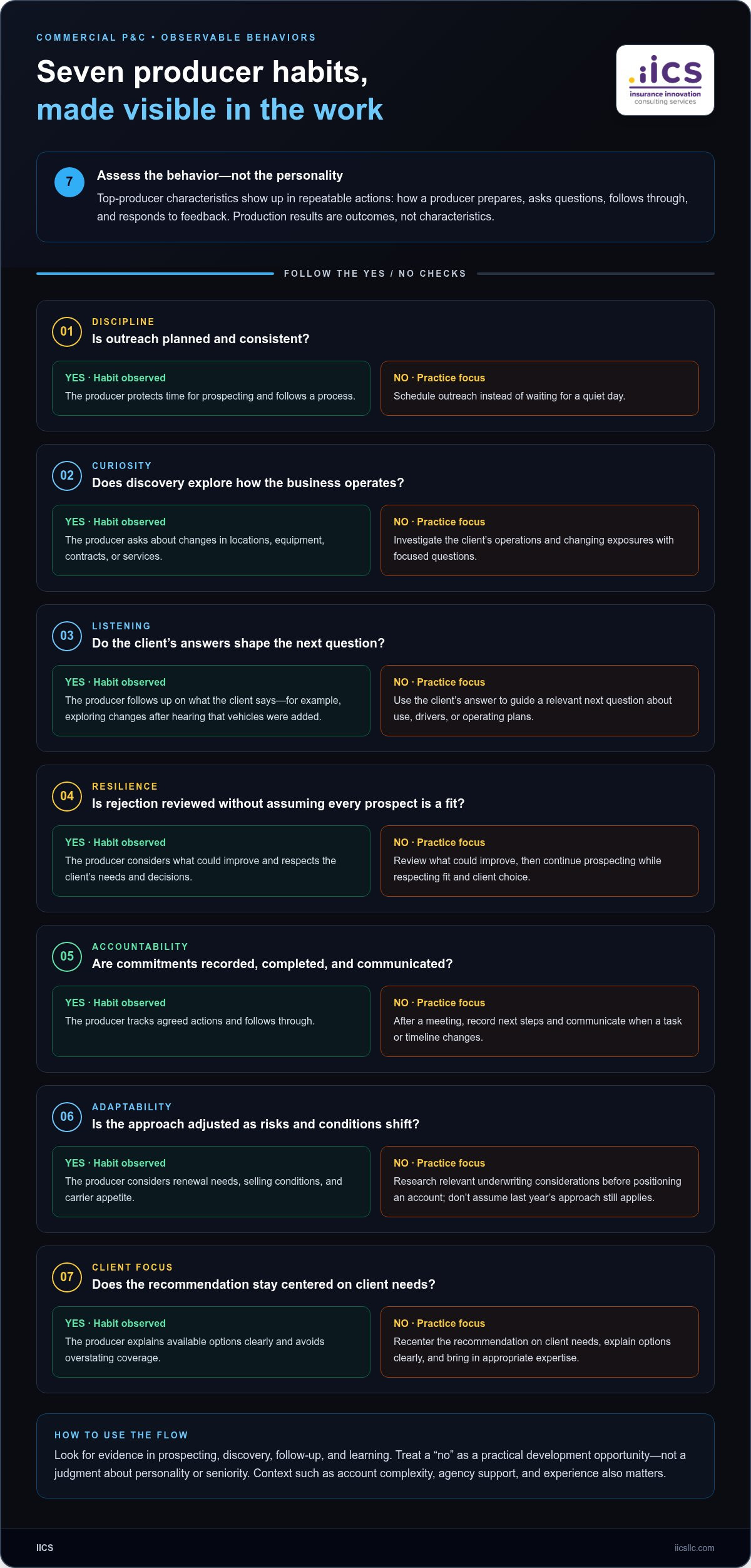
Discipline: Protects time for consistent prospecting. A disciplined producer schedules outreach and follows a process rather than waiting for a quiet day to appear.
Curiosity: Investigates how a business operates. For example, the producer asks about changes in locations, equipment, contracts, or services that could affect the client’s risk profile.
Listening: Uses the client’s answers to guide the next question. If a business mentions adding vehicles, the producer explores how their use, drivers, and operating plans have changed.
Resilience: Learns from rejection without treating every prospect as a fit. A producer reviews what could improve, then continues prospecting while respecting the client’s needs and decisions.
Accountability: Owns commitments and next steps. After a meeting, the producer records agreed actions, follows through, and communicates if a timeline or task changes.
Adaptability: Adjusts the approach as renewal needs, selling conditions, and carrier appetite shift. A producer researches relevant underwriting considerations before positioning an account, rather than assuming last year’s approach still applies.
Client focus: Keeps the client’s needs at the center of the recommendation. The producer explains available options clearly, avoids overstating coverage, and brings in appropriate expertise when a question goes beyond their role.
How curiosity, listening, and risk awareness improve producer conversations
Useful discovery moves beyond asking what coverage a business currently has. Ask how it operates, what has changed, when policies renew, and which exposures concern decision-makers. Then listen for details that call for a relevant follow-up. A new service line, for instance, may prompt questions about operations and timing. The Occupational outlook for insurance sales agents describes the broader work of the profession. In commercial P&C, strong conversations also require attention to risk details and carrier appetite.
Why discipline, resilience, and accountability compound over time
These traits make opportunities less dependent on memory or mood. Planned prospecting creates a steady routine; recorded follow-up helps prevent commitments from slipping; and reviewing setbacks turns rejection into a chance to refine preparation. Adaptability keeps that process relevant as an account changes. The goal isn’t to force a sale. It’s to make the next informed, suitable step.
Because these behaviors can be practiced, producers can build them through structured development. IICS’s commercial P&C Sales Academy combines microlearning, AI call coaching, mentoring, and weekly workshops to support consistent practice and feedback.
Top Insurance Producer vs. Average Producer: Compare Behaviors, Not Personality
“Average” and “top” are useful only when they describe actions, not a person’s worth. A producer’s style, seniority, and book size don’t tell a coach what to reinforce. Observable behaviors offer a fairer coaching basis than personality labels: they show what happened in the work and what can be practiced next.
Use the comparison below to spot differences in routine, not to promise a particular result. Stronger behaviors can improve the quality and consistency of the sales process, but outcomes also depend on account fit, market conditions, and other factors.
How do strong producers handle prospecting and follow-up differently?
Reactive outreach leaves timing to chance. A stronger process tracks effective dates and starts conversations early enough to understand the account before renewal. With a typical renewal buying window of 30-60 days, outreach can begin 60-90 days before expiration. Follow-up should move the discussion forward, not simply repeat “checking in.” Reference a known exposure, clarify a pending item, or ask a focused question that helps determine the next step.
How do top producers respond to objections and changing needs?
Consider the response, not the script. If a prospect says, “I am happy with our current agent,” a defensive producer may immediately argue for a change. A more deliberate response stays calm and explores what the prospect values, whether a specific concern remains, and whether a conversation would be useful. The goal is to understand, not pressure.
That same discipline applies when needs change. A quote request is an opening, not the whole conversation. Ask what prompted it, how the business has changed, and what the client wants to address at renewal. Then shape the discussion around relevant exposures and current carrier appetite, rather than forcing last year’s approach onto a different situation. Keep explanations accurate, and bring in appropriate expertise when a question exceeds your role.
For self-assessment, review a recent prospecting sequence, discovery conversation, renewal follow-up, and call review. Ask: Was the next action clear? Did the client’s answers guide the discussion? Did the follow-up add value? Those answers offer a practical starting point for coaching the behaviors that matter.
How to Assess and Strengthen Your Insurance Producer Characteristics
Improvement starts with evidence, not a vague instruction to “be better.” Choose one behavior, examine what’s happening now, and build a repeatable way to practice it. The characteristics of a top insurance producer develop through consistent action and useful feedback, not by trying to overhaul every habit at once.
Use this five-step cycle to turn self-assessment into a workable development plan:
Choose a behavior. Pick one specific area, such as asking stronger discovery questions or completing planned follow-up.
Review evidence. Look at call notes, prospecting activity, completed follow-ups, preparation, or client feedback where available.
Identify a gap. Compare what you intended to do with what the evidence shows. Keep the focus on actions you can control.
Practice. Schedule a small, repeatable action and use coaching or peer feedback to refine it.
Reassess. Review the same evidence after a consistent period. Keep the practice, adjust it, or choose the next behavior to develop.
Which evidence can reveal a producer’s strengths and gaps?
Start with commitments: Did prospecting happen as planned? Was the producer prepared for the meeting? Were agreed follow-ups completed? Call reflection can reveal whether questions invited useful detail, whether the producer listened for changes in the client’s business, and whether the conversation ended with clear next steps. Client feedback can add perspective on communication and service. No single measure tells the whole story, so look for patterns across more than one interaction.
A lost account or a difficult call may offer a learning opportunity, but neither is a complete performance diagnosis. Account fit, timing, and market conditions can influence outcomes. Review the producer’s choices and process alongside the result. That keeps coaching fair and directs attention toward behaviors that can actually change.
How can producers turn one trait into a weekly practice?
Make the trait concrete. “Improve discipline” is too broad to guide a workday. Instead, choose a routine, such as blocking time each week to prepare for upcoming client conversations, then record whether the preparation was completed and what it helped uncover. At the next review, use call notes or coaching feedback to decide what to repeat or refine.
Practice should connect directly to the work. To strengthen discovery, prepare a few open questions for a real client conversation, listen closely to the answers, and note where a follow-up question would have clarified an exposure or changed need. Structured development can help organize that cycle of action, feedback, and reassessment. IICS’s commercial P&C Sales Academy combines microlearning, AI call coaching, mentoring, and weekly workshops. For focused support in building producer habits, explore producer development with IICS.
How Structured Development Builds the Characteristics of a Top Insurance Producer
A trait becomes useful when it changes what a producer does in the work. Discipline, for example, is more than an intention to stay organized. It can mean preparing for client conversations consistently, reviewing what happened, and applying a lesson to the next opportunity. That kind of progress takes deliberate practice, timely feedback, mentoring, and accountability. Good development gives producers a structure for using all four.
Without a system, training can become a burst of information that fades under the pressure of daily work. A consistent approach connects a focused lesson to a real sales behavior, gives the producer a chance to practice it, and creates a point to review progress. The goal is not to promise a particular sales result. It’s to make productive behaviors easier to repeat and improve.
What does a consistent producer-development system include?
Effective development combines short, focused learning with feedback on actual sales conversations, one-to-one mentoring, and group discussion. Each element supports a different part of behavior change: a lesson introduces a skill, call feedback highlights what to refine, and mentoring helps translate insight into a practical next step. Weekly workshops create space to revisit challenges and learn with others.
For example, a producer working on curiosity might study a discovery concept, practice asking relevant questions in client conversations, and review whether the answers led to useful follow-up. A coach can point out where the producer moved too quickly or missed a chance to explore a changing exposure. Structured AI sales coaching for insurance can also support timely reflection on calls. The important link is between the lesson and the behavior, not simply completing training.
IICS’s commercial P&C Sales Academy brings these components together in a 90-day development system. It includes 60 tactical microlearning modules, AI call coaching, mentoring, and weekly workshops. Producers can use that structure to work on a specific behavior, apply it in their day-to-day conversations, and receive feedback as they continue practicing.
How does IICS connect commercial P&C experience with development?
Producer development is stronger when practice reflects the actual demands of commercial insurance. The questions asked, account details explored, and conversations held around client needs all matter. IICS founder Ralph J. Blust brings more than 40 years of insurance-industry leadership experience, informing a development approach built for commercial P&C producers rather than generic sales scenarios.
The next step is to choose one behavior you want to strengthen and consider what practice and feedback would help you build it. Explore the Sales Academy to learn how its structured development approach can support that work.
Turn Your Next Conversation Into a Development Opportunity
The next step isn’t to become a different kind of salesperson. It’s to make one deliberate improvement in how you prepare, listen, or follow through, then carry that improvement into the next client interaction. The characteristics of a top insurance producer take shape through choices repeated under real working conditions.
Pick a behavior that would make your conversations or account work more effective. Decide what you’ll do differently, and make room to review how it went. Agency leaders can use the same approach in coaching: focus on a clear action, give specific feedback, and agree on a practical next move. Progress becomes easier to build when development is part of the work, not an occasional conversation.
For producers and agency teams ready to strengthen commercial P&C performance with focused practice and coaching, explore the IICS Sales Academy. Choose a next step, commit to the work, and keep building habits that serve both your clients and your growth.
Frequently Asked Questions
What is the most important characteristic of a top insurance producer?
There’s no single trait that guarantees top performance, but disciplined follow-through is especially important in commercial P&C. A producer may need to coordinate prospecting, risk discussions, renewal timing, and client service without losing track of commitments. For example, after identifying an unresolved exposure, they document the next action and make sure it’s addressed. Evaluate this behavior alongside curiosity and sound judgment, not as a substitute for the full picture of performance.
Can an introvert become a top insurance producer?
Yes. Effective production doesn’t require a naturally outgoing personality. An introverted producer can prepare thoughtful questions before a meeting, listen carefully, and send a concise recap that confirms decisions and responsibilities. Those actions help clients feel understood without requiring the producer to adopt someone else’s style. The practical test is whether the producer initiates necessary conversations, understands client needs, and reliably completes the work that supports the relationship.
How do agencies measure whether a producer is becoming more effective?
Use activity measures and outcome trends together. An agency might review whether prospecting commitments were met, meetings were prepared for, and follow-ups were completed, then consider discovery quality, client feedback, and production trends. Set shared definitions and a review period before comparing performance, so the team is evaluating the same behaviors. Interpret results in context: account mix, experience, market conditions, and agency support can all shape what the numbers show.
Do top insurance producers need to specialize in one industry?
No. Specialization can help a producer build deeper familiarity with an industry’s operations, exposures, and common coverage discussions, but it isn’t the only path to effectiveness. The right focus depends on agency strategy, carrier access, and the producer’s capabilities. A producer with a broader book still needs to prepare for each account, ask informed questions, and distinguish what they know from what requires further expertise. Never promise coverage beyond your authority or understanding.
How early should a producer contact a prospect before a policy renewal?
Begin early enough to understand the account before a last-minute quote request drives the process. IICS guidance places outreach 60-90 days before expiration, while the renewal buying window is generally 30-60 days. Treat those periods as planning benchmarks, not fixed deadlines for every account. A complex operation or a client’s particular circumstances may call for a different approach. Use the initial conversation to learn what has changed and agree on useful next steps.
Can sales coaching improve producer performance if someone already has experience?
Yes. Experience doesn’t automatically show which habits are helping or limiting results. An experienced producer can review a challenging call, identify where a client’s concern went unanswered, and test a more effective follow-up in the next similar conversation. Coaching is most useful when feedback is specific and followed by practice. It should build on the producer’s existing expertise while addressing observable opportunities, rather than assuming tenure alone means every part of the process is working.