Commercial Insurance Producer Mentoring: The Elite Framework for 2026
Updated: Oct 2
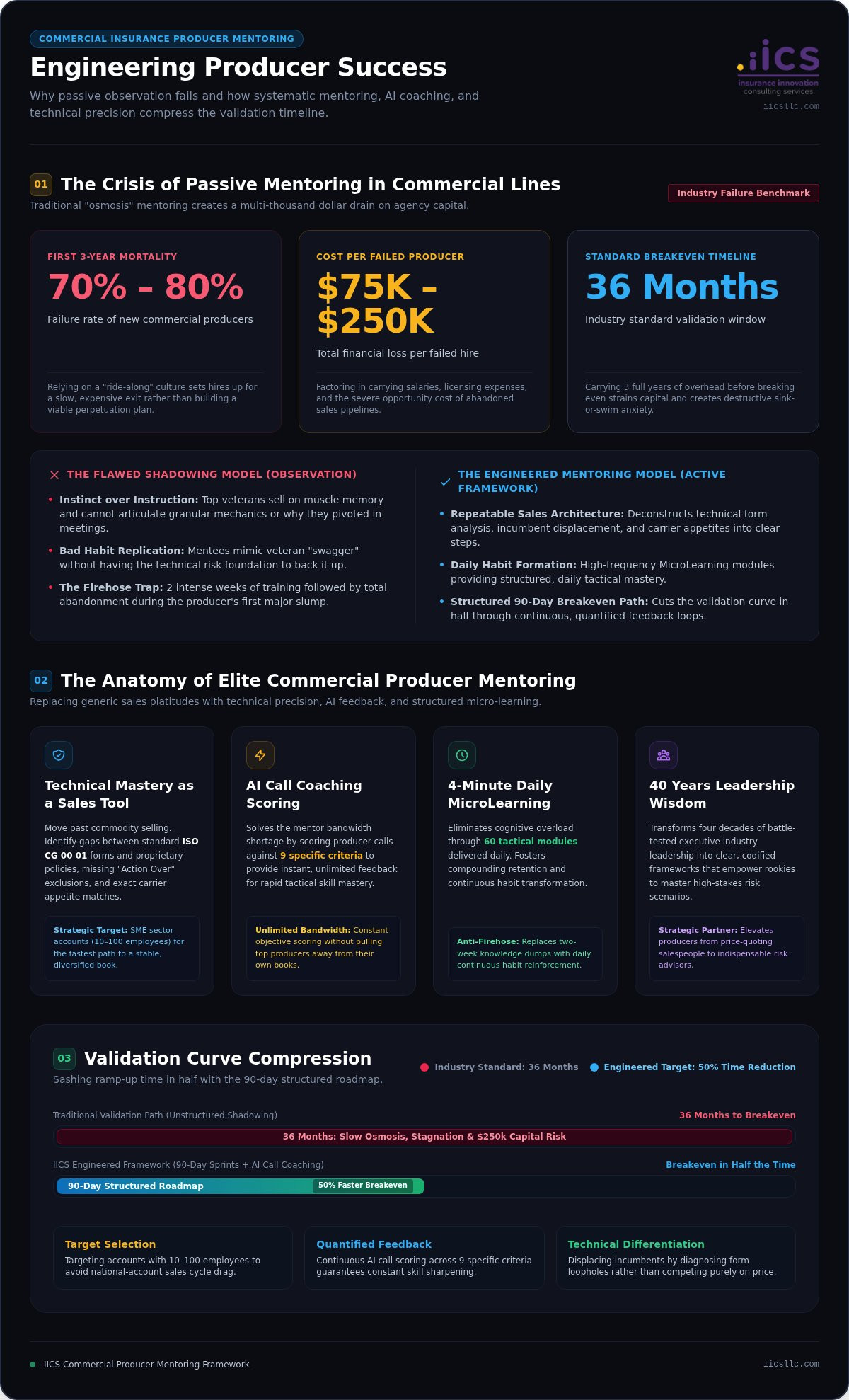
Most agencies accept an 80% failure rate for new hires as the unavoidable cost of doing business. They hire a producer, sit them next to a veteran who's too busy to talk, and pray they'll absorb success by osmosis. It's a $250,000 gamble that rarely pays off. If you're tired of watching six-figure investments walk out the door after two years of stagnation, it's time to realize that traditional commercial insurance producer mentoring is dead. Elite performance isn't caught; it's engineered through a systematic process.
You likely agree that the industry standard 36-month validation timeline is a massive drain on your agency's capital. It's frustrating to see talent wither because your best mentors simply don't have the bandwidth to teach. This guide promises to deliver the battle-tested strategies required to slash ramp-up time in half and build a high-performance book of business. We'll preview the 90-day framework that combines AI call coaching with 40 years of executive leadership to transform your team into a disciplined, revenue-generating machine that masters complex risk scenarios with ease.
Table of Contents
The Crisis of Passive Mentoring in Commercial Lines
Stop pretending that proximity equals proficiency. Most agencies rely on a "ride-along" culture that sets new hires up for a slow, expensive exit. Leading industry benchmarks reveal a grim reality: 70% to 80% of new commercial producers fail within their first three years. This isn't a talent problem; it's a structural one. Traditional commercial insurance producer mentoring often consists of a new hire watching a veteran work, hoping they'll somehow catch the magic. But top producers usually make the worst mentors. They sell on instinct and decades of muscle memory. They're too busy managing their own books to provide the granular, tactical feedback a rookie needs to survive. Without a framework, they can't explain why they pivoted in a meeting or how they identified a specific risk gap. When a veteran says, "Just watch how I do it," they're inadvertently setting a trap, because they can't articulate the decades of nuance that dictates their every move.
The 'Shadowing' Trap: Why Observation is Not Education
Passive observation is the most expensive way to train. When a new producer shadows a veteran, they see the result, but they miss the mechanics. They don't see the hours of research, the technical form analysis, or the subtle psychological cues used to displace an incumbent agent. This lack of depth leads to bad habit replication. The junior producer mimics the veteran's "swagger" without having the technical foundation to back it up. Without formal mentorship structures that demand active, tactical engagement, the mentee remains a spectator. They aren't learning to hunt; they're just watching someone else eat. Effective development requires moving beyond "watching" into a repeatable sales system, like the one found inside the academy. If your training relies on osmosis, don't be surprised when your ROI evaporates.
Calculating the Real Cost of Non-Producing Hires
The Anatomy of Elite Commercial Insurance Producer Mentoring
Elite commercial insurance producer mentoring demands a shift from generic sales platitudes to technical precision. Most training programs focus on "closing" without teaching the producer what they're actually closing. If you can't explain the gap between an ISO CG 00 01 and a custom proprietary form, you aren't a risk advisor; you're a commodity. According to this Bureau of Labor Statistics overview of insurance sales agents, specialized knowledge is a core component of the professional landscape. Elite mentors focus on the small-to-medium enterprise (SME) sector because it offers the fastest path to a stable, diversified book. SME accounts with 10 to 100 employees provide the perfect training ground for mastering complex risk without the glacial sales cycles of national accounts.
Technical Mastery as a Sales Tool
Understanding carrier appetite is your greatest competitive advantage. A producer who knows exactly which carrier wants a specific class of business saves weeks of frustration. Effective commercial insurance producer mentoring must bridge the gap between academic theory and the legal impact of state and municipal nuances. Can your producer identify a missing "Action Over" exclusion in a construction policy? That knowledge displaces incumbent agents faster than a lower premium ever will. It's about precision. It's about being the smartest person in the room when high-stakes risk is on the table. When a producer understands the legal nuances of their specific territory, they transition from a salesperson to a strategic partner.
Micro-Learning: The 4-Minute Daily Edge
Most agencies try the "firehose" method. They drown the new hire in two weeks of intense training and then wonder why they're lost by day thirty. Habit formation requires a different rhythm. Elite mentoring utilizes MicroLearning, specifically 60 tactical modules delivered in bite-sized, four-minute videos. This creates a repeatable daily discipline. Instead of overwhelming the brain, you build skill retention one layer at a time. This methodical approach is exactly what we teach inside the Sales Academy to ensure every module translates into a real-world win. You don't build an elite book of business in a weekend. You build it through 90 days of relentless, incremental improvement.
Integrating AI Sales Coaching with Veteran Mentorship
Traditional commercial insurance producer mentoring often suffers from what we call the "delayed autopsy." You record a sales call on Monday, but your mentor doesn't review it until the following Friday. By then, the prospect has moved on, the details are fuzzy, and the opportunity for a course correction is dead. Elite performance requires a faster feedback loop. While a human mentor is limited by the hours in a day, AI provides a relentless, objective mirror for every interaction. It transforms the coaching process from a subjective opinion into a data-driven discipline, ensuring that every minute spent on the phone contributes to the producer's technical mastery.
The AI Sales Coach: Data-Driven Precision
Our proprietary AI coaching system scores calls against nine specific criteria, ranging from active listening to the precision of technical risk explanations. It doesn't just listen; it analyzes tone, pacing, and the use of plain language to demystify complex P&C concepts. This level of granularity aligns with Harvard Business Review's framework for sales coaching, which emphasizes that generalized, one-size-fits-all training is a recipe for mediocrity. AI allows producers to engage in unlimited role-play sessions with instant scoring. This builds a layer of data-backed confidence that effectively eliminates call anxiety. When a producer knows their talk-to-listen ratio is optimized and their objection handling is sharp, they walk into high-stakes meetings with an entirely different presence.
The Veteran Mentor: Strategic Wisdom
Data is powerful, but it lacks context. This is where the veteran mentor steps in to interpret the AI's findings and apply 40 years of high-level leadership. While the AI identifies that a producer struggled with an objection, a mentor like Ralph Blust explains the "why" behind it. Navigating the classic "I'm happy with my current agent" response requires more than a script; it requires the strategic nuance to uncover hidden dissatisfaction in a prospect's current coverage. The mentor uses the AI's data as a baseline to coach on enterprise-level personal branding and complex closing scenarios. This synergy ensures that the producer isn't just a polished talker, but a sophisticated risk advisor. You can see how this combination of technology and experience functions inside the academy, where we bridge the gap between digital precision and human intuition. It's the difference between a producer who merely survives and one who dominates their niche.
The 90-Day Roadmap to Producer Breakeven
Validation isn't a three-year journey. It's a 90-day sprint. Most agencies allow new hires to wander aimlessly for months, but elite commercial insurance producer mentoring demands immediate, structured activity. If you aren't tracking success through a "Suspect List" categorized by hard effective dates, you aren't building a book; you're just hoping for a miracle. Our framework compresses the traditional three-year learning curve into three distinct trimesters of tactical execution. We focus on the engine of growth: generating 100 expiration-date leads per month and initiating outreach exactly 60 to 90 days prior to policy renewal.
Phase 1: Weaponizing the Basics
Month one is about building the machine. We move past the abstract and into the "window trigger map." This identifies the critical 30 to 60-day renewal buying window where incumbents are most vulnerable. Producers must master the first-call basics to qualify accounts in minutes, not hours. By focusing on a high-volume suspect list based on hard expiration dates, the producer builds a pipeline that is mathematically guaranteed to provide opportunities. You don't need a 30-year veteran to teach this. You need a repeatable system that demands the generation of those first 100 leads within the first thirty days. This discipline creates the momentum required to survive the initial grind.
Phase 2: Mastering the Pivot
By month two, the focus shifts to the "pivot." This is where the producer learns to respond to the top eight industry-standard objections with surgical precision. Most rookies fold when they hear, "I'm happy with my current agent." Elite mentoring teaches them to use AI-assisted industry insights to sound like a 20-year veteran on day one. We transition the producer from a "rate-checker" to a "risk-consultant." Instead of asking for a dec page to save ten percent, they learn to ask risk-focused questions that expose coverage gaps. This is where the technical mastery discussed earlier becomes a lethal sales tool. By month three, the producer is navigating complex selling scenarios and managing a pipeline that closes three to five new accounts every single month.
Stop waiting years for your producers to pay for themselves. You can enroll your next hire in the Sales Academy and start the 90-day clock to profitability today.
The IICS Sales Academy: Where Mentoring Becomes Mastery
Elite P&C producers aren't born with an innate gift for risk assessment. They're built through a rigorous, uncompromising process. Most agencies hope for a "natural" salesperson, but hope is a failing strategy in a bifurcated soft market. True commercial insurance producer mentoring requires a transition from passive observation to a structured system of mastery. At IICS, we've proven that formal training doesn't just improve performance; it doubles the likelihood of a new hire reaching top-producer status. By replacing the traditional three-year "wait and see" approach with a 90-day intensive framework, we ensure your agency's capital is an investment, not a sunk cost.
A Track Record of Elite Performance
The IICS Sales Academy isn't based on theoretical sales models. It's built on a 40-year track record of continuous growth and development across the country. Our founder, Ralph J. Blust, has led organizations through $100MM GWP growth and held national leadership roles at industry-defining firms like Pathpoint and National Flood Services. This curriculum mirrors the tactics used by real-world, high-growth entities to dominate their niches. We don't just teach producers how to sell; we teach them how to think like a Chief Revenue Officer. You can learn more about the IICS mission and our history of transforming the industry's talent landscape.
Joining the Ranks of the Elite
What should you expect inside the 90-day intensive system? It's a high-stakes environment designed to break bad habits and install a repeatable sales engine. Every trimester starts on the 1st of the month, delivering 60 tactical MicroLearning modules alongside 1:1 call coaching directly with Ralph Blust. This isn't a passive course. It's a results-driven program where producers are scored against nine critical criteria. For agencies ready to scale their team's performance, we're offering a 50% discount on retail tuition using the code "Summer2026". This reduces the monthly investment from $3,000 to $1,500 per student with no hidden fees or upsells. It's time to stop gambling on unvalidated payroll and start building a high-performance book. Take the first step toward agency-wide excellence and see inside the Sales Academy today.
Engineering the Future of Your Agency
The era of allowing new producers to "find their way" through passive observation is over. You've seen the evidence: agents achieve 52% higher sales through formal training compared to those left to wander. By integrating AI-driven scoring across nine specific criteria with 40+ years of P&C leadership, you move from a culture of hope to a culture of precision. Elite commercial insurance producer mentoring is the only way to ensure your next hire hits breakeven in half the industry norm time. It's a strategic necessity in a market that no longer rewards mediocrity.
Don't let your agency's capital become another casualty of the industry's 70% failure rate. It's time to install a repeatable sales system that masters complex risk scenarios and drives consistent growth. Apply for the IICS Sales Academy and use code Summer2026 for 50% off retail tuition to secure your spot in the next 90-day trimester. The future of your agency depends on the standards you set today. Choose the path of disciplined, elite performance and watch your book of business transform.
Frequently Asked Questions
What is the difference between insurance coaching and mentoring?
Coaching is tactical and results-driven, focusing on specific skills like objection handling, while mentoring provides long-term strategic guidance. Elite commercial insurance producer mentoring at IICS blends both by pairing daily micro-learning with veteran leadership. This dual approach ensures that producers don't just learn "how" to sell, but also understand the "why" behind complex risk decisions. It's the difference between a one-off tip and a lifelong career foundation.
How long does it take for a commercial producer to become profitable?
Industry benchmarks suggest a 36-month validation period, but a structured framework can slash this in half. Most agencies carry non-producing payroll for far too long because they lack a 90-day roadmap. By focusing on SME accounts and generating 100 leads per month based on hard expiration dates, producers reach breakeven significantly faster. It turns a three-year gamble into a three-month sprint toward profitability and a high-performance book of business.
Can AI really help with insurance sales coaching?
AI provides the unlimited, objective feedback that human mentors simply don't have the hours to deliver. Our proprietary system scores every call against nine specific criteria, identifying subtle issues in tone, pacing, and technical accuracy. This allows producers to practice in private and build data-backed confidence before facing a prospect. It eliminates the "delayed autopsy" of weekly reviews, providing the real-time correction necessary for elite skill retention.
What are the most common reasons new insurance producers fail?
Failure rates hit 70% to 80% when agencies rely on passive shadowing instead of a structured sales system. New hires often fail because they lack technical P&C mastery and receive inconsistent feedback. Without a clear 90-day plan, producers struggle to navigate the "I'm happy with my current agent" objection or identify coverage gaps. Most hires don't lack talent; they lack the disciplined framework required to survive the initial commercial sales grind.
Is 1-on-1 mentoring better than group workshops for P&C agents?
Neither is a silver bullet on its own; elite performance requires a hybrid approach. 1-on-1 mentoring provides the strategic nuance needed for high-stakes enterprise accounts, while group workshops foster peer accountability and shared market insights. Our academy combines both, ensuring producers receive personalized feedback from veterans like Ralph Blust alongside the energy of a weekly live workshop. This balance prevents the isolation that often leads to producer burnout in the first year.
How do I measure the ROI of producer mentoring?
Measure ROI by comparing the cost of the program against the reduction in unvalidated producer payroll. Formally trained agents achieve 52% higher sales and a 31% increase in new clients compared to unguided hires. Additionally, a 53% increase in lead-to-prospect conversion rates provides a direct lift to agency revenue. When you factor in the $250,000 cost of a failed hire, the return on a structured development system is immediate and substantial.
What should be included in a 90-day producer development plan?
A robust plan must include 60 tactical modules delivered as daily micro-learning to ensure habit formation. It should focus on building a "Suspect List" by hard expiration dates and mastering the 60 to 90-day renewal buying window. The roadmap must transition from foundational sales skills in month one to advanced technical mastery and objection handling by month three. This structure ensures the producer is always focused on revenue-generating activities.
How does the IICS Sales Academy differ from generic sales training?
Generic training ignores the technical complexity of Property and Casualty risk. The IICS Sales Academy is built exclusively for P&C agents by a veteran with 40 years of industry leadership. We utilize AI call coaching and focus on granular details like ISO vs. custom forms, which generic programs miss. This specialized commercial insurance producer mentoring ensures graduates don't just sound like salespeople; they function as sophisticated risk advisors for their clients.