Commercial Insurance Prospecting Letters: Write Messages That Open Doors
A prospecting letter earns attention by showing why it matters to the business before asking for a conversation. That’s the difference between commercial insurance prospecting letters that open doors and generic outreach that gets ignored. A broad pitch can weaken your credibility; a specific, accurate observation about a prospect’s operations gives them a useful reason to keep reading.
Knowing you should personalize a message is one thing. The harder part is connecting a company’s business context to a relevant insurance conversation, then following up consistently without leading with a quote request. The strongest letters are concise, professional, and focused on the prospect’s needs.
This guide explains how to write specific messages, use examples to make your point, and offer a clear next step without pitching prematurely. You’ll also learn how to build a repeatable prospecting rhythm around policy effective dates, starting outreach 60 to 90 days before expiration and recognizing that the renewal buying window typically falls 30 to 60 days out. The goal is a stronger letter and a more disciplined commercial P&C sales process.
Table of Contents
Why Commercial Insurance Prospecting Letters Still Need a Clear Point
Build a Commercial Insurance Prospecting Letter That Earns a Reply
Commercial Insurance Prospecting Letter Examples for Different Situations
Time, Personalize, and Follow Up on Commercial Prospecting Letters
Turn Better Prospecting Letters Into a Repeatable Producer Skill
Why Commercial Insurance Prospecting Letters Still Need a Clear Point
A business decision-maker doesn’t owe a producer their attention. A letter has to earn it. Commercial insurance prospecting letters are first-contact messages from commercial property and casualty (P&C) producers to business decision-makers. Their purpose is to show why a conversation could be useful, not to sell a policy before the producer understands the operation.
A prospecting letter is different from a quote, which presents terms for a specific insurance need, and a service notice, which shares information about an existing relationship or policy. A first-contact letter shouldn’t imply that you’ve reviewed the recipient’s coverage, found a gap, or determined what protection is appropriate. Instead, establish a credible reason to talk and let the recipient decide whether the discussion is worthwhile.
What a commercial insurance prospecting letter should accomplish
Give the recipient one clear reason the message may be relevant. It could connect to the business’s operations, a change in its work, or a genuine introduction through a shared business contact. Specificity signals preparation, but it doesn’t require pretending to know the prospect’s insurance program.
For example, a producer writing to a contractor could refer to the types of projects the company performs and ask whether its risk-management priorities have changed as its work has grown. The producer isn’t claiming the contractor lacks coverage. The message connects business context to a reasonable question.
Then ask for one proportionate next step, such as a brief introductory conversation. Don’t demand an application, request confidential documents, or push for a quote before the prospect has expressed interest. The first letter opens a door; it isn’t a full sales presentation.
Why generic insurance sales letters get ignored
Letters aren’t outdated by default. Irrelevant letters are. A message that starts with your products, experience, or promise to “save money” asks the reader to care before giving them a reason. Broad claims can sound interchangeable, while dense insurance jargon and long introductions make the recipient work to find the point.
Lead with the prospect’s business context, then explain why it prompted you to reach out. Keep the language plain and the focus narrow. A manufacturer, contractor, and professional services firm may have different operational questions; one generic pitch cannot credibly address them all. If you can’t explain why this particular business should care, revise the letter before sending it.
A prospecting letter is an invitation to discuss business risk, not a coverage guarantee. That distinction protects your credibility and keeps the message honest. You’re demonstrating informed curiosity, not diagnosing an insurance program you haven’t reviewed.
Commercial producers write to owners, executives, finance leaders, and others involved in business decisions, not personal-lines consumers shopping for individual policies. Respect their time. Make the purpose obvious, show sound judgment, and leave room for a real conversation to begin.
Build a Commercial Insurance Prospecting Letter That Earns a Reply
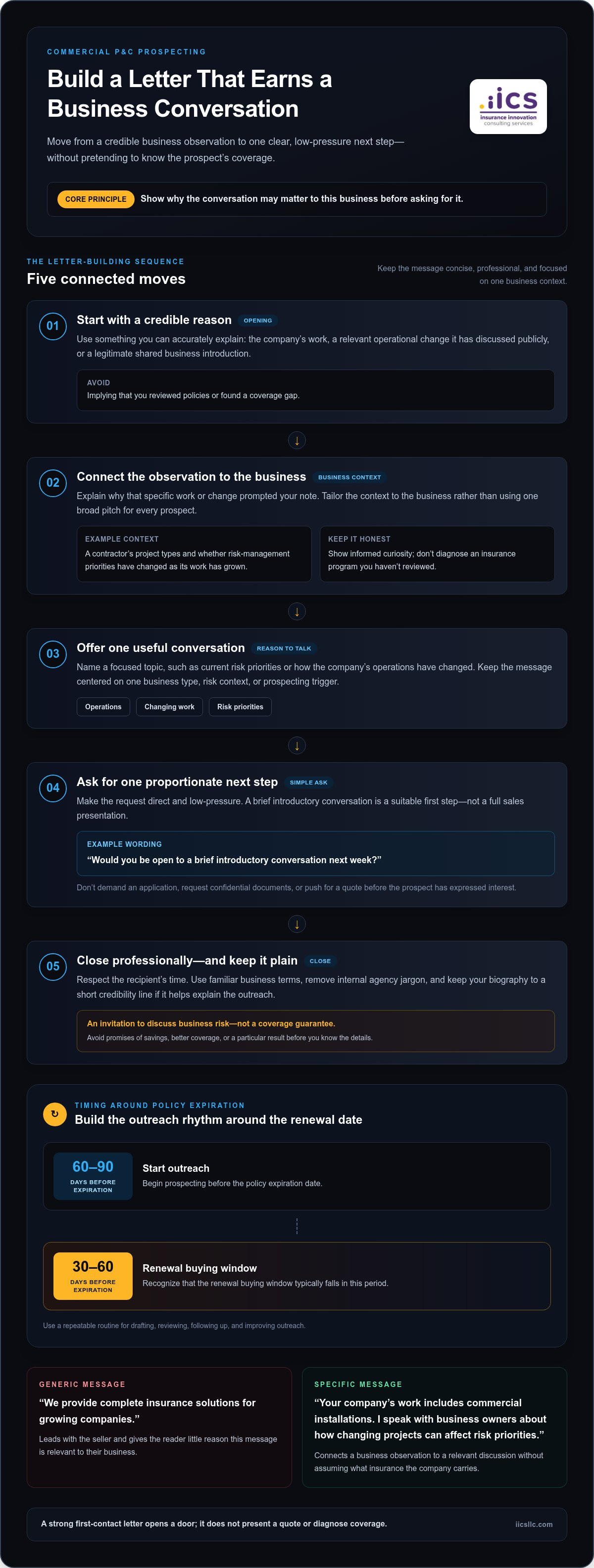
A strong letter makes a short case for why a conversation may be useful to this specific business. Build it in order: open with a credible reason for reaching out, connect that reason to the recipient’s business, suggest a focused topic, ask for one simple next step, and close professionally. Keep the message centered on one business type, risk context, or prospecting trigger. Trying to cover every line of insurance weakens your point.
Open with a specific, credible reason for reaching out
Start with something you can accurately explain, such as a shared business introduction, the kind of work the company performs, or a relevant operational change the prospect has discussed publicly. Then connect that fact to a conversation you could have. Don’t imply that you’ve reviewed the company’s policies or identified a coverage gap. You’re opening a discussion, not presenting a diagnosis.
For example, instead of writing, “We provide complete insurance solutions for growing companies,” you might say: “I’m reaching out because your company’s work includes commercial installations. I speak with business owners about how changing projects can affect risk priorities.” This is specific without assuming what insurance the business carries.
Make the offer and call to action easy to understand
Offer one useful conversation, such as discussing current risk priorities or how the company’s operations have changed. Keep the ask direct and low-pressure: “Would you be open to a brief introductory conversation next week?” Avoid promising savings, better coverage, or a particular result. Those claims depend on details you don’t yet have.
Plain language also shows respect for the reader’s time. Use familiar business terms, remove internal agency jargon, and keep your biography to a short credibility line if it helps explain why you’re contacting them. Producers can also develop these conversations through structured commercial sales training and coaching.
Use this framework to draft a first-contact letter:
Opening: “I’m reaching out because [factual business observation or legitimate introduction].”
Business context: “Businesses involved in [specific operation or work type] may want to consider how [relevant risk context] affects their priorities.”
Reason to talk: “I’d welcome a conversation about how your operations and risk priorities are evolving.”
Next step: “Would you be open to a brief introductory call?”
Close: “Thank you for your time, [Producer name, role, and contact details].”
Replace every bracket with accurate information, and remove any line you can’t support. Before sending, check that the letter makes one relevant point, doesn’t imply knowledge of the prospect’s coverage, and asks for a conversation rather than a policy commitment. If the recipient can’t quickly tell why you wrote, sharpen the opening.
Commercial Insurance Prospecting Letter Examples for Different Situations
The right message depends on why you’re reaching out. A new introduction needs a credible connection, renewal-window outreach needs respectful timing, and a post-conversation note should accurately reflect what was discussed. The structure can stay familiar, but the trigger, business context, and next step must fit the recipient. These commercial insurance prospecting letters use placeholders you can adapt without inventing details or assuming what coverage a business has.
Example 1: A legitimate business introduction
Trigger: A mutual business contact introduces you to a company owner. Focus: Establish the connection and suggest a relevant topic. Next step: Request a brief introductory conversation.
“Hello [Name], [Mutual contact] suggested I introduce myself. I work with businesses in [business type] and am interested in how changes in [relevant operation or business priority] shape risk discussions. I don’t know your current insurance arrangements, but I’d welcome a brief conversation to learn about your priorities and share perspectives relevant to your operations. Would [day or time option] work for an introduction? Regards, [Producer name and contact details].”
The introduction gives the recipient a clear reason for the contact. Describe the mutual contact’s role accurately, and don’t suggest they endorsed your services unless they did.
Example 2: Outreach before a policy expiration
Trigger: A known policy expiration date creates a timely reason to reach out. Focus: Invite a conversation about changing operations and risk priorities. Next step: Ask whether the prospect is open to an introductory discussion.
Plan renewal-related outreach 60 to 90 days before policy expiration. Treat the date as a scheduling cue, not evidence of a coverage problem or a reason to promise better terms.
“Hello [Name], I understand [business name]’s policy is due to renew around [expiration date]. I’m reaching out ahead of that date to introduce myself and ask whether your business priorities or operations have changed since the last renewal. If a conversation about your current risk priorities would be useful, would you be open to a brief introduction? Regards, [Producer name and contact details].”
Example 3: Follow-up after a business conversation
Trigger: You spoke with the prospect and agreed on a follow-up. Focus: Refer to the specific topic discussed. Next step: Suggest the agreed action without portraying interest as a commitment.
“Hello [Name], thank you for speaking with me about [topic discussed]. As agreed, I’m sending a note so we can continue the conversation about [specific question or business change]. Would [proposed next step] still be useful? If your priorities have shifted, I’m happy to follow your lead. Regards, [Producer name and contact details].”
Keep the framework, change the evidence
A template is a starting structure, not a substitute for prospect research. Change the recipient-specific facts, reason for contact, and requested next step; retain a clear opening, focused message, professional close, and restrained tone. Avoid language meant for active client service, such as confirming a policy has been reviewed, discussing binding instructions, or reporting coverage decisions. Those statements imply a relationship or work that hasn’t occurred. Before sending, check every reference against what you actually know and what the prospect actually said.
Time, Personalize, and Follow Up on Commercial Prospecting Letters
A relevant letter sent at the wrong point can miss its opportunity. For renewal-related outreach, plan to contact a prospect 60 to 90 days before policy expiration. This gives you time to introduce a useful conversation before the renewal buying window, which typically falls 30 to 60 days before expiration. These ranges serve different purposes: the first is an outreach planning window; the second is the prospect’s likely buying period. Neither is a reason to assume the business has a coverage problem.
Effective dates are useful planning cues, not evidence of a gap or an invitation to make promises about pricing or coverage. If you don’t know the date, don’t imply that you do. Base the message on a verified business context instead.
Create a practical follow-up rhythm
A letter without a next action is easy to forget. Track your outreach in a producer-owned list, spreadsheet, or existing workflow. Record the sent date, prospect, policy effective date if known, response, and next action. Set a specific next-touch date when you send the letter. This turns follow-up from a memory test into a repeatable habit.
Let the prospect’s response guide what happens next. If they ask you to reconnect later, note the timing and respect it. If they decline or state a contact preference, record it and act accordingly. If there’s no response, use a measured follow-up that adds context rather than repeating the same message. Review results by conversations held and qualified next steps, not just letters sent. Activity matters, but progress matters more.
Personalize responsibly and review compliance
Use accurate, relevant business details: the prospect’s stated operations, a legitimate introduction, or a timely event you can verify. Avoid sensitive assumptions and unsupported claims about their policies, claims history, or risk controls. A focused observation shows preparation; invented familiarity damages trust.
Keep the communication channel in view. Direct mail and email may raise different requirements, and applicable federal and state rules can change. Before starting or adjusting a campaign, have current solicitation, privacy, and email requirements reviewed by the appropriate compliance or legal resource for your organization. Don’t rely on a blanket rule or assume that practices acceptable for a mailed letter automatically apply to an email. Follow your organization’s review process and honor a prospect’s stated preferences.
Use your tracking process to improve the work, too. Note which business contexts lead to substantive conversations, where prospects disengage, and whether your next steps are clear. Then refine the message and rehearse the follow-up conversation as part of consistent producer development. IICS offers producer development and training to help strengthen the skills and habits behind disciplined commercial prospecting.
Turn Better Prospecting Letters Into a Repeatable Producer Skill
A strong letter isn’t a one-off writing exercise. It reflects several producer skills working together: researching a business, identifying a relevant risk conversation, communicating clearly, and following through. Producers improve when they practice the full sequence, review what they wrote, and use responses to refine their approach. The objective isn’t to send more words. It’s to make each contact more purposeful.
Practice letters as part of a complete sales conversation
Use a letter to set the context for a first conversation, not to script the call. The message can explain why you’re reaching out and identify a business issue worth exploring. If the prospect responds, ask open questions about operations, priorities, and changes rather than repeating the letter aloud or jumping straight to a product pitch.
Build a simple practice loop: draft a letter for a specific business type, review it with a manager or coach, send it through the appropriate process, then assess the response and next step. Ask whether the opening is factual, the reason for contact is clear, and the requested action is easy to understand. Feedback can reveal vague phrasing or assumptions that are hard to catch when you review your own work.
That practice develops more than writing. Strong prospect research helps you choose relevant context; risk-focused questions turn an initial response into a useful discussion; disciplined follow-up keeps the conversation from disappearing from view. The IICS 90-day Sales Academy curriculum combines producer development with consistent practice and coaching.
Build consistency through structured producer development
Commercial insurance prospecting letters become more effective when producers have a repeatable way to draft, review, and learn from them. IICS develops commercial P&C producers through training and producer development. The Sales Academy is a 90-day development system with 60 tactical micro-learning modules, unlimited AI call coaching, 1:1 mentoring, and weekly group workshops.
These elements support a practical rhythm: learn a skill, apply it to a real prospecting task, receive feedback, and carry the learning into the next conversation. For example, a producer might refine a letter’s opening, then practice asking a clear follow-up question during a call. The aim is stronger judgment and consistency, not a guaranteed sales result.
The program draws on IICS leadership experience, including founder Ralph J. Blust’s more than 40 years of insurance industry leadership. Experience informs development; it doesn’t replace the producer’s preparation, effort, or responsibility to tailor communication to each prospect.
For agency leaders and producers, the IICS Sales Academy offers a structured way to develop commercial P&C prospecting skills.
Make Your Next Prospecting Conversation Count
Your next letter is a chance to build a stronger sales habit, not just fill another line on a prospecting list. Choose one business, identify a relevant reason to reach out, and use the response, or lack of one, to sharpen your next move. That’s how commercial insurance prospecting letters become part of deliberate producer practice instead of isolated bursts of activity.
For producers and agency leaders, the bigger opportunity is creating a consistent environment for improvement. IICS supports commercial P&C development through the Sales Academy, where daily micro-learning, AI call coaching, mentoring, and weekly workshops help producers practice and strengthen core sales skills. Founder Ralph J. Blust brings more than 40 years of insurance industry leadership experience to that work.
Build the skill through focused practice and coaching, then bring that discipline to every conversation. Explore the IICS Sales Academy and take the next step toward more consistent commercial P&C producer development.
Frequently Asked Questions
How long should a commercial insurance prospecting letter be?
A commercial insurance prospecting letter should be brief enough to read quickly, often about one page. There’s no magic word count; make every sentence earn its place. Keep the opening focused on the recipient, explain one reason a conversation could be useful, and make the next step easy to spot. If the reader has to search through your biography or a list of services to find the point, cut and revise.
Should a prospecting letter go to a business owner, CFO, or risk manager?
Address the person whose role best fits the topic and the business’s decision process. An owner may be the right contact at a smaller company, while a CFO may oversee financial decisions and a risk manager may coordinate risk matters. Verify the recipient’s name and role through reliable business information or a legitimate introduction. If responsibilities are unclear, keep your first message respectful and ask who handles the relevant discussion.
Is direct mail or email better for commercial insurance prospecting?
Neither channel is automatically better; choose based on what’s appropriate for the relationship, the recipient’s known preferences, and your agency’s process. A mailed letter can provide a formal introduction, while email can make a short exchange easier. Keep the message relevant in either format, and don’t assume that rules for one channel apply to the other. Have current requirements reviewed before sending, especially for email campaigns.
Can an insurance producer prospect a business that already has an agent?
Yes, a business having an agent doesn’t prevent a producer from making a professional introduction. Don’t criticize the incumbent or imply the business is poorly protected. Focus on whether the decision-maker would value another perspective on a business change or risk priority. If the prospect isn’t interested, respect that response. Any outreach should follow applicable requirements and your agency’s standards for solicitation and prospect contact.
Should a commercial insurance prospecting letter include a quote?
Usually, no. A quote depends on information about the business, its exposures, and underwriting considerations that a first-contact letter typically won’t establish. Including a speculative price or coverage comparison can create a misleading impression. Instead, explain the topic you’d like to discuss and invite the prospect to decide whether a conversation makes sense. Move toward quoting only after the prospect expresses interest and provides the information needed for that process.
What should a producer do after sending a prospecting letter?
Record the outreach and choose a specific next action instead of treating delivery as the finish line. If the prospect replies, respond to the point they raised and prepare a focused follow-up question. If there’s no reply, consider one thoughtful follow-up that adds a relevant angle rather than repeating the original pitch. Stop or adjust contact when the prospect requests it, and use the outcome to improve future outreach.
How can a producer personalize a letter when little business information is available?
Personalize only with facts you can verify. Use the correct business name, a confirmed role, and a reliable description of the company’s work, then ask an open question rather than pretending to know its risks. For instance, you might ask whether the company’s operations or priorities have changed. If you can’t identify a credible reason for contact, do more research or wait instead of filling gaps with assumptions.