Converting Leads into Insurance Clients: The Elite Commercial Producer Playbook
Updated: Oct 6
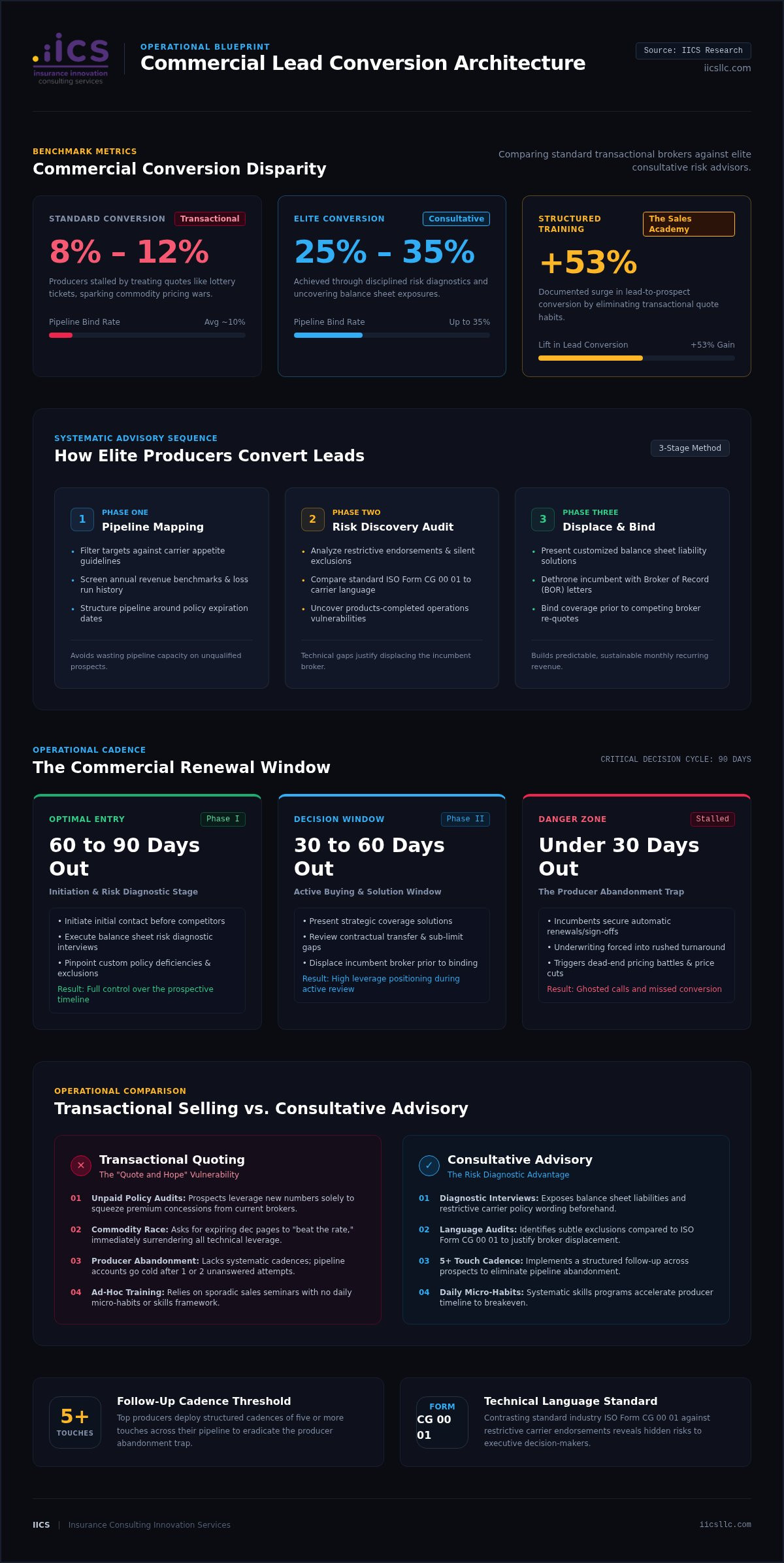
While the standard commercial conversion rate stalls between 8% and 12%, elite producers consistently bind 25% to 35% of their prospect pipeline. The difference isn't raw lead volume; it is execution discipline. You already know the frustration of watching qualified prospects vanish the moment you deliver an initial quote, or grinding through dead-end pricing battles against entrenched incumbents. Acting as an unpaid quote dispenser is a losing strategy. Successfully converting leads into insurance clients demands a structured diagnostic approach that exposes critical coverage gaps and makes commoditized pricing races irrelevant.
You will master a battle-tested, consultative framework designed to double your conversion rates from first discovery call to bound policy. We'll examine the operational habits, renewal trigger tracking systems, and technical coverage analyses top commercial producers rely on to displace competitors, win Broker of Record letters, and build predictable monthly revenue.
Table of Contents
The Commercial Lead Conversion Bottleneck: Why Most Quotes Stall
How to Convert Leads into Commercial Insurance Clients: A 3-Phase Guide
Evaluating Conversion Strategies: Transactional Selling vs. Consultative Advisory
Daily Disciplines and Modern Tools That Multiply Conversion Rates
Accelerating Producer Conversion Mastery: The Structured Development Solution
The Commercial Lead Conversion Bottleneck: Why Most Quotes Stall
Commercial lead conversion isn't about collecting loss runs or slinging certificates. It is the disciplined discipline of converting leads into insurance clients by taking raw inquiries and binding comprehensive, profitable policies. Yet most producers watch viable commercial accounts slip through their fingers. Why? Because they mistake quoting for selling.
Relying on "quote and hope" tactics positions business insurance as an interchangeable commodity. When you ask for expiring declaration pages to see if you can "beat the rate," you forfeit your leverage. You instantly force yourself into a pricing war against an incumbent carrier that already holds the relationship. Winning commercial accounts demands uncovering hidden balance sheet exposures during your earliest interactions. If a business owner only views you as an estimator, they will gladly drop your proposal the second their current agent matches the price.
The Trap of Transactional Quoting vs. Risk Advisory
Matching declarations pages guarantees low closing ratios. Rate-checking prospects routinely use rookie producers for unpaid policy audits, leveraging new numbers solely to squeeze concessions from their existing broker. You do the heavy underwriting lifting; the incumbent gets the commission renewal.
Breaking this cycle requires replacing transactional estimation with risk discovery. Producers who complete structured skills programs, like The Sales Academy, achieve a 53% increase in lead-to-prospect conversion precisely because they stop quoting down to the penny and start diagnosing operational exposure.
The Mechanics of the Commercial Renewal Window
Timing dictates leverage. Commercial buyers operate within a tight 30-to-60-day renewal buying window where real policy decisions happen. If you pitch a business owner outside this critical frame, your message falls on deaf ears. If you wait until 15 days prior to expiration, the incumbent has already initiated auto-renewals or secured executive sign-off.
Elite commercial outreach follows a strict operational timeline:
60 to 90 Days Out: Initiate contact, conduct balance sheet risk diagnostic interviews, and identify custom policy deficiencies.
30 to 60 Days Out: Present strategic coverage solutions during the prospect's active decision window, displacing the incumbent before binding occurs.
Under 30 Days Out: Expect stalled decisions. Outreach launched inside 30 days forces rushed underwriting and leads directly to ghosted calls.
Missing this cadence is the silent killer of your pipeline. When producers track renewal dates accurately, converting leads into insurance clients shifts from a chaotic guessing game into a predictable advisory process.
How to Convert Leads into Commercial Insurance Clients: A 3-Phase Guide
Elite producers never rush to deliver rate indications. They recognize that sprinting to produce numbers signals desperation, instantly commoditizing their value. High-performing advisors follow an intentional, multi-stage trajectory designed to dismantle the incumbent broker's relationship. Mastering this consultative sequence is the secret to converting leads into insurance clients with consistency and precision.
Phase 1: Pipeline Mapping and Strategic Qualification
Top producers filter targets upfront against strict carrier appetites, annual revenue benchmarks, and loss run histories. Don't waste energy on accounts outside your sweet spot. Organize your active pipeline strictly around target policy expiration dates rather than random contact times. Applying proven advanced commercial insurance sales techniques during initial qualification calls ensures you invest time exclusively into buyers willing to engage on an advisory level.
Phase 2: The Comprehensive Technical Risk Discovery Audit
True differentiation happens deep inside policy wording, not on an executive summary comparison sheet. Audit the prospect's active program to pinpoint restrictive endorsements, silent exclusions, and sub-limits that leave them exposed. For instance, contrast standard industry wording like ISO Form CG 00 01 against restrictive, proprietary carrier language that guts essential coverage. Identifying form deficiencies uncovers exposure that justifies switching agents. Walk decision-makers through practical gaps in products-completed operations, contractual liability transfer agreements, and misaligned payroll classifications. Once a CFO realizes their balance sheet is vulnerable, premium price differences become trivial.
Phase 3: Differentiated Presentation and Binding the Account
Deliver an executive proposal structured around comprehensive risk mitigation and balance sheet preservation. If your discovery revealed catastrophic coverage gaps that an incumbent ignored, leverage a Broker of Record (BOR) letter. A BOR allows you to take control of their preferred carrier lines immediately, displacing the incumbent without triggering a messy bidding circus. Secure binding commitments weeks before policy termination, locking competitors out of the renewal conversation entirely.
Refining these advisory instincts requires deliberate practice; agency teams looking to build disciplined diagnostic habits often look into The Sales Academy to transform their pipeline execution.
Evaluating Conversion Strategies: Transactional Selling vs. Consultative Advisory
Transactional selling creates a brutal race to the bottom. When you rely on premium undercutting to close accounts, you attract volatile buyers who will abandon your agency the moment another broker shaves off two percent. Agency profitability cannot survive on high policy churn. In contrast, consultative advisory selling establishes balance sheet stewardship that makes competitors irrelevant. Transforming your pipeline requires shifting your identity from an eager quote-gatherer to an indispensable corporate advisor.
Consultative Advisory vs. Spread-the-Market Quoting
Spread-the-market quoting burns operational capacity for minimal return. Producers spend dozens of hours gathering payroll records and property schedules across ten different carriers, only to lose on an obscure exclusion. This transactional grind exhausts your staff and erodes margins. Conversely, producers who execute a structured advisory methodology realize a 31% increase in new client acquisition over time.
The structural divergence between these two approaches is stark:
The Transactional Trap: Attracts price-sensitive buyers, relies on commoditized quoting platforms, and creates constant renewal anxiety as clients shop every year.
The Advisory Advantage: Audits operational risk exposures, commands higher average account commissions, and sustains multi-year retention rates above ninety percent.
Dismantling the "I Am Happy with My Current Agent" Objection
When a prospect says they are happy with their incumbent, they usually mean they are comfortable with inactivity. Don't attack their current broker. Criticizing a competitor insults the buyer's past decision-making and raises immediate defensive barriers. Instead, frame your involvement as an independent second opinion designed to verify risk controls.
Deploy precise diagnostic questions that test coverage integrity:
"When was the last time your agent audited your third-party vendor contracts to verify that your indemnification clauses match your actual liability exclusions?"
"Did your current broker structure your business interruption limits based on historical gross revenue or your actual post-loss operational continuity requirements?"
"Can you point to the specific endorsement in your policy that protects your balance sheet against supply chain failure?"
These questions shift the dynamic from a sales pitch to an objective business audit. By positioning yourself as a specialized risk consultant, converting leads into insurance clients becomes a natural outcome of balance sheet defense rather than high-pressure selling.
Daily Disciplines and Modern Tools That Multiply Conversion Rates
Microlearning and Consistent Daily Sales Habit Formation
Agency leaders often waste capital on exhausting, day-long sales bootcamps. Information overload sets in before lunch; producers revert to their comfortable bad habits within seventy-two hours. Durable behavioral transformation occurs through daily microlearning. Consuming structured two-to-four-minute tactical modules allows commercial agents to implement a single technique immediately on their morning discovery calls.
Sustainable performance relies on executing non-negotiable operational habits every single week:
Daily Trigger Pipeline Audits: Review suspect lists by expiration date every morning, initiating contact exclusively inside the 60-to-90-day window.
Objective Skill Calibration: Dedicate fifteen minutes daily to evaluating recent call recordings against structured benchmark rubrics.
Aligning these daily micro-disciplines with established insurance agency sales performance metrics replaces emotional guesswork with predictable agency growth.
Leveraging AI Call Coaching for Continuous Conversation Mastery
Ride-alongs and manual manager call reviews are difficult to scale. They leave producers with unchecked conversational blind spots that crater closing percentages. Modern agencies deploy AI sales coaching for insurance to analyze every live interaction against strict commercial sales benchmarks.
Objective automated systems evaluate calls across critical performance variables: discovery question depth, talk-to-listen ratios, objection handling mechanics, and explicit next-step commitments. Producers can practice realistic role-play scenarios against synthetic executive buyers, learning to dismantle gatekeeper resistance and evasive CFO stall tactics without burning actual market prospects. In parallel, enterprise sales execution platforms like CloseStrong empower sales teams to operationalize these strategic conversation frameworks across every live deal.
Mastering these high-stakes commercial disciplines requires structured practice. Explore how The Sales Academy equips producers with unlimited AI coaching and proven daily frameworks to dominate your target accounts.
Accelerating Producer Conversion Mastery: The Structured Development Solution
Sink-or-swim onboarding is an expensive failure. An independent agency cannot afford to carry an unproductive commercial producer for two or three years while hoping they figure out how to close business. Sunk salaries, management fatigue, and lost pipeline opportunities drain agency capital. Transforming raw opportunity into predictable commission requires an intentional operational system, not unguided trial-and-error. Cutting producer time-to-breakeven by half demands a structured 90-day execution framework that ingrains advisory disciplines before bad habits solidify.
The 90-Day Architecture of High-Performing Producers
Rookies don't fail because they lack ambition. They fail because they lack a systematic process for pipeline development and technical discovery. A rigorous 90-day curriculum bridges this divide by moving producers step-by-step through core commercial foundations, strategic renewal mapping, and advanced displacement tactics.
Producers master sixty tactical modules and calibrate their delivery inside weekly live workshops where active deals are pressure-tested. Discover the detailed progression by exploring Inside the Sales Academy. This structured environment combines peer accountability with unlimited AI call coaching against nine evaluation criteria, ensuring that converting leads into insurance clients becomes an instinctual, repeatable reflex.
Bridging Experience Gaps with Veteran Sales Mentorship
Software dashboards and passive training videos cannot replace high-level strategic counsel. Complex commercial accounts require seasoned nuance. When producers face entrenched incumbents or sophisticated financial buyers, they need guidance from mentors who have navigated the hardest market cycles.
Direct 1:1 call coaching delivers high-stakes feedback grounded in over 40 years of commercial P&C leadership. Discover how veteran guidance shapes top talent at About IICS. Pairing automated call analytics with seasoned executive mentorship gives producers the poise to command boardroom respect. By mastering diagnostic positioning, converting leads into insurance clients shifts from an uphill struggle into a systematic, repeatable engine for top-line revenue growth.
Claim Your Commercial Advantage Through Advisory Mastery
Competing on premium rates is a trap that erodes agency margin. Elite commercial success isn't about collecting dec pages or hoping an underwriter slashes pricing; it requires controlling the renewal calendar, diagnosing hidden policy exposures, and reinforcing daily sales disciplines. Mastering the art of converting leads into insurance clients demands treating commercial production as a professional advisory craft. Built on a 40-year track record of commercial P&C industry leadership, structured training transforms average performers into top-tier producers. The data is clear: trained agents achieve a 53% increase in lead-to-prospect conversion alongside a 31% increase in new client acquisition.
Stop losing viable commercial accounts to price cuts and stalled momentum. When your team executes proven diagnostic frameworks and daily micro-habits, winning high-margin business becomes predictable. Take command of your pipeline and start outmaneuvering the competition. Explore the IICS Sales Academy and transform your producer conversion rates today.
Frequently Asked Questions
How long does it take to convert a commercial insurance lead into a client?
Converting a commercial lead typically requires 30 to 90 days across multiple structured touchpoints. Commercial buyers don't make impulsive decisions. Winning substantial middle-market accounts requires five or more touches over an extended cycle. The actual binding decision happens during the 30-to-60-day renewal window. Producers expecting quick transactions fail because they ignore corporate procurement rhythms, underwriting reviews, and executive consensus building.
What is the most effective way to respond when a lead says they are happy with their current agent?
Validate the relationship immediately, then position yourself as an objective second opinion rather than a hostile competitor. Don't attack the incumbent broker. Instead, ask diagnostic questions regarding contract indemnification clauses, operational coverage exclusions, or recent business changes. By auditing balance sheet defenses rather than quoting rates, converting leads into insurance clients becomes feasible even when prospects feel loyal to their existing agent.
Why do commercial insurance leads stall after receiving an initial quote?
Commercial leads stall because transactional quoting strips away producer leverage and commoditizes the relationship. Handing over an unprompted quote turns you into an unpaid rate estimator. The prospect simply shares your figures with their existing agent to negotiate a price match. Without establishing coverage gaps and exposure audits, the prospect has zero operational incentive to navigate the headache of switching brokers.
How far in advance of policy expiration should producers begin contacting leads?
Initial outreach should systematically begin 60 to 90 days before the policy expiration date. Initiating discovery inside this window gives you time to complete comprehensive risk audits and align carrier appetites before the buyer enters their active 30-to-60-day decision phase. Waiting until 30 days prior leaves you rushed, forces you into commoditized quoting, and hands the incumbent an easy defensive renewal victory.
Can commercial insurance producers convert leads without offering the lowest premium?
Yes, elite producers routinely bind accounts at higher premiums by solving structural coverage exposures that cheaper policies ignore. Mid-market executives prioritize balance sheet preservation over fractional percentage savings. When you demonstrate how restrictive policy exclusions or inadequate sub-limits expose company capital, premium price becomes secondary. Successfully converting leads into insurance clients relies on delivering undeniable technical risk reduction rather than engaging in margin discounting.
What role does AI call coaching play in improving lead conversion rates?
AI call coaching provides objective, instantaneous analysis of live sales conversations to eliminate costly producer blind spots. By scoring calls against standardized criteria like discovery depth, objection handling, and next-step commitments, producers calibrate their pitch daily. This automated feedback loop lets agents practice difficult scenarios against synthetic executive buyers, accelerating skill mastery and pipeline consistency without burning real market opportunities.