Developing Future Leaders in an Insurance Agency: The Complete Guide
Updated: 17 hours ago
Your top commercial producer is almost certainly the wrong person to run your business tomorrow. Closing complex accounts requires relentless individual drive, but executive stewardship demands operational systems, strategic discipline, and organizational vision. Successfully developing future leaders in an insurance agency is not about crowning your biggest book of business; it is a forged operational discipline. You likely feel the constant friction of handling daily crises yourself, trapped without a clear succession pipeline while wondering who can actually protect your equity when you step away.
You shouldn't have to sacrifice your firm's independence to private equity simply because your producers lack executive readiness. In this guide, you will discover how to systematically identify, mentor, and build next-generation leadership to secure agency perpetuity. We will examine the structured frameworks needed to elevate high-performing producers into accountable executives, accelerate break-even timelines, and safeguard your valuation for the long haul.
Table of Contents
The Perpetuation Crisis: Why Developing Future Leaders in an Insurance Agency Is Critical
Core Competencies: What Separates Future Agency Leaders from Average Producers
Leadership Development Models: In-House Ad Hoc vs. Structured Academy Systems
Step-by-Step Blueprint: Developing Future Leaders in an Insurance Agency
Building Your Agency Leadership Pipeline with IICS: Proven Commercial P&C Perpetuation
The Perpetuation Crisis: Why Developing Future Leaders in an Insurance Agency Is Critical
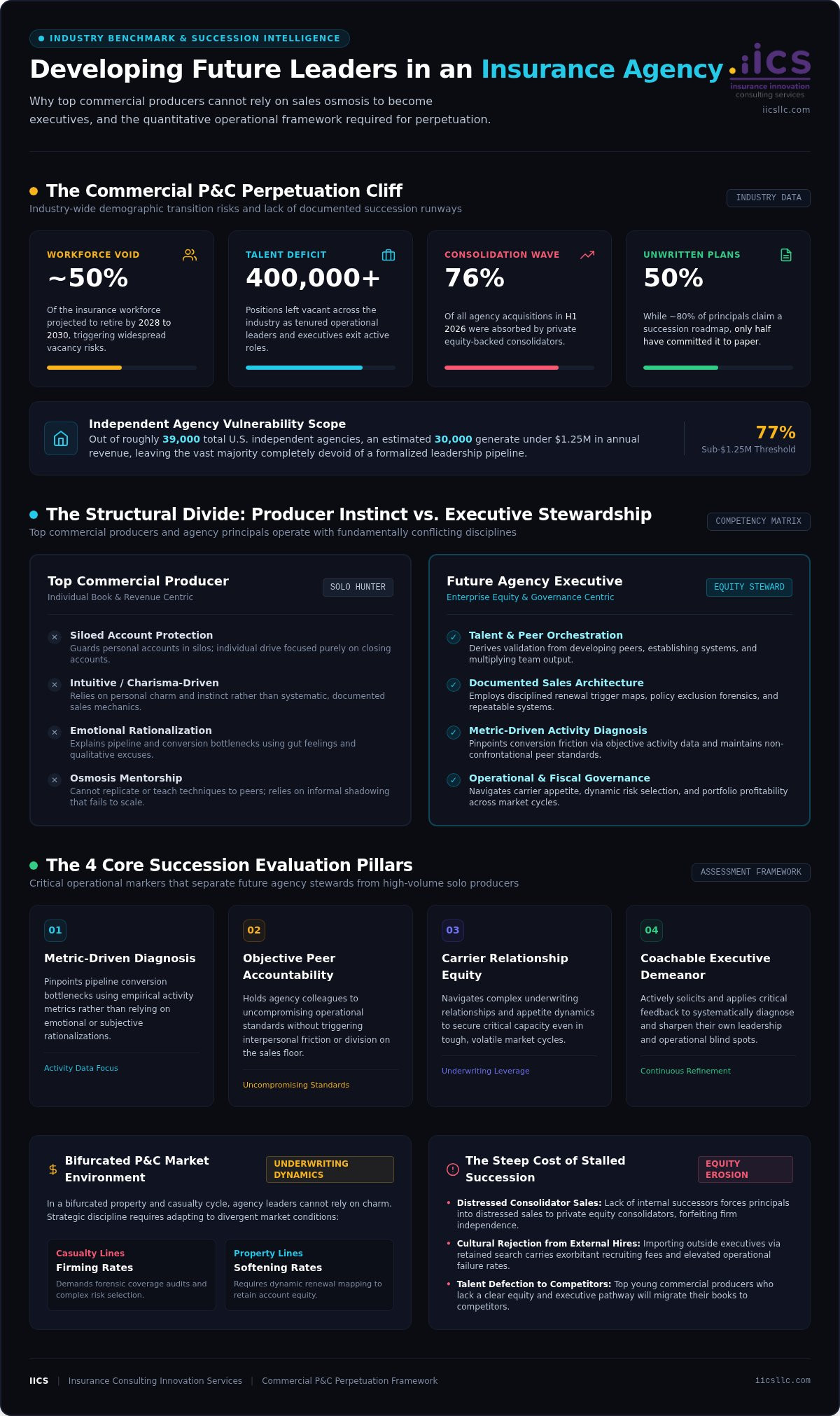
Agency leadership development is not an HR luxury; it is an operational safeguard that protects your enterprise equity. Roughly 50% of the insurance workforce is projected to retire by 2028 to 2030, leaving over 400,000 positions vacant across the industry. Out of approximately 39,000 independent insurance agencies in the United States, an estimated 30,000 generate under $1.25 million in revenue, and the vast majority lack a viable succession pipeline. While roughly 80% of principals claim to have a roadmap, only half have committed it to paper. Without rigorous succession planning, your agency's hard-won market value remains hostage to time.
The True Cost of Stalled Agency Succession
The Commercial P&C Reality: Producers vs. Principals
Elite commercial production and executive stewardship require fundamentally conflicting skill sets. Closing complex middle-market casualty accounts demands aggressive hunter instincts, sharp risk analysis, and individual persistence. Running a firm demands fiscal governance, talent orchestration, and operational discipline. The myth of the natural transition hurts independent agencies; top producers do not magically become competent executives simply by aging. Most agency principals spend their days trapped in operational firefights, leaving no room for meaningful mentorship. True capability does not spread through casual osmosis. Successfully developing future leaders in an insurance agency demands a deliberate architecture that isolates, trains, and tests executive judgment long before ownership transfers.
Core Competencies: What Separates Future Agency Leaders from Average Producers
Mastery of the Commercial Insurance Sales Architecture
Future executives don't rely on intuition or luck. They build predictable revenue through structured pipeline mechanics, disciplined renewal trigger maps, and forensic coverage audits. True successors master complex policy exclusions, contractual liability nuances, and coverage forensics long before taking the helm. Applying advanced commercial insurance sales techniques allows an elite producer to deconstruct how accounts are won and systematically replicate that success across the sales floor. If a producer cannot document and teach their own sales architecture, they cannot lead an agency.
Coaching and Accountability Instincts
The transition from producer to principal hinges on where an individual draws validation. Average producers protect their accounts in silos; prospective executives actively develop their peers. You can spot future agency leaders by evaluating four core leadership traits:
Metric-driven diagnosis: They pinpoint conversion bottlenecks using activity data rather than emotional rationalizations.
Objective peer accountability: They hold colleagues to uncompromising standards without creating interpersonal friction.
Carrier relationship equity: They navigate complex underwriting relationships to secure capacity when negotiations get tough.
Coachable demeanor: They seek critical feedback to sharpen their own operational weaknesses.
Transforming these raw instincts into executive stewardship takes intentional effort. Agency owners seeking to instill this level of operational discipline often partner with outsourced producer development programs to bridge the gap between commercial sales success and executive leadership.
Leadership Development Models: In-House Ad Hoc vs. Structured Academy Systems
The Failure Modes of Informal In-House Shadowing
Informal shadowing fails because daily agency emergencies inevitably take precedence. The moment a critical commercial property account hits an unexpected cancellation notice or a major carrier changes underwriting guidelines, scheduled coaching sessions vanish. Ride-alongs often do little more than reinforce the individual quirks and bad habits of the senior producer. This ad-hoc approach stretches producer break-even timelines across three to four years, draining operational capital while leaving the young producer completely unprepared for strategic executive governance.
The Multiplier Effect of Structured Development Systems
Rigorous, academy-style systems replace sporadic advice with engineered habits. Rather than pulling senior leadership away from core agency responsibilities, modern training engines utilize daily microlearning, objective performance analytics, and structured feedback to build commercial capabilities systematically.
Take a look at how leading platforms structure this environment by exploring inside the academy, where deliberate practice replaces passive observation. Structured systems provide clear advantages:
Daily Microlearning: Bite-sized operational modules instill disciplined routines without dragging producers out of production.
Objective AI Call Coaching: Automated speech and tone analytics evaluate client interactions without executive bias.
Targeted Skill Benchmarking: Measurable milestones reveal pipeline velocity and technical retention in real time.
Uninterrupted Momentum: Training cadence remains rock-solid even during shifting market conditions or sudden agency claims spikes.
Research confirms this impact: agents who complete formal, activity-based training programs increase their sales by up to 90% compared to untrained peers, averaging 27% more policies and 31% more new clients. When agencies systematize development, they accelerate producer profitability while laying an operational foundation that protects long-term independence.
Step-by-Step Blueprint: Developing Future Leaders in an Insurance Agency
Transforming commercial producers into agency principals is not an accidental milestone. It requires an engineered pipeline with clear operational gates. Developing future leaders in an insurance agency demands a phased framework that tests behavioral accountability and commercial command before granting enterprise authority. When executed systematically, this blueprint protects independence while converting raw producer talent into proven agency equity.
Step 1 & 2: Establishing Foundational Disciplines
Start by auditing raw prospecting metrics, submission-to-bind conversion rates, and client retention habits. Next, institute structured 90-day execution sprints focused purely on pipeline velocity, cross-sell identification, and mid-market risk management. Aligning your baseline with the elite insurance producer development plan ensures your prospective leaders build uncompromising personal production habits before they attempt to direct peers.
Step 3 & 4: Coaching, Measurement, and Peer Influence
Once individual production stabilizes, test the candidate's coaching instincts and communication clarity under pressure. Deploy deliberate developmental mechanisms across their weekly workflow:
Daily Microlearning Drills: Enforce 10-minute technical reviews on commercial policy language, exclusions, and endorsements to build encyclopedic coverage knowledge.
Objective AI Call Analysis: Leverage speech analytics to evaluate how well candidates listen, handle pricing pushback, and articulate risk differentiation.
Live Peer Workshops: Assign prospective leaders to facilitate weekly objection-handling sessions, evaluating their poise and pedagogical clarity in real time.
Junior Account Shadowing: Have candidates run pre-renewal strategy reviews for newer producers, measuring their ability to diagnose deal risks.
Step 5: Enterprise Governance and Ownership On-Ramps
The final phase shifts the producer from tactical execution to corporate stewardship. Transition candidates by exposing them directly to carrier relationship management, loss-ratio portfolio reviews, and contingent commission modeling. Establish written, objective milestones that govern title advancement and equity vesting. Link these milestones directly to overall insurance agency sales performance benchmarks. When emerging leaders see an explicit, transparent bridge between operational discipline and agency valuation, your succession path secures itself. Ready to build this operational engine inside your agency? Discover how our structured curriculum at inside the academy accelerates producer break-even timelines and establishes lasting leadership accountability.
Building Your Agency Leadership Pipeline with IICS: Proven Commercial P&C Perpetuation
Surrendering your firm to outside consolidators is not inevitable. You can protect your agency's equity and independence by turning internal talent development into a core operational strength. Insurance Agency Consulting Services (IICS) serves as the dedicated development engine for independent commercial property and casualty agencies nationwide. Rather than leaving succession to luck, IICS deploys a disciplined framework that turns raw producer ambition into proven executive capability. Through an intensive 90-day Sales Academy, daily microlearning modules, objective AI sales coaching, and weekly live workshops, your producers develop the commercial acumen and accountability required to lead.
The Power of 40+ Years of Commercial P&C Experience
Theory cannot replace hard-won market experience. Led by Ralph Blust, who brings over 40 years of commercial P&C industry leadership, IICS builds curriculums informed by real-world underwriting appetite, carrier negotiations, and complex risk placement. Blust's battle-tested track record helps agency owners transition out of operational triage by installing proven leadership systems across their production floors. Discover the executive foundation guiding this methodology by reading more about IICS.
Accelerating Time-to-Breakeven for Future Agency Principals
Unstructured training burns runway and frustrates top talent. In contrast, producers who complete the IICS Sales Academy double their likelihood of becoming top producers while reaching their revenue break-even point significantly faster than the industry norm. This accelerated financial independence protects your agency's capital reserves while locking down talent retention. High-performing producers stay when they see an undeniable operational path toward firm leadership and equity growth.
For independent agency owners managing aggressive revenue targets alongside succession planning, IICS also provides fractional CRO and CGO services. These targeted executive solutions deliver immediate sales management discipline, establishing predictable governance while developing future leaders in an insurance agency from within your own ranks.
Stop running your succession plan on borrowed time. Connect with IICS today to evaluate your production floor and implement a systematic leadership pipeline that guarantees your agency's long-term independence.
Take Control of Your Agency's Leadership Pipeline
Agency perpetuity is never an accident; it is an active investment in operational discipline. Leaving executive readiness to casual shadowing forfeits your firm's future to external consolidators and risks your hard-earned equity. Developing future leaders in an insurance agency requires deliberate habit formation, technical commercial acumen, and transparent executive accountability.
You don't have to navigate this transition alone or sacrifice your production focus to build a curriculum from scratch. Led by 40-year industry veteran Ralph Blust, IICS provides a proven developmental framework combining daily microlearning, objective AI call coaching, and high-impact mentorship. Academy graduates double their likelihood of becoming elite producers while reaching break-even velocity in record time. Take the decisive step to protect your firm's independence. Build your next generation of leaders with the IICS Sales Academy and cement your agency's equity for decades to come.
Frequently Asked Questions
Why do top-producing commercial insurance agents often struggle when promoted to leadership?
How long does it typically take to develop a commercial producer into an agency leader?
Developing future leaders in an insurance agency typically requires 18 to 36 months of deliberate progression. While foundational commercial sales mechanics and disciplined prospecting habits can be solidified within a structured 90-day development cycle, mastering broader executive responsibilities takes extended practical exposure. Candidates must progressively handle carrier contract negotiations, loss-ratio portfolio governance, and team performance coaching before agency principals can safely transition equity or corporate voting control.
What are the risks of using informal shadowing to train future agency leaders?
Informal shadowing creates severe operational vulnerabilities. First, it relies entirely on the availability of busy agency principals, meaning coaching sessions are routinely canceled whenever claims spike or client emergencies occur. Second, shadowing unintentionally transfers personal shortcuts, obsolete negotiation habits, and individual biases rather than institutional standards. Over time, this ad-hoc approach stretches producer break-even timelines and leaves emerging leaders unprepared to manage modern data-driven underwriting environments.
How does AI-driven sales coaching support leadership development in an insurance agency?
AI sales coaching analyzes actual prospect conversations against standardized criteria, providing immediate feedback on pacing, objection handling, and risk diagnosis. For future leaders, this technology eliminates subjective guesswork. Emerging executives learn to identify deal friction objectively rather than relying on gut feelings. Mastering these automated analytics trains candidates to run data-backed pipeline reviews, teaching them how to diagnose conversion bottlenecks and coach their peers with surgical precision.
Can an insurance agency develop future leaders without distracting current executive staff?
Yes, by utilizing outsourced development academies and fractional executive leadership models. Platforms featuring daily microlearning lessons, objective AI call evaluations, and weekly live workshops carry the heavy lifting of foundational skill building. This structured architecture insulates current agency principals from daily training triage. Leadership can then focus on core agency operations while stepping in only for strategic mentorship milestones and high-level enterprise reviews.
What key performance metrics indicate a producer is ready for an agency leadership track?
Look beyond top-line commission volume. Executive readiness reveals itself through consistent pipeline velocity, superior submission-to-bind conversion rates, and high client retention on middle-market accounts. Operationally, prospective leaders demonstrate disciplined CRM documentation, active carrier appetite mastery, and a willingness to facilitate peer workshops. When a producer routinely analyzes conversion data and mentors junior peers without prompt, they have outgrown individual sales execution.
How does formal leadership training improve independent insurance agency enterprise value?
Prospective buyers and valuation consultants heavily discount agencies that depend solely on a founding principal's personal book or relationships. As M&A and corporate finance specialists at Pinnacle Global Advisory note when evaluating enterprise readiness, implementing formal systems for developing future leaders in an insurance agency proves your revenue engine runs predictably without you. It protects carrier appointments, stabilizes producer retention, and ensures operational continuity. That institutional stability directly commands higher valuation multiples and preserves firm independence against predatory buyouts.