Effective Prospecting Techniques for P&C Insurance: The Elite Producer Framework
Updated: 6 days ago
More prospecting activity won’t fix a pipeline built on bad timing. Effective prospecting techniques for P&C insurance start with knowing which accounts are approaching renewal, when buyers are most likely to act, and what coverage questions can earn a meaningful conversation. Without that discipline, producers burn hours on dead-end leads and generic scripts that get rejected before the real discussion begins.
If you’re facing inconsistent lead flow or a long road to breakeven, the problem may not be effort. It may be the absence of a repeatable system. Elite commercial producers use data and timing to focus their outreach, build a Suspect List around actual expiration dates, and engage prospects during the 90-day renewal buying window.
This article breaks down a practical framework for building a stronger commercial pipeline, with methods designed to help producers progress toward a $100M+ pipeline without relying on volume alone. You’ll learn how to identify better-fit accounts, prioritize outreach, replace rejection-triggering scripts with relevant conversations, and measure the daily activity that moves prospects forward. The difference is systematic execution.
Table of Contents
The Shift from Generalist to Elite P&C Prospecting
An order taker waits for referrals, responds when a prospect asks for a quote, and relies on a familiar script to start conversations. An Elite Producer works differently: they choose a defined market, study account timing, and bring a relevant business question to each interaction. That distinction matters in Property and casualty insurance, where commercial buyers need more than a price. They need a producer who can connect coverage discussions to their operations and risks.
Generic scripts fail because they sound interchangeable. A business owner who hears the same broad pitch from multiple agents has little reason to keep listening. Effective prospecting techniques for P&C insurance replace canned openings with preparation: understand the prospect’s industry, identify a plausible exposure to discuss, and ask a question that earns the next conversation. The goal isn’t to force a quote. It’s to establish relevance.
Random Acts of Prospecting create activity without a dependable process. A structured 90-day system gives producers a target profile, a regular prospecting cadence, coaching, and clear measures of progress. IICS reports 52% higher sales for formally trained agents, underscoring the value of developing skills rather than leaving new producers to figure it out alone. Explore the producer Sales Academy to see how structured development supports that shift.
The Cost of Non-Producing Producer Hires
There’s no single breakeven timeline that applies to every agency. Compensation, support costs, sales cycle length, and account mix all affect when a producer becomes profitable. But when onboarding is informal and tactical development is missing, new hires can spend months building inconsistent habits instead of a qualified pipeline. The cost isn’t only salary; it’s also management time, lost opportunity, and delayed revenue. A deliberate training plan makes expectations and skill gaps visible earlier.
Defining Your Target Commercial Profile
Build a simple prospect filter before adding names to your Suspect List:
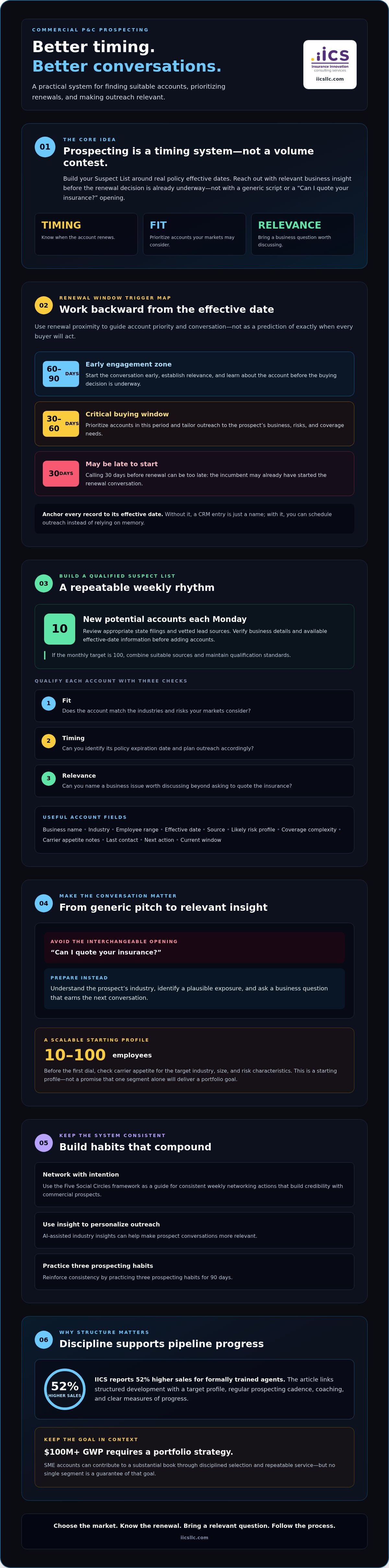
Fit: Does the account match the industries and risks your markets consider?
Timing: Can you identify its policy expiration date and plan outreach accordingly?
Relevance: Can you name a business issue worth discussing beyond “Can I quote your insurance?”
For example, when targeting niches like logistics and freight, studying specialized providers such as cargoinsureonline.com can help you pinpoint sector-specific exposures—such as inland transit or ocean marine risks—to formulate far more relevant discussion questions.
Mastering the 90-Day Renewal Buying Window
Calling a prospect 30 days before renewal may feel timely. Often, it’s late: the incumbent may already have started the renewal conversation. A more disciplined approach maps outreach backward from the policy effective date, giving you room to establish relevance before the buying decision is underway.
Think of the Window Trigger Map as a working CRM view, not a prediction of exactly when every buyer will act. Use it to prioritize accounts by renewal proximity and guide what you say at each stage. That kind of timing matters in a large, varied market. The Insurance Information Institute’s P&C insurance industry statistics offer useful context on the industry producers serve, but your own prospecting decisions should be grounded in account-level details.
Building the Suspect List by Effective Date
The effective date is the anchor for renewal prospecting. Without it, a CRM record is just a name; with it, you can schedule relevant outreach instead of relying on memory. Every Monday, review appropriate state filings and other vetted lead-source menus, identify 10 new potential accounts, and verify the business details and available effective-date information before adding them. Ten weekly names create a consistent base; combine suitable sources and maintain qualification standards if your monthly target is 100.
Track the fields that make the list actionable: business name, industry, employee range, effective date, source, likely risk profile, coverage complexity, carrier appetite notes, last contact, next action, and current window. Categorize each suspect by the nature of its exposures and the complexity of its coverage needs. Don’t treat an unverified date as fact; flag it for confirmation.
The Window Trigger Map Execution
Use the map to distinguish a front-door quote request from a renewal trigger. A quote request signals an immediate stated need. A renewal trigger creates a planned opportunity to learn about the account before the incumbent’s process is complete.
60–90 days before effective date: Research the business, validate the timing, and open a low-pressure conversation about operational changes and risk priorities.
30–60 days before effective date: Explore whether the prospect is reviewing coverage and identify any gaps, service concerns, or changing exposures that warrant a closer look.
Inside 30 days: Respect the compressed timeline. Confirm whether the prospect is still considering options rather than assuming a full market review is practical.
Replace “Can I quote your insurance?” with a specific question: “Have your operations, contracts, or locations changed since your last renewal?” A useful question can create a reason to reassess the incumbent relationship without attacking it. These effective prospecting techniques for P&C insurance depend on disciplined timing, accurate records, and outreach tailored to the buyer’s stage. Producers seeking a structured way to build these habits can review the 90-day producer Sales Academy.
High-Impact Prospecting Strategies: Networking and SME Dominance
Map the Five Social Circles
Set three specific actions for each circle every week. Keep them useful and relationship-first, not a quota of requests for business:
Professional: Check in with a business adviser; attend an industry gathering; share a useful risk insight with a contact.
Personal: Reconnect with someone you know; ask what businesses they work with; offer to introduce them to a relevant contact.
Community: Participate in a local or industry group; volunteer expertise; follow up with someone you met.
Carrier: Ask an underwriter about appetite changes; discuss a class of business they’re seeking; share a well-qualified risk for feedback.
Client: Schedule a coverage conversation; ask about operational changes; request an introduction when your service has earned it.
Make the warm-introduction request easy to answer: “Who do you know in [industry] who might value a conversation about [specific risk]?” Ask permission before using someone’s name, and never pressure a contact to refer. Log the source, introduction, meeting, and qualified-prospect outcome in your CRM. IICS reports a 53% increase in lead-to-prospect conversion; tracking your own referral results helps identify which activities are producing meaningful progress.
Build an SME Commercial Account Blueprint
Look for businesses whose complexity may be overlooked: changing operations, new contracts, multiple locations, or questions that don’t get a clear response from their current adviser. For example, seeing how dedicated brokerages like AllCover Insurance Brokers structure coverage for commercial property owners demonstrates how nuanced asset exposures can shape consultative discussions. These are conversation prompts, not proof that an account is poorly served. Ask what has changed and what the owner wants from the renewal process before suggesting a review. For more commercial sales development, explore the producer Sales Academy.
In person, slow your pace, maintain natural eye contact, and explain value in plain language. Virtually, look toward the camera, remove distractions, and pause to confirm understanding. Whether the meeting is across a table or a screen, lead with the business issue, not insurance jargon. That’s how effective prospecting techniques for P&C insurance turn relationships into credible opportunities.
Leveraging AI and Micro-Habits for Prospecting Consistency
AI can help a producer prepare for a first conversation, but it can’t replace judgment or verify coverage on its own. Use it to turn credible industry information into plain-language discussion prompts, then check every claim against reliable sources and applicable policy documents. The goal isn’t to sound like a veteran by pretending to know everything. It’s to ask sharper questions and show you’ve done your homework.
AI-Assisted Risk and Industry Insights
Start with a focused prompt: “Summarize common operational risks for businesses in this industry in plain language. Suggest three questions an insurance producer could ask to learn how the prospect manages those exposures. Identify sources I should verify.” Treat the output as preparation, not advice or a promise of coverage. For a relevant loss example, ask AI to draft a hypothetical scenario based on a verified risk, then label it clearly as illustrative and confirm the details before using it with a prospect.
AI can also help organize a comparison of ISO and custom policy forms if you provide the exact documents and ask it to flag wording differences for human review. Don’t assume it has identified every material distinction. Check the cited text yourself and consult the appropriate coverage expertise before describing implications. A careful producer might say, “I noticed different wording in these provisions. Would it be useful to review how they relate to your operations?” That’s more credible than presenting an unverified interpretation as fact.
Build Consistency with Micro-Learning and Call Coaching
A training firehose is easy to forget once the next call arrives. Short, focused practice gives producers a specific skill to apply, review, and repeat. Try a daily three-minute learning block, then use the idea in one prospect conversation. Keep the “Rule of Three Basics” simple for 90 days:
Prepare: Research one prospect and write one relevant risk question.
Practice: Make a planned prospecting contact and focus on one conversation skill.
Review: Capture what worked, what stalled, and the next step.
AI Sales Coaching can help producers review calls against a consistent rubric, such as opening clarity, quality of questions, listening, and agreed next steps. If an agency uses a nine-criterion scorecard, coaching can make feedback more specific, but scores should guide practice, not stand in for a manager’s judgment. Protect sensitive information and follow your agency’s approved processes for call review.
These effective prospecting techniques for P&C insurance work best when insight becomes repeatable action. To build AI call coaching and micro-learning into a structured development plan, explore the 90-day producer Sales Academy.
Scaling Your Success: The 90-Day Elite Producer System
Prospecting creates opportunity. A repeatable sales process turns opportunity into a book of business. The IICS Sales Academy is a 90-day development program for P&C producers, designed to connect prospecting habits with the skills needed to move a commercial account forward. It offers structure and focused practice; it shouldn’t be treated as a guarantee of breakeven by a specific date. A producer’s results depend on factors such as pipeline quality, sales-cycle timing, and execution.
Use a Sales Cycle Snapshot to keep each opportunity moving: record the prospect’s business priorities, renewal timing, decision-makers, information still needed, agreed next step, and target follow-up date. After an initial conversation, for example, the next step might be a discovery meeting to understand operations and exposures. That leads to an informed coverage discussion, a proposal review, and a clear decision point. No vague “checking in.” Every interaction should earn a purposeful next action.
The 90-Day Development Trimester
The program’s three-month progression builds from core skills to pipeline execution and then to more advanced selling. Each stage gives producers a focus for practice and coaching:
Month 1, Topics 1–20: Establish foundations and core commercial sales skills.
Month 2, Topics 21–40: Develop the pipeline and apply tools such as Window Trigger Maps.
Month 3, Topics 41–60: Work through selling scenarios, renewals, and personal brand development.
That sequence helps connect the prospecting methods in this article to the conversations and follow-through that convert qualified interest into business. It’s a focused development cycle, not a substitute for sustained activity after the program ends.
Development Support for Producers and Agency Principals
Producer development can also be supported through outsourced training and fractional CRO/CGO services, which are among IICS’s offerings. For agency principals, the value is a more deliberate approach to developing sales capability and growth leadership. Weekly live workshops provide a setting for continued learning and peer accountability, while producers apply the work to active opportunities and review progress against clear next steps.
Effective prospecting techniques for P&C insurance become more powerful when they’re practiced within a complete sales system. To review the program structure and curriculum, explore the Sales Academy curriculum and ask about the next available enrollment period.
Turn a Prospecting Framework into Consistent Growth
Elite prospecting isn’t about making more calls at random. It’s about targeting accounts with intention, using effective prospecting techniques for P&C insurance at the right point in the renewal cycle, and building the discipline to follow through. A focused Suspect List, thoughtful relationship-building, and regular practice give producers a clearer path from first contact to next step.
Training helps make that process repeatable. IICS reports 52% higher sales for formally trained producers and brings more than 40 years of P&C leadership experience to producer development. Its Sales Academy includes AI Call Coaching to help producers review conversations and strengthen their approach. Results vary, but the standard is clear: prepare, practice, and measure your progress.
Ready to build those habits with structured development? Explore the IICS Sales Academy and take the next step toward a more consistent commercial pipeline. Your next level starts with the prospecting action you take today.
Frequently Asked Questions
What is the most effective time to prospect for P&C insurance?
Begin outreach 60–90 days before a prospect’s policy expiration, then focus on the 30–60-day period as the renewal buying window. Starting early gives you time to understand the business and earn a conversation before the renewal is already in motion. Confirm effective dates rather than guessing, and adjust your follow-up to the prospect’s actual timeline and interest.
How many leads should a P&C producer generate each month?
Use at least 100 leads per month, organized around verified or clearly flagged effective dates, as a working target in this framework. Lead volume alone isn’t success: track how many names meet your target profile, become qualified prospects, and advance to a concrete next step. If conversion is weak, review source quality and outreach relevance before simply increasing activity.
What is a Window Trigger Map in insurance sales?
A Window Trigger Map is a planning tool that connects prospect outreach to policy timing and buying signals. It can distinguish a direct quote request from a renewal opportunity and help producers set appropriate follow-ups around expiration dates. Use it to record what prompted contact, where the prospect is in the decision cycle, and the next agreed action. It’s a prioritization aid, not a guarantee that a prospect will buy.
How do I handle the objection “I am happy with my current agent”?
Acknowledge the relationship without challenging it: “That makes sense. What does your agent do particularly well for your business?” Listen first. If the prospect is open to it, ask whether operations, contracts, or exposures have changed since the last renewal. Offer a focused conversation around that change, not an unsolicited claim that their current coverage is inadequate. If they decline, respect the answer and ask permission to reconnect at a more suitable time.
Can AI really help with commercial insurance prospecting?
Yes, when producers use it as a preparation and coaching aid, not as an authority on coverage. AI can help draft plain-language industry risk questions or organize information for a first call. Verify factual claims and policy wording against reliable sources and original documents. AI Sales Coaching can also provide feedback against defined call criteria, helping producers identify specific skills to practice while retaining human judgment.
What are the best lead sources for commercial P&C producers?
Strong sources include state filings, appropriate lead-source menus, client and professional referrals, community and industry relationships, and carrier conversations that clarify appetite. Evaluate each source by fit and outcomes, not just the number of names it supplies. Record where a lead came from, confirm business details and effective-date information, then measure whether it becomes a qualified prospect. Follow agency processes for accessing and using records.
Why do most new insurance producers fail in their first year?
There isn’t a single cause, and failure rates vary by agency and producer. Common obstacles include unclear expectations, limited tactical coaching, inconsistent prospecting, and a pipeline filled with poorly qualified names. New producers may also rely on generic scripts instead of learning how to start relevant commercial conversations. A defined activity plan, regular feedback, and measurable next steps can make skill gaps visible sooner.
How does micro-learning improve insurance sales performance?
Micro-learning breaks sales development into short lessons that producers can apply between live conversations instead of trying to absorb too much at once. IICS’s Sales Academy uses daily video modules that are 2–4 minutes long, alongside coaching and practice. A producer might study one call skill, use it in a conversation, then review what happened. Repetition makes learning actionable; results still depend on consistent application.