Elite P&C Insurance Sales Objections and Rebuttals: The 2026 Producer Playbook
Updated: 5 days ago
Why are you still letting a "satisfied" prospect walk away when their current coverage is a ticking time bomb of nuclear verdicts and social inflation? In a 2026 market where property premiums have dropped 6.3 percent but umbrella rates are climbing by 5.3 percent, relying on luck isn't a strategy. It's a professional liability. You know the frustration of losing a hard-won lead to an incumbent agent who hasn't looked at the file in years. It is exhausting to get trapped in a race to the bottom on price when you know the client's risk profile demands more than a simple discount.
We are going to fix that. This playbook provides the elite P&C insurance sales objections and rebuttals required to master high-stakes negotiations and turn a "no" into a closed file. You will learn the risk-based strategies used by the top 1 percent of commercial producers to double their success rates. We'll move beyond emotional reactions to rejection and provide a systematic framework for growth. This is your roadmap to reaching breakeven revenue in half the industry time and securing your place among the elite.
Table of Contents
The Psychology of P&C Objections: Why Standard Scripts Fail
Standard scripts are comfort food for mediocre producers. They offer a false sense of security while your pipeline starves. Most P&C insurance sales objections and rebuttals fail because they ignore the "Objection Gap." This gap exists when a prospect cannot distinguish your value from their current agent's service. To them, insurance is a commodity. If there is no perceived technical difference, "I'm happy" is the easiest path to ending the call. It is a polite way of saying you haven't given them a reason to care.
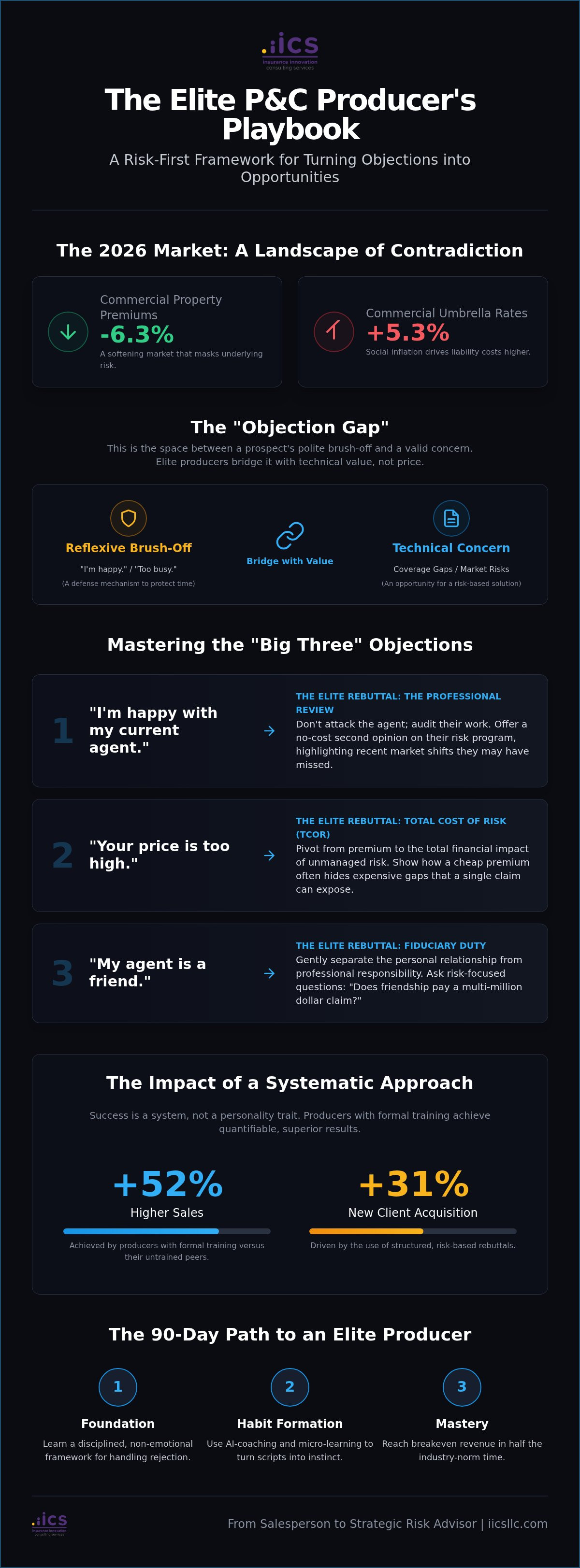
You must separate the reflexive brush-off from a valid concern. A reflexive response is a defense mechanism. It is muscle memory designed to protect their time. A valid concern, however, is a specific hurdle like a multi-year contract or a deep-seated relationship with the incumbent. In the 2026 market, where commercial property premiums have dropped 6.3 percent while umbrella rates spiked 5.3 percent, price-based rebuttals are losing their teeth. You cannot win on "saving money" when the market is already softening in key areas. You win by shifting to a "Risk-First" mindset, moving from a salesperson to a strategic advisor who understands the volatility of the current landscape.
The Incumbent Advantage Myth
Loyalty is rarely about the agent. It is usually about the perceived pain of change. Most prospects aren't actually loyal; they are just busy. They mask the effort of switching with the language of satisfaction. Elite producers use a Window Trigger Map to identify when an incumbent has become complacent or when a specific market shift, such as the rise of nuclear verdicts, creates a gap in the current program. Hiring a producer who cannot navigate these psychological waters is a high-stakes mistake that costs agencies hundreds of thousands in lost opportunity.
Data-Backed Success Rates
Success in this field is not a matter of personality. It is a matter of systematic development. Data from the Sales Academy shows that producers who undergo formal training achieve 52 percent higher sales than their untrained peers. This includes a 31 percent increase in new client acquisition through the use of structured P&C insurance sales objections and rebuttals. The first 90 days are the critical "rewiring" phase. This is where a producer moves from a fear-based reaction to rejection toward a disciplined, non-emotional execution of a proven framework.
Mastering the 'Big Three' Commercial P&C Objections
Tactical success in high-stakes environments requires more than a witty comeback. It demands a systematic dismantling of the prospect's comfort zone. When you encounter the "Big Three" objections, your goal isn't to argue. It is to reframe the conversation around technical proficiency and risk mitigation. Most P&C insurance sales objections and rebuttals fail because they stay on the surface. You must go deeper. You must challenge the status quo by exposing the gaps that your competitors are too comfortable to mention.
The first hurdle is the incumbent bond. When a prospect says they are "happy," they are usually just avoiding the perceived labor of a transition. Break this by using a Professional Review angle. Don't attack the agent; attack the lack of a recent, rigorous audit. If their current program hasn't been adjusted for the 5.3 percent rise in umbrella premiums or the $15 billion litigation financing market, they aren't "happy." They are exposed. Use the Sales Cycle Snapshot to maintain control of this narrative. This ensures you aren't just another solicitor, but a consultant with a superior methodology.
When the conversation turns to price, the amateur producer defends the quote. The elite producer pivots to Total Cost of Risk (TCOR). In a market where commercial property rates have dropped 6.3 percent but liability costs are skyrocketing due to social inflation, a lower premium often signals a dangerous reduction in coverage quality. Mastering these P&C insurance sales objections and rebuttals is a core component of the Sales Academy curriculum, where we teach producers to lead with value rather than rates.
Deconstructing 'The Agent is a Friend' Scenario
Friendship is a common shield, but it doesn't pay claims. You must pivot to fiduciary duty. Ask the prospect: "When was the last time your friend audited your 'Completed Operations' coverage against current nuclear verdict trends?" If the answer is silence, the friendship is a business liability. Elite producers use risk-focused questions to separate personal affection from corporate survival. This is particularly effective for SME commercial accounts where the bond is often purely social and lacks technical depth.
Fighting the 'Commodity' Trap
Stop letting prospects treat P&C insurance like a utility. If they ask you to "just email the quote," they are preparing to send your hard work to the PDF graveyard. Frame the agenda by explaining that a quote without a risk-architecture briefing is professional negligence. Highlight the difference between standard ISO forms and custom manuscript endorsements. While property rates soften, the restrictive nature of new liability exclusions means "cheap" coverage is often no coverage at all. Focus on carrier appetite to prove you are the superior choice.
Advanced Rebuttals for Complex Risk and Market Scenarios
The "Broker of Record" roadblock is often a test of your resolve. Do not retreat. Explain that a BOR is an administrative tool, not a shield against professional negligence. You must also navigate the legal impact of shifting municipal and state laws. A policy that was compliant in 2025 might be deficient in 2026 due to new third-party litigation financing rules, which have grown into an $18 billion market. Mastering these P&C insurance sales objections and rebuttals requires knowing the law better than the incumbent does.
The Technical Rebuttal: ISO vs. Proprietary Forms
Premium is a distraction. The real battle is won in the definitions of the CG 00 01 form versus carrier-specific proprietary wording. Proprietary forms often contain silent exclusions that standard ISO forms do not. Use Small Commercial Focus Filters to identify accounts where these technical nuances provide you with an undeniable edge. A single custom endorsement can bridge a coverage gap that would otherwise bankrupt a client, turning a "lost" deal into a high-revenue partnership based on technical superiority.
Using AI for Risk Insights
Use technology to pre-empt objections before the prospect even opens their mouth. By leveraging AI Sales Coaching for Insurance, you can generate plain-language loss examples that mirror the prospect's specific industry and geographic risks. This isn't about scaring the client. It is about providing the data necessary to validate a change in their insurance program. When you can show a prospect exactly how a similar firm in their county was decimated by a specific liability gap, the "I'm happy" objection evaporates.
Building the Habit: From Scripts to Instinctive Mastery
Knowledge is cheap. Execution is expensive. Most producers fail because they treat training like a one-time event rather than a daily discipline. You cannot master P&C insurance sales objections and rebuttals by reading a PDF once a year. You need a relentless feedback loop that identifies your weaknesses in real time. Standard agency training is often a graveyard of good intentions where scripts are filed away and never practiced. Elite performance requires a structured, four-step approach to habit formation that moves concepts from the page to the subconscious.
Step 1: Daily MicroLearning. We utilize 3-minute modules to avoid the "firehose" effect that leads to cognitive overload.
Step 2: AI Call Coaching. This system scores your responses against 9 critical criteria, removing the guesswork from your development.
Step 3: Weekly Live Workshops. You will battle-test your scripts against peers and coaches who won't let you off the hook with easy answers.
Step 4: 1:1 Call Coaching. Work directly with veteran sales experts to refine your tonality, pacing, and the subtle "risk-first" cues that close deals.
The Power of MicroLearning in 2026
Spaced repetition is the only way to achieve permanent behavioral change in a high-pressure sales environment. Our 60 tactical modules are delivered over 90 days to ensure the lessons stick. This methodical pace allows you to master Effectiveness Tools that track your lead-to-prospect conversion with clinical precision. You don't need a thousand new ideas. You need to commit to three basic habits every week for ninety days. This consistency is what separates the top 1 percent from those who are merely "worth hiring."
AI Sales Coaching: The Data-Driven Edge
Traditional coaching is often limited by a principal's subjective opinion. AI coaching is different. It provides real-time feedback on tonality, objection handling, and specific next-step guidance based on data, not feelings. It eliminates the "I think" and replaces it with "The data shows." You can explore the mechanics of this system Inside the Sales Academy to see how we accelerate producer development. Stop guessing why you lost a deal and start using data to ensure you win the next one.
Ready to transform your rejection rate into a closing ratio? Apply for the 90-day Sales Academy and start building the habits of an elite producer.
The 90-Day Path to Becoming an Elite P&C Producer
The difference between a struggling producer and an elite performer is 90 days of disciplined, data-backed development. You cannot expect a new hire to navigate the 2026 market by simply handing them a phone and a list of leads. They will drown in the complexity of nuclear verdicts and shifting carrier appetites. The IICS Sales Academy is designed to prevent this stagnation. It is a three-month development system that transforms raw potential into a high-revenue asset. Our graduates don't just survive; they thrive, reaching breakeven revenue in half the industry norm time. This is achieved through a relentless focus on the technical mechanics of P&C insurance sales objections and rebuttals.
For agencies that lack the internal bandwidth to manage this level of training, we offer Fractional CRO and CGO services. We provide the outsourced leadership necessary to ensure your team is hitting their milestones without distracting you from agency operations. We have a 40-year track record of continuous growth, and we know that if a producer is worth hiring, they are worth developing the right way. This isn't a suggestion. It's an investment in the long-term solvency of your firm.
The Curriculum for Commercial Mastery
Our program is organized into a rigorous trimester structure that mirrors the progression of a high-stakes sale. The first 20 modules focus on Foundations, ensuring every producer understands the technical language of risk. Modules 21 through 40 dive into Pipeline development, where we introduce the Suspect List By Effective Date. This tool ensures your producers are never "cold calling" but are instead targeting buying windows with surgical precision. The final 20 modules cover Elite Tactics, where we master the advanced P&C insurance sales objections and rebuttals that win complex commercial accounts. This structured path is why our graduates achieve 52 percent higher sales and a 31 percent increase in new client acquisition.
Your Battle Plan for Q3 2026
As we move into the third quarter of 2026, the softening property market creates a unique opportunity to capture market share from complacent incumbents. You must apply the Window Trigger Map to your current pipeline immediately. Identify which prospects are seeing premium drops but lack the liability protection required for the current litigation environment. This is your entry point. For agencies ready to scale, we are offering the code Summer2026 for a 50 percent tuition reduction for the next trimester. The next session starts on the first of the month. Don't wait for your competition to upgrade their skills first. Apply for the Sales Academy with code Summer2026 and secure your team's future today.
Secure Your Dominance in the 2026 P&C Market
The 2026 market doesn't reward effort; it rewards precision. You've seen why standard scripts fail and how shifting the conversation to a "Risk-First" framework can dismantle even the most stubborn incumbent loyalty. Mastering the technical nuances of P&C insurance sales objections and rebuttals is no longer optional for those aiming for the top tier. It requires moving beyond theory and into a disciplined, data-backed habit loop that replaces hesitation with instinctive mastery.
Our graduates achieve 52 percent higher sales by utilizing a 40-year track record of elite producer development. We don't just teach you what to say. We use AI-driven coaching to score your performance against 9 critical criteria, ensuring every response is sharp, technical, and non-emotional. This systematic approach is the only way to reach breakeven revenue in half the industry norm time.
Ready to stop losing deals? Join the Sales Academy and save 50% with code Summer2026. Your future as an elite producer starts with a single, decisive step toward professional mastery. You have the talent; now get the framework to match it.
Frequently Asked Questions
How do I handle the 'your rates are too high' objection in a hard market?
Pivot the conversation from premium rates to the Total Cost of Risk (TCOR). In the 2026 market, where liability costs are driven by social inflation and nuclear verdicts, a lower price often indicates a dangerous gap in coverage. You must explain that premium is only one component of the financial impact of a loss. Elite producers use this moment to highlight technical deficiencies in the prospect's current program.
What is the best rebuttal for 'I am happy with my current insurance agent'?
Break the incumbent bond by offering a "Professional Review" instead of a competing quote. Most "happy" prospects are simply avoiding the perceived labor of switching. Ask risk-focused questions about their "Completed Operations" coverage or how their current agent has audited their program against recent municipal law changes. This separates the friendship from the fiduciary duty, forcing the prospect to realize that their agent's complacency is a business liability.
Can AI coaching really improve my insurance sales rebuttals?
Yes, because it provides an objective, data-driven feedback loop that traditional agency coaching lacks. Our AI system scores your P&C insurance sales objections and rebuttals against nine critical criteria in real time. It analyzes tonality, pacing, and technical accuracy to eliminate opinion-based feedback. This allows producers to identify exactly where they are losing the narrative and provides immediate next-step guidance for improvement.
How many leads per month should a new P&C producer generate?
An elite P&C producer should generate at least 100 leads per month based on specific policy expiration dates. This is the minimum volume required to maintain a healthy pipeline and hit a target of three to five new accounts monthly. Using tools like the Suspect List By Effective Date ensures you are targeting prospects 60 to 90 days before their renewal, which is the optimal buying window for commercial accounts.
What is the difference between a reflexive brush-off and a real sales objection?
A reflexive brush-off is a psychological defense mechanism designed to protect the prospect's time, such as saying "we're all set." It is muscle memory, not a technical rejection. A real sales objection is a specific hurdle, like a multi-year contract or a deep-seated relationship. Elite producers identify the brush-off early and use provocative questions to bypass the reflex and reach the underlying technical concerns.
How long does it take to see results from professional insurance sales training?
Producers typically see behavioral shifts within the first 30 days, but the full 90-day system is required for permanent habit formation. Our Sales Academy graduates achieve 52 percent higher sales by the end of the program because they commit to three basic habits every week. By following a structured trimester curriculum, producers reach breakeven revenue in half the industry norm time, moving from "worth hiring" to "elite performer" rapidly.
What are the common mistakes producers make when responding to objections?
The most frequent error is reacting emotionally and defending the price rather than the risk architecture. Producers often fail because they treat P&C insurance sales objections and rebuttals as an argument to be won instead of a consultation to be led. Other mistakes include falling into the "commodity trap" by emailing quotes without an agenda or ignoring technical wording differences between ISO and proprietary forms that could win the deal.
Is there a discount for the IICS Sales Academy in 2026?
Invited agencies can secure a 50 percent tuition reduction for the 2026 trimester sessions. This brings the monthly investment down from $3,000 to $1,500 per student. To access this rate, agencies must use the discount code Summer2026 during the application process. This covers the full 90-day curriculum, including unlimited AI call coaching, weekly live workshops, and monthly 1:1 sessions with our veteran sales experts.