Elite Producer Framework 2026: Sales Accountability
- Aug 6
- 11 min read
You are likely overpaying for mediocrity and calling it an investment. If your producers plateau after their first year, you don't have a talent problem; you have an accountability problem. Most agency owners treat their sales floor like a casino where they are the ones losing the house. Establishing true accountability for insurance sales teams isn't about micromanagement. It's about data. It is about moving from a culture of "hoping for sales" to an elite performance ecosystem where success is the only logical outcome.
We understand the exhaustion of watching high-potential hires turn into high-cost liabilities. You deserve visibility into daily activities and a pipeline that doesn't vanish when you stop looking at it. This article promises to reveal the Elite Producer Framework 2026. You will learn how to build a system that helps producers reach breakeven in half the industry time while doubling their likelihood of becoming top-tier performers. We will explore the mechanics of data-driven coaching, the necessity of fractional leadership, and the path to predictable revenue growth through P&C sales mastery.
Table of Contents
What is Accountability for Insurance Sales Teams in 2026?
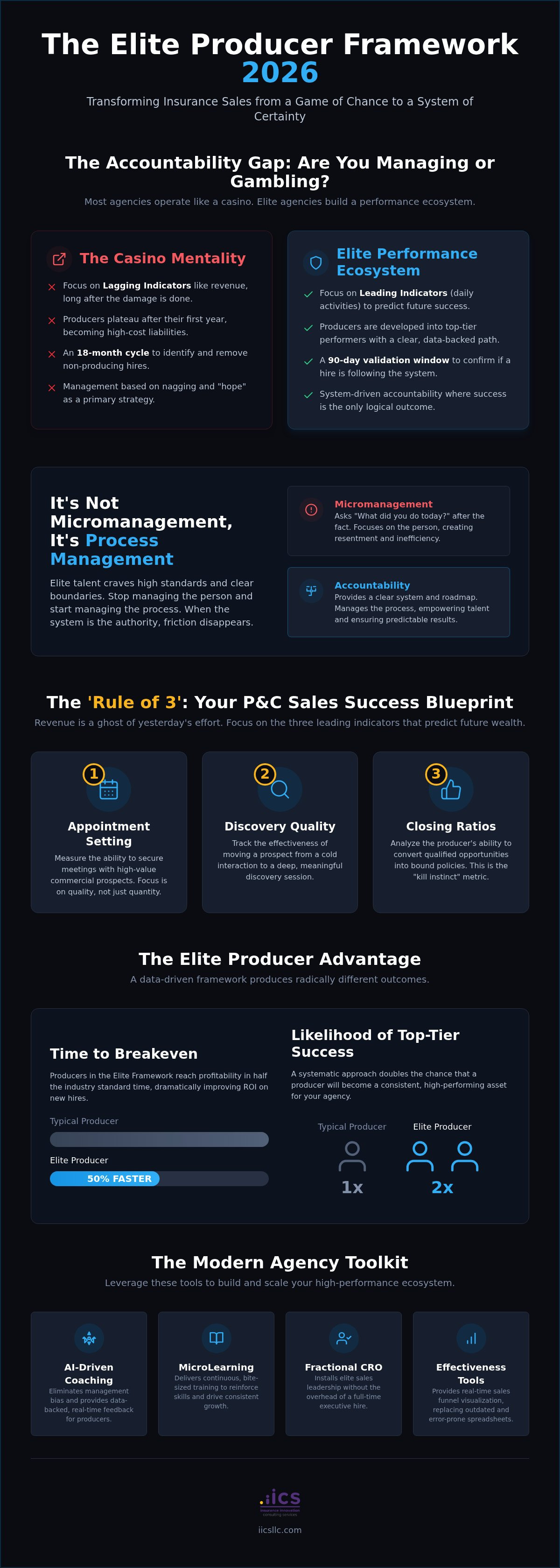
Real accountability is not a disciplinary meeting held after a bad quarter. In the context of Business Performance Management, it is the systematic alignment of daily activity, professional behavior, and final results. Most agency owners fixate on lagging indicators like written premium or revenue. By the time those numbers hit your desk, the damage is already done. You can't manage revenue; you can only manage the activities that create it.
Effective accountability for insurance sales teams distinguishes between what happened and what is happening right now. Traditional boss-down management, where a principal constantly nags producers for updates, is a relic of the past. It's inefficient and breeds resentment. In 2026, elite agencies operate on a model of self-governed excellence. The Elite Producer mindset assumes that if the data is visible, the professional will course-correct before a slump occurs.
The High Cost of the Accountability Gap
Hoping for the best is a high-stakes gamble that few agencies can afford. When standards are vague, you end up with non-producing hires who drain your salary pool for eighteen months before you finally cut ties. This inconsistency doesn't just hurt your bottom line; it poisons your culture. High performers don't want to carry the weight of plateaued veterans. An Elite Producer is defined as a professional who achieves breakeven in half the industry norm time through disciplined, data-backed execution.
Accountability vs. Micromanagement: The Direct Truth
Many owners avoid enforcing standards because they fear being labeled a micromanager. There's a sharp distinction. Micromanagement is managing the person; accountability is managing the process. If you have to ask a producer what they did today, you've already lost. Elite talent actually craves high standards and clear boundaries because it removes the guesswork from their success. They want to know exactly where the bar is set.
By implementing advanced commercial insurance sales techniques, you provide your team with a roadmap rather than a leash. When the system is the authority, the friction between management and talent disappears. You stop being the "bad guy" and start being the architect of a high-performance environment where success is predictable and measurable.
Defining the Leading Indicators of P&C Sales Success
Revenue is a ghost of yesterday's effort. If you are only looking at written premium to judge your producers, you're managing by the rear-view mirror. Elite agency owners focus on the leading indicators that predict future wealth. True accountability for insurance sales teams requires a relentless focus on the activities that occur before the policy is ever bound. You must track the levers you can actually pull. In the world of high-value P&C commercial accounts, this comes down to the "Rule of 3": appointment setting, discovery, and closing ratios.
These three metrics provide a clear window into a producer's future. If the appointment setting is high but the discovery quality is low, your producer is busy, not productive. If discovery is excellent but closing ratios are stagnant, they lack the technical "kill" instinct. Data-driven feedback in the first 90 days is the only way to prevent a bad hire from becoming a six-figure mistake. You don't have eighteen months to see if someone "has it." You have ninety days to see if they follow the system.
Activity Metrics vs. Revenue Targets
Tracking dials is a vanity exercise if those dials don't result in meaningful discovery calls. A producer can make a hundred calls a day and still fail if their approach is flawed. You need to measure the quality of the engagement. Top 10% producers distinguish themselves in the first three months by their ability to move prospects from a cold call to a deep discovery session. This is why it's vital to integrate a specific insurance producer development plan into your weekly reviews. These milestones act as a roadmap for the producer and a diagnostic tool for the manager. When a producer misses a milestone, you don't guess why; you look at the activity data and find the specific break in the chain.
Effectiveness Tools for the Modern Agency
Spreadsheets are where data goes to die. They are manual, prone to error, and usually outdated by the time you read them. Modern agencies use specialized effectiveness tools to visualize the sales funnel in real time. This transparency creates a psychological shift on the sales floor. When performance dashboards are visible to the entire team, accountability becomes self-enforced. According to Best Practices Of Effective Sales Leaders, assuming accountability for the entire employee lifecycle is a hallmark of elite leadership. By providing these tools, you are assuming responsibility for the environment, which allows your producers to own their results. If your current system relies on manual entry and guesswork, it's time to explore how the Sales Academy automates this accountability and drives elite performance.
How to Implement a 5-Step Accountability System Without Friction
Implementing a system of accountability for insurance sales teams doesn't have to trigger a mutiny. In fact, your best producers will welcome it. Accountability fails when it's viewed as a threat rather than a tool for professional growth. To build a self-sustaining sales culture, you need a framework that operates independently of your constant supervision. This requires moving from subjective management to a data-driven system where performance is visible, measurable, and rewarded.
Step 1: Define the standard. If your producers don't know the exact activity count required for success, they'll default to the path of least resistance. Don't let them. Step 2: Sync weekly. Monthly reviews are too late to save a failing quarter; you need a frequent cadence to catch slippage early. Step 3: Deploy MicroLearning. Use 5-minute modules to fix specific skill gaps as they arise. Step 4: AI coaching. Objective feedback from technology removes the friction of personality clashes and provides a neutral ground for improvement. Step 5: Progress. Tie performance directly to career mentoring and higher-tier opportunities.
Building the Weekly Performance Rhythm
The anatomy of a 15-minute high-impact accountability meeting is simple. You review the activity data, identify one specific bottleneck, and role-play the solution immediately. Large accounts aren't won in the field; they're won in the agency training room. High-level insurance agency sales performance depends on these small-group workshops where producers can fail safely. This rhythm ensures that your team is always "game-ready" for high-stakes discovery calls.
The 3-Month Sales Academy Approach
The 90-day intensive program is the industry's sweet spot for producer development. In the first 30 days, you establish the foundation of rigorous activity. By day 60, the focus shifts to building momentum and filling the pipeline with qualified P&C prospects. By day 90, the producer should be hitting the activity levels that lead to breakeven in record time. Integrating personal coaching and 1:1 call reviews into this 90-day window transforms a new hire into a disciplined, elite producer who understands that their results are a direct consequence of their discipline.
Leveraging AI Coaching and MicroLearning for Continuous Growth
Most agency principals are the bottleneck of their own growth. You spend your weekends listening to call recordings or, worse, guessing why a high-value commercial deal died in the discovery phase. You can't scale your own ears. To maintain high-level accountability for insurance sales teams, you must replace your gut feelings with objective data. This is where technology bridges the gap between mediocre performance and elite execution.
The implementation of AI sales coaching for insurance removes the subjectivity that often poisons the manager-producer relationship. AI doesn't care about a producer's tenure or their excuses; it only cares if they followed the validated sales process. By analyzing every call recording, these systems identify "closing leaks" that human managers often miss. This automated feedback loop creates a coachable culture where producers are held accountable by the data, not by a principal's mood.
MicroLearning: Training That Sticks
Traditional day-long seminars are a waste of your agency's capital. Information overload ensures that 90% of the content is forgotten within forty-eight hours. Elite producers need just-in-time solutions, not once-a-year events. MicroLearning solves this by delivering 5-minute modules that address specific objections or technical gaps exactly when they occur. By delivering targeted skills at the moment of need, MicroLearning significantly compresses the timeline for a producer to reach breakeven revenue. This approach transforms training from a chore into a high-performance tool that producers actually complete because they see the immediate impact on their commission checks.
Data-Driven Feedback vs. Gut Feelings
Objective data is the ultimate antidote to producer defensiveness. When you tell a producer they talk too much, they'll likely disagree. When the AI shows them a "Talk vs. Listen" ratio of 70/30 on a failed discovery call, the argument ends. You can't argue with a transcript that highlights the complete absence of value-based keywords. This level of precision allows for highly effective 1:1 call coaching sessions. Instead of a general "how's it going" meeting, you can spend fifteen minutes refining the specific skills the data flagged as weak. If you are ready to stop guessing and start growing, it is time to enroll your team in the Sales Academy to install these elite accountability systems today.
Fractional CRO: The Solution for Scaling Accountability
Most agency principals are trapped in a cycle of "principal-led" sales management that eventually suffocates growth. You are the visionary, the top producer, and the human resources manager. It's an impossible trifecta. When you are too close to your team, enforcing a rigorous system of accountability for insurance sales teams becomes personal rather than professional. A Fractional Chief Revenue Officer (CRO) solves this by providing the executive-level leadership necessary to scale without the overhead of a full-time hire. They bridge the gap between your ownership goals and the daily execution of your producers.
Outsourcing producer development is often more effective than internal management because it removes the "friendship tax." A fractional leader doesn't care about the personal history of a plateaued producer; they care about the data. They implement the "Elite Producer" framework with an outsider’s authority, ensuring that the standards you set are actually met. This objective leadership transforms the sales floor from a place of comfort into a laboratory of high-stakes performance. It allows you to step out of the weeds and back into the role of agency owner.
When to Hire a Fractional CRO
If your sales meetings have devolved into casual chats about the weekend, you've outgrown your current model. Signs that you need a Fractional CRO include inconsistent pipeline visibility and a lack of non-negotiable activity standards. The ROI is clear. Instead of hiring another non-producing staff member, you are investing in the leadership that ensures every producer on your payroll is earning their keep. This external authority provides the friction necessary to sharpen your team's skills while allowing you to focus on high-level agency strategy. It's about moving from a "manager" mindset to a "leader" mindset.
The IICS 40-Year Track Record
Success in the P&C industry isn't about luck; it's about a 40-year track record of continuous growth and development. At IICS, we leverage decades of experience to drive agency growth through a synergy of Fractional CRO services and the Sales Academy. This combined approach ensures that your producers aren't just trained; they are led by professionals who understand the practical realities of the market. Your next step is to audit your current accountability system. Are your producers reaching breakeven in half the industry time, or are you still funding their stagnation? It's time to demand more from your sales floor and install the leadership required for elite potential.
Build Your Agency’s Legacy of Performance
Accountability isn't a burden; it's the foundation of every top-tier P&C agency. You've seen how shifting from lagging revenue to leading activity indicators changes the game. You've discovered how AI-driven coaching and fractional leadership remove the principal's bottleneck. Now, you have a choice. You can continue managing by gut feeling or install a battle-tested system that demands excellence. True accountability for insurance sales teams is the only path to predictable growth in 2026.
With over 40 years of P&C leadership experience, we've refined a process where graduates achieve breakeven in half the industry time. Our Sales Academy integrates AI-powered coaching and MicroLearning modules to ensure your team never plateaus. It's time to stop hoping for sales and start engineering them. Double your producer ramp-up speed with the IICS Sales Academy. Your agency's elite future starts with the first data-driven step.
Frequently Asked Questions
How do I hold a top-producing insurance agent accountable without them leaving?
You hold top producers accountable by managing the process, not the person. Elite performers actually thrive under high standards because it validates their status and removes the guesswork from their continued success. If a producer threatens to leave because you demand data-driven visibility, they are likely holding your agency hostage. True accountability for insurance sales teams ensures that the agency owns the process while the producer owns the execution.
What are the most important KPIs for a new P&C producer?
The most critical KPIs for a new P&C producer are leading activity indicators rather than lagging revenue numbers. You must track appointment setting, discovery call quality, and closing ratios with surgical precision. These metrics predict future revenue long before a policy is ever bound. If a producer hits their activity numbers but fails to close, you have a specific skill gap that requires immediate coaching intervention.
Can AI really help with sales accountability in the insurance industry?
AI removes human bias and subjectivity from the management process. It analyzes call recordings to identify "closing leaks" and tracks talk-to-listen ratios that human ears often miss. This technology provides objective feedback that producers cannot argue with. It turns coaching sessions from subjective debates into data-backed strategy meetings that focus entirely on performance improvement.
What is the difference between sales training and an accountability system?
Sales training provides the "how," while an accountability system ensures the "how" actually happens. You can train a producer on the best commercial sales techniques in the world, but without a system to track their usage, that knowledge is wasted. Accountability is the bridge between knowing what to do and actually doing it every single day without fail.
How long does it take to see results from a new accountability framework?
You will see activity-based results almost immediately. Once clear, non-negotiable standards are established, producer output typically spikes within the first fourteen days. Revenue-based results, such as a robust pipeline and increased closing rates, generally materialize within the first 90 days of implementing a data-driven framework. Consistency is the only variable that dictates the speed of your ROI.
Why do most insurance producer onboarding programs fail in the first 90 days?
Most onboarding programs fail because they lack real-time visibility into daily activities. Principals often wait until the end of the month to check results, which is far too late to correct a downward trend. Without a system of accountability for insurance sales teams, new hires drift into bad habits that become permanent by day 91. You cannot manage what you do not measure daily.
Is a fractional CRO worth the investment for a mid-sized agency?
A fractional CRO is an essential investment for agencies looking to professionalize their sales leadership. For mid-sized firms, it provides the "outsider authority" needed to enforce high standards without the six-figure overhead of a full-time executive. This leader installs the systems that allow the principal to focus on high-level strategy rather than daily activity policing and producer hand-holding.
What is the "breakeven revenue" norm for P&C producers in 2026?
The industry norm for breakeven is often cited as two to three years; however, elite producers aim much higher. Using a structured framework, graduates reach breakeven in approximately half the industry norm time. This acceleration is achieved through high-intensity activity tracking and specialized commercial P&C training. If your producers aren't profitable by their second year, your current system is failing your agency.