Fractional Chief Revenue Officer for Insurance: Scaling P&C Agency Growth in 2026
Updated: 6 days ago
Is your agency actually growing, or are you just working harder to stay in the same place? Most P&C agency owners are trapped in a "Super Producer" cycle that guarantees long-term stagnation. You're playing the role of CEO, manager, and top salesperson simultaneously, yet your producers are still taking too long to reach breakeven. Hiring a fractional chief revenue officer insurance expert isn't a luxury for the distant future; it's the tactical pivot required to scale in 2026 without the $300,000 overhead of a full-time executive.
You've likely realized that a lack of a repeatable sales system is the single greatest threat to your agency's valuation. It's exhausting to manage an inconsistent pipeline while wondering if your next hire will actually produce. We're going to show you how to operationalize producer development and install a high-growth engine that runs without your constant intervention. You'll discover how to leverage sophisticated sales data and AI-driven insights to create a culture of elite performance. This guide previews the transition from a founder-led grind to a predictable, self-sustaining revenue machine built on the foundation of our battle-tested 90-day Sales Academy system.
Table of Contents
The Growth Plateau: Why Insurance Agency Revenue Stalls
Every P&C agency eventually hits an invisible ceiling. It is the precise point where the principal's personal book and management duties collide, leaving zero bandwidth for strategic scaling. You cannot effectively manage ten producers while simultaneously chasing your own seven figure accounts. This is not just a time management issue; it is a structural failure. Without the intervention of a fractional chief revenue officer insurance specialist, most agencies remain trapped in a perpetual cycle of "one step forward, two steps back."
The 'Super Producer' Trap for Agency Owners
Owner-led sales are the ultimate bottleneck. If you are the primary engine of revenue, your agency's exit value is effectively capped because the business cannot function without you. You have built a high paying job rather than a scalable asset. Shifting from tactical selling to strategic leadership requires a fundamental re-engineering of your growth engine. While a Chief Revenue Officer focuses on the entire revenue lifecycle, many owners try to play this role part-time between client calls. It never works. Mentoring producers becomes a "when I have time" activity, which in reality means it never happens with the consistency required for success.
The Real Cost of Producer Turnover
The industry average for a producer to reach breakeven is a staggering 24 months. Consider the capital drain on your firm. When a hire fails in the first twelve months, you haven't just lost their salary; you've lost the opportunity cost of the business they failed to write. Most agencies rely on "firehose" training, throwing vast amounts of technical knowledge at a new hire and hoping they figure out how to sell by osmosis. It's an expensive gamble that rarely pays off.
Direct financial loss of salary, benefits, and licensing fees.
The "invisible" cost of wasted management hours spent on non-performers.
Erosion of agency culture as veteran staff witness a revolving door of failed hires.
The first 90 days represent the most critical window for producer retention. If you don't have a structured development system like the Sales Academy, you are likely watching your investment walk out the door. High-stakes growth demands a predictable ramp-up process that turns raw talent into elite producers in half the industry standard time.
What Does a Fractional Chief Revenue Officer for Insurance Actually Do?
A fractional chief revenue officer insurance professional is not a glorified sales manager. While a manager focuses on "how many calls did you make today," a fractional CRO builds the infrastructure that makes those calls profitable. They bridge the gap between high-level vision and daily execution. In a complex business insurance market overview, this role prioritizes Gross Written Premium (GWP) growth while maintaining healthy loss ratios. It's about operationalizing growth through a systemic lens, ensuring every producer follows a battle-tested roadmap rather than winging it.
Architecting the Agency Sales System
Efficiency is the byproduct of a superior system. A fractional CRO develops a Suspect List By Effective Date to ensure the pipeline is always full of actionable opportunities. By mapping the 30-60 day renewal buying window, they position producers to strike when prospects are most likely to move. They also align producer activity with specific carrier appetite. Why waste time on risks your carriers don't want? This alignment increases hit ratios and solidifies carrier relationships simultaneously.
Data-Driven Performance Management
Standard CRM reports are often post-mortems of failure. A fractional CRO implements effectiveness tools that provide real-time visibility into the sales process. They leverage AI Sales Coaching to provide 24/7 feedback, ensuring producers refine their pitch after every interaction. Weekly live workshops create a culture of radical accountability. It's no longer about effort; it's about measurable outcomes and precision. If your current growth strategy feels like a series of disconnected tactics, it might be time to see how fractional leadership can restructure your agency for 2026.
Fractional CRO vs. Full-Time Hire: A Strategic Comparison
The financial reality of the P&C industry is stark. A high-caliber, full-time executive often commands a base salary exceeding $300,000 plus bonuses and equity. For a mid-market agency, this represents a massive fixed cost that can stifle cash flow before the first new policy is even written. Engaging a fractional chief revenue officer insurance expert provides the same level of strategic depth at a fraction of the overhead. You're investing in a result, not a headcount. Why pay for a full-time salary when you only need the high-level strategy and systemic oversight to move the needle?
The ROI of Seasoned Leadership
Credibility is a currency in the insurance world. When a veteran like Ralph Blust, with a 40-year track record of growth, steps into your agency, your standing with carriers and wholesalers changes instantly. This external perspective brings industry-wide best practices that a single-agency leader simply cannot match. Beyond immediate production, this leadership significantly impacts agency valuation. Private equity firms and aggregators pay premium EBITDA multiples for agencies with predictable, system-driven revenue. By reducing the "trial and error" cost of building a sales culture, you're effectively protecting your agency's long-term equity.
When to Make the Move
Is your agency actually ready for this transition? The "sweet spot" for the fractional model typically includes agencies with revenue between $2M and $20M and a team of five or more producers. If your revenue has remained stagnant for three consecutive quarters or you are personally suffering from "Super Producer" burnout, the time is now. This isn't just about fixing a problem; it's about preparing for an elite future. Many of our clients use this model as a bridge. They install the latest growth methodologies and AI-driven tools through fractional leadership, only hiring a full-time successor once the engine is already running at high RPMs.
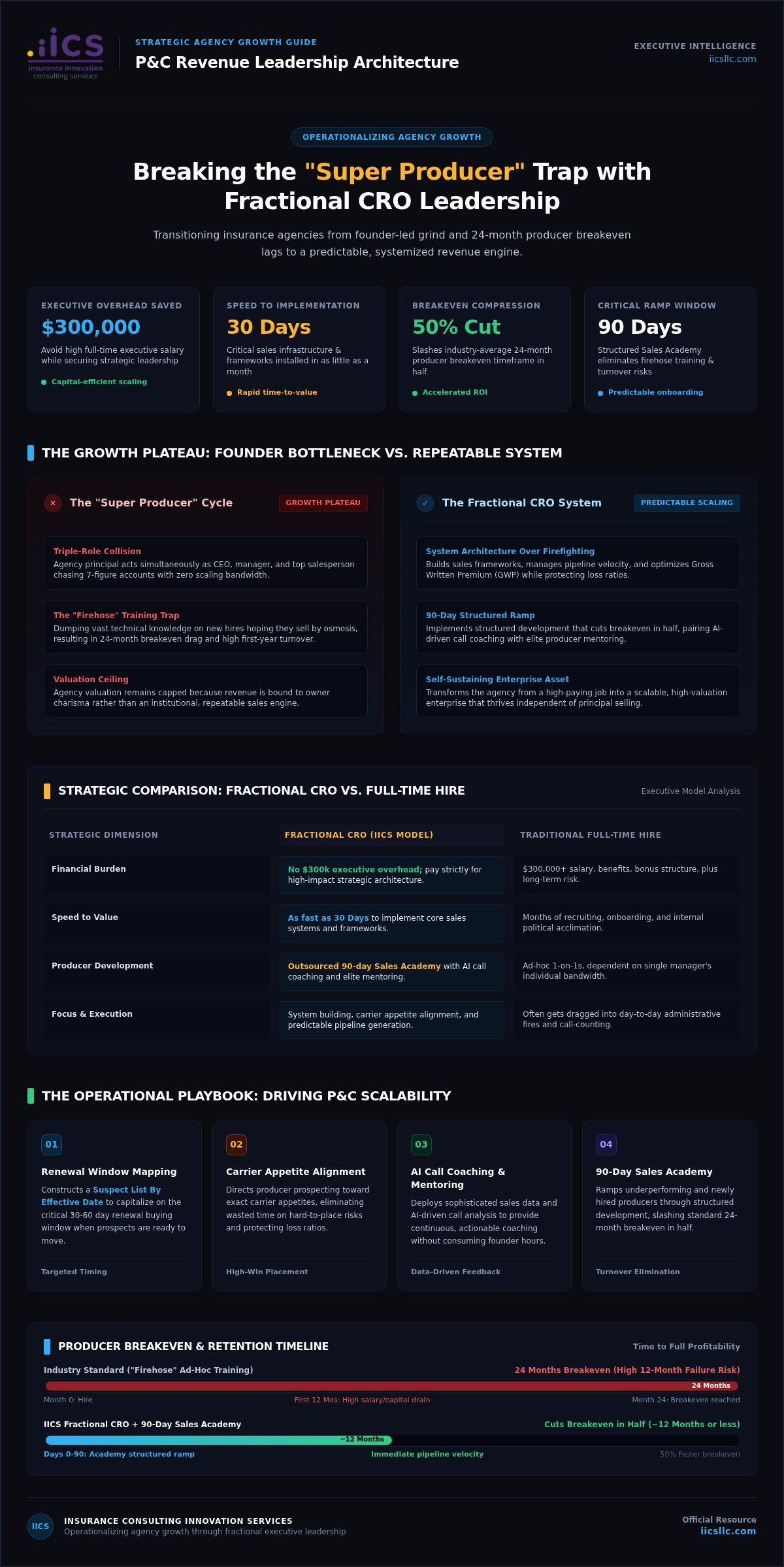
The Fractional CRO Playbook: Operationalizing P&C Growth
Generic sales advice fails in the Commercial P&C world because it ignores the technicalities of the insurance renewal cycle. A fractional chief revenue officer insurance expert doesn't just "motivate" your team; they install a clinical, five step playbook designed to exploit market timing. This is about moving from a culture of random activity to one of systematic precision. Stop guessing which producers will succeed. Start operationalizing the process that makes success inevitable.
The playbook begins with a ruthless audit of current pipeline and producer effectiveness metrics. We look past "calls made" and analyze conversion velocity. From there, we implement a 90-day development system to ramp up underperformers and new hires. This structured approach includes:
Window Trigger Map: Identifying the precise moments when a prospect is most vulnerable to a quote request.
AI Call Coaching: Using objective data to refine sales scripts and roleplay scenarios.
Appetite Alignment: Reviewing carrier appetite and loss ratios to ensure producers aren't wasting time on unplaceable risks.
Mastering the Renewal Buying Window
Timing is everything in P&C. If your producers are reaching out 30 days before a policy expiration, they've already lost. An elite fractional chief revenue officer insurance leader trains the team to initiate contact 60 to 90 days out. This creates a strategic runway to identify "Windows" for standard quote requests before the incumbent agent can lock down the renewal. Mastering this cycle is the foundation of superior Insurance Agency Sales Performance and long term GWP growth.
Building the Elite Producer Habit
Most training fails because of the "firehose" effect. We replace overwhelming seminars with MicroLearning, delivering small, actionable insights that producers can actually use. The goal is to commit to three basic habits every week for 90 days. We use specific tools like the "Small Commercial Focus Filter" to help producers prioritize high value suspects over low commission distractions. This discipline transforms average employees into elite performers who own their results. If you are ready to stop managing by "gut feel" and start leading with data, it's time to explore the Sales Academy framework and see how a fractional CRO can rebuild your agency's DNA.
The IICS Advantage: Fractional Leadership Meets the Sales Academy
Most agencies fail because they mistake random activity for progress. They hire producers, hope for the best, and wonder why the revenue needle doesn't move. Engaging a fractional chief revenue officer insurance leader from IICS ends the guesswork. We don't just offer advice; we install an engine. Our fractional services integrate directly with the 90-day Sales Academy, creating a seamless transition from executive strategy to producer execution. This isn't a theory. It's a battle-tested framework for those who refuse to settle for industry average results.
You gain 1:1 mentoring from a founder with a 40-year track record of continuous growth. This is the same high-level strategic thinking that has driven success at organizations like Pathpoint and Insureon. We've distilled those elite growth strategies into a structured system for independent agencies. You don't need a cheerleader. You need a coach who has navigated every market cycle and knows exactly how to operationalize a sales force for maximum GWP. It's time to stop playing "Super Producer" and start leading a self-sustaining revenue machine.
AI-Driven Growth: The Future of Agency Sales
Growth in 2026 requires more than just grit; it demands technological precision. IICS leverages AI Sales Coaching for Insurance to eliminate the subjectivity of traditional sales management. Our proprietary system scores calls against nine critical criteria, providing producers with real-time feedback that can double their output. Why wait for a quarterly review when your team can improve after every interaction? This data-driven layer ensures that your fractional chief revenue officer insurance expert is making decisions based on objective performance data, not gut feelings.
Scaling to Mastery
We focus exclusively on Commercial P&C. There is no generic sales fluff or "one size fits all" methodology here. Your team receives full access to our effectiveness tools and weekly live workshops, ensuring that elite habits are reinforced until they become second nature. This is about total immersion in a culture of performance. If you are serious about transforming your agency into a high-growth engine, it's time to take the next step. Learn more about the IICS Sales Academy and discover how our structured 90-day system can redefine your agency's future. Positioning for elite performance isn't a dream; it's a strategic mandate.
Reclaim Your Time and Scale Your Agency
Growth in 2026 isn't about working harder; it's about building a system that works for you. You've seen how the "Super Producer" trap kills agency value and why a repeatable sales framework is the only way to break the invisible ceiling. By engaging a fractional chief revenue officer insurance specialist, you secure elite leadership without the massive overhead of a full-time executive. It's the tactical pivot required to turn a stagnant book into a high-growth engine.
IICS brings a 40-year track record of continuous growth, leveraging the same strategies that fueled success for Pathpoint and Insureon. We don't just provide advice. We deploy proprietary AI Sales Coaching technology to score calls and double producer output. This is about moving from gut-feel management to data-driven mastery. Are you ready to stop firefighting and start leading? It's time to operationalize your growth and build a self-sustaining revenue engine. Scale Your Agency with IICS Fractional Leadership today and start your journey toward elite performance.
Frequently Asked Questions
What is a fractional CRO in the context of an insurance agency?
A fractional CRO is an elite, part-time executive who architects the agency’s growth strategy and operationalizes the sales engine. They focus on Gross Written Premium growth, pipeline management, and producer effectiveness without the $300,000 overhead of a full-time hire. Unlike a tactical manager, they build systems that ensure long-term scalability and agency valuation. This role is designed for agencies needing veteran leadership to bridge the gap between high-level vision and daily producer execution.
How does a fractional CRO differ from an insurance sales consultant?
Consultants typically offer high-level advice and leave; a fractional chief revenue officer insurance leader takes ownership of your results. While a consultant provides a firehose of information, a CRO installs a repeatable development framework like our 90-day Sales Academy. They manage producer accountability, align activities with carrier appetite, and integrate advanced tools into the daily workflow. This ensures a permanent cultural transformation rather than a temporary boost in activity.
How much does a fractional chief revenue officer for insurance cost?
The cost of engaging a fractional CRO is a strategic investment that scales with your agency's needs. It is significantly lower than the $300,000 base salary often required for a full-time executive hire. Pricing typically depends on the number of producers and the complexity of the sales engine being built. This model allows you to access elite leadership and battle-tested systems without the heavy fixed overhead of a traditional C-suite position.
Can a fractional CRO help with producer recruitment and onboarding?
A fractional CRO provides the structure that makes recruitment and onboarding successful. They define the elite producer profile and install the 90-day development system that cuts the 24-month industry average breakeven time in half. By providing a clear roadmap from day one, including daily micro-learning and AI-driven feedback, the CRO ensures new hires reach profitability faster. This reduces the financial drain and cultural erosion caused by high producer turnover.
How long does it take to see results from a fractional CRO engagement?
Most agencies begin seeing systemic improvements within the first 30 days. While permanent cultural shifts take longer, the implementation of a Suspect List By Effective Date provides immediate pipeline clarity. Producers typically show measurable gains in conversion velocity and new client acquisition within the first 90-day cycle of our Sales Academy. This speed is driven by consistent accountability and real-time AI coaching that identifies skill gaps in days, not months.
Is a fractional CRO suitable for small independent agencies?
What metrics should an insurance CRO track to ensure growth?
A sophisticated CRO tracks metrics beyond simple call volume to protect agency valuation. Key performance indicators include lead-to-prospect conversion rates, account acquisition velocity, and GWP growth per producer. They also monitor loss ratios and carrier appetite alignment to ensure the book of business remains profitable. Using AI-driven effectiveness tools allows the CRO to score calls against nine critical criteria, providing an objective view of the sales team’s progress and immediate skill gaps.
How does AI call coaching integrate with fractional leadership?
AI call coaching acts as the eyes and ears of the fractional chief revenue officer insurance expert. It provides real-time feedback to producers on every interaction, scoring performance against nine specific tactical criteria. This data allows the CRO to identify skill gaps immediately instead of waiting for quarterly reviews. It creates a culture of radical accountability where producers receive the guidance they need to refine their pitch and close business with clinical precision.