From Good to Great: Become a Better Insurance Producer
Updated: Oct 6
What separates a good producer from a great one may not be talent, but a system they can repeat. The move from good to great insurance producer performance starts when prospecting, discovery, follow-up, and renewal conversations no longer depend on motivation or incoming quote requests. Strong producers build habits that create qualified opportunities and help clients make informed decisions. Consistency is the advantage.
You may already know what effective selling looks like. The challenge is doing it reliably while managing a full pipeline, changing market conditions, and competing priorities. Written premium alone won’t show whether your activity is building durable momentum. You need clear measures for the behaviors that lead to results, along with a practical way to strengthen those behaviors through practice and useful feedback.
This article lays out a routine for commercial P&C producers, from focused prospecting and deeper discovery to disciplined follow-up and proactive renewal conversations. You’ll also learn how to assess progress beyond premium and create a development path with practice, coaching, and accountability. The goal isn’t to work harder at random. It’s to make better performance repeatable.
Table of Contents
What separates a good insurance producer from a great one?
A good commercial insurance producer can execute the fundamentals: respond to prospects, gather information, present options, and service accounts. A great producer makes those fundamentals consistent, client-centered, and measurable. The difference isn’t personality or one unusually strong sales month. It’s a repeatable way of working that improves conversations and gives the producer evidence of progress.
A great commercial P&C producer prepares carefully, learns how a client’s operations create risk, explains coverage clearly, and follows through so clients can make informed decisions. A high-level overview of what insurance is provides useful context for the role. In practice, a producer connects that purpose to each prospect’s actual operations and exposures instead of defaulting to a product pitch.
What does great producer performance look like in commercial P&C?
It starts before the meeting. The producer reviews what’s known about the prospect, prepares relevant questions, and uses discovery to understand how the business operates. A contractor, for example, may need a different risk conversation from a professional-services firm when evaluating exposures like general liability or commercial auto—an operational focus shared by firms like Hako Risk Advisors. Ask about the work, people, property, and possible disruptions before discussing coverage options.
Great producers also explain trade-offs in plain language, invite questions, and agree on a clear next step. They don’t pressure clients or promise the lowest premium. They build trust by helping clients understand their choices, then maintain contact through disciplined follow-up and reliable renewal engagement. The standard is observable: Were relevant questions asked? Were the client’s concerns addressed? Was the agreed next step completed?
Why effort alone does not make a producer great
A packed calendar can hide weak sales habits. Activity becomes purposeful when it serves a defined prospect or client need and moves the relationship toward a clear next step. Logging calls without prioritizing suitable prospects, preparing for conversations, or following through on commitments can create motion without momentum.
Inconsistent prospecting makes the pipeline unpredictable. A producer who prospects only when renewal work slows may face stretches with too few qualified opportunities. Protecting regular time for outreach, even during busy periods, makes pipeline-building less dependent on urgency.
Not every result is under a producer’s control. Carrier appetite, pricing, coverage availability, and broader market conditions can affect whether an account moves forward. Great producers recognize those variables without using them to excuse inconsistent execution. They track the actions they can own, such as preparation, quality of discovery, timely follow-up, and renewal engagement. That’s the practical shift from good to great insurance producer performance: control the process, learn from the evidence, and keep improving the work.
Build the commercial insurance skills that improve every client conversation
Strong commercial sales conversations aren’t improvised. They bring together four skills: discovery, clear risk explanation, thoughtful objection handling, and disciplined next steps. To choose a development priority, review a recent call or meeting and ask: Did I learn how the business operates? Did I explain the risk in terms the client could follow? Did I respond to concerns with curiosity? Did we agree on what happens next? The weakest answer points to a skill worth practicing.
A quote request is a starting point. A complete risk-focused conversation connects the client’s operations and exposures to an informed coverage discussion and a clear next step. Producers who make that distinction are better positioned to serve the client, not just process a transaction—a standard demonstrated by independent firms such as lewisagencytx.com when structuring tailored commercial coverage.
Ask better questions before discussing coverage
Start with open-ended questions, then listen for details that shape the risk picture. For example: “How does work move from order to delivery?” “What’s changed in your operations since we last spoke?” “Which interruption would be hardest for the business to absorb?” These questions can surface changes in equipment, services, locations, or processes that a quick request for limits might miss.
Resist the urge to jump straight to a proposal. Summarize what you heard and confirm you’ve understood before moving forward. Then verify current carrier appetite and relevant policy terms through appropriate, up-to-date sources. Don’t promise that a risk will be accepted, guarantee a coverage result, or interpret wording beyond your authority. Accuracy builds trust; assumptions put it at risk.
Make follow-up and objection handling more deliberate
Every follow-up should give the client a reason to engage: information they requested, a useful clarification, or a decision date you agreed on. Before ending a conversation, confirm who owns the next action and when you’ll reconnect. “Just checking in” rarely creates clarity.
Objections are invitations to understand, not challenges to defeat. If a prospect says, “I’m happy with my current agent,” don’t argue or criticize that relationship. Try: “That’s good to hear. What do you value most about working with them?” Their answer may show there’s no immediate opening, or it may reveal a future point where another perspective could help. Respect the answer and agree on an appropriate next step.
To improve from good to great insurance producer performance, practice one conversation skill at a time. After a call, note what you asked, what you learned, and whether the next step was clear. Revisit the same skill in later conversations and look for evidence of improvement, not just a feeling that the call went well. If structured practice and feedback would help, consider a commercial producer development program.
Diagnose the gap between good and great with a producer self-assessment
“I need to get better at sales” is too vague to guide improvement. A useful assessment identifies a behavior you can observe, measure, and change. Review a consistent period, such as the previous 30 days, and compare what you actually did with the habits that support a stronger pipeline and client experience.
Use this good-versus-great checklist to identify a development priority:
Prospecting: Good producers reach out when time allows. Great producers protect regular outreach time, focus on suitable prospects, and can describe their pipeline and upcoming effective dates.
Discovery: Good producers collect the information needed to quote. Great producers document operational changes, relevant exposures, and the client’s priorities before moving to coverage discussions.
Follow-up: Good producers reconnect when they remember. Great producers record the agreed next step, who owns it, and when it should happen.
Renewals: Good producers handle renewal tasks as they arise. Great producers track effective dates and begin conversations early enough for the client to review changing operations, exposures, and options.
Learning: Good producers rely on experience. Great producers review calls or meetings, seek specific feedback, and practice a skill they can use in upcoming conversations.
Which behaviors should a producer assess first?
Start with pipeline quality, not just its size. Can you identify each opportunity’s fit, stage, effective date, and next action? Then review a sample of recent conversations. Did discovery capture meaningful business changes and risk details, or stop at basic information? For renewals, check whether outreach began early enough to support an informed review and placement. Choose the gap that appears repeatedly, not the one that feels easiest to fix.
Track activity and conversion using definitions everyone understands. For example, define a “quality conversation” before counting one, and decide whether conversion means a prospect agreeing to a meeting, requesting a proposal, or becoming a client. Record the same measures over the same time period at each review. A consistent baseline helps show whether a change in behavior is producing a change in results.
How should agency leaders interpret performance measures?
Pair outcomes, such as new business or retention, with leading indicators producers can influence, including completed follow-ups, quality conversations, and renewal reviews initiated. If results lag while the habits are strong, investigate external factors such as market conditions, carrier appetite, or account mix. If follow-ups are routinely missed, that points to a coaching opportunity.
Don’t turn one producer’s numbers into a universal standard. Targets may differ by role, book, experience, and market. Leaders should establish clear definitions, review comparable client and pipeline data, and use measures to guide coaching rather than label people. This evidence-based approach makes the shift from good to great insurance producer performance specific: identify one behavior, practice it, then check whether the evidence changes.
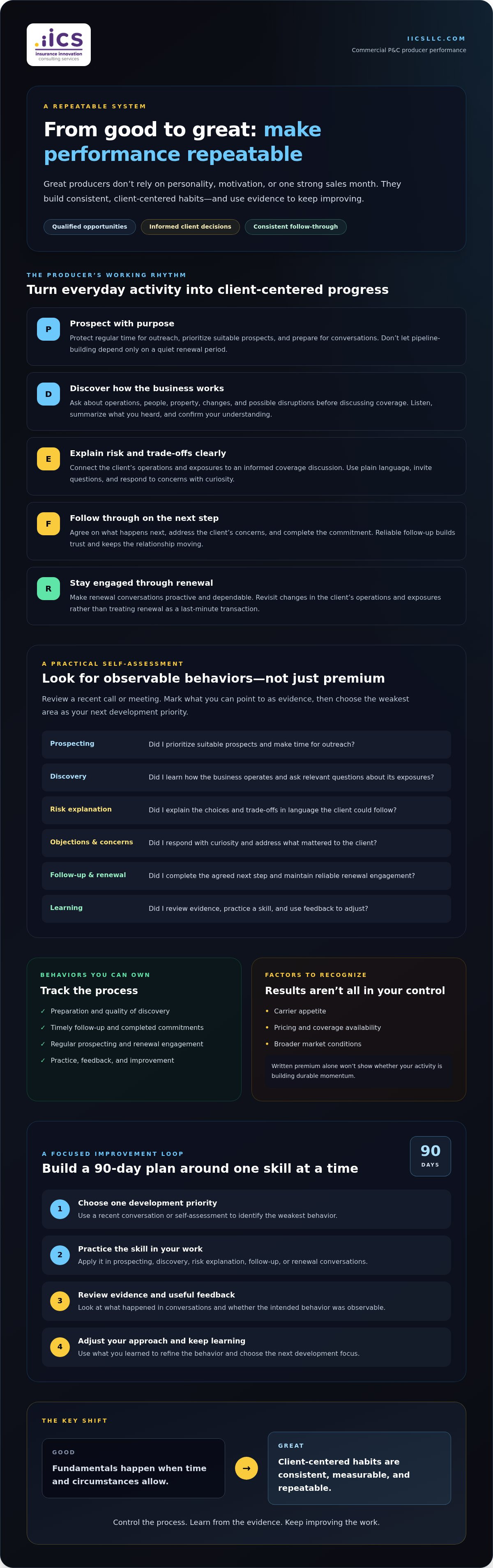
Create a 90-day action plan to move from good to great
A development plan only works if it fits the producer’s real workload. Use the next 90 days to focus on one high-impact behavior, practice it consistently, review evidence, and adjust. Don’t try to overhaul every part of your sales process at once.
Choose one skill, schedule the practice, review real examples, and adjust at a set checkpoint. For instance, if discovery calls often miss operational changes, practice a small set of open-ended questions in upcoming meetings. Afterward, note what you asked, what you learned, and whether the client’s details changed your understanding of the risk.
Turn a self-assessment into weekly practice
Build a weekly rhythm around the work that keeps opportunities moving: protect time for prospecting, prepare before client conversations, complete agreed follow-ups, and reserve a short block to reflect. Keep the routine realistic. A schedule that repeatedly gets displaced isn’t a system.
Days 1-30: Select one behavior from your assessment, set a baseline, and practice it in relevant conversations.
Days 31-60: Review call or meeting examples with a coach or manager. Agree on one adjustment and apply it in the next round of practice.
Days 61-90: Compare current examples with the baseline, assess progress, and decide whether to reinforce the skill or focus on a new priority.
Build renewal outreach into the plan, too. Use effective dates to organize the workload and begin outreach 60-90 days before policy expiration. This gives time for clients to review changing operations, exposures, and options before renewal. The appropriate process may vary by account and agency workflow.
Measure progress without confusing activity with results
Agree on a small set of measures before practice begins. Pair leading indicators, such as prospecting blocks completed, quality conversations, or follow-ups completed as promised, with outcomes such as new business and client retention. Define each measure clearly, use the same time period at each review, and record relevant context, including changes in account mix or carrier appetite.
At the 90-day review, ask: Did the target behavior become more consistent? What evidence supports that conclusion? Did a related outcome change, and what else may have influenced it? These questions keep the review focused on learning rather than crediting or blaming one activity for every result. For a deeper measurement framework, consult your agency’s guidance on sales performance and apply its definitions consistently.
Structured practice, feedback, and accountability can help commercial P&C producers work on specific development priorities.
When structured producer development can close the performance gap
Development works best when its format matches the gap. Self-directed learning offers flexibility, but it can be difficult to sustain without feedback or a clear way to apply new ideas. Internal coaching can connect practice to agency priorities, though its usefulness depends on leaders having time and a consistent coaching approach. Structured external development may suit producers who need a defined cadence, practical exercises, and accountability beyond what the agency can provide internally.
The goal isn’t training for its own sake. It’s to create a reliable cycle: learn a skill, apply it in real conversations, review what happened, and decide what to practice next. That cycle can turn the goal of going from good to great insurance producer into observable professional development.
What should an agency evaluate in a development program?
Look for commercial P&C relevance, practical application, feedback, and a clear learning cadence. Ask how practice connects to actual producer conversations and agency priorities. Clarify the expected time commitment, included resources, and how progress is reviewed. A program should explain what participants will practice and how they’ll receive feedback, not simply provide content to consume.
Consider the trade-offs, too. Self-directed learning leaves the producer in control of pace but requires personal follow-through. Internal coaching can align closely with agency workflows, but may compete with leaders’ other responsibilities. External development can add structure and a fresh coaching perspective, while requiring producers to make time for the work. The right choice depends on the gap and the support already available.
How IICS structures development for commercial P&C producers
For producers who need guided practice and regular feedback, IICS offers a 90-day Sales Academy designed specifically for commercial P&C. Its curriculum combines 60 tactical micro-learning modules with AI call coaching, 1:1 mentoring, weekly group workshops, and monthly coaching. The daily video lessons are short, and the program provides a structured way to learn, apply, and review sales skills. Progress depends on consistent participation and practice.
AI call coaching offers producers another way to review conversations and identify areas to strengthen. Combined with mentoring and workshops, it supports a development process that includes individual feedback and group learning.
Agency leaders can also consider outsourced producer development and fractional CRO/CGO services when they need sales leadership and ongoing producer training. The right fit depends on whether the priority is an individual producer’s skill development or broader agency sales performance.
Make your next producer improvement measurable
Great producer performance isn’t a personality trait or a single strong month. It’s built through client-centered conversations, consistent prospecting and follow-up, and a willingness to review evidence and strengthen one skill at a time. Choose a specific behavior to practice, make room for it in your weekly routine, and measure progress alongside business outcomes. That’s a practical path from good to great insurance producer performance.
IICS offers a 90-day Sales Academy for commercial P&C producers, combining 60 tactical modules, AI call coaching, 1:1 mentoring, and weekly group workshops. IICS founder Ralph J. Blust brings more than 40 years of insurance industry leadership experience.
Ready to build a repeatable development routine?Explore the IICS Sales Academy to review its coaching and practice structure and see whether it fits your goals. Start with one skill, practice it deliberately, and keep measuring your progress.
Frequently Asked Questions
What makes an insurance producer great?
A great commercial P&C producer consistently prepares, asks thoughtful questions about a client’s risks, follows through, and helps clients understand their options. They learn how a business operates before discussing coverage, then verify carrier appetite and policy details with appropriate expertise. Greatness isn’t a personality type or a single strong month. It’s a set of observable habits strengthened through practice, feedback, and reflection.
How can an insurance producer increase sales performance?
Start by reviewing prospecting, discovery, follow-up, and renewal conversations to find one behavior to improve. For example, if next steps aren’t consistently documented, record the action, owner, and date after every client interaction. Practice the behavior, review examples with a manager or coach, and track leading indicators alongside outcomes. Use consistent definitions and review periods that fit the producer’s role and agency.
How long does it take to become a top insurance producer?
There’s no single timeline for becoming a top insurance producer. Progress depends on factors such as experience, role, market, book of business, agency support, and consistency of development. A structured plan can make improvement more deliberate, but it can’t guarantee a particular result or shortcut. Set a review period, choose observable behaviors to strengthen, and use evidence from practice and performance reviews to adjust the plan.
What skills should a commercial insurance producer develop first?
Begin with prospecting discipline, risk-focused discovery, clear explanations, follow-up, and renewal planning. These skills support the sales cycle from identifying a relevant prospect to agreeing on a useful next step. Build product and carrier knowledge alongside them, and verify current carrier appetite and policy wording rather than relying on assumptions. A manager can help prioritize the skill most relevant to your pipeline, client conversations, or responsibilities.
How can an agency tell whether producer training is working?
Agree on intended behaviors and measures before training starts, then review their application over a defined period. Look at practice quality, completed follow-ups, pipeline indicators, and relevant business outcomes. Compare similar roles and opportunities, accounting for differences in markets and books of business. Lesson completion alone doesn’t show that a skill is being used. Coaching conversations can reveal what’s getting in the way and what to reinforce next.
Is AI call coaching enough to improve an insurance producer?
AI call coaching can support consistent call review and help identify opportunities to improve, but it doesn’t replace human judgment, insurance expertise, or deliberate practice. Its value depends on relevant feedback and the producer’s willingness to apply it. A balanced development approach can combine AI feedback with coaching from experienced professionals, peer discussion, and practice on real sales skills. Treat AI as one tool in the learning process, not the whole process.
What is the difference between producer training and producer development?
Training typically focuses on teaching particular knowledge or skills; development supports applying and improving them over time through practice, feedback, and accountability. Commercial P&C producers may benefit from a combination of focused learning, coaching, and opportunities to review real conversations. Before choosing a program, assess the producer’s needs, the relevance of the content, and how progress will be reviewed. Neither training nor development guarantees a particular sales result.