Get Insurance Producers to Prospect Consistently
Updated: 17 hours ago
What if inconsistent prospecting isn’t a motivation problem, but a calendar problem? If you’re asking how to get insurance producers to prospect consistently, you may recognize the pattern: renewals and client service take priority, outreach slips, and then the team scrambles to fill the pipeline. Arbitrary activity targets won’t fix that. Producers need a rhythm tied to real sales opportunities, and managers need measures that show where the process is breaking down.
This article lays out a practical prospecting system producers can repeat and managers can coach without micromanaging. You’ll learn how to use policy expiration dates to plan outreach, set clear activity and pipeline measures, and distinguish inconsistent execution from a weak lead source. You’ll also see how to introduce the system so accountability feels purposeful, not imposed. The goal is steady action built into the workweek, not another burst of effort that disappears when service demands rise.
Table of Contents
Why Insurance Producers Struggle to Prospect Consistently
For a commercial P&C producer, prospecting competes with work that feels urgent because someone is waiting: a renewal needs attention, a client has a service issue, or a colleague needs an answer. Those responsibilities matter, but they don’t necessarily create tomorrow’s pipeline. If outreach has no protected place in the week, it gets pushed aside until the pipeline looks thin. Then the pressure returns, this time as a need to produce results quickly.
That’s why motivation-only campaigns rarely last. A team meeting or short-term challenge can prompt a burst of activity, but without a routine, the behavior often fades as other demands take over. Vague expectations such as “make more calls” make postponement easier. Producers need to know which prospects to work, what action to take next, and when progress will be reviewed. Managers need to provide coaching and useful feedback, not just a target.
Why prospecting loses priority in a busy agency
Service tasks arrive with visible consequences and deadlines. Pipeline work is less immediate: a prospect may not be ready to discuss coverage, may not respond, or may not fit the agency. That uncertainty can make outreach feel less rewarding, even when it matters strategically. The answer isn’t to dismiss service work. While automated tools such as Lead Lock Tek can help keep calendars full and office operations running smoothly, agencies must also make prospecting specific enough to hold its place in a busy schedule.
Before assuming a producer lacks discipline, diagnose the obstacle. Few outreach attempts may point to an execution or capacity issue. Regular attempts with little response may indicate a problem with the prospect list, message, or timing. Conversations that don’t progress may call for practice and coaching. Sales management principles include aligning motivation, training, and accountability. The Sales management principles overview offers context for why a single activity target can’t solve every performance gap.
What consistency means for a commercial P&C producer
Consistency doesn’t mean imposing the same daily call quota on every producer. It means defining scheduled, documented actions that the producer can complete and the manager can review. Those actions might include researching a suitable account, making a planned outreach attempt, following up after a conversation, or recording why a prospect isn’t a fit. The right measures depend on the workflow and lead source.
Consistent prospecting is a repeatable, measurable weekly behavior, not a promise of a particular sales result. Producers control preparation, outreach, follow-up, and accurate records. They don’t control when a prospect is ready to buy, whether the timing aligns, or whether the account is a fit. Track both action and pipeline response so coaching can distinguish a follow-through issue from a timing or source issue.
This is the foundation of a broader agency sales performance framework: clear expectations, producer ownership, and coaching that responds to evidence. A disciplined rhythm supports future pipeline health, but it doesn’t guarantee a specific number of new accounts. The next step is to give that rhythm a practical anchor: policy expiration dates.
Build an Insurance Prospecting System Around Policy Expiration Dates
A policy expiration date gives prospecting a practical anchor. It helps producers identify potential commercial opportunities and plan outreach before a renewal decision is imminent. Instead of starting each week with “Who should I call?”, a producer can work from a forward-looking list organized by effective date. That turns prospecting from a vague intention into a defined workflow, with prospects and timing already in view.
Turn expiration dates into a working prospect list
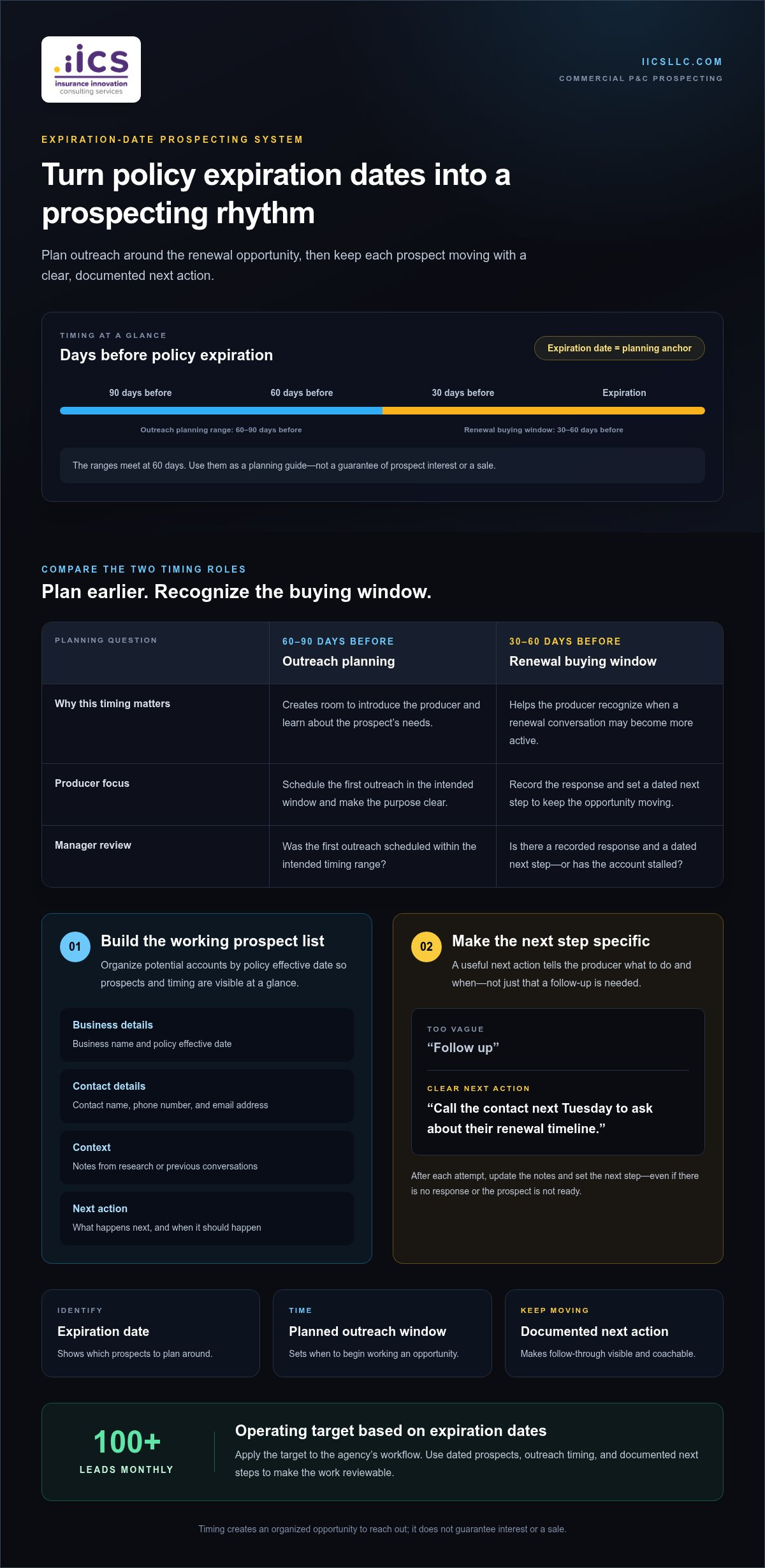
A Suspect List By Effective Date should be useful at a glance. For each prospect, record:
Business name and policy effective date
Contact name, phone number, and email address
Notes from research or previous conversations
The next action and when it should happen
The next-action field is essential. “Follow up” is too vague to guide a busy producer. “Call the contact next Tuesday to ask about their renewal timeline” gives the action a clear purpose. After each attempt, update the notes and set the next step, even if there’s no response or the prospect isn’t ready. A list supports outreach, but it doesn’t replace qualification, a relevant conversation, or the relationship-building needed to understand an account.
Match outreach timing to the renewal opportunity
Use the timing as a planning guide: begin outreach 60 to 90 days before expiration, then account for the 30 to 60-day renewal buying window. These ranges play different roles. Earlier outreach creates room to introduce the producer and learn about the prospect’s needs. The buying window helps the producer recognize when a renewal conversation may become more active. Neither date guarantees interest or a sale.
Managers can review each prospect’s effective date and ask practical questions: Is the first outreach scheduled in the intended window? Has the producer recorded a response? Is there a dated next step, or has the account stalled without explanation? This makes coaching specific to timing and follow-through, rather than relying on a generic activity count.
An expiration date identifies the prospect, a planned outreach window sets the timing, and a documented next action keeps the opportunity moving.
The operating target is at least 100 leads monthly, based on expiration dates. Treat it as a target to apply to the agency’s workflow, not a universal industry benchmark. Managers should consider lead quality, producer capacity, and how the agency defines a workable lead. An expiration-date list creates structure, but producers still need to develop their qualification and sales-cycle skills. Structured producer development can reinforce the habits behind a consistent prospecting process.
Compare Prospecting Approaches: Motivation, Manager Accountability, and Structured Coaching
There isn’t one prospecting approach that fits every producer. Some experienced producers can protect their own time; others need clearer expectations and regular feedback. When activity is happening but conversations aren’t progressing, more reminders won’t fix a skills gap. The useful question isn’t simply whether producers are making enough calls. It’s what support will help them take the right next action consistently.
Think of motivation, manager review, and structured coaching as different levels of support. Motivation can prompt a start, accountability can make progress visible, and coaching can improve execution. Each has a role, and none replaces the others in every situation.
Self-directed habits: The producer owns the calendar blocks and reviews their own progress. This can work well for experienced producers with a clear prospecting plan, but weak follow-through may go unnoticed.
Manager-led review: The manager sets expectations and checks activity and pipeline records. This adds visibility, but inconsistent reviews or feedback focused only on volume can limit its value.
Structured coaching: The producer practices specific sales-cycle skills and receives feedback on execution. This supports development, but progress can stall if practice isn’t connected to real outreach and follow-up.
When individual discipline is enough, and when it is not
An experienced producer with a defined target market and dependable pipeline process may need only protected calendar blocks and a brief weekly self-review. Repeatedly missed blocks, incomplete prospect records, or outreach that stops after the first attempt suggest the producer needs more structure. If activity is steady but response or qualification remains weak, examine lead fit and messaging before raising the target.
Targets should reflect the producer’s role, existing book, available prospecting time, and source quality. A single quota applied to every producer can reward raw volume without showing whether activity is relevant or advancing an opportunity.
What coaching adds to activity tracking
An activity log can show how often a producer reached out. On its own, it can’t show whether the conversation uncovered a business need, established a relevant reason to reconnect, or ended with a clear next step. Reviewing a sample of calls or notes adds context. A manager can reinforce effective discovery, help refine an opening, or practice a response to a common objection, then agree on what the producer will try next.
AI call coaching can provide another feedback option alongside manager input and 1:1 practice. IICS includes AI sales coaching for insurance in its producer development approach. Whatever the format, the purpose is to turn observations into practice, not simply generate another score to monitor.
IICS cites formal-training benchmarks of 52% higher sales, 31% more new clients, and 53% higher lead-to-prospect conversion. These figures provide a reason to take training seriously, but they don’t promise a particular result for an individual producer or agency. For managers, the practical test is whether activity expectations fit the role, lead quality is considered, and feedback helps producers improve the next conversation.
How to Put a Consistent Prospecting Cadence into Practice
A prospecting cadence becomes workable when producers help define the actions and managers agree in advance how progress will be reviewed. Set those expectations before introducing activity targets. That gives each target a clear purpose and helps it fit the producer’s workload, rather than making it feel like a number imposed from above. Use this rollout to make consistent prospecting part of the agency’s regular operating practice.
Create a weekly rhythm producers can repeat
Ask each producer to reserve recurring prospecting blocks around service and renewal responsibilities. The aim isn’t to pretend every week is identical. Agree on realistic times and on how to reschedule when urgent work interrupts them. Use the Sales Cycle Snapshot to identify three producer-owned steps and the risk-focused questions that will guide each conversation. Then review planned actions and follow-ups during a regular manager check-in.
Select prospects. Have the producer choose accounts that fit the agency’s target and identify a clear reason for outreach. Prioritize opportunities that can be worked thoughtfully, not just names that increase a count.
Schedule outreach. Put specific prospecting blocks and follow-up actions on the calendar. Account for the producer’s current service and renewal workload, and agree on how to protect or reschedule the time.
Record outcomes. After each action, capture whether contact was made, what was learned, and the next step with a date. “Try again” isn’t a plan. Record what the producer will do and when.
Review progress. At the agreed check-in, compare planned actions with completed actions, conversations, follow-ups, and account outcomes. Decide together what to keep, adjust, or practice next.
Measure progress without turning coaching into micromanagement
Use a small set of measures to make coaching useful: planned outreach, completed actions, conversations, documented next steps, and new-account outcomes. Each measure tells a different part of the story. If planned actions aren’t completed, explore workload, confidence, or process friction. If activity is happening but conversations aren’t developing, review targeting, lead quality, and the producer’s approach before raising the activity expectation.
When commitments are missed, don’t jump straight to tighter monitoring. Ask what blocked the plan, agree on a specific adjustment with the producer, and document the next review date. If lead quality is weak, examine the source and fit of the prospects rather than treating more outreach as the automatic fix. Accountability means clear ownership and follow-through, not watching every move.
The target of 3 to 5 new accounts monthly can help frame performance discussions, but it isn’t a promised result or a universal quota for every producer. Review it alongside the producer’s role, capacity, activity, lead quality, and pipeline progress. A consistent cadence gives managers evidence to coach and producers a clear process to own. IICS’s producer training and coaching supports agencies working to develop those skills and routines: explore IICS producer training and coaching.
How IICS Helps Agencies Build Lasting Producer Prospecting Habits
A prospecting calendar gives producers a process. Sustaining that process takes practice, useful feedback, and leadership that reinforces the behavior over time. For commercial P&C agencies that need more than a one-time activity push, IICS’s Sales Academy provides a structured producer-development program. It connects learning with sales-cycle actions, helping producers develop the skills behind prospecting as well as the activity itself.
Connect daily practice with coaching and accountability
The 90-day Sales Academy includes 60 tactical microlearning modules, daily lessons, mentoring, AI call coaching, and weekly group workshops. Short lessons help producers focus on a specific skill and apply it in their work. For example, a producer can practice preparing for an initial conversation, use that skill in outreach, then bring questions or learning points into a coaching session. The goal is consistent application, not simply completing lessons.
AI call coaching provides feedback on sales conversations and helps producers reflect on what happened and identify an area to practice. It supports development; it isn’t lead generation and doesn’t guarantee production outcomes. Mentoring and workshops add human discussion and practice, while managers can connect learning activities to each producer’s agreed prospecting actions. The 90-day Sales Academy brings these elements together in a structured development program.
Choose a next step that fits the agency’s development needs
First, identify whether the gap is individual or systemic. If one producer struggles to open conversations or follow through while peers use the same process successfully, focused skill practice and feedback may be the right starting point. If the whole team lacks clear expectations, reliable coaching, or a shared prospecting routine, leaders may need to address the management process as well as individual development. Training is most useful when it responds to a specific performance need.
IICS brings more than 40 years of insurance-industry leadership experience to producer development. That experience informs its work with agencies and individual producers. The IICS leadership background provides more information about that experience. IICS also provides outsourced producer development and fractional CRO/CGO services for agencies seeking sales leadership and ongoing training.
Want to move from sporadic outreach to a development plan producers can practice and managers can coach? Start a conversation with IICS about the skills, habits, and support your agency needs. Explore producer development with IICS.
Make the Next Prospecting Week More Intentional
The best time to strengthen a prospecting routine is before the pipeline becomes a source of pressure. Choose one practical change to put into action this week, then observe what helps producers follow through and what gets in their way. A schedule is a starting point, not a rigid script. Use what the team learns to refine the routine so it fits actual workloads and supports better conversations.
If you’re deciding how to get insurance producers to prospect consistently, focus on building a system the team can sustain and improve. Producers should understand what they own, while managers create space for useful feedback and adjustments. That balance keeps accountability connected to development rather than surveillance. Small, deliberate refinements can turn prospecting from an occasional push into part of how the agency operates.
IICS brings more than 40 years of insurance-industry leadership experience to producer development. Its Sales Academy combines daily microlearning, AI call coaching, mentoring, and weekly workshops. Use a structured development approach to help your team practice a prospecting rhythm and give managers a clear way to coach it. Explore producer development with IICS.
Frequently Asked Questions
Is cold calling still effective for commercial insurance producers?
Yes, cold calling can open commercial insurance conversations when it’s targeted and relevant, but dialing alone isn’t a strategy. Before calling, identify why the account might be a fit and prepare a concise reason for reaching out. For example, refer to the prospect’s industry and ask whether they’re reviewing a particular risk or upcoming coverage decision. Treat a call as the start of a relationship, not a demand for an immediate quote.
How many prospecting calls should an insurance producer make each day?
There’s no daily call count that fits every producer because books of business, service duties, prospect sources, and roles differ. Set expectations based on available prospecting time and the work needed to reach suitable accounts. A producer with a short outreach block might plan a focused set of calls, then review connections and follow-ups. Measure meaningful attempts and resulting conversations, not just dials, and adjust the plan if the quality of activity is low.
Can insurance producers prospect consistently without buying leads?
Yes. Producers can develop prospects through policy expiration research, professional relationships, referrals, networking, and relevant public business information. The key is to build a dependable source that fits the agency’s target market, then qualify each prospect before investing time in outreach. Self-sourced prospecting takes research and persistence; a name on a list isn’t automatically an opportunity. While commercial trade and service businesses frequently implement structured lead generation frameworks through specialized providers like Growth Local to ensure consistent inbound opportunities, insurance producers relying on direct outreach must keep their source and targeting rationale visible so managers can evaluate pipeline health.
What should a producer include in a first prospecting email?
A first email should make its relevance clear quickly. Use a specific subject line, identify yourself and your agency, explain why you’re contacting that business, and ask one easy-to-answer question. For example, mention the prospect’s industry and ask who handles discussions about risk management or insurance planning. Keep the message concise, avoid unsupported claims about their current coverage, and suggest a reasonable next step. Personalize the note rather than sending a generic pitch to a broad list.
How can a manager tell whether low results come from poor leads or weak follow-up?
Compare patterns across the prospect list and the producer’s documented actions. If suitable prospects rarely respond despite timely, repeated attempts, review the source, targeting, and message. If prospects engage but agreed next steps aren’t completed, follow-up execution may be the gap. Listen to sample conversations and inspect notes for evidence: Was the right contact reached? Did the producer learn anything useful? Was a next action agreed? Diagnose the cause before changing targets.
How long does it take an insurance producer to build a consistent prospecting habit?
There’s no reliable fixed timeline for every producer. The pace depends on how clear the routine is, how often it’s practiced, and whether the schedule accounts for service demands and interruptions. Start with a manageable recurring commitment and review it regularly. If the producer repeatedly misses it, identify the barrier rather than simply extending the timeline. Confidence, workable prospect lists, and timely feedback can all affect whether the routine becomes sustainable.
Can AI coaching help insurance producers improve prospecting conversations?
Yes, AI coaching can help producers review sales conversations and identify moments to practice, such as the opening, discovery questions, or how a call ends. It’s most useful when feedback leads to a specific action, like asking a clearer follow-up question on the next call. Producers and managers should use coaching as a development aid, not a substitute for judgment or a guarantee of stronger results. Pair it with real-world practice and human feedback.