How to Build a Predictable Sales Pipeline for Insurance
Updated: Oct 6
What if a dependable commercial insurance pipeline had less to do with bursts of cold calls and more to do with the calendar? When prospecting activity rises and falls, future revenue is hard to forecast. Learning how to build a predictable sales pipeline for insurance starts with replacing sporadic outreach with a repeatable system.
Producers know consistent prospecting matters. The challenge is knowing which accounts to prioritize, when to reach out, and how to move each opportunity through clear stages. Without defined ownership and follow-up habits, even a full pipeline can be difficult to trust.
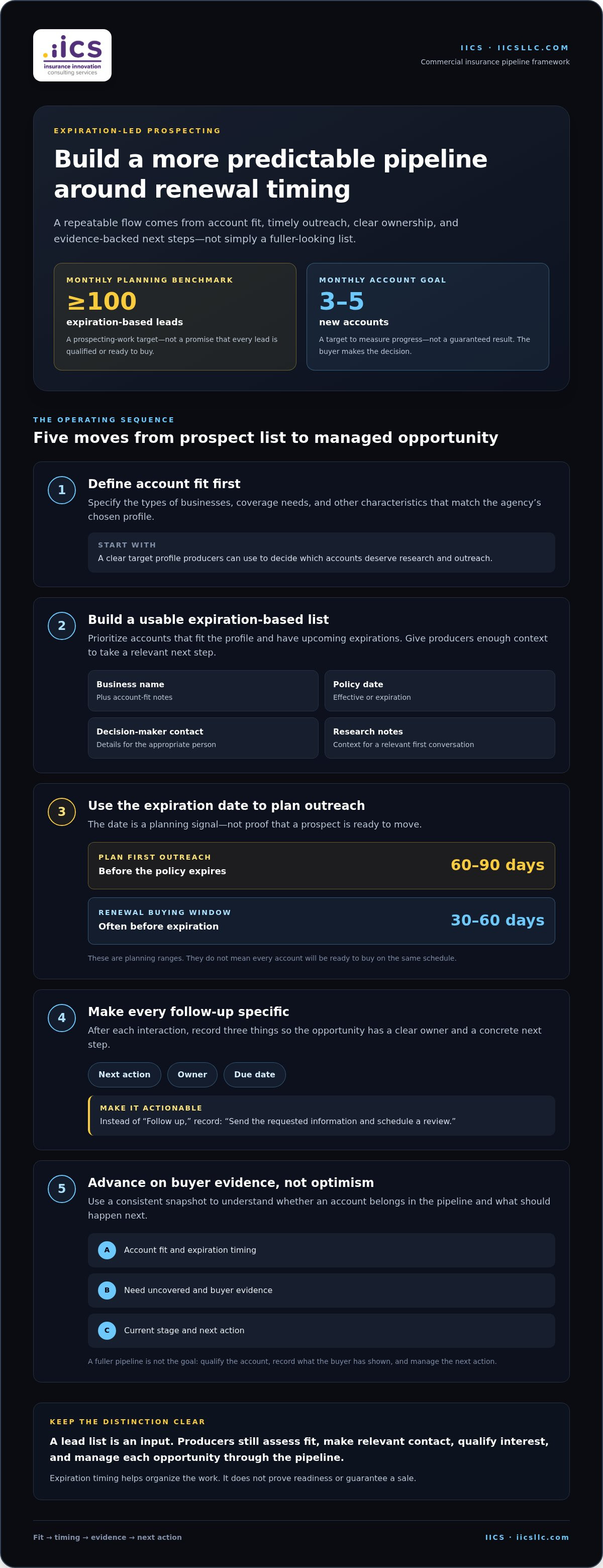
This guide lays out a practical framework built around expiration timing, producer-owned pipeline stages, and measurable weekly execution. You’ll see how to organize expiration-based leads, start prospecting 60-90 days before expiration, and track progress toward a target of 3-5 new accounts monthly. You’ll also learn how coaching can reinforce consistent execution without confusing producer development with lead generation.
Table of Contents
Why an Insurance Sales Pipeline Becomes Unpredictable
A pipeline that depends on the next referral or a burst of end-of-month calls isn't a system. It’s a gamble. When prospecting varies from week to week, producers have fewer qualified opportunities to advance, and agency leaders have less visibility into future revenue.
Commercial property and casualty renewals offer a practical planning signal: policy expiration dates help producers decide which accounts to research and when to begin outreach. An expiration date doesn’t prove a prospect is ready to move or guarantee a sale. Predictability comes from managing the work around those dates, recording buyer evidence, and assigning a clear next action to every opportunity.
What makes an insurance pipeline predictable?
A predictable insurance pipeline is a managed flow of qualified opportunities, each tied to account fit, renewal timing, a defined stage, and a visible next action. That information helps producers and managers see whether opportunities are progressing or sitting untouched.
Separate leading indicators from lagging outcomes. Outreach, scheduled conversations, and completed follow-ups show whether producers are executing the process. Bound accounts show what that work ultimately produced. Since bound business comes after the activity, reviewing both helps producers spot pipeline gaps before they become disappointing sales results.
This is a producer-owned growth system, not a promise of ready-made prospects. A lead list is only an input. Lead generation describes the broader process of attracting and identifying potential customers; producers still need to assess account fit, make relevant contact, qualify buyer interest, and manage each opportunity through the pipeline.
Why policy expiration dates change prospecting priorities
Expiration dates give prospecting a useful anchor. Use outreach 60-90 days before expiration as a planning benchmark, while recognizing that the renewal buying window is often 30-60 days before expiration. These ranges help producers organize early outreach and follow-up. They don’t mean every account will be ready to buy on the same schedule.
For example, a producer can identify accounts with upcoming expirations, research whether they fit the agency’s target profile, and begin outreach within the planned window. In sectors like real estate, consulting resources from specialists like Commercial Property Insurance UK can provide valuable perspective on how property owners evaluate policies and coverage terms. If a decision-maker isn’t ready to talk, record the response and set a relevant next action. The date helps establish priority, not certainty.
That distinction is central to how to build a predictable sales pipeline for insurance. Referrals can contribute valuable opportunities, but relying on them alone leaves timing and volume outside the producer’s control. An expiration-led rhythm gives producers a repeatable way to focus their effort, while qualification and follow-through determine whether an account belongs in the pipeline.
How to Build an Expiration-Led Insurance Pipeline Step by Step
A workable pipeline starts with producer discipline, not a purchased list. In practical sales pipeline management, opportunities move through visible steps. For commercial insurance, expiration timing helps producers decide which accounts to research, prioritize, and approach. Producers remain responsible for qualification and follow-through.
Build and prioritize an expiration-based prospect list
Start by defining account fit. Specify the types of businesses, coverage needs, and other characteristics that align with your agency’s chosen profile. Then build a working suspect list with the details producers need to take action:
Business name and relevant account-fit notes
Policy effective or expiration date
Contact details for the appropriate decision-maker
Research notes that can guide a relevant first conversation
Prioritize accounts that fit your focus and have upcoming expirations. A planning benchmark is at least 100 expiration-based leads monthly. Treat that as a target for organizing prospecting work, not a guarantee that every lead is qualified or ready to buy. While solutions like The Fraction offer automated lead generation systems to help professionals maintain consistent client acquisition, producers must still evaluate account fit and guide each prospect through the sales cycle.
Set outreach and follow-up actions producers can repeat
Schedule first outreach 60-90 days before expiration. This creates time to learn about the account before its renewal decision, but the date alone doesn’t prove buyer readiness. Begin with relevant, risk-focused questions: What exposures or operational changes should you understand? What coverage concerns matter to the business? What information would help determine whether a review makes sense?
After every interaction, record a specific next action, an owner, and a due date. “Follow up” is too vague. “Send the requested information and schedule a review” gives the producer a clear commitment and makes the opportunity easier to manage.
Use a simple sales-cycle snapshot to connect the conversation to pipeline progress: account fit, expiration timing, need uncovered, buyer evidence, current stage, and next action. Advance an account when the evidence supports it, not because a producer wants a fuller-looking pipeline. The goal of 3-5 new accounts monthly is a target, not a promised result. Consistent execution makes the process measurable, but the buyer still makes the decision.
That’s the operating discipline behind how to build a predictable sales pipeline for insurance: producers create and manage opportunities themselves rather than mistaking lead supply for sales progress. IICS’s producer development training can help agencies reinforce prospecting and follow-through habits.
Which Pipeline Stages and Metrics Reveal Real Sales Progress?
A pipeline stage should describe what the buyer has done and what the producer will do next. Labels like “hot” or “working” don’t forecast anything on their own. To understand how to build a predictable sales pipeline for insurance, define each stage using observable evidence, then apply those definitions consistently across producers.
Define stages around buyer progress and producer commitments
Use a sequence that reflects a commercial account’s progress, from initial fit through a decision. For every opportunity, capture the stage, evidence that qualifies it, the next producer action, and how long it has remained there.
Identified account: The business appears to fit the agency’s profile. Record the basis for that fit and relevant expiration timing.
Contacted: Outreach has been made. Record the response, if any, and the next attempt or agreed follow-up.
Discovery: A conversation has surfaced a potential need, renewal timing, or other relevant buyer information. Document what the buyer shared and the next agreed step.
Proposal: A proposal has been presented in response to an identified need. Record the buyer’s feedback and decision timeline.
Decision: The buyer is evaluating options or has indicated a decision. Track outstanding questions and the next scheduled action.
Outcome: Record whether the account was won, lost, or deferred, along with the relevant reason.
Don’t advance an opportunity just because a producer sent another email. Advance it when there’s evidence of buyer need and timing, along with a clear next action. An agency management system or CRM can capture stage changes, dates, follow-up ownership, and aging. The tool matters less than consistent, accurate updates.
Choose leading indicators that improve forecasting
Review measures that show whether producers are building and moving opportunities, then compare them with results. Useful leading indicators include expiration-based prospects added, timely outreach completed, conversations held, and next actions recorded. Pair these with stage conversion, time in each stage, new-client outcomes, and the account-quality criteria set by the agency.
Outreach counts measure pipeline activity; buyer-confirmed need, renewal timing, stage evidence, and an agreed next step make an opportunity more credible for forecasting. A high call count alone can’t tell a manager whether an account is qualified or progressing.
Look for patterns rather than arbitrary benchmarks. If opportunities repeatedly stall after discovery, review whether producers are establishing a clear need and buyer-led timeline. If proposals age without a decision, examine the recorded follow-up and buyer feedback. Consistent stage definitions turn these patterns into specific coaching conversations while keeping activity, conversion, new-client results, and account quality distinct.
How to Run a Weekly Pipeline Rhythm Without Creating Busywork
A pipeline review should change what producers do next. If the meeting only counts calls or repeats CRM entries aloud, it’s activity theater. A useful weekly rhythm checks buyer evidence, upcoming commitments, and where opportunities are getting stuck. That’s how to build a predictable sales pipeline for insurance without turning management into paperwork.
Run a focused producer pipeline review
Use the same sequence each week so producers know what to prepare and managers can spot patterns. Keep the discussion focused on accounts that need a decision or action:
Refresh records. Update stages, buyer evidence, expiration timing, follow-up owners, and due dates.
Review priorities. Ask which accounts have a relevant expiration date, a potential need, and a defined next action.
Inspect stalled opportunities. Find overdue follow-ups and opportunities whose stage lacks current buyer evidence. Requalify them, set a next step, or remove them from active forecasting.
Commit to actions. End with each producer’s named accounts, specific next steps, and dated commitments before the next review.
Coach one behavior. Choose a skill connected to a real pipeline gap, then agree on how the producer will practice it.
Keep the review focused on evidence. “I sent three emails” reports activity; “the decision-maker described a coverage concern and agreed to a follow-up discussion” shows progress. For more guidance on producer performance, see insurance agency sales performance.
Coach the behaviors behind stalled opportunities
Pipeline patterns can show where coaching will matter most. If accounts repeatedly stall after first contact, examine whether producers are reaching the right person and earning a substantive conversation. If discovery doesn’t lead to a defined next step, review how producers ask risk-focused questions and confirm buyer priorities. If follow-ups go overdue, practice concise, relevant ways to re-engage.
Use call reviews to identify one specific behavior, then pair feedback with a practice action. For example, have the producer rehearse a discovery question and a clear way to agree on the next step. “Improve your follow-up” is a warning, not a coaching plan. For a related look at technology-supported call development, read about AI sales coaching for insurance.
A consistent review rhythm makes accountability visible without rewarding empty volume. Learn more about insurance producer development and coaching.
How IICS Helps Agencies Make Pipeline Execution Repeatable
A well-designed pipeline only works if producers use it consistently. Training and coaching reinforce the habits behind the system, including timely outreach, evidence-based stage progression, and clear follow-up ownership. They support execution; they don’t supply leads or guarantee sales results.
IICS’s 90-day Sales Academy develops property and casualty producers through 60 tactical modules, daily microlearning, unlimited AI call coaching, 1:1 mentoring, and weekly workshops. The AI coaching scores calls against nine criteria and provides next-step guidance. Each learning method supports a different part of the routine: short lessons introduce practical skills, call coaching helps producers examine conversations, mentoring provides individualized guidance, and workshops reinforce practice. Agencies can explore the Sales Academy to see how structured development can complement their pipeline process.
Match the development approach to the pipeline problem
Start with the execution gap, not the training format. If a producer struggles to follow up, qualify an account, or move an opportunity forward using buyer evidence, focused coaching can target that behavior. If the agency needs ongoing producer development or broader sales oversight, outsourced producer development or fractional sales leadership may better fit the need. IICS brings more than 40 years of insurance industry leadership experience to producer growth and development.
For more background on that experience, visit IICS leadership experience. The key is to connect development to observable pipeline work, not treat training as a replacement for prospecting or management.
Turn the framework into the next 90 days of action
Choose one pipeline behavior to standardize first, such as recording a specific next action after every prospect conversation. Before training begins, establish a baseline by reviewing how consistently producers record follow-ups and document buyer evidence. Then keep the weekly pipeline review focused on those commitments and use a monthly progress check to identify patterns, reinforce improvement, and adjust coaching priorities.
That’s how to build a predictable sales pipeline for insurance: pair clear producer-owned steps with repeated practice and management follow-through. The aim isn’t to promise a particular outcome. It’s to make the work visible, coachable, and repeatable. Agencies can learn more about IICS producer development.
Turn Pipeline Discipline Into Consistent Producer Execution
A reliable commercial insurance pipeline doesn’t depend on a month-end scramble. It grows from prospecting tied to renewal timing, stages grounded in buyer evidence, and weekly reviews that end with clear producer-owned actions. Track leading indicators alongside bound accounts, and use stalled opportunities to identify where follow-up or coaching needs attention.
That’s the practical answer to how to build a predictable sales pipeline for insurance: create a repeatable process, measure the work that moves opportunities forward, and reinforce it through consistent development. Training doesn’t replace prospecting, but it can help producers execute the system with greater discipline.
IICS brings insurance-specific experience to producer development. Ralph J. Blust has more than 40 years of insurance industry leadership experience, and the 90-day Sales Academy combines 60 tactical modules with AI call coaching, mentoring, and weekly workshops.
Ready to strengthen the habits behind your pipeline? Explore IICS producer development and take the next step toward more consistent execution. With a clear process and committed producers, your agency can build momentum one action at a time.
Frequently Asked Questions
How do insurance agencies create a predictable sales pipeline?
Agencies create a more predictable pipeline by setting a consistent prospecting rhythm, defining producer-owned stages, and recording a clear next action for each qualified opportunity. For commercial P&C, policy expiration dates provide a useful way to prioritize accounts. Review pipeline evidence weekly, coach gaps in follow-up or qualification, and compare leading indicators, such as timely outreach, with outcomes like new accounts. Predictability comes from disciplined execution, not guaranteed sales.
How far ahead of a policy expiration should an insurance producer start outreach?
Use outreach 60-90 days before policy expiration as a planning benchmark. The renewal buying window is typically 30-60 days, so starting earlier can give the producer time to make contact, learn about the account, and follow up. An expiration date is a prioritization signal, not proof that the buyer is ready to change coverage or agents. Record the prospect’s response and agree on a relevant next step.
How many leads should an insurance producer generate each month?
Use at least 100 expiration-based leads monthly as a planning benchmark for commercial prospecting. Treat this as a target for building and managing the prospect pool, not a guarantee that each lead will qualify or convert. Producers should apply the agency’s account-fit criteria, prioritize relevant expiration dates, and track outreach and buyer evidence. A separate target of 3-5 new accounts monthly is a goal, not a promised result.
What stages should a commercial insurance sales pipeline include?
A practical commercial pipeline can include identified account, contacted, discovery, proposal, decision, and outcome. Define each stage by evidence of buyer progress and the producer’s next commitment. For example, an account should move beyond discovery when the producer has documented a relevant need, timing, and agreed next action. Avoid advancing stages simply because outreach occurred. Consistent definitions make pipeline reviews more useful across producers.
Which metrics should an insurance agency track to forecast sales?
Track leading indicators such as expiration-based prospects added, timely outreach, conversations completed, and next actions recorded. Pair those with stage conversion, opportunity aging, new-client outcomes, and account-quality measures chosen by the agency. Activity counts show whether producers are executing; buyer-confirmed need, timing, and an agreed next step offer stronger evidence for forecasting. Review the measures together, and avoid relying on unsupported industry benchmarks or arbitrary conversion targets.
How often should insurance producers review their sales pipeline?
Producers should review pipeline priorities weekly so overdue follow-ups, stalled stages, and upcoming expiration opportunities don’t go unnoticed. Before each review, update stages, buyer evidence, next actions, owners, and due dates. Use the discussion to resolve specific account questions and end with dated commitments. A separate monthly check can help managers look for broader patterns in stage progression and coaching needs without repeating the weekly record-by-record review.
Can sales coaching help improve an insurance producer’s pipeline consistency?
Yes. Focused coaching can help producers strengthen the behaviors that keep opportunities moving, including discovery, risk-focused questions, stage discipline, and relevant follow-up. Managers can review a call, identify one specific skill to improve, and agree on a practical action to practice. Structured development can reinforce the pipeline process, but it doesn’t replace prospecting or guarantee sales results. Consistency improves when coaching connects directly to observable producer actions.