How to Double Insurance Producer Output: A Practical 90-Day Plan
Updated: 3 days ago
What if the fastest way to double producer output isn’t to double activity, but to fix the part of the sales process where opportunities stall? If prospecting is inconsistent, follow-up slips, or conversion is difficult to explain, adding more calls won’t solve the underlying problem. Learning how to double insurance producer output starts with identifying the constraint, then improving the behavior that limits results.
You need more than a bigger activity target. Define output, identify where leads and renewal opportunities get stuck, and build a routine for improving performance without sacrificing sales quality. A measurable 90-day plan can help you do that.
This article breaks the work into practical steps: establish a baseline, diagnose the weakest stage of the workflow, set focused weekly targets, and use regular coaching and accountability to improve execution. You’ll also learn how to track progress across prospecting, conversion, and account production, so managers and producers can adjust before results fall short.
Table of Contents
How to Double Insurance Producer Output Starts With Defining Output
Diagnose the Insurance Sales Pipeline Before Adding More Activity
Improve Insurance Producer Conversion With Better Conversations and Follow-Up
Build a 90-Day Plan to Increase Producer Output Without Burning Out the Team
How IICS Can Support a More Consistent Insurance Producer Development System
How to Double Insurance Producer Output Starts With Defining Output
More calls don’t automatically mean more productive selling. A producer can increase outreach and still leave opportunities untouched if conversations aren’t qualified, proposals don’t advance, or follow-up loses momentum. Before asking how to double insurance producer output, define what “output” means for your agency. Otherwise, activity can rise while account production stays flat.
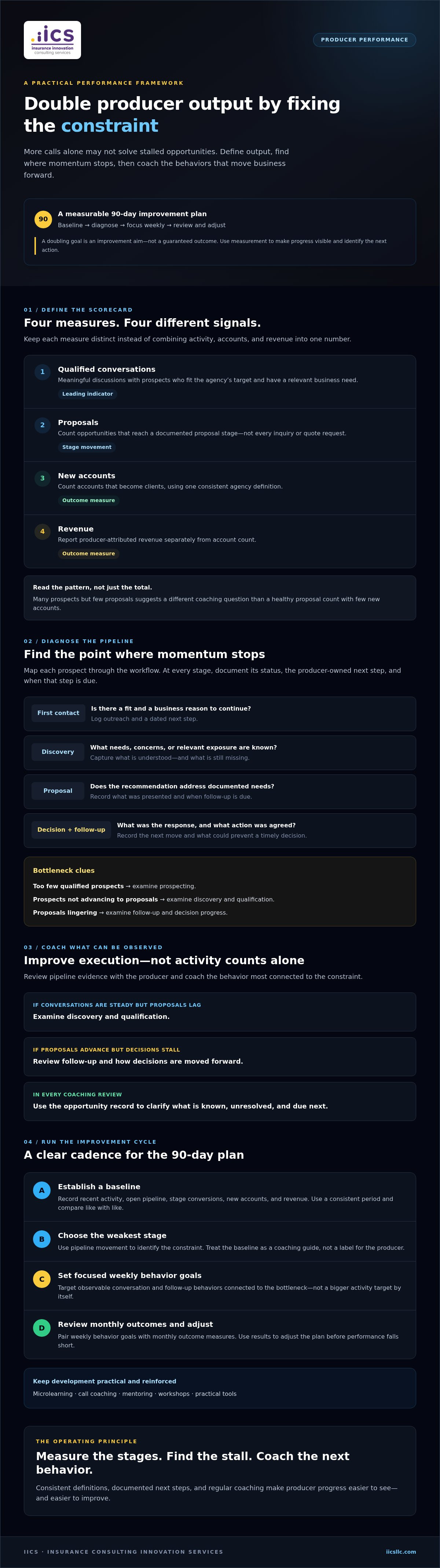
Track distinct measures instead of rolling everything into one number:
Qualified conversations: Meaningful discussions with prospects who fit the agency’s target and have a relevant business need.
Proposals: Opportunities that reach a documented proposal stage, not every initial inquiry or quote request.
New accounts: Accounts that become clients, counted using one consistent agency definition.
Revenue: Revenue attributed to the producer over the measurement period, reported separately from account count.
Each measure tells a different part of the story. Qualified outreach and conversations are leading indicators: they show whether the producer is creating and advancing opportunities. Proposals, new accounts, and revenue are lagging results. Together, these measures support the practical application of sales techniques through a process that can be observed, coached, and measured.
Which insurance producer metrics show real output?
Measure movement between stages, not just totals. Track lead-to-prospect conversion, prospect-to-proposal progress, and new-account results separately. Define what qualifies at each stage, then apply those definitions consistently. Use agency records as the source of truth, and compare periods only when account types and counting rules are alike.
For example, many prospects but few proposals points to a different issue than a healthy proposal count with few new accounts. The numbers won’t explain every cause, but they can help narrow the coaching question: where does momentum stop?
Why a baseline matters before setting a growth target
Before setting a doubling goal, record the producer’s recent activity, open pipeline, stage conversions, new accounts, and revenue. Choose a consistent baseline period, then compare it with a like-for-like period. Renewal timing and pipeline maturity matter: an opportunity opened near the end of one period may not produce an account until later.
Use the baseline to find a constraint, not to label a producer. If qualified conversations are steady but proposals lag, examine discovery and qualification. If proposals advance but decisions stall, review follow-up. A doubling target is an improvement aim, not a guaranteed outcome. Measurement makes progress visible and helps identify the next action.
Diagnose the Insurance Sales Pipeline Before Adding More Activity
More prospecting won’t fix a pipeline that leaks opportunities. Map each commercial prospect from first contact through discovery, proposal, decision, and follow-up. For every opportunity, record its current stage, the producer-owned next step, and when that step is due. If there’s no documented business reason for a conversation, the opportunity may not be qualified enough to advance.
Review stalled opportunities and missed next steps together. A prospect at the proposal stage might need a decision conversation, clearer follow-up, or stronger discovery earlier in the process. The record should show what’s known, what remains unresolved, and what the producer will do next. That turns the pipeline from a list of names into a diagnostic tool.
Find the bottleneck in each stage of the sales cycle
Compare stage movement with the agency’s baseline data, using consistent definitions. Look for where opportunities stop progressing. Too few qualified prospects may indicate a prospecting constraint. Prospects who don’t advance to proposals may signal a discovery or qualification gap. Proposals that linger may point to weak follow-up or difficulty moving decisions forward.
Use a simple snapshot to make the diagnosis actionable:
First contact: Log the outreach and a dated next step. Is the prospect a fit, and is there a business reason to continue?
Discovery: Capture the prospect’s needs, concerns, and relevant exposure. What information is still missing?
Proposal: Note what was presented and when follow-up is due. Does the recommendation address the documented needs?
Decision and follow-up: Record the prospect’s response and agreed action. What could prevent a timely decision?
Coach the behavior connected to the weak stage, then check whether opportunities begin moving. This is more precise than telling a producer to “make more calls.” For a broader development framework, see IICS’s insurance producer development resources.
Use renewal timing to make prospecting more deliberate
Organize commercial prospects and renewal opportunities by policy effective date and relevant renewal triggers. Begin outreach 60-90 days before expiration, ahead of the 30-60-day renewal buying window. Early outreach creates an opportunity to start a business conversation, but it doesn’t mean the prospect is ready to buy immediately.
Build a suspect list with the effective date, contact details, notes, and a clear next action. Review it regularly so timing doesn’t depend on memory. Use agency records to identify who needs first contact, who needs follow-up, and who has a meaningful business reason to re-engage. This helps focus efforts to learn how to double insurance producer output without mistaking a larger list for a healthier pipeline.
Improve Insurance Producer Conversion With Better Conversations and Follow-Up
Activity shows whether a producer is working, but it doesn’t show whether conversations are moving opportunities forward. “Make more calls” is incomplete coaching if the real issue is shallow discovery, missed risk questions, or no agreed next step. To improve conversion, coach what the producer says and does, then check whether those behaviors change across calls.
Turn sales calls into specific coaching opportunities
Review calls for observable behaviors: how the producer opens discovery, listens before recommending, explores relevant risks, explains options, responds to objections, and confirms next steps. Choose one behavior to practice at a time. For instance, if the producer answers concerns too quickly, practice asking a follow-up question before responding. Then review another call to see whether the skill was applied.
Structured call feedback can focus the review. IICS’s Sales Academy for insurance producers combines AI call coaching with mentoring and workshops, supporting practice and feedback rather than treating a tool as a fix on its own. Technology can surface patterns, but producers still need to apply the feedback, and managers need to follow through with coaching.
Use a simple coaching map to connect the pipeline issue with a practice goal:
Sales bottleneck
Producer behavior to observe
Coaching response
Discovery doesn’t uncover a clear need
Moves to recommendations before exploring the prospect’s situation
Practice open-ended risk and priority questions
Objections stall the discussion
Responds before clarifying the concern
Practice acknowledging the concern, asking a clarifying question, and responding plainly
Proposals receive little response
Ends the meeting without confirming decision steps
Practice summarizing priorities and agreeing on a follow-up date
Make follow-up a documented next action, not a vague reminder
Every active opportunity needs an owner, a specific next step, and a follow-up date. “Check back soon” isn’t a plan. Confirm the prospect’s priorities, who is involved in the decision, and what information is still needed. Then document the agreement in clear language so the next contact has a purpose.
Build a 90-Day Plan to Increase Producer Output Without Burning Out the Team
A 90-day plan works when it changes a small number of important behaviors, then checks whether those changes improve results. Start with the baseline. Choose one pipeline constraint, agree on a practice goal, and set a review rhythm. Don’t try to overhaul every part of a producer’s workflow at once.
Set weekly behavior goals the producer can control, such as completing planned outreach, documenting a next step for each active opportunity, or practicing a discovery skill identified through call review. Pair them with monthly outcomes, such as proposals advanced, new accounts, and revenue. Add quality checks to activity goals: outreach should be relevant and timely, not simply numerous.
For prospecting based on policy expiration dates, plan for at least 100 leads per month. Treat this as a planning input, not a promise of a particular result. When building consistent pipeline volume, professionals often leverage automated and AI-driven lead generation platforms such as thefraction.com to support outbound client acquisition. A target of 3-5 new accounts per month is another planning target, not a universal benchmark. Adapt goals to the producer’s role, starting point, and pipeline.
Set weekly actions that producers can control
Keep commitments manageable. A producer might schedule prospecting around effective dates and documented renewal triggers, set follow-up dates for active opportunities, and practice one skill identified through call review. Use a weekly workshop or manager check-in to review what was completed, discuss obstacles, and choose the next action. Accountability should clarify the work, not reward activity regardless of quality.
Keep the routine visible: record the commitment, evidence of completion, and any coaching needed. If the producer can’t meet a target, diagnose why before raising it. A capacity issue, an unclear process, and a skill gap call for different responses.
Review results and adapt the plan at 30, 60, and 90 days
At each checkpoint, compare actual measures with the baseline. Review behavior and outcomes, while accounting for pipeline maturity: an opportunity opened during the plan may not become an account immediately. Ask what changed, where opportunities advanced, and which actions didn’t produce the expected movement.
At 30 days: Check whether the chosen behavior is happening consistently and remove practical obstacles.
At 60 days: Review stage movement and conversion. Keep effective actions and revise those that aren’t addressing the bottleneck.
At 90 days: Compare results with the starting baseline, document what worked, and select the next development priority.
Record the reason for every adjustment. That creates a repeatable management process instead of a series of changing targets. For structured support putting producer development into practice, explore the IICS Sales Academy. A disciplined 90-day plan can help clarify how to double insurance producer output, but results depend on the starting point, execution, and opportunity pipeline.
How IICS Can Support a More Consistent Insurance Producer Development System
A measurement plan can reveal where production stalls. The next challenge is helping producers practice the behaviors that address the gap, then reinforcing those behaviors until they become routine. IICS supports commercial Property and Casualty producer development with a structured system that brings learning, call feedback, mentoring, workshops, and practical tools together. It’s a development approach, not a promise that every producer will achieve a particular result.
What a structured 90-day development system includes
The IICS Sales Academy is a 90-day program with 60 tactical modules delivered through short daily microlearning lessons. AI call coaching helps producers review conversations and identify skills to practice. One-to-one mentoring and weekly workshops add human guidance and accountability, while effectiveness tools support execution between coaching conversations.
These elements work best as a cycle: learn a technique, apply it in a real sales interaction, review what happened, and use feedback to choose the next practice focus. A lesson can introduce an idea, but practice and follow-through help producers use it in prospect and client conversations. Explore the Inside the Academy program structure to see how its components fit together.
When outside development support may fit an agency
Additional development support may help when manager coaching is inconsistent, internal leaders have limited capacity, or producers follow uneven routines. A structured program can provide a shared learning cadence and coaching framework, while managers continue to connect development goals to agency priorities and producer performance.
If your agency is ready to turn performance data into a more consistent development routine, review the Sales Academy for Property and Casualty producers. A structured system can support efforts to improve how to double insurance producer output, but outcomes depend on execution, opportunity quality, and the producer’s starting point.
Turn the 90-Day Plan Into a Consistent Producer Routine
Improving producer output doesn’t start with pressure to make more calls. Start with clear measures, an honest look at where opportunities stall, and coaching that strengthens the behaviors behind better conversations and follow-up. A 90-day plan gives managers and producers a practical rhythm for testing changes, reviewing progress, and adjusting without treating a growth target as guaranteed.
That’s the foundation of how to double insurance producer output: define the result, identify the constraint, then build repeatable execution around it. IICS brings more than 40 years of insurance industry leadership experience to producer development. Its Sales Academy combines 60 tactical modules with AI call coaching, mentoring, and weekly workshops to support learning and practice.
If your agency is ready to build a more consistent development system, Explore the IICS Sales Academy and review how its structure could support your producers’ goals. Set the baseline, focus the coaching, and keep improving one measurable step at a time. Progress comes from disciplined action.
Frequently Asked Questions
How can an insurance agency measure producer output accurately?
Measure activity and production results separately, using consistent definitions and agency records. Track leading indicators such as qualified outreach and conversations alongside proposals, new accounts, and revenue. Then review movement between stages, including lead-to-prospect conversion and prospect-to-proposal progress. Compare like-for-like periods and account types. This shows where opportunities advance or stall more clearly than call volume alone.
Can an insurance producer really double their output in 90 days?
It’s possible to make substantial progress in 90 days, but doubling output isn’t guaranteed. Results depend on the producer’s starting point, opportunity pipeline, execution, and how output is defined. A practical approach to how to double insurance producer output is to set a baseline, identify one constraint, practice a targeted behavior, and review progress regularly. Track outcomes as well as activity so a higher call count isn’t mistaken for improved production.
What should an agency do first when an insurance producer is underperforming?
Start with a consistent baseline, not a label. Review recent activity, pipeline stages, follow-up, conversion, and account outcomes, then compare similar periods and account types. Look for where opportunities stop moving. For example, prospects may be qualified but not reaching the proposal stage. Discuss the evidence with the producer, agree on one observable behavior to improve, and schedule a review to assess whether the change helps.
How many leads should an insurance producer work each month?
For commercial prospecting based on policy expiration dates, plan to generate at least 100 leads per month. Treat that as a planning input, not a universal production benchmark or a promise of new accounts. Define what qualifies as a workable lead, organize prospects by effective date, and document contact details, notes, and next actions. Monitor lead quality and stage progression alongside volume to see whether prospecting is creating viable opportunities.
When should commercial insurance producers contact prospects before renewal?
Begin outreach 60-90 days before a policy’s expiration date. That timing comes before the 30-60-day renewal buying window, so early contact can start a conversation without assuming the prospect is ready to make a decision. Organize prospects by effective date and record relevant renewal triggers, contact details, and follow-up actions. This helps producers prioritize timely outreach instead of relying on memory or last-minute reminders.
Does AI sales coaching improve insurance producer performance?
AI sales coaching can support producer development by helping review calls, surface behaviors to practice, and provide structured feedback. It doesn’t replace human coaching or guarantee better results. Producers still need to apply feedback in real conversations, while managers should connect practice to pipeline outcomes and follow up consistently. Use the tool as part of a broader development routine that includes skill practice, mentoring, and review, rather than expecting technology alone to fix conversion or production challenges.
What should a 90-day insurance producer development plan include?
A useful plan includes a baseline, one clearly defined bottleneck, weekly behavior goals, coaching and practice, and scheduled reviews of activity and outcomes. Check progress at 30, 60, and 90 days, accounting for pipeline maturity when evaluating new accounts or revenue. Keep actions that address the constraint, revise those that don’t, and document why. IICS’s Sales Academy is a 90-day program with 60 tactical modules, AI call coaching, mentoring, and weekly workshops.