How to Double Insurance Producer Output in 2026: The Cross-Selling Strategy Blueprint
- Jul 28
- 12 min read
Why are you burning your marketing budget on cold leads while your current book of business remains a dormant goldmine? Most producers are trapped in a quote-and-hope cycle, acting as replaceable vendors instead of elite advisors. You likely feel the weight of stagnant commissions and the constant threat of client churn. It's time to stop the leak. By implementing precise cross selling strategies for insurance producers, you can stop chasing new business and start mining the wealth you've already built.
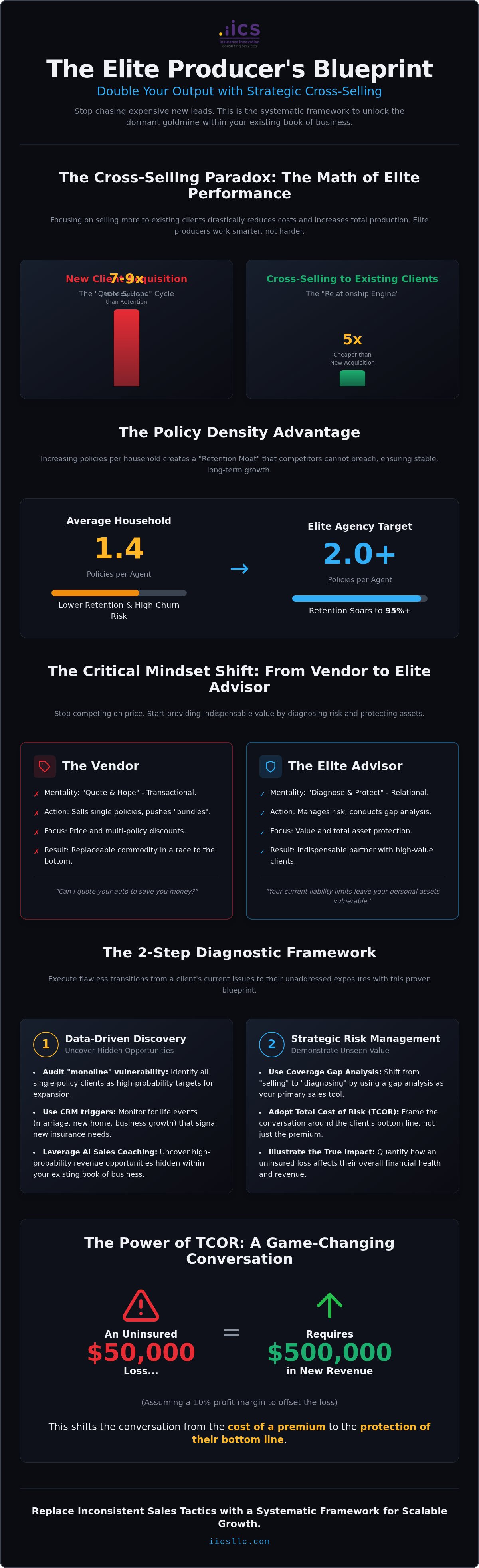
You know that the average P&C household holds only 1.4 policies with their primary agent, yet agencies reaching a 2.0 policy density see retention soar to 95% or higher. This isn't about generic bundling; it's a diagnostic discipline. This guide provides the blueprint to master the systematic frameworks used by top-tier producers to double their annual output. We'll explore how to leverage data-driven discovery and trigger-based outreach to transition into high-stakes commercial risk management. If you're ready to move from the middle of the pack to the elite tier, this is your roadmap.
Table of Contents
The Cross-Selling Paradox: Why "Selling More" is the Key to Doubling Producer Output
The Diagnostic Framework: Moving from "Bundling" to Strategic Risk Management
Data-Driven Discovery: Identifying Hidden Revenue with Precision
The Step-by-Step Blueprint to Doubling Producer Output Through Cross-Selling
Building an Elite Cross-Selling Culture: Mastery over "Trial and Error"
The Cross-Selling Paradox: Why "Selling More" is the Key to Doubling Producer Output
Are you an insurance producer or a lead-generation addict? Most producers spend their careers chasing the next "hit" of a new lead while ignoring the goldmine already sitting in their CRM. This is the Cross-Selling Paradox. By focusing on selling more to fewer people, you actually increase your total production volume while decreasing your workload. Why hunt for scraps when you are already sitting on a feast?
The math of elite performance is undeniable. Research indicates that acquiring a new customer costs seven to nine times more than retaining an existing one. Furthermore, Cross-selling is roughly five times cheaper than cold acquisition. When you stop treating your book of business as a static list and start seeing it as a dynamic asset, the "Output Ceiling" vanishes. Elite producers don't work more hours; they extract more value from every interaction. They've moved past the "Transaction Trap," where every sale is a one-off event, and instead built a "Relationship Engine" that fuels itself.
Most producers fail because they suffer from a vendor mindset. They sell a policy to solve a single problem. This creates a fragile connection. An elite advisor, however, makes a psychological shift from "selling policies" to "protecting assets." They identify every gap in a client's risk profile. When you pivot to this diagnostic approach, you're no longer a line item on a budget; you're a necessary partner in their financial security. Are you ready to stop being a quote-and-hope vendor?
The Revenue Impact of the Multi-Policy Client
The lifetime value (LTV) of a multi-line account dwarfs that of a single-line client. Every additional policy added to a household creates a "Retention Moat." When a client has three or more policies, the administrative friction of "shopping around" becomes too high. They stay longer, pay more, and refer more often. Effective cross selling strategies for insurance producers turn your book into a fortress that competitors cannot breach. This stability reduces the frantic pressure for constant lead generation, allowing you to focus on high-value advisory work.
Calculating Your Untapped Production Potential
To double your output in 2026, you must first audit your "monoline" vulnerability. Every single-policy client is a flight risk. Identify these accounts and flag them as high-probability targets for expansion. We define Producer Output as the combined value of new business acquisition plus the compounding revenue generated through account depth. By setting a 2026 production goal that prioritizes internal account growth, you can hit your revenue targets without spending a single dollar on external marketing. The revenue you need is already in your office; you just haven't asked for it yet.
The Diagnostic Framework: Moving from "Bundling" to Strategic Risk Management
Stop talking about "bundling." Every cut-rate carrier on television offers a bundle. When you compete on bundling, you are competing on price. You are signaling to the client that your primary value is a multi-policy discount. This is a commodity play and a race to the bottom. Elite producers don't bundle; they diagnose. They use a systematic framework to uncover exposures the client didn't even know existed. This shift from vendor to advisor is the cornerstone of effective cross selling strategies for insurance producers.
In the commercial sector, this means adopting the Total Cost of Risk (TCOR) approach. TCOR looks beyond the annual premium to include indirect costs like lost productivity, reputational damage, and out-of-pocket expenses. When you explain that an uninsured $50,000 loss requires $500,000 in new revenue to offset at a 10% profit margin, the conversation changes instantly. You're no longer talking about their insurance bill. You're talking about their bottom line. By using a Coverage Gap Analysis as your primary sales tool, you identify holes in their financial armor and offer the shield. It creates a psychological vacuum that the client feels compelled to fill.
The "Vendor" vs. "Elite Advisor" Mentality
The vendor asks, "Can I quote your auto to save you money?" The Elite Advisor says, "Based on your business growth, your current liability limits leave your personal assets vulnerable." Do you see the difference? One is a beggar; the other is a guardian. While research shows that 64% of homeowners already bundle their home and auto policies, this is merely the low-hanging fruit where most agents stop. To move beyond this, you need a structured path like the elite insurance producer development plan. Position yourself as a fractional risk manager. Business owners don't want more bills, but they are desperate for the precision that an expert provides.
Mapping Cross-Sell Opportunities by Line of Business
Elite performance requires a "Risk Map" for every client interaction. For commercial clients, the natural progression moves from basic P&C into Professional Liability, Cyber, or Directors and Officers (D&O) coverage. In personal lines, the bridge should always lead from Home and Auto to Umbrella and Life. Technology is the primary enabler here. Industry leaders often highlight Four Ways Independent Insurance Agencies Can Tech Up, specifically using data to flag these gaps automatically before the client even realizes they have a need. Mastering this diagnostic voice is exactly what we teach in our Sales Academy, helping producers reach breakeven in half the industry norm time through disciplined, high-value cross selling strategies for insurance producers.
Data-Driven Discovery: Identifying Hidden Revenue with Precision
Is your CRM a graveyard of contact information or a precision-guided revenue engine? Most producers treat their database like a digital filing cabinet. Elite performers treat it like a heatmap. To double your output, you must stop guessing who might need another policy and start knowing who is ready to buy. Data-driven prioritization leads to conversion rates two to three times higher than undifferentiated outreach. By segmenting your book and applying the "Top 20%" strategy, you focus your energy where the exposure is greatest and the premium is highest.
Precision requires more than just a list of names. It requires a systematic audit of your client files. Using outsourced insurance producer coaching to review your current accounts can reveal massive, unaddressed gaps that a busy producer might overlook. You aren't just looking for another sale. You are looking for the "monoline" vulnerability that puts the entire account at risk. When you identify these high-probability triggers, you stop being a solicitor and start being a strategist. This is the core of sophisticated cross selling strategies for insurance producers.
Trigger Events: When to Start the Conversation
Timing is as critical as the message itself. The 90-day post-sale review is the most underutilized window in the industry. The client has already trusted you once, and the onboarding friction is gone. This is the moment to pivot from the initial transaction to a broader risk discussion. Research shows that trigger-based outreach converts at 5% to 15% per event. Whether it is a business milestone like a new lease or a personal life event, these moments demand new coverage. Even an annual renewal should never be a simple "price check." It's an "exposure check." If you aren't identifying new risks at renewal, you're leaving the door open for a competitor to do it for you.
Using AI to Perfect the Delivery
Data tells you who to call, but AI tells you how to talk to them. Through AI sales coaching for insurance, producers can analyze their tone, timing, and word choice on every call. It identifies subtle "buying signals" in routine service interactions that the human ear often misses. Did the client mention a new piece of equipment? Did they ask about a neighbor's recent claim? These are invitations. By using a data-backed feedback loop, you can refine your scripts and ensure your delivery matches the high-stakes environment of elite risk management.
The Step-by-Step Blueprint to Doubling Producer Output Through Cross-Selling
Knowledge is useless without a tactical plan. You've identified the gaps and analyzed the data. Now, you must execute. Elite cross selling strategies for insurance producers aren't about luck; they are about a repeatable, high-stakes process. This five-step blueprint ensures you never leave revenue on the table or leave a client's assets exposed to unnecessary risk.
Step 1: The Pre-Call Audit. Never dial blind. Before you initiate any interaction, review the account for monoline vulnerabilities. If you don't know the win before you pick up the phone, you've already lost.
Step 2: The "Incidental" Transition. Move from the current service issue to the new exposure. The transition should feel like a natural extension of your advisory role, not a pivot to a sales pitch.
Step 3: The Education Phase. Quantify the risk of the gap. Use the data you've gathered to show the client exactly what is at stake. If they don't understand the financial impact of the exposure, they won't value the solution.
Step 4: The Solution Presentation. Position the new line as a "completion" of their plan. You aren't adding an extra cost; you're finishing the job of protecting their business or family.
Step 5: The "Elite" Follow-Up. Systematize the relationship. Use your CRM to schedule reviews based on the trigger events we discussed. Consistency is the difference between a one-time sale and a lifetime account.
Elite Scripts for Seamless Transitions
The "By the way" technique is the ultimate tool for low-friction cross-selling. It works because it's framed as an afterthought of professional care. For example, "By the way, while reviewing your file, I noticed your Umbrella limits haven't moved despite your new property acquisitions." Even better is the "Professional Standards" script. Tell the client, "Our agency's professional standards require us to ensure every client is aware of their Cyber exposure. I'd be doing you a disservice if I didn't address this today." When you encounter the "I already have a guy for that" objection, don't retreat. Ask a diagnostic question: "I respect that. When was the last time your guy audited your Professional Liability against your 2026 revenue projections?" Force them to realize that their "guy" might be asleep at the wheel.
Overcoming the "Price Objection" in Cross-Selling
If a client complains about the cost, you've failed to explain the risk. You must reframe the conversation from "extra cost" to "asset protection." Use the Cost of No Action (CONA) to drive urgency. Show them that the premium is a fraction of the potential out-of-pocket loss. Research indicates that trigger-based cross-selling converts at 5% to 15% because the need is immediate and undeniable. The Elite Close is the precise moment the client realizes they are dangerously under-protected and that you are the only one capable of fixing it. To master these high-stakes transitions and scripts, join our next Sales Academy cohort and start training like an elite producer.
Building an Elite Cross-Selling Culture: Mastery over "Trial and Error"
Relying on "sales tips" is for amateurs. If your growth depends on a producer happening to remember a clever line during a call, your agency is built on sand. Elite performance requires a systematic, agency-wide framework that removes the guesswork. You don't need more suggestions. You need a battle-tested methodology that turns account expansion into an involuntary reflex. This is how you move from accidental growth to a 40-year track record of systematic success.
A culture of excellence is forged through discipline. It requires continuous MicroLearning to keep the producer's edge sharp in a volatile 2026 market. When cross selling strategies for insurance producers are baked into the daily rhythm of the office, the "Output Ceiling" disappears. You aren't just selling more policies. You are building a high-performance engine where every team member understands that total risk management is the only acceptable standard of service.
Weekly Workshops and Live Role-Play
Stop practicing on your clients. It's expensive and inefficient. Elite producers refine their delivery in a controlled, high-stakes environment before they ever pick up the phone. Our weekly live workshops provide the arena for this development. We focus on the hard truths of the industry, ensuring that insurance sales meeting topics center entirely on account expansion and diagnostic precision. This builds the muscle memory required to handle complex commercial exposures with total confidence. Accountability isn't a burden here; it's the fuel for your transformation.
Your Path to Doubling Production in 90 Days
Transformation isn't an overnight event. It's a 90-day roadmap designed to strip away vendor habits and install the Elite Advisor mindset. The results speak for themselves. IICS graduates reach breakeven revenue in 50% less time than the industry norm. They don't just survive; they dominate. By mastering the diagnostic disciplines we've outlined, you can double your annual production output without ever buying another lead. The blueprint is ready. The only question is whether you have the discipline to follow it. If you're tired of stagnant growth and high churn, it's time to elevate your game. Apply for the Sales Academy and dominate your market today.
Dominate the 2026 Market: Your Blueprint for Elite Output
The path to doubling your revenue doesn't require a single new lead. It requires a fundamental shift in how you view your current book of business. By moving from a vendor mentality to a diagnostic risk management framework, you stop competing on price and start winning on expertise. Implementing these cross selling strategies for insurance producers ensures that your clients are fully protected and your commission growth is permanent. Why settle for stagnant numbers when the revenue you need is already sitting in your database?
Mastery isn't found in trial and error. It's found in a battle-tested methodology. IICS brings a 40-year track record of elite producer development, utilizing advanced AI Sales Coaching and 1:1 mentoring to refine your advisory voice. Our graduates reach breakeven in half the industry time because they don't guess; they execute. Apply for the IICS Sales Academy and Double Your Output. The goldmine is already in your office. It's time to start digging.
Frequently Asked Questions
How do I start a cross-selling conversation without sounding pushy?
Frame the conversation as a professional obligation rather than a sales pitch. Lead with your agency's professional standards, explaining that you are conducting a diagnostic audit to ensure no hidden gaps exist in their protection. When you position the discussion around asset preservation and risk mitigation, you sound like a trusted advisor instead of a pushy solicitor.
What is the best line of insurance to cross-sell to a commercial P&C client?
Professional Liability and Cyber coverage are the highest-value additions for commercial accounts in the 2026 market. These lines address volatile risks that many general liability policies overlook. By moving into these specialized areas, you solidify your role as a fractional risk manager and move the relationship beyond a simple commodity transaction.
How often should I review my existing book of business for cross-sell opportunities?
Perform a deep-dive audit at the 90-day post-sale mark and again during every annual renewal cycle. Elite producers also use their CRM to monitor for specific trigger events, such as business expansions or property acquisitions. This systematic approach ensures you capture the high conversion rates associated with timely, relevant outreach.
Can AI sales coaching really help me improve my cross-selling numbers?
AI sales coaching provides objective, data-driven feedback on your verbal delivery and timing. It identifies subtle buying signals and missed opportunities that even veteran producers might overlook during routine service calls. This technology allows you to refine your cross selling strategies for insurance producers by ensuring your scripts match the client's intent.
What are the most common objections to cross-selling and how do I handle them?
The "price objection" and the "I already have a guy" response are the most frequent hurdles you will face. Handle these by quantifying the Cost of No Action. Show the client that the premium is a small fraction of the potential out-of-pocket loss that their current coverage, or their other agent, has failed to address.
How does cross-selling impact my overall agency retention rates?
Increasing policy density is the most effective way to build a fortress around your book of business. Agencies that move from the industry average of 1.4 policies per household to 2.0 or higher see retention rates climb to 95% or more. Multi-policy clients face higher administrative friction to leave, making them your most stable assets.
Is it better to cross-sell at the time of the initial sale or during the renewal?
The initial sale solves the immediate problem, but the 90-day post-onboarding window is the ideal time for account expansion. While renewals are a mandatory touchpoint for an exposure check, the 90-day review catches the client while their trust in your expertise is at its peak and the onboarding friction has vanished.
How can I double my producer output if I am already working 50 hours a week?
You don't double output by working 100 hours; you do it by increasing the revenue depth of your existing schedule. Stop burning hours on low-conversion cold leads and focus on high-probability targets within your own CRM. This shift in strategy allows you to extract more commission value from every minute you spend on the phone.