How to Effectively Onboard a New Insurance Producer
Updated: 1 day ago
A new producer doesn’t become productive just by completing orientation. To learn how to effectively onboard a new insurance producer, connect operational readiness with the sales habits that build a commercial P&C pipeline. If systems, expectations, and coaching arrive in separate pieces, the producer is left to figure out how the work fits together.
Hiring, licensing, carrier access, and agency systems all matter, but they’re only part of the picture. Producers also need clear expectations, regular feedback, and practical ways to assess progress before closed business tells the whole story. Without a shared process, onboarding can vary from one manager to another, making early development difficult to evaluate.
This article lays out a repeatable sequence, from operational setup and role expectations to coached sales activity and review milestones. You’ll learn how to track early indicators such as prospecting consistency, appointment setting, and call quality, then use those signals to guide development for new and experienced producers. The aim is a connected process, not a one-time orientation.
Table of Contents
Why effective insurance producer onboarding must start before the first sale
Build a ready-to-sell onboarding workflow for a new insurance producer
Choose the right onboarding model: checklist, manager-led, or structured development
Set practical onboarding milestones and coach progress without guessing
Extend onboarding with structured commercial P&C producer development
Why effective insurance producer onboarding must start before the first sale
A producer can have a calendar full of introductions and still not know what to do next. Onboarding should connect the agency’s people, workflows, compliance steps, and sales expectations before the pressure to produce takes over. Treat it as a coordinated path from accepted offer to role clarity, operational readiness, and supported sales activity, not as a stack of forms to complete.
Onboarding is the structured process of integrating a producer into the agency’s role, systems, workflows, and performance expectations; orientation is an initial introduction, while training develops skills over time. A useful foundation is the onboarding process, but insurance producer onboarding must also connect agency operations with commercial selling. If onboarding ends after the first day, access may remain incomplete, responsibilities may be unclear, and sales practice may lack coaching. The producer is present, but not necessarily ready to work effectively.
What does insurance producer onboarding include?
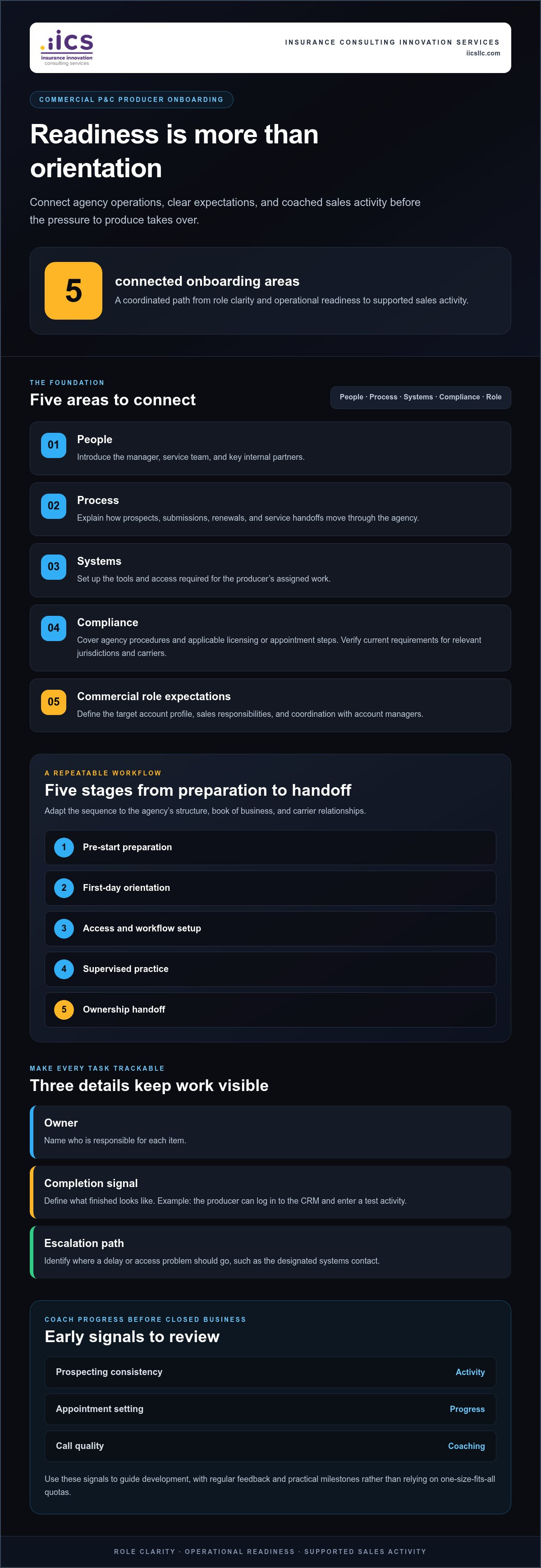
Build the process across five connected areas. People means introductions to the manager, service team, and key internal partners. Process covers how prospects, submissions, renewals, and service handoffs move through the agency. Systems includes the tools and access needed for assigned work, whether that involves standard agency management platforms or specialized solutions like debt elimination software for insurance agents. Compliance covers agency procedures and applicable licensing or appointment steps. Commercial role expectations define the target account profile, sales responsibilities, and how the producer coordinates work with account managers.
Assign an owner to each area. Agency leadership defines the role and success expectations. Operations coordinates systems access and workflow instruction. The person responsible for compliance tracks applicable requirements and records. The producer completes assigned learning, confirms understanding, and raises blockers. Carrier appointments and related steps depend on the producer’s situation, carrier relationships, and applicable state requirements. Agencies should verify current requirements for each relevant jurisdiction rather than rely on a generic checklist.
Why early expectations shape the producer experience
Before the start date, agree on the producer’s role scope, target account profile, initial activity expectations, and access to the manager. Clarify what the producer may handle independently, where supervised practice is expected, and who can answer questions about coverage, submissions, or client handoffs. These decisions give the manager and new hire a shared operating picture before the first opportunity arrives.
Unclear ownership creates friction quickly. Operations may assume the manager requested access, while the manager assumes it is already arranged. The producer loses time and receives conflicting guidance. Vague sales expectations create the same problem: one leader may emphasize prospecting, another may expect immediate quoting, and the producer may not know which behavior to prioritize.
How to effectively onboard a new insurance producer starts with making the path visible: name an owner for each task, define what completion looks like, and identify where to escalate a delay. Review onboarding feedback and workflow bottlenecks when available. The goal isn’t paperwork completed. It’s a producer who understands the role, can use the agency’s processes, and has support to begin building sound commercial P&C sales habits.
Build a ready-to-sell onboarding workflow for a new insurance producer
A sequence creates momentum, and clear ownership makes it reliable. The core stages are pre-start preparation, first-day orientation, access and workflow setup, supervised practice, and an ownership handoff. Adapt the sequence to the agency’s structure, book of business, and carrier relationships. A checklist should guide the work, not assume every producer or agency has identical requirements.
Use a task tracker that names the owner, completion signal, and escalation path for each item. For example, operations might own CRM access. Completion means the producer can log in and enter a test activity. An access problem goes to the designated systems contact. This keeps dependencies visible instead of leaving the new hire to chase answers.
What should be ready before the producer's first day?
Before day one, the sales manager should prepare a role scorecard, a point of contact, an initial schedule, and context for the accounts or market segment the producer will support. Operations can coordinate access to the agency management system, CRM, carrier resources, and documentation tools. Identify client-service contacts and explain confidentiality, recordkeeping, and internal escalation procedures. SHRM's employee onboarding guide offers a broader framework for preparing and integrating employees. Agencies can apply those practices while tailoring the steps to commercial P&C work.
Keep legal and regulatory requirements distinct from internal preferences. The agency’s compliance owner should identify which requirements apply and coordinate relevant producer information and records with the appropriate agency and carrier contacts. Licensing, appointments, and carrier procedures depend on applicable rules and relationships, so verify current requirements for the relevant jurisdictions and carriers. Label an agency-specific documentation convention as internal policy, not as a legal mandate.
How should the agency confirm readiness to sell?
Readiness is demonstrated, not assumed. Before a producer independently handles relevant work, a manager should review role knowledge, access, workflow practice, and required approvals. A short practice scenario can reveal gaps: ask the producer to locate the right client record, document a prospect interaction, identify the next step in the agency’s submission process, and explain when to involve an account manager or compliance contact.
Record each review item as complete, in progress, or blocked. Attach an owner and next action to unresolved dependencies. If carrier access is pending, for example, name the person following up and define what must happen before the producer performs work that relies on it. The producer’s manager should confirm the handoff from supervised practice to assigned responsibilities, including who remains available for questions.
That is how to effectively onboard a new insurance producer without confusing access with readiness. Agencies can also connect operational onboarding with continued sales development as a complementary layer.
Choose the right onboarding model: checklist, manager-led, or structured development
The right onboarding model depends on what the producer must learn, how much manager capacity is available, and what development resources the agency already has. A checklist can standardize repeatable tasks. A manager can explain judgment and context. A structured blended approach combines both, adding deliberate practice and feedback so commercial skills don’t depend on who happens to be free that day.
This comparison is a decision framework, not a universal ranking. Match the model to producer experience, role complexity, agency capacity, and existing development resources. A seasoned hire entering a familiar workflow may need a focused checklist and targeted manager reviews. A new-to-commercial producer or someone taking on a complex role may need more demonstration, practice, and frequent feedback. Ask what the producer must do independently and what the consequences are if they get it wrong.
When is a checklist-only approach enough?
Use a checklist for administrative tasks with clear completion criteria and accountable owners, such as confirming system access or locating documentation standards. It helps prevent omissions, but it can’t show whether someone can guide a client conversation, make a sound pipeline decision, or apply a process to an unfamiliar account. Pair checklists with manager review whenever a task requires judgment or has significant client or workflow consequences.
What does a structured blended approach add?
For example, a producer might review a documented discovery process, rehearse it with a manager, and then receive feedback on a real or simulated conversation. Centralizing digital modules and tracking progress through WestNet LMS can streamline this coursework before live practice. The manager still owns role expectations and agency procedures; structured development reinforces selling skills. When deciding how to effectively onboard a new insurance producer, make both responsibilities visible rather than assuming task completion equals readiness.
Set practical onboarding milestones and coach progress without guessing
Progress should be visible before the first sale, but it shouldn’t be reduced to a raw count of calls or quotes. Leading indicators show behaviors and skills that can influence future performance; lagging outcomes show results already achieved, such as closed business. Use both, and agree on relevant measures with the agency rather than imposing universal quotas that ignore account mix, sales cycle, and producer experience.
Organize milestones around observable stages: readiness, workflow execution, prospecting habits, discovery, follow-up, and manager feedback. At each stage, define what the producer will demonstrate and who will review it. A prospecting milestone might be consistent completion of agreed outreach with accurate CRM notes. A discovery milestone could focus on asking relevant risk questions and confirming next steps.
Which early indicators show onboarding is working?
Look for completed setup, demonstrated workflow competence, and consistent follow-through on agreed actions. Review pipeline movement and the quality of follow-up, but don’t mistake activity volume for readiness. A full calendar means little if conversations lack a clear purpose or next step.
Use a shared sales cycle snapshot to record account stage, the producer-owned next action, its due date, and any risks or information gaps to explore. This gives the manager and producer a common view of progress without turning the check-in into a scoreboard. Keep the record focused on client relevance, sound documentation, and commitments the producer can control.
How should managers coach a new producer?
Schedule brief, recurring check-ins and give feedback close to the observed call or client interaction. Start by asking about the producer’s intent or assessment, then reinforce what worked and address one improvement. End with a clear next-step commitment, such as practicing a discovery question or updating a prospect record by an agreed time.
Coaching should include both inquiry and direction. Ask what the producer noticed, but be direct about agency workflows and commercial P&C conversations when expectations aren’t clear. If follow-up is weak, review a specific interaction, clarify the expected documentation, and agree on how the next client touchpoint will add value. This turns how to effectively onboard a new insurance producer into a cycle of observe, coach, practice, and review, not a guess based on early sales alone.
For additional coaching context, explore AI sales coaching for insurance. Agencies can also use a structured insurance producer development program to complement manager-led check-ins.
Extend onboarding with structured commercial P&C producer development
Agency onboarding establishes how work gets done inside that agency. Sustained producer development builds the selling judgment and habits needed to apply those workflows consistently as accounts and conversations grow more complex. The handoff shouldn’t be a hard stop: managers can connect development topics to current priorities, reinforce agency-specific processes, and use coaching to turn learning into deliberate practice.
IICS’s 90-day Sales Academy is designed to complement, not replace, agency onboarding. The program combines 60 tactical micro-learning modules, daily video lessons of 2 to 4 minutes, unlimited AI call coaching, monthly one-to-one coaching, and weekly group workshops. AI feedback scores calls against nine criteria and provides next-step guidance, while human coaching brings context to the producer’s actual role.
How can a development program reinforce onboarding?
Make the connection practical. If the agency is emphasizing a specific target account profile or discovery approach, managers can relate learning and call review to those priorities. AI feedback can help a producer reflect on a conversation, but it shouldn’t replace experienced coaching or agency guidance. The manager remains responsible for clarifying internal workflows and client-service expectations.
The agency also retains ownership of its systems, licensing processes, carrier relationships, and client-service procedures. A development program supports producer skill-building; it doesn’t complete agency-specific setup or determine which requirements apply. That distinction keeps responsibilities clear while allowing operational onboarding and sales development to reinforce each other.
What should agency leaders do next?
Start with the process you already have. Map each onboarding step, owner, handoff, delay, and development gap before adding a tool or program. Then choose one measurable readiness improvement, such as making manager feedback more consistent or ensuring a producer can demonstrate a key workflow, and review it with the producer’s manager.
This focused review helps leaders connect development activity to the agency’s real needs instead of adding training without a clear purpose. IICS brings more than 40 years of insurance industry leadership experience to producer development. Results depend on agency context, the manager’s involvement, and the producer’s execution. IICS offers outsourced producer development, weekly live workshops, and fractional CRO/CGO services to support agency sales performance.
Turn your onboarding process into a development advantage
The next step isn’t to add more tasks. Decide what a producer should be able to do with confidence, then build a clear path to that capability. Choose one point where new hires tend to lose momentum, such as applying a sales process in real conversations, and make the manager’s coaching response part of the plan.
That focus keeps onboarding connected to the work producers actually need to perform. It also gives agency leaders a practical way to refine the process: identify where support is needed, adjust the development plan, and make ownership clear. The goal isn’t to rush a producer past important steps. It’s to help them build sound habits with the right guidance.
Strengthen your onboarding with structured commercial P&C development. Explore IICS’s Sales Academy and producer development services to find a development approach that supports your agency’s coaching priorities.
Frequently Asked Questions
How long should insurance producer onboarding take?
There’s no single timeline that fits every producer. Role complexity, prior experience, agency processes, and applicable licensing or carrier requirements all affect the schedule. Set milestones instead of promising an identical calendar, and distinguish operational readiness from longer-term sales development. For example, a manager can confirm that a producer can navigate a workflow before assigning that work independently, then continue reviewing sales habits as the producer gains experience.
What should an insurance producer onboarding checklist include?
Include the information and access a producer needs to begin the role, plus a way to verify each step is complete. Cover role expectations, key contacts, agency systems, documentation practices, client-service handoffs, required records, and manager check-ins. For a practical test, ask the producer to locate a sample account record and explain where a client interaction should be documented. Separate internal conventions from legal or carrier requirements, and verify applicable rules with responsible contacts.
Who is responsible for onboarding a new insurance producer?
Onboarding is shared, but every task needs one accountable owner. Agency leadership defines the role and resources; operations coordinates records and system access; compliance personnel oversee relevant requirements; and the sales manager leads practice and feedback. The producer owns assigned learning and follow-through. A simple responsibility map can prevent gaps: for each task, name the owner, the person who needs to be informed, and who resolves a blocker if the task stalls.
Should experienced insurance producers follow the same onboarding process as new producers?
Experienced producers still need onboarding, but the learning emphasis should reflect the role and demonstrated ability. A veteran may need less foundational sales instruction and more guidance on agency-specific account handling, carrier relationships, documentation, and service handoffs. Don’t use tenure as proof of readiness. Ask the producer to demonstrate relevant workflows, then target practice and coaching to any gaps. Keep the agency’s essential readiness checks consistent while tailoring support.
Can a producer sell insurance before all onboarding requirements are complete?
Don’t assume employment alone authorizes a producer to perform every insurance activity. Applicable licensing, appointment, carrier, and agency requirements can vary by producer, activity, and jurisdiction. Before assigning work that may depend on those requirements, use a documented readiness review and verify current rules with the agency’s responsible compliance contacts. This is a process safeguard, not legal advice; avoid relying on a generic checklist as a substitute for situation-specific verification.
How do you onboard a remote insurance producer effectively?
Use a shared plan that makes responsibilities, access steps, and questions visible to both the producer and manager. Schedule regular conversations rather than relying on messages alone, and demonstrate workflows through screen sharing or guided practice where appropriate. Set clear expectations for documentation, client handoffs, and follow-up. Remote onboarding still requires deliberate relationship-building: introduce the producer to the colleagues they’ll rely on and make it clear how to raise a blocker.
What should a manager discuss during a new producer's first check-in?
Ask what feels clear, what remains blocked, and which client conversation or workflow would benefit from practice. Review the producer’s next steps on active opportunities, focusing on whether actions are relevant and documented, not just how many activities occurred. Give specific feedback tied to an observed example, clarify the immediate priority, and agree on one or two commitments before the next meeting. Record operational issues separately and route each to the person who can resolve it.