How to Grow an Insurance Agency: A Practical 2026 Growth Plan
What if your agency’s biggest growth obstacle isn’t a lack of activity, but a lack of alignment? If you’re asking how to grow an insurance agency, start by looking beyond the next hire or marketing campaign. In Q1 2026, average commercial P&C premiums declined 1.2% after 33 consecutive quarters of increases, according to IMA Financial Group. Growth can’t depend on market tailwinds alone.
Recruiting, sales, carrier access, and marketing may feel like separate priorities, but they affect one another. More activity doesn’t automatically produce stronger results. If producer effort isn’t tied to measurable outcomes, or new business comes at the expense of retention and profitability, the agency may be working harder without building a more durable business.
This guide lays out a practical growth plan that connects market focus, producer execution, client retention, and operating capacity. You’ll learn how to identify the constraint holding growth back, translate priorities into trackable outcomes, and build the leadership and development rhythm to follow through. The aim isn’t growth at any cost. It’s repeatable sales execution that strengthens the whole agency.
Table of Contents
How to Grow an Insurance Agency Starts With Defining Better Growth
Build an Insurance Agency Growth Engine Around a Clear Market Focus
Improve Conversion and Retention Without Chasing Growth at Any Cost
Scale Agency Growth by Strengthening Producer Habits and Leadership
Turn the Growth Plan Into Action With IICS Producer Development
How to Grow an Insurance Agency Starts With Defining Better Growth
Premium growth can look impressive while the agency is losing ground. New business may be offset by clients leaving at renewal, acquisition effort may consume too much producer time, or added accounts may strain service capacity. A useful definition of growth balances revenue, profitability, retention, and the agency’s long-term value. Tracking those measures separately helps leaders distinguish expansion from real progress.
A sustainable agency growth system is a repeatable way to choose suitable accounts, convert opportunities, retain clients, and match sales activity to the agency’s capacity. It connects the principles of insurance to daily commercial P&C decisions: which risks to pursue, how to serve clients, and where to invest producer effort. The right first move depends on the agency’s goals and the constraint currently limiting results.
Which insurance agency growth metrics should leaders track?
Separate the measures so a strong result in one area can’t conceal a weakness in another. Review new-business results, renewal outcomes, retention, revenue, and profitability as distinct views of agency health. Then connect outcomes to activity. Compare producer outreach and qualified conversations with opportunities advanced and accounts won. If activity is steady but conversion is weak, the issue may be sales execution. If the pipeline is thin or renewals are declining, the agency needs a different response.
New business: Track opportunities, wins, and the revenue they produce.
Renewals and retention: Review accounts retained and lost, along with the reasons behind those outcomes.
Revenue and profitability: Assess whether growth contributes to the agency’s financial goals and sustainable value.
Producer activity: Measure actions that create and advance opportunities, not activity for its own sake.
Use a consistent reporting period, such as a monthly review alongside a broader quarterly assessment. Assign an owner to each measure, define how it’s recorded, and agree on what action to take when results move off target. A dashboard without ownership is just observation.
How to diagnose the agency’s biggest growth constraint
Start with the gap between the agency’s goal and actual results. Compare that gap with available capacity: producer time, service workload, leadership attention, and pipeline quality. Don’t try to fix every weakness at once. Identify the point where improvement would make the greatest difference.
Test market focus: Is the agency pursuing accounts that fit its capabilities and goals?
Check pipeline and conversion: Are there enough suitable opportunities, and are producers advancing them?
Review retention: Are renewal losses undermining new-business gains?
Assess leadership and capacity: Are priorities clear, and can the team execute them reliably?
Choose one constraint as the next priority, name who owns it, and define the result that would show progress. If producers are generating opportunities but not converting them, adding more outreach initiatives may create noise rather than growth. Focus first, then measure, learn, and adjust. That discipline is a practical starting point for how to grow an insurance agency without confusing busyness with durable performance.
Build an Insurance Agency Growth Engine Around a Clear Market Focus
A reliable pipeline doesn’t come from waiting for referrals or launching occasional campaigns. It comes from choosing accounts the agency can serve well, identifying where those prospects are, and giving producers a repeatable way to start relevant conversations. That focus turns prospecting from scattered activity into a process leaders can review and improve.
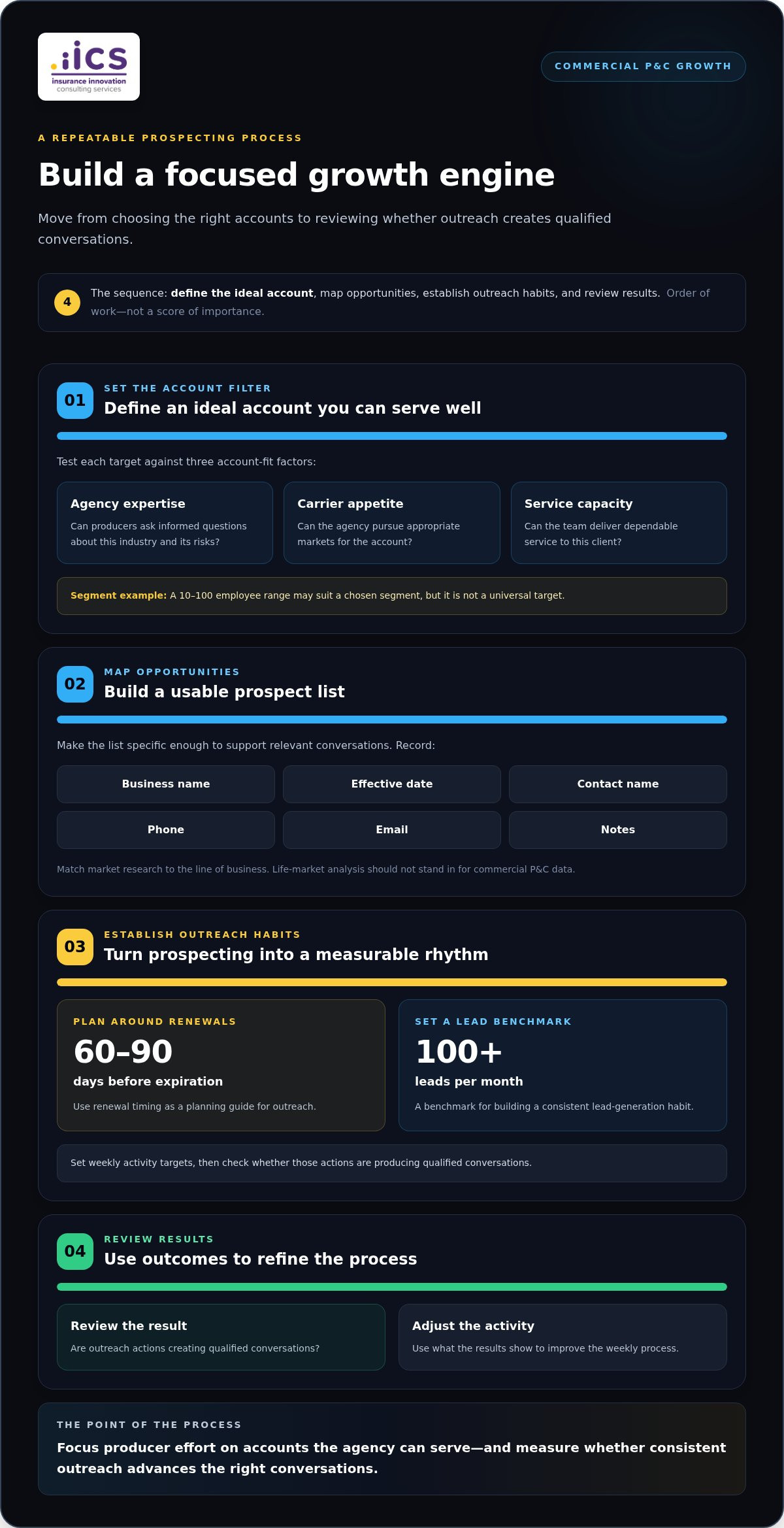
Use a four-step sequence: define the ideal account, map opportunities, establish outreach habits, and review results. Each step should inform the next. A producer pursuing a defined group of commercial accounts can prepare for more relevant conversations than one working from an undifferentiated list. Match market research to the line of business. For example, life insurance industry trends and statistics may inform life-market analysis, but they shouldn’t stand in for commercial P&C data.
Choose an ideal account profile the agency can serve well
Define the profile around three tests: the agency’s expertise, carrier appetite, and service capacity. Consider industries and risk characteristics where producers can ask informed questions, the agency can pursue appropriate markets, and the team can deliver dependable service. A 10-100 employee range may suit a chosen segment, but it isn’t a universal target. Focus helps producers build useful industry knowledge and explain why an account may fit, rather than relying on a generic pitch.
Turn prospecting into a measurable weekly process
Start with a suspect list, not a vague instruction to “prospect more.” Record each business name, effective date, contact name, phone, email, and notes. Work backward from renewal timing, using outreach 60-90 days before expiration as a planning guide. Build a consistent lead-generation habit around expiration dates, with at least 100 leads per month as a benchmark. Then set weekly activity targets and review whether those actions produce qualified conversations. If outreach is happening but conversations aren’t, refine the account profile or message before increasing volume.
Keep the sequence visible and owned:
Define: Write down the account characteristics that fit expertise, appetite, and service capacity.
Map: Build a focused list of prospects and record relevant renewal timing.
Reach out: Schedule recurring prospecting blocks and track attempts and conversations.
Review: Assess which segments and approaches generate qualified opportunities, then adjust the next cycle.
Consistency matters more than a burst of activity. Referrals can create valuable opportunities, and campaigns can build momentum, but neither should be the agency’s only source of pipeline. Carrier access supports a market strategy; it isn’t a strategy by itself. More appointments won’t tell producers which accounts to pursue or how to develop them.
Once the target and process are clear, producer development can reinforce consistent execution. IICS’s commercial P&C Sales Academy combines daily microlearning, AI call coaching, mentoring, and weekly workshops in a structured 90-day program. Producers can practice the habits the agency has chosen to measure and apply them to its market focus.
Improve Conversion and Retention Without Chasing Growth at Any Cost
New accounts tell only part of the growth story. An agency can add business and still weaken its book if renewal losses rise, sales effort fails to convert, or new accounts don’t fit its service capacity. Compare new-business activity with renewal outcomes to see whether growth is durable. Track the two separately, then assess them together: are new wins building the book, or mainly replacing accounts that left?
That comparison sharpens decisions. If prospect activity is healthy but few opportunities advance, examine the sales process. If producers are winning accounts while retention slips, review the renewal experience and the fit of the business being written. Neither pattern has one automatic solution. Results depend on execution, account fit, and the agency’s ability to deliver on its commitments.
Find where prospects stop moving through the sales cycle
Give each stage a clear producer-owned action and next step. A first conversation should lead to an agreed follow-up; a discovery meeting should clarify the account’s needs and what information is still required. Review lead-to-prospect conversion and meeting-to-opportunity movement consistently. If prospects stall, inspect call quality for gaps in discovery, message clarity, or follow-through before changing the entire sales strategy.
Call reviews make those gaps easier to discuss objectively. Focus on observable behaviors: Did the producer ask questions that uncovered the prospect’s priorities? Was the agency’s role explained clearly? Did the conversation end with a specific next step and owner? IICS AI call coaching scores calls against nine criteria and provides feedback and next-step guidance. Paired with mentoring, it supports focused practice and gives producers a structured way to review conversations.
Protect renewals while developing new business
Renewal preparation competes with prospecting for attention, so leaders need a deliberate plan for both. Treat the 30-60-day renewal buying window as a planning consideration, not a fixed rule for every account. Map renewal dates and common triggers, such as changed operations, emerging exposures, service concerns, or questions about coverage. Use those triggers to guide timely, risk-focused conversations rather than reducing the review to a last-minute rate comparison.
Track renewal results separately from new accounts. For each renewal period, review accounts retained and lost, the reasons recorded, and whether relevant conversations happened early enough to support informed decisions. Compare those findings with new-business wins and conversion movement. The goal isn’t to force retention at any cost. It’s to understand which clients the agency serves well and where its process can improve.
For stalled prospects: Identify the stage where movement slows, then coach the specific skill or follow-up action.
For renewal risks: Assign an owner, prepare relevant questions, and document next steps before the account reaches a decision point.
For leadership reviews: Examine new-business and renewal measures side by side, without allowing one to conceal the other.
Strong sales execution and thoughtful renewal work reinforce each other. That’s the discipline behind how to grow an insurance agency without mistaking volume for quality: pursue suitable business, follow through consistently, and judge progress by both new opportunities won and client relationships sustained.
Scale Agency Growth by Strengthening Producer Habits and Leadership
Hiring more producers isn’t always the next move. If expectations are unclear, coaching is inconsistent, or follow-through is weak, additional headcount can multiply activity without improving execution. First determine whether results are limited by producer skills or agency structure. A discovery gap may call for targeted practice; competing priorities or a missing sales-management rhythm require leadership attention.
Development works best when it supports the agency’s wider growth priorities. Producers need to know which behaviors matter, how those behaviors connect to business outcomes, and who will help remove obstacles. Use a scorecard that pairs activity and execution measures with outcomes, then review it consistently. Check whether producers are completing agreed actions, advancing opportunities, and documenting next steps.
Create a repeatable producer development cadence
Build a steady rhythm, not a one-time training event. Combine short practice sessions with call feedback, mentoring, and peer accountability. Ask each producer to commit to a specific weekly behavior, such as improving discovery questions or setting a clear next step before ending a prospect conversation. Review the commitment against agreed measures at the next check-in. Consistent repetition gives leaders a clearer view of what’s improving and where coaching should focus.
A practical insurance producer development plan connects the skill being practiced to the agency’s chosen market and sales process. IICS’s commercial P&C Sales Academy uses daily 2-4-minute lessons, AI call coaching, 1:1 mentoring, and weekly group workshops within a structured 90-day program. Producer development is one lever in the growth system, alongside market focus, retention, and operating capacity.
Know when additional sales leadership can unlock capacity
Look for patterns: priorities change without explanation, coaching varies by manager, or performance conversations don’t lead to clear commitments and follow-up. Those signs may point to a structural issue rather than a producer skill gap. Sales leadership sets direction, clarifies roles, establishes expectations, and maintains accountability. The agency still needs a sound market strategy and the capacity to serve the accounts it pursues.
When strategic sales direction is missing, fractional CRO or CGO support can add leadership focus. Before adding headcount, examine whether existing producers have clear priorities, useful coaching, and enough time to execute. That’s a more disciplined starting point for how to grow an insurance agency.
IICS supports producer development through its Sales Academy, outsourced producer development, and fractional CRO/CGO services. The right approach starts with the agency’s constraint: clarify whether the need is individual skill development, consistent team training, or sales leadership.
Turn the Growth Plan Into Action With IICS Producer Development
A growth plan only matters if people can execute it. Put the agency’s chosen priority into a working sequence: diagnose the constraint, prioritize the response, assign an owner, measure agreed outcomes, and adjust based on what results show. If the constraint is a producer’s sales skill, development may be appropriate. If the issue is unclear direction across the team, training alone won’t solve it.
IICS works with commercial Property and Casualty agencies on producer development and sales execution. Its Sales Academy is a structured 90-day program that supports producer habits through daily learning, call feedback, mentoring, and weekly group workshops. These tools reinforce an agency’s strategy alongside a clear market focus, disciplined retention practices, and leadership accountability.
What structured producer development can add to the growth plan
The Sales Academy curriculum contains 60 tactical modules, delivered as daily 2-4-minute video lessons. Producers can put a focused concept into practice, then use call coaching and mentoring to examine how it shows up in conversations. AI call coaching scores calls against nine criteria and provides feedback and next-step guidance. Personal coaching and group learning create further opportunities to reflect and practice.
Use the 90-day Sales Academy curriculum to develop behaviors your agency has chosen to strengthen. Set expectations first: identify the behavior to improve and the measure that will indicate whether it’s being applied. A structured program is most useful when its focus aligns with the agency’s market, sales process, and performance priorities.
Choose the next step that matches the agency’s constraint
Match the response to the problem. If producers need stronger discovery, follow-up, or sales conversations, structured training and ongoing coaching create a practice-and-feedback rhythm. If leaders lack clear priorities, consistent coaching, or a way to follow through on performance commitments, the gap may be broader than individual skill. IICS provides outsourced producer development and fractional CRO/CGO leadership to address sales training and leadership needs.
Before starting, specify what should change, who owns the work, and how progress will be reviewed. For example, a producer development priority might focus on consistent next steps after prospect meetings, while a leadership priority might be clarifying expectations and coaching responsibilities across the team. Both require alignment, active participation, and follow-through.
IICS is led by Ralph J. Blust, whose insurance industry leadership experience spans more than 40 years. That experience informs IICS’s focus on developing commercial P&C producers and strengthening sales execution. Keep the agency’s growth plan in view: producer development should contribute to the larger system, not operate as a disconnected initiative.
Explore IICS’s Sales Academy for commercial P&C producer development and see how its structured learning, coaching, and mentoring support agency priorities.
Make Your Next Growth Decision Count
The next step isn’t to launch another initiative. Decide what the agency will do differently, who will own that change, and how you’ll know whether it’s working. Pick one priority, set a clear review point, and protect the time and leadership attention needed to follow through. That’s how a growth plan becomes a management habit instead of another document that loses momentum.
If your priority is stronger producer execution, IICS can connect development to your agency’s commercial P&C growth goals. Its 90-day Sales Academy combines microlearning, AI call coaching, mentoring, and workshops. Choose the support that fits your agency’s current need, then measure progress against the outcomes you’ve defined.
Knowing how to grow an insurance agency is only the beginning. Consistent action turns the plan into progress. Explore IICS producer development and agency growth support and take the next step with a focused plan.
Frequently Asked Questions
Can an insurance agency grow without hiring more producers?
Yes. An agency can grow by improving how its current team uses time and develops opportunities. Leaders might simplify handoffs, reduce time spent on low-fit accounts, or help producers strengthen discovery and follow-up. Before recruiting, assess whether existing workloads leave room for more selling and whether roles are clear. If producers are already at capacity, adding work without service support may strain client experience rather than create healthy growth.
How does carrier access affect an independent insurance agency's growth?
Carrier access affects which risks an agency can pursue and how well it can respond to client needs, but appointments alone don’t create a growth strategy. An agency should understand where its available markets align with its chosen commercial accounts and producer expertise. Independent commercial brokers such as Just Quote Me demonstrate how leveraging the right market relationships to provide bespoke business coverage creates distinct competitive advantages. For example, if the agency wants to serve a particular industry, compare carrier appetite and underwriting requirements with the risks common to those businesses. More options help when they support a focused plan.
What is the difference between agency revenue growth and agency profitability?
Revenue growth means the agency is generating more income; profitability reflects what remains after the costs of producing and servicing that business. Revenue can rise while profitability weakens if acquisition effort, compensation, or service demands grow faster. Review income alongside expenses, cash collections, and workload by account or segment. Beyond gross margins, maintaining disciplined accounts receivable and cash flow management—as highlighted in financial planning guidance from smartar.com—ensures that new revenue translates into durable working capital. The useful question is whether growth contributes to sustainable agency performance.
How can an insurance agency grow through acquisition?
An agency can grow through acquisition by combining its existing operation with another agency’s clients, talent, and capabilities. Start by defining the strategic purpose, such as entering a complementary segment or adding expertise, then assess client retention risks, producer fit, service workload, systems, and cultural compatibility. Plan integration before closing: assign relationship owners, communicate clearly with clients, and track account retention and operating performance. Acquisition can accelerate growth, but it won’t fix an unclear strategy.
When should an insurance agency create a succession plan?
Create a succession plan before ownership or leadership transition becomes urgent. Planning early gives the agency time to clarify who may lead, how client and producer relationships will be maintained, and what knowledge must be transferred. Document key responsibilities and identify where decisions depend on one person. Review the plan as ownership, staffing, and business goals change. A succession plan is not only about retirement; it also helps the agency prepare for unexpected leadership changes.
How many new commercial accounts should an insurance producer target each month?
A practical planning target is 3-5 new accounts per month, but it shouldn’t become a quota detached from account fit or producer capacity. Set expectations based on the producer’s experience, sales cycle, target segment, and ability to service wins. Track qualified opportunities and conversion alongside closed accounts. If activity is strong but account quality or retention suffers, revisit the target and sales process rather than pushing volume alone.
What should an agency owner review before joining an insurance agency network?
Review how the network’s structure fits your agency’s strategy and operating model. Examine carrier access, services and technology provided, financial obligations, contractual commitments, ownership of client relationships and data, branding expectations, and the process for leaving. Clarify how the arrangement could affect producer workflows and client service, not just market access. Compare those terms with what your agency needs to accomplish, and have qualified advisers review contractual and financial implications before making a commitment.