How to Handle Price Objections in Commercial Insurance Without Discounting
Updated: 7 hours ago
What if “too expensive” isn’t a rejection, but a signal that the comparison isn’t clear yet? When a prospect challenges a quote, the pressure to defend the premium or offer a discount can arrive fast. Price matters, especially when renewal costs or competing proposals are under scrutiny. But handling price objections in commercial insurance starts with a better move: pause and find out what the client means by expensive.
A lower premium may reflect different limits, exclusions, deductibles, forms, or service assumptions. Until you know what the prospect is comparing, a quick discount can weaken the conversation without resolving the concern. The stronger response is direct, curious, and grounded in the account.
This article offers a practical process for uncovering the concern behind the words, explaining relevant coverage and service details in plain language, and agreeing on a useful next step. You’ll find questions to ask, ways to compare proposals, and guidance for keeping the conversation moving when the issue is budget, perceived value, or a genuine coverage trade-off.
Table of Contents
Why a Commercial Insurance Price Objection Deserves a Better Response
“Your quote is too expensive” can sound like a demand for a lower premium. Treating it that way too soon is a mistake. A price objection is a signal to clarify what the buyer is reacting to, not an automatic instruction to discount. Is the premium outside the planned budget? Is the timing difficult? Does the buyer question the coverage, or simply feel unsure that the recommendation is worth the cost?
Your first response sets the tone. A calm acknowledgment shows you’ve heard the concern and gives you room to ask a useful follow-up question. A defensive explanation can close that door; an immediate concession can skip the question entirely. Strong handling price objections in commercial insurance means understanding the concern before choosing a response. That’s also the foundation of Value-added selling: make relevant value clear instead of competing on price alone.
Stay precise. You can explain the proposal and review appropriate options, but don’t promise savings or coverage outcomes you can’t substantiate. If a premium change is considered, base it on an accurate, authorized quote revision and explain the coverage implications clearly. The goal isn’t to win a moment with an unsupported assurance. It’s to help the buyer make an informed decision.
What might “your quote is too expensive” mean?
It may mean the buyer can’t fit the premium into the budget, has a competing quote, or doesn’t yet see why your recommendation merits the investment. Those are different concerns, and each calls for a different conversation. A competing figure is especially hard to interpret until you know whether the proposals address comparable exposures and use equivalent limits, deductibles, forms, and endorsements.
Don’t guess. Ask briefly: “Could you help me understand what feels high, the total premium, the coverage, or how it compares with another option?” Then listen. The answer gives you a clearer starting point than an assumption does.
Why discounting too early can weaken the conversation
An immediate concession may lower the figure without addressing affordability, a coverage difference, or uncertainty about the recommendation. It can also leave the buyer unsure what changed. Clarify the concern first. Then determine whether an accurate, authorized quote revision is appropriate and explain any resulting trade-offs plainly.
Clarify before you respond: a discount can change the number, but only a question can reveal what the buyer needs to understand.
How to Diagnose the Real Price Concern in a Commercial Insurance Conversation
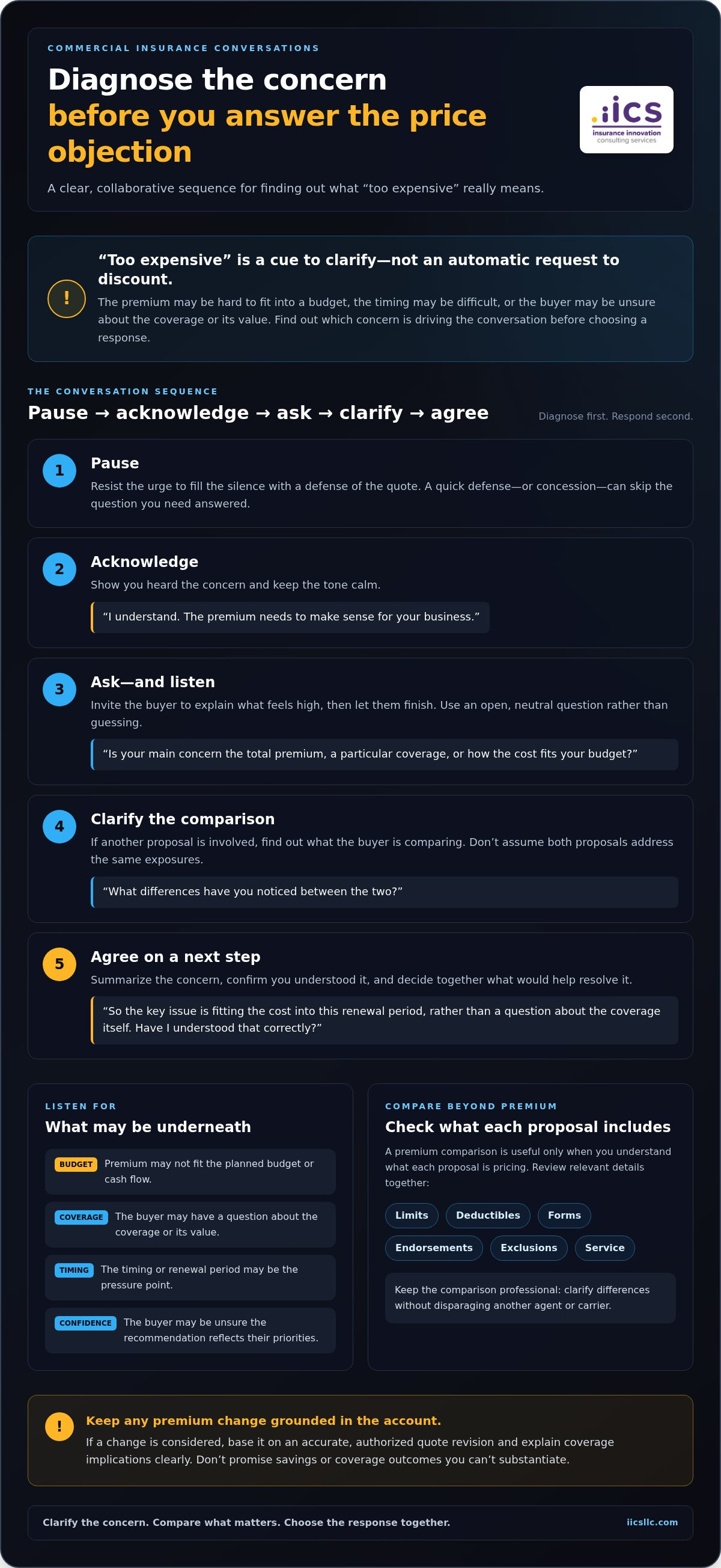
The phrase “too expensive” is too broad to answer well. Use a deliberate sequence instead of reaching for a counterargument: pause, acknowledge, ask, listen, clarify the comparison, then agree on a next step. That rhythm keeps the conversation collaborative and gives you a clearer basis for responding.
Pause: Resist the urge to fill the silence with a defense of the quote.
Acknowledge: “I understand. The premium needs to make sense for your business.”
Ask and listen: Invite the prospect to explain what feels high, then let them finish.
Clarify: Find out what the buyer is comparing and which details matter most.
Agree on a next step: Summarize the concern and decide together what would help resolve it.
This is the working discipline behind handling price objections in commercial insurance: identify the objection before you choose your response. As a concise rule, “Diagnose first; respond second.”
Questions that uncover what the prospect is comparing
Ask open questions in plain language, without suggesting that the buyer’s comparison is wrong. For example: “Is your main concern the total premium, a particular coverage, or how the cost fits your budget?” If they mention another proposal, try: “What differences have you noticed between the two?” or “Would it help to compare the limits, deductibles, and coverage details side by side?”
These questions invite specifics without challenging the prospect or disparaging another agent or carrier. Don’t assume two proposals address the same exposures. Clarify what’s being compared, then review the relevant details together.
Listen for budget, coverage, timing, and trust concerns
Listen for the kind of issue beneath the objection. A budget or cash-flow concern may call for a different discussion than a question about coverage value. Timing may be the pressure point. Or the buyer may be unsure that the recommendation reflects their priorities. Don’t treat every objection as a negotiation tactic or an invitation to reduce coverage.
Before explaining, reflect the concern back neutrally: “So the key issue is fitting the cost into this renewal period, rather than a question about the coverage itself. Have I understood that correctly?” A brief confirmation can prevent you from solving the wrong problem.
After the conversation, record the buyer’s priorities, the quote details being compared, and the agreed next step. That note keeps a follow-up focused and helps distinguish an unresolved question from a decision about budget or timing. IICS’s Sales Academy includes training on common objections and responses, giving producers a structured way to practice these conversations.
Comparing Commercial Insurance Quotes Beyond Price
A premium comparison is useful only when you understand what each proposal is pricing. Start with the same business exposures and coverage assumptions where possible, then review the details side by side. If information differs or is unclear, mark it for follow-up rather than treating the proposals as equivalent. A simple comparison list can help keep the discussion factual and focused on the buyer’s priorities.
Premium: Compare the quoted total and the coverage basis used to calculate it.
Limits: Review the limits shown for the coverages that matter to the prospect’s stated priorities.
Deductibles: Note the applicable deductibles and how they differ between proposals.
Forms: Identify the policy forms referenced in each proposal.
Endorsements: Compare the endorsements included or identified in the documents.
Exclusions: Note stated exclusions and flag wording that needs closer review.
Service: Clarify what service expectations or support are described in each proposal, rather than assuming they’re the same.
Which quote details deserve a side-by-side review?
Prioritize the limits and deductibles connected to the buyer’s concerns, then check the forms, endorsements, and exclusions referenced in each proposal. Separate what the documents clearly show from what you’re inferring. If a difference depends on specific policy wording, don’t overstate its effect. Identify the relevant documents and review the wording carefully before drawing a conclusion. In commercial property coverage, advocacy firms like Integrity Adjusters & Associates frequently see how subtle wording variations and specific policy forms directly influence claim settlements when a loss occurs.
How to explain value without making a sales pitch
For further consultative selling ideas, see Advanced Commercial Insurance Sales Techniques. The same disciplined approach applies here: tie your explanation to a relevant detail, then confirm the buyer understands the distinction.
Two premiums that look alike can represent different proposals if their limits, deductibles, forms, exclusions, or assumptions don’t match. This is the practical heart of handling price objections in commercial insurance: make the comparison accurate before discussing which option fits.
What to Say When a Commercial Insurance Prospect Says the Price Is Too High
The right response doesn’t sound like a rebuttal. It acknowledges the concern, asks one clear question, and gives the prospect space to answer. Use these lines as starting points, not scripts to recite word for word. A natural, attentive conversation is more effective than language that sounds designed to corner the buyer.
A calm opening that keeps the conversation productive
Try: “I understand. Can you tell me what’s driving the concern most, the overall premium, a specific coverage, or how it fits your budget?” This respects the buyer’s reaction without agreeing that the proposal is overpriced. Then pause and listen. Avoid rushing into a defense or filling the silence with reasons the prospect should accept the quote.
After hearing the answer, summarize it neutrally: “It sounds like the main concern is the budget impact, rather than a specific question about the coverage. Is that right?” If the prospect corrects you, you’ve learned something useful. If they agree, you have permission to focus the next part of the conversation.
Responses for a competing quote or a fixed budget
“Thanks for sharing that. Would it be useful to review the proposals side by side, including the limits, deductibles, forms, and assumptions, so we can see what’s driving the difference?”
This invites a like-for-like review without suggesting the other agent or carrier has missed something. Agree on which documents to review and when you’ll reconnect. Don’t characterize policy terms until you’ve examined the relevant details.
For a firm budget, try: “I hear that staying within the budget is important. Which priorities should we keep in view as we consider possible next steps?” A budget concern doesn’t automatically mean reducing coverage is suitable. If an alternative is considered, discuss it only when appropriate, authorized, and accurately represented, including relevant trade-offs. Confirm whether the buyer wants to review a specific option or revisit the budget and priorities first.
Keep the sequence simple: acknowledge, ask, listen, summarize, and agree on a next step. This turns handling price objections in commercial insurance into a repeatable conversation without promising savings or outcomes you can’t substantiate.
Tone: Calm, respectful, and not defensive.
Question: One open question that fits the buyer’s concern.
Listening: Let the buyer finish before summarizing.
Comparison: Use verified proposal details, not assumptions.
Next step: Agree on a specific action together.
Producers can build fluency with these responses through repeated practice and specific feedback. IICS’s Sales Academy includes objection-response training to help producers strengthen their approach to common sales conversations.
How Producer Practice Turns Price-Objection Skills Into a Repeatable Method
A useful response in one conversation doesn’t automatically become a reliable skill. Producers build consistency by practicing realistic commercial P&C scenarios, receiving specific feedback, and trying again. The goal isn’t to memorize a perfect script. It’s to make good habits observable under pressure: ask before explaining, listen without interrupting, compare documented details accurately, and confirm a next step.
A focused practice loop for objection handling
Keep each practice round focused. Choose one objection, such as a prospect saying a renewal premium exceeds the budget, and define the business context and buyer priorities before role-play begins. The producer’s first task is to understand the concern, not defend the quote.
Practice: Respond to the objection, ask a clarifying question, and listen for the buyer’s actual priority.
Review: Give feedback on a specific behavior, such as whether the question was open-ended or the comparison stayed accurate.
Repeat: Run the scenario again, focusing on one improvement and ending with a clear, mutually agreed next step.
Track behaviors, not just whether the role-play sounded smooth. Did the producer clarify what the prospect was comparing? Did they reflect the concern accurately? Did they distinguish known quote details from assumptions? Did they agree on what happens next? Specific measures make feedback actionable and help producers identify where to focus in the next round.
When structured producer development can help
For teams that want a consistent development framework, IICS’s Sales Academy is a 90-day program for commercial P&C producers. It combines 60 tactical microlearning modules with unlimited AI call coaching, mentoring, and weekly workshops. AI call coaching provides feedback against 9 criteria, giving producers specific input they can use to review and refine their approach. Explore the Inside the 3-Month Insurance Sales Training Program to learn how the program is structured.
Short learning modules can reinforce a technique; coaching can focus attention on an individual call; workshops can provide a setting to practice with others. These methods support deliberate skill development, but they don’t guarantee a particular sales result. Producers still need to apply sound judgment to each buyer, account, and proposal. For additional perspective on AI-supported call feedback, read about AI sales coaching for insurance producers.
That’s how handling price objections in commercial insurance becomes a repeatable method: practice the behaviors, review what happened, and make the next attempt more precise.
Make Every Price Conversation More Deliberate
A price objection is a reason to get curious, not a cue to cut the premium. Ask what’s driving the concern, listen for the real priority, and compare proposals using documented details before explaining value. Then agree on a clear next step without promising savings or coverage outcomes you can’t support.
That’s the discipline behind handling price objections in commercial insurance. It strengthens the conversation by replacing reflexive responses with questions, accurate comparisons, and practice. Repeating that process helps producers build a more consistent approach, one conversation at a time.
For commercial P&C producers seeking a structured development path, the IICS Sales Academy combines a 90-day development system with 60 tactical modules, unlimited AI call coaching, and 1:1 mentoring. Founder Ralph J. Blust brings 40+ years of insurance industry leadership experience to producer development. Explore the IICS Sales Academy for commercial P&C producers.
Keep asking, listening, and practicing. Meet price concerns with clarity and confidence, without making discounting your first move.
Frequently Asked Questions
What should I say when a commercial insurance client says the premium is too high?
Acknowledge the concern, then ask what feels high: the total premium, a specific coverage choice, or the effect on the client’s budget. Listen to the answer before explaining the proposal. If they’re comparing quotes, offer to review documented terms side by side without criticizing another agent or carrier. Before ending the conversation, summarize what you heard and agree on a clear next step together.
How do you handle a price objection without discounting?
First clarify what the buyer means by “price.” Ask a neutral question, then respond to the concern they identify rather than guessing. If it’s a competing quote, compare relevant limits, deductibles, forms, and other documented terms. If it’s a budget concern, discuss priorities before considering options. Effective handling price objections in commercial insurance means avoiding unsupported promises and never proposing a coverage change without understanding the client’s needs.
Should I match a competitor’s commercial insurance quote?
Don’t assume a competing premium represents equivalent coverage. Ask what the prospect is comparing, then review the available proposals for differences in limits, deductibles, forms, coverage terms, and assumptions. Explain only what the documents support, and avoid claims about another agent or carrier. If the comparison needs closer review, identify the details to examine and agree on a follow-up rather than promising to match a price before you understand the proposals.
How can I explain the value of commercial insurance when a buyer focuses on cost?
Connect the explanation to the buyer’s stated risks and priorities. For example, if a prospect asks about a particular limit, explain how that limit appears in the proposal and where to review it. Use specific policy details instead of general claims about peace of mind. Make relevant differences and limitations clear, and don’t imply that a policy guarantees a particular outcome. A focused explanation makes the recommendation easier to assess.
Can I offer less coverage to meet a prospect’s budget?
You can discuss options when they’re appropriate, but a lower premium shouldn’t be the only consideration. First clarify the prospect’s priorities and the exposures the coverage addresses. If you present a change, explain how it affects the documented coverage and describe relevant trade-offs accurately. Don’t assume that reducing a limit or changing a term is suitable simply because it may affect premium. Keep the recommendation grounded in the account and policy details.
How can insurance agencies help producers improve at handling price objections?
Use realistic commercial P&C role-play, call review, coaching, and repeat practice. Give specific feedback on observable behaviors: Did the producer clarify the concern, listen carefully, compare terms accurately, and agree on a next step? IICS’s 90-day Sales Academy combines 60 tactical modules with AI call coaching, mentoring, and weekly workshops. Structured development can reinforce skills, but no training program guarantees an individual sales result.
When should a producer follow up after a price objection?
Agree on the timing and purpose of the follow-up during the conversation. The next step might be reviewing proposal details, answering a coverage question, or revisiting the buyer’s priorities. Send a concise recap of what you both agreed to, then follow through as promised. A useful follow-up advances the discussion; repeated generic check-ins can add pressure without resolving the concern or giving the prospect information they can act on.