How to Hire Insurance Producers With No Experience: A Practical Guide
What if your next strong commercial P&C producer doesn’t have an insurance résumé yet? Learning how to hire insurance producers with no experience starts with a different question: not “Who already knows the business?” but “Who has the discipline and coachability to learn it?”
It’s understandable to favor an experienced hire. They may bring industry knowledge and a network, but experience alone doesn’t guarantee performance. A newcomer can be harder to assess, and a poor hire can absorb management time without building a productive pipeline. Potential isn’t enough. Look for evidence of transferable skills, be clear about the trade-offs, and plan how you’ll develop the person after the offer.
This guide explains how to evaluate communication, resilience, curiosity, and follow-through before making a decision, then turn those strengths into a structured path toward producer capability. A new hire shouldn’t be left to figure it out alone. Focused lessons, coaching, mentoring, and workshops create direction and accountability from the start.
Table of Contents
Why Hire an Insurance Producer With No Experience? Start With the Agency Need
How to Assess Coachability and Transferable Skills in Insurance Producer Candidates
Experienced Producer or Promising Beginner? Compare the Hiring Trade-Offs
How to Hire an Inexperienced Insurance Producer: A Repeatable Selection Process
Why Hire an Insurance Producer With No Experience? Start With the Agency Need
An experienced producer may know the terminology, understand sales cycles, and be ready to contribute sooner. But experience alone doesn’t guarantee performance, and strong candidates can be difficult to recruit or retain. A beginner may make sense when an agency wants to build its talent pipeline, has the capacity to develop someone, and can support a ramp-up period. Start with an honest question: do you need immediate production, or can you invest in future capacity?
What does an inexperienced insurance producer hire mean?
An inexperienced producer is someone without prior insurance sales experience, not necessarily someone without professional experience. They may have built customer relationships, pursued business development, handled difficult conversations, or followed through on a demanding sales process in another field.
“No insurance experience means no prior insurance sales background, not no evidence of sales potential.” Keep three considerations separate: insurance knowledge can be learned, sales capability must be assessed, and licensing status is a distinct requirement. An insurance producer’s work may overlap with the role of an insurance broker, but titles and responsibilities can differ. What a new hire may discuss or do depends on applicable state licensing requirements, so define responsibilities accordingly.
When is hiring for potential a sound agency decision?
Hiring for potential is a deliberate investment, not a shortcut around recruiting. It can suit an agency with a clear need to grow its team, provided leaders can give the new producer consistent direction. Before opening the role, consider whether the agency can provide:
Coaching time: A manager who can observe work, give timely feedback, and reinforce expectations.
A defined market: A clear picture of the businesses the producer should learn to serve and the problems they may face.
Repeatable routines: Practical guidance for prospect research, outreach, follow-up, and reviewing conversations.
Room to develop: Expectations that recognize learning takes time while still making progress visible.
If the role must deliver immediate results and management has no capacity to coach, a novice hire may create pressure rather than solve a staffing problem. If the agency can establish a learning rhythm and measure consistent activity, developing someone from the ground up becomes more realistic. Don’t hire for potential and then manage as if the person arrived fully formed.
Development support can also come from outside the agency. IICS draws on more than 40 years of insurance industry leadership experience to support producer growth. Its outsourced producer development and training services give agencies structured support for developing commercial P&C talent. The core hiring question remains practical: can your agency turn a promising candidate’s existing strengths into the skills and knowledge the role demands?
How to Assess Coachability and Transferable Skills in Insurance Producer Candidates
A polished interview can hide a weak fit. A candidate who says they’re persistent or a quick learner hasn’t proved either claim. Assess what they’ve done, how they respond to new information, and whether they can apply feedback. A consistent process also helps you compare candidates against the same role requirements instead of relying on chemistry or résumé familiarity.
Which transferable skills matter in commercial insurance sales?
Look for evidence of disciplined outreach, relationship building, clear communication, and steady follow-through. A candidate from account management might describe how they maintained client relationships; someone from business development might show how they researched prospects and organized outreach. Ask what they personally did, what obstacle came up, and what happened next. Specific actions carry more weight than confident claims.
Strong commercial conversations also depend on curiosity and clarity. Can the candidate ask thoughtful questions before offering a solution? Can they explain an unfamiliar or complex idea in plain language? Ask how they handled rejection, responded to direct feedback, and stayed engaged with goals that required repeated effort. The strongest evidence of coachability isn’t a claim of being open-minded; it’s listening to feedback, trying it, and adjusting based on what happens.
How can interview exercises reveal learning potential?
Use the same brief exercise for each finalist. Ask the candidate to role-play an initial conversation with a business owner. Give only basic context, then observe whether they listen, ask relevant follow-up questions, and stay composed when they don’t know an answer. You’re not testing insurance expertise. You’re watching how they handle uncertainty and gather information.
Then offer one clear coaching point, such as asking a follow-up question before proposing a next step. Repeat the role-play and note whether the candidate applies the suggestion. They don’t need to perform perfectly. Look for an observable change: did they pause, listen more closely, or use the advice without becoming defensive?
Round out the exercise by asking how they’d organize follow-up after that first conversation. A useful answer should explain how they would record what was discussed, identify an appropriate next step, and follow through. Keep the prompt consistent across candidates, and score behavior rather than personality.
A simple scorecard makes those observations easier to compare. Rate each area against the same scale and record a brief example from the interview rather than relying on a vague impression.
Listening: Responds to what was said instead of rushing to pitch.
Curiosity: Asks relevant questions and seeks context.
Resilience: Handles a challenging moment without shutting down.
Preparation: Follows instructions and arrives ready to engage.
Follow-through: Completes the exercise and explains a sensible next step.
Learning agility: Applies a specific coaching point on the second attempt.
Use the results to guide the next decision, not to manufacture certainty. If a promising candidate shows learning agility, your agency still needs a way to build and reinforce that capability. IICS’s Sales Academy provides a structured development program for commercial P&C producers, combining focused lessons, AI call coaching, mentoring, and workshops.
Experienced Producer or Promising Beginner? Compare the Hiring Trade-Offs
Experience can shorten the learning curve, but it can’t eliminate hiring risk. A producer with a track record may already understand insurance conversations and agency workflows, but past tenure alone doesn’t prove prospecting discipline, coachability, or fit with your market. A beginner may bring strong sales habits from another field but needs a deliberate path to build insurance knowledge and commercial P&C capability.
What can an experienced producer bring that a novice may need to learn?
An experienced hire may be familiar with coverage discussions, renewal cycles, account handoffs, and the pace of agency work. A novice may need to build that context from the ground up. Define which capabilities the role truly requires on day one. Is the priority an existing commercial book, familiarity with a particular customer segment, or the ability to create and sustain productive conversations? The answer changes which résumé matters.
Use the comparison to identify trade-offs, not to declare one profile superior. An experienced producer can still require substantial onboarding, while a beginner can adapt quickly when the agency provides direction. The deciding factor is the match between the candidate’s evidence and the work your agency needs done.
When can a beginner be the stronger long-term fit?
A beginner may be a sound choice when the agency can invest management time and provide consistent sales routines. Curiosity helps them learn the business; consistency supports the daily effort prospecting requires; and receptiveness to coaching makes practice productive. These traits don’t guarantee revenue. They give you evidence to weigh alongside the development resources you can commit.
Don’t sell the role with an unsupported promise of fast production. Set clear expectations for learning, activity, feedback, and progress, then review them regularly. Hiring for potential means making a reasoned investment, not predicting a guaranteed outcome or fixed time to productivity. That distinction is central to how to hire insurance producers with no experience responsibly.
A defined development system helps turn that investment into a consistent learning process. IICS provides producer development and training for agencies that want to build capability through structured support. Before choosing either profile, be precise about the job: what must the producer already know, and what can your agency teach?
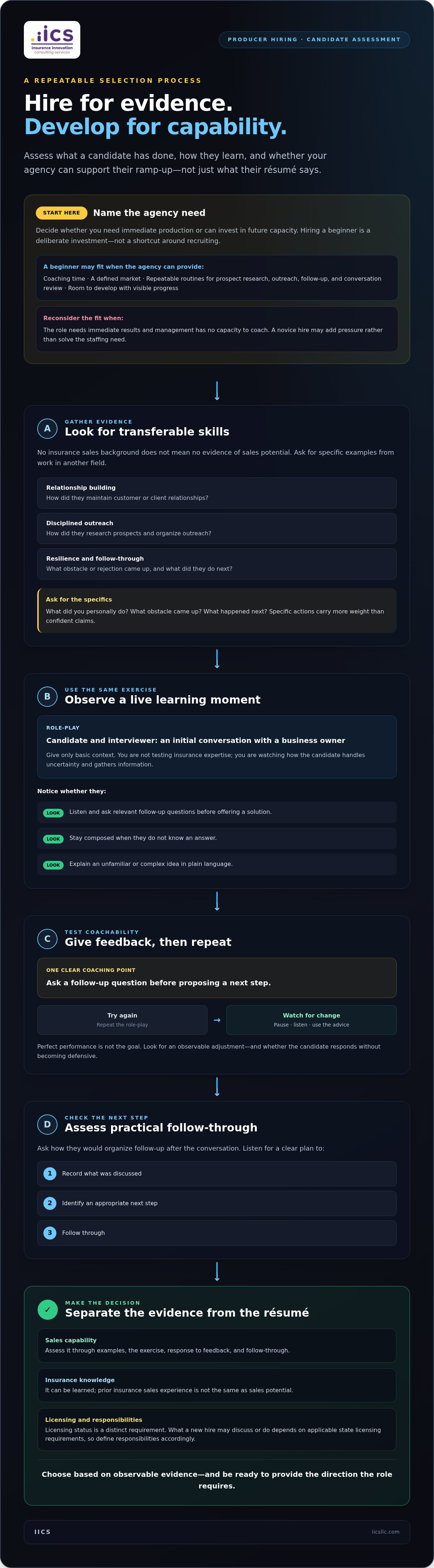
How to Hire an Inexperienced Insurance Producer: A Repeatable Selection Process
A disciplined process makes hiring decisions easier to explain and helps you select for the role you actually need. Keep the sequence consistent: define outcomes, write the role, source candidates, assess evidence, and decide. Each step should connect candidate potential to the work, supervision, and development your agency can provide.
Define the outcomes. Describe the target customer profile, the problems the producer should learn to discuss, and the responsibilities they’ll handle. Separate day-one expectations, such as clear communication and organized follow-up, from insurance knowledge and sales skills you expect to develop. Identify how the producer will collaborate with account managers and other colleagues.
Write the role honestly. Explain the daily work, including prospect research, outreach, conversation preparation, follow-up, and internal collaboration. Clarify who provides supervision, how feedback is delivered, and when early progress reviews will take place. Avoid presenting a novice role as a shortcut to immediate production.
Source against the requirements. Look for candidates whose work history provides evidence of the skills you need, whether that comes from customer-facing roles, business development, or relationship management. Keep the criteria tied to the role instead of relying on familiar industry backgrounds or general impressions.
Assess evidence consistently. Use the same structured questions, short role-play exercise, and scorecard for each candidate. Record specific examples: what the candidate did, how they responded to feedback, and whether they followed through. Score against the role’s requirements, not confidence, rapport, or intuition alone.
Make and document the decision. Compare notes against the same criteria, identify evidence that supports the choice, and record any gaps the development plan must address. Before setting expectations around licensing or permitted activities, make sure they reflect applicable state requirements.
Set early expectations around leading indicators the producer can influence and managers can observe. These might include completing agreed prospect research, preparing for conversations, making planned outreach, documenting next steps, and following through on commitments. Review the quality and consistency of these activities alongside learning progress. Don’t impose universal quotas without considering the role, market, and agency process; establish a clear baseline and review it fairly.
Consistency matters after the interview, too. Use a shared scorecard with space for evidence, concerns, and follow-up questions. If one interviewer values persistence while another prioritizes listening, define what each looks like in practice before comparing candidates. That gives the decision a defensible basis and makes the eventual coaching priorities clearer.
Selection is only the starting point. IICS provides structured producer development and training to help agencies build producer capability after the hire.
How to Develop a New Insurance Producer After the Hire
A hiring decision identifies potential; it doesn’t build capability by itself. New producers need deliberate practice, clear expectations, and management follow-through to turn learning into repeatable work. Without that structure, even a promising hire can be left guessing what to do, how to improve, and whether progress is on track.
What should a structured development rhythm include?
Build a rhythm that connects focused learning to real work. A lesson introduces a skill, the producer applies it in a conversation or practice exercise, and a manager or coach helps them reflect on what happened. Then set a specific next step to practice. Repetition matters: one conversation offers a snapshot, while regular review helps reveal patterns in preparation, listening, questions, and follow-through.
Call review makes feedback more concrete. Instead of saying “be more curious,” discuss a moment when the producer could have asked a follow-up question, then agree on what to try next time. Keep the review focused on observable behaviors and practical adjustments. Pair coaching with regular accountability so learning doesn’t disappear behind a busy calendar.
The IICS Sales Academy is a 90-day development system with 60 tactical modules delivered as daily 2-4-minute micro-learning video lessons. It combines unlimited AI call coaching, 1:1 mentoring, and weekly group workshops. The program gives commercial P&C producers a structured way to connect daily learning with coaching and ongoing practice.
How can agencies evaluate whether development is working?
Don’t judge a developing producer by a single outcome. Review a balanced picture of learning and work over time, using expectations that fit the role and the agency’s sales process. For example, managers can examine whether the producer prepares consistently, completes agreed follow-up, applies coaching points, and conducts increasingly productive conversations. Results matter, but they don’t explain the whole development story on their own.
Activity: Is the producer completing agreed prospecting and follow-up work consistently?
Conversation quality: Are listening, relevant questions, and clarity improving with practice?
Learning application: Does feedback show up in the producer’s next attempt?
Role progress: Is the producer moving toward the expectations defined for the position?
Use those observations to adjust coaching, reinforce effective behaviors, and address gaps early. Hiring well is the beginning; development requires a system and consistent management attention. Discuss producer development with IICS as you plan how to support your next commercial P&C producer.
Turn Your Next Hire Into a Growth Opportunity
The next step isn’t to wait for a perfect résumé. Decide what your agency is prepared to teach, who will reinforce that learning, and how you’ll recognize progress before results fully mature. That clarity makes it easier to hire for potential without confusing optimism with a plan.
As you put how to hire insurance producers with no experience into practice, treat development as part of the hiring decision, not a task to solve later. Set expectations your managers can sustain, then create a clear path for the new producer to learn, practice, and improve. IICS’s producer development services support that growth with consistent learning and coaching.
Build a stronger producer development system with IICS and give your next promising hire a clearer path to contribute. With a structured approach to learning and coaching, your agency can develop talent with purpose and build toward lasting growth.
Frequently Asked Questions
Do insurance producers need a license before they can sell insurance?
Yes, a producer generally needs the applicable state license before selling insurance. Licensing rules vary by state and may depend on the lines of authority involved, so agencies should verify requirements with the relevant state insurance department. Until the person is properly licensed, assign only work that’s permitted without that license. Build licensing status into role planning, and change responsibilities only when the producer is authorized to perform them.
Can someone become an insurance producer without a college degree?
Yes, a college degree isn’t a universal prerequisite for becoming an insurance producer. Employers may have their own education preferences, while state licensing requirements are separate and vary by jurisdiction. For hiring, focus on the actual job criteria: communication, reliability, learning agility, and the ability to meet licensing requirements. A candidate without a degree can still demonstrate relevant skills through work examples, customer interactions, or other evidence of responsibility.
What happens if a new insurance producer misses early performance expectations?
First, determine whether the gap is caused by unclear expectations, a skill deficit, inconsistent activity, or a barrier outside the producer’s control. Review recent work together, select one or two behaviors to improve, and agree on what support and follow-up will look like. For example, if follow-up notes are incomplete, practice documenting next steps and review a sample together. Record the adjustment and reassess progress against the role’s expectations.
How long does it take a new insurance producer to become productive?
There’s no reliable, universal timeline. Productivity depends on the role, the complexity of the accounts, the producer’s starting skills, and the quality of training and supervision. Instead of promising a fixed date, define stages of progress: learning the agency’s workflow, handling conversations with appropriate support, and meeting agreed role expectations. Review each stage regularly. This makes delays easier to diagnose and helps distinguish a normal learning curve from a persistent performance issue.
Can someone with no insurance experience sell commercial insurance?
Yes, a candidate can enter commercial insurance without prior insurance experience, but they must meet applicable state licensing requirements before selling or soliciting insurance. The agency should define duties accordingly and provide the industry knowledge the person needs to discuss commercial risks responsibly. For example, a new producer might first learn how the agency prepares for a client conversation and how to involve experienced colleagues when a question exceeds their current knowledge.
What transferable skills are useful for an entry-level insurance producer?
Skills from roles involving complex decisions can transfer well. A customer success professional may be experienced at clarifying needs, managing expectations, and keeping a relationship on track; a project coordinator may be strong at tracking commitments across several people. Ask candidates to describe a specific situation, their actions, and the result. Then explore how they’d apply that approach to preparing for a business conversation or organizing its next steps.
Should an agency hire an inexperienced producer or an experienced one?
Choose based on the work the agency needs covered and the support it can provide. If the role depends on immediate familiarity with a specific commercial segment, relevant experience may be essential. If the priority is developing future capacity, a beginner with evidence of disciplined learning may fit. When deciding how to hire insurance producers with no experience, judge the candidate against defined role needs, then confirm your agency can provide the supervision and learning support that choice requires.