How to Keep Insurance Producers Motivated: A Practical Agency Playbook
A bigger commission won’t fix a motivation problem you haven’t diagnosed. If you’re asking how to keep insurance producers motivated, start by looking beyond the scoreboard: inconsistent effort can point to a skill gap, unclear expectations, limited capacity, or waning motivation. Each calls for a different response.
Commissions matter, but they rarely create reliable daily habits on their own. Producers also need clear priorities, useful feedback, recognition that feels earned, and a path to develop. Without those basics, generic incentives can reward a short burst of activity while leaving the underlying barrier untouched.
This playbook shows you how to identify what’s draining engagement before choosing an intervention, then build practical management routines that support steady progress and retention. You’ll learn how to set meaningful goals, coach with focus, recognize contributions, and make development part of the workweek rather than another burden on an already full calendar. The aim isn’t identical results from every producer. It’s a consistent system that gives each person clearer direction and a fair opportunity to improve.
Table of Contents
Why insurance producer motivation slips, and why the cause matters
Treating every performance dip as an attitude problem is a costly shortcut. A producer who misses a target may be discouraged, but they may also lack product knowledge, clear priorities, enough time, or a workable process. Apply pressure or offer a bonus before you know which barrier is present, and you risk rewarding the wrong behavior while leaving the real issue untouched.
Producer motivation is the sustained willingness and ability to take purposeful sales actions. For diagnosis, separate willingness from capability and conditions: motivation concerns the producer’s drive to act, while skill, role clarity, capacity, and process friction affect whether effective action is possible. These factors interact, but they call for different management responses. The broader field of work motivation also examines how personal and workplace factors shape effort, a useful reminder that motivation isn’t simply a personality trait.
How to recognize a motivation problem without guessing
Look for a change in patterns, not a single disappointing result. Compare the producer’s recent prospecting consistency, follow-up, participation in team activity, and ownership of goals with their own established habits. One missed target or a difficult sales period isn’t enough to diagnose disengagement. Results can fluctuate even when purposeful activity remains steady.
Then ask what changed. Has the workload grown? Has confidence in a particular sales conversation dropped? Are goals still understood and relevant? Does the producer have enough support, or has the client pipeline shifted? Ask privately and listen for specifics rather than treating silence or frustration as proof of low commitment.
What leaders should diagnose before offering an incentive
Start with the conditions around the work. Confirm that expectations and performance measures are clear and that the producer can influence the activities being measured. A target tied to outcomes the producer can’t reasonably control may weaken ownership rather than strengthen it.
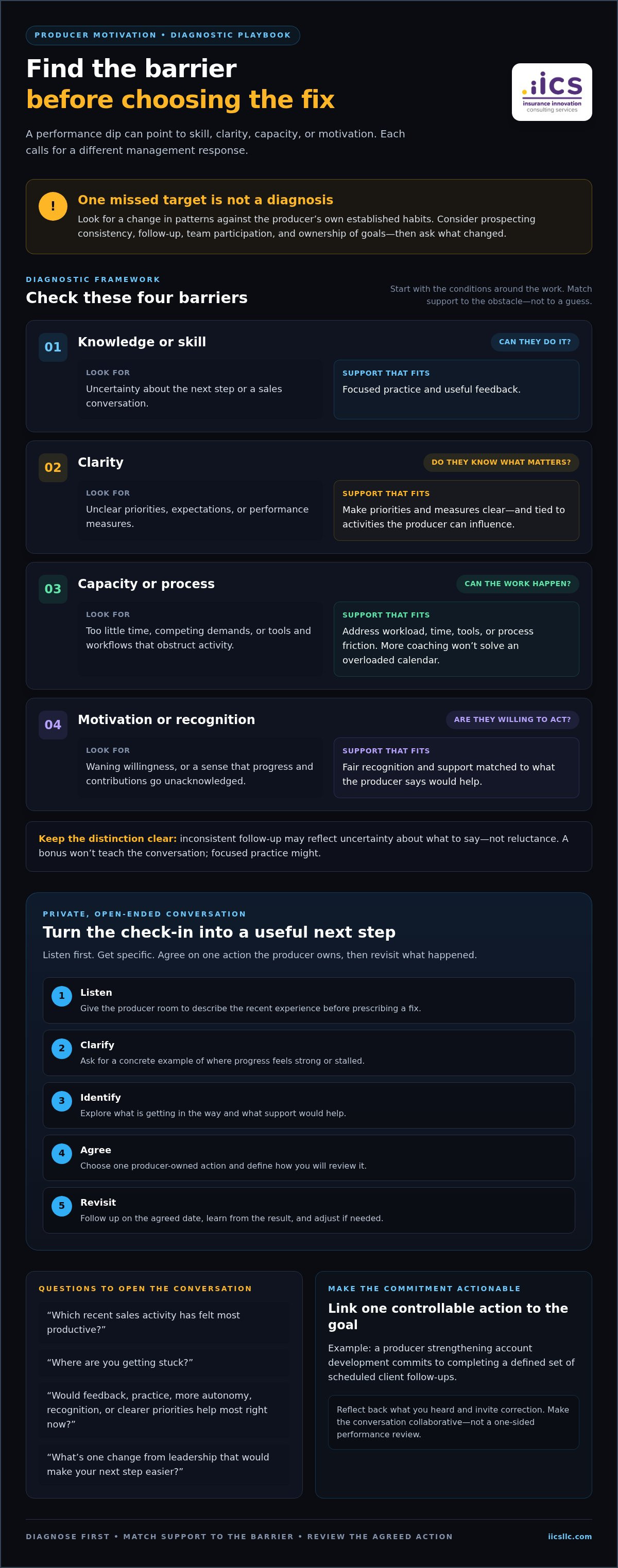
Next, identify the barrier: knowledge, practice, time, tools, or recognition. For example, inconsistent follow-up could reflect uncertainty about what to say, not reluctance to contact prospects. A bonus won’t teach the conversation, but focused practice might. Likewise, added coaching won’t solve a calendar overloaded with competing demands.
Knowledge or skill: Can the producer explain the next step and carry it out confidently?
Clarity: Do they know which priorities and measures matter?
Capacity or process: Is there enough time, and are tools and workflows helping rather than obstructing activity?
Motivation or recognition: Is the producer willing to act, and do they see progress and contributions acknowledged fairly?
Only after this check should you choose an intervention. The question isn’t simply, “How do I get this person to sell more?” It’s, “What is preventing the next purposeful action?” That distinction is central to how to keep insurance producers motivated without mistaking incentives for a complete management strategy.
How to identify what motivates each insurance producer
A useful check-in isn’t a speech designed to lift someone’s mood. It’s a focused conversation that helps the producer name what’s working, what’s stuck, and what kind of support would make the next step possible. Keep it private, curious, and specific. The goal is not to guess what motivates someone, but to understand their perspective and agree on a practical action.
Useful coaching begins with the producer’s specific barrier, not the leader’s favorite solution.
Use this sequence to keep the discussion constructive:
Listen: Give the producer room to describe the recent experience without interrupting to prescribe a fix.
Clarify: Ask for a concrete example of where progress feels strong or stalled.
Identify: Explore what’s getting in the way and what kind of support would help.
Agree: Choose one action the producer owns and define how you’ll review it.
Revisit: Follow up on the agreed date, learn from the result, and adjust if needed.
Questions for a useful producer check-in
Open-ended questions make it easier to hear what the producer actually needs. Try asking, “Which recent sales activity has felt most productive?” and “Where are you getting stuck?” Then explore confidence, workload, goals, and support: “Would feedback, practice, more autonomy, recognition, or clearer priorities help most right now?” Close this part with, “What’s one change from leadership that would make your next step easier?”
Listen for details, not just preferences. A producer who asks for practice with discovery conversations may need a different response from someone whose schedule leaves little time for prospecting. Reflect back what you heard, then invite correction: “So the priority is protecting time for follow-up. Have I got that right?” This makes the conversation collaborative rather than a one-sided performance review.
Turn the conversation into a measurable commitment
Translate the discussion into one controllable action linked to a relevant commercial P&C sales objective. For example, a producer working to strengthen account development might commit to completing a defined set of scheduled client follow-ups. Agree on a realistic review date and what evidence will show progress, such as completed follow-ups and the next steps recorded. Focus on the action and learning, not a promised sales result.
This connection between individual behavior and team outcomes is central to insurance agency sales performance: a clear commitment gives a manager something concrete to support and review, while the producer retains ownership. At the follow-up, ask what helped, what created friction, and whether the action still fits the goal. If development or call practice is the agreed support, IICS’s 90-day Sales Academy offers commercial P&C producers a structured development path. A consistent conversation-and-review loop is a practical foundation for how to keep insurance producers motivated without relying on vague encouragement.
Which motivation strategies work best for insurance producers?
There’s no universal incentive that reliably moves every producer. Choose the response that fits the barrier: compensation can clarify priorities, recognition can reinforce meaningful effort, and coaching can build skill. Autonomy, peer learning, and structured development address other needs. The strongest strategy is specific, fair, and tied to an observable change in behavior, not simply a louder version of what hasn’t worked.
Use this comparison to match the intervention to the need and decide what progress to watch:
Match the response to the producer's need
Recognition works when meaningful effort or progress has been overlooked, but it shouldn’t replace useful feedback. If confidence or skill is the constraint, coaching and practice are more direct than praise alone. If priorities keep colliding, clarify what matters or grant more autonomy where appropriate. Peer learning and development can help producers build capability over time, especially when new learning connects to real work.
Keep the intervention proportional. A producer who needs focused practice doesn’t need a new incentive plan; someone whose priorities are unclear needs direction before added accountability. For ongoing commercial P&C producer development, IICS’s structured Sales Academy builds learning and coaching into a defined program.
When incentives help, and when they can miss the mark
Transparent incentives can reinforce clearly defined outcomes when producers understand how the plan works and believe it’s applied fairly. Before changing compensation, consider agency goals, plan clarity, and whether producers can influence the measures. Poorly explained thresholds may divert attention from client-focused sales behaviors. Rewards also don’t build capability by themselves. Pairing incentives with actionable feedback, including AI sales coaching for insurance, can help producers understand what to improve, not just what outcome to chase.
Track the progress signal that fits the chosen strategy, then review it with the producer. That’s a more disciplined approach to how to keep insurance producers motivated than treating compensation as the answer to every performance challenge.
How to build a weekly motivation rhythm that lasts
Motivation is easier to sustain when leaders make direction, practice, and feedback part of the regular workweek. A dependable cadence reduces the uncertainty that can drain effort: producers know what matters, have a chance to practice, and can see whether their actions are moving forward. Keep the rhythm simple enough to maintain during busy weeks. Consistency matters more than adding another meeting.
Frequent feedback connects a producer’s actions to specific improvements, making the next step clearer and easier to repeat.
A practical weekly cadence for agency leaders
Start the week by agreeing on priorities and producer-owned next actions. Make those actions specific to the producer’s commercial P&C goals, such as following up on an account discussion or preparing for a renewal conversation. Midweek, use a brief workshop or peer discussion to practice one relevant sales situation. End the week with a short review of progress, obstacles, and the next commitments.
For renewal planning, where relevant, build outreach around the 60-to-90-day pre-expiration window. Use it to organize timely account conversations and follow-up, not as a substitute for considering each client’s circumstances and agency process. A clear weekly plan can help producers protect time for this work alongside new-business activity.
Measure progress without reducing motivation to a quota
Results matter, but they don’t tell the whole story. Review a small number of indicators the producer can influence, then interpret outcomes in context. Depending on the role and goal, that might include:
Activity quality: Are conversations purposeful and relevant to the client?
Follow-through: Are agreed next steps completed and documented?
Learning application: Is the producer using a practiced skill in real conversations?
Results: What outcomes followed, and what market or pipeline conditions help explain them?
Don’t turn the list into a surveillance exercise. Use the indicators to guide a useful discussion: what’s improving, where is the process getting stuck, and what should the producer try next? Avoid comparing people without accounting for differences in experience, accounts, and opportunity. A quota-only review can obscure strong controllable actions or conceal a support need.
Connect the weekly actions to a longer development goal so practice serves a purpose beyond this week’s numbers. A thoughtful producer development plan can align individual goals with agency growth while keeping progress specific to each producer. That alignment is a practical foundation for how to keep insurance producers motivated: clear expectations, relevant practice, and reviews that help people improve.
Build that rhythm into your agency’s producer development with IICS’s 90-day Sales Academy, which combines 60 daily microlearning lessons, each two to four minutes long, with AI call coaching, 1:1 mentoring, and weekly workshops.
How IICS helps agencies sustain producer motivation through development
Motivation is difficult to sustain if producers are expected to improve without a clear development path. Agency leaders still need to set fair expectations, remove avoidable barriers, and coach consistently. Structured learning supports that management effort by giving producers regular opportunities to build skills, practice, and apply feedback in their work.
IICS’s Sales Academy is a 90-day development program for commercial property and casualty producers. Its structure combines 60 daily microlearning lessons, each two to four minutes long, unlimited AI call coaching, veteran 1:1 mentoring, and weekly workshops. This regular mix of practice, feedback, and support gives producers a clear structure for developing their skills.
What structured development adds to a manager's effort
Short lessons make it practical to revisit sales concepts regularly, while workshops give producers a place to discuss and practice relevant situations. AI call coaching adds another feedback channel: Academy calls are scored against nine criteria, with feedback and next-step guidance to help producers identify areas for improvement. Mentoring adds a human development component alongside structured practice.
These elements give managers useful material for coaching conversations. Instead of relying on broad advice to “do more,” a leader and producer can discuss a specific skill, review what the producer is practicing, and connect the learning to an agreed development goal. Explore the Sales Academy program details to see how its learning structure is organized.
Choose a next step based on the agency's development need
The Academy is designed for agencies seeking a structured development path for individual commercial P&C producers. If the challenge extends beyond one producer, IICS’s outsourced producer development and training can support broader training needs. Fractional CRO/CGO services provide executive-level growth support. Start by defining the development gap, then align the support to that need.
Use development as one part of a consistent management system, not a replacement for clear goals, fair accountability, or regular communication. Leaders should still connect practice to relevant sales activities and review progress in context. IICS draws on a 40-year track record in insurance leadership and producer development to help agencies build producer capability.
If your agency is ready to strengthen producer development with a structured approach, discuss producer development with IICS. Identify the skill or process your team most needs to improve, then match the development plan to that priority. That’s a practical step toward how to keep insurance producers motivated through meaningful progress, rather than relying on incentives alone.
Make producer development part of the agency’s operating rhythm
The next step isn’t to launch another short-lived campaign. Choose one development priority your agency can support consistently, then give it the attention and follow-through to make it part of how the team works. Motivation isn’t a switch a leader flips. It grows when producers can see a meaningful path forward and trust that their effort will be met with useful support.
That takes commitment from leadership, too. Protect time for development, make room for honest conversations, and treat progress as something to build rather than demand overnight. If you’re considering how to keep insurance producers motivated over the long term, focus on creating conditions where learning and purposeful action can continue through changing goals and challenging sales periods.
IICS’s Sales Academy combines microlearning, AI call coaching, mentoring, and weekly workshops to support ongoing producer growth. Explore producer development with IICS and take the next step toward a stronger, more capable team.
Frequently Asked Questions
How do you motivate an insurance producer who has lost confidence?
Help the producer rebuild confidence through a small, supported win tied to real work. Ask which part of the sales process now feels hardest, then choose a single situation to prepare for, such as opening a renewal conversation or responding to an objection. Practice the wording together, let the producer lead the next conversation, and review what they learned afterward. This focused approach supports how to keep insurance producers motivated without treating a temporary setback as a permanent trait.
Can recognition motivate insurance producers without cash incentives?
Yes, meaningful recognition can reinforce behaviors that support strong client relationships, even when it isn’t tied to a cash reward. Be precise: thank a producer for uncovering a client’s concern through thoughtful questions, or for completing a difficult follow-up with care. Recognition works best when it’s timely and credible. It shouldn’t replace fair compensation or access to development, but it can make the standards behind good work more visible to the whole team.
How often should managers meet with insurance producers about motivation?
Meet often enough to address obstacles before they become a pattern, and adjust the cadence to the producer’s situation. A newer producer may benefit from frequent, focused conversations about a current task, while an experienced producer may prefer a regular check-in plus a longer development discussion at agreed intervals. Keep a brief record of commitments and revisit them next time. That follow-through signals that the conversation matters, without turning every meeting into a quota review.
What should an agency leader do when a producer rejects coaching?
Ask what specifically makes coaching feel unhelpful before insisting on a format. The producer may distrust the purpose, find the timing disruptive, or see no connection to their actual sales work. Explain the outcome you’re trying to improve, then offer a narrow choice, such as discussing one client conversation or rehearsing one objection. Agree on what useful progress would look like. If the producer continues to decline, address expectations and accountability directly and consistently.
How can remote insurance producers stay motivated and connected?
Remote producers can stay connected when team interaction has a clear purpose, not just a calendar slot. Pair a regular one-to-one with an occasional case discussion where colleagues share how they handled a client question or renewal challenge. Make contributions visible across the team, including thoughtful work that happens outside meetings. Shared goals can create alignment, while private conversations leave room to discuss individual workloads and circumstances without putting anyone on display.
Which producer performance metrics are useful for motivation conversations?
Use a few clearly defined measures that connect day-to-day sales work with business outcomes. For example, review whether planned prospecting took place, whether follow-ups were completed, and whether qualified opportunities advanced, then consider results alongside pipeline conditions and account mix. A metric is useful if it helps identify a next action or support need. If it only ranks producers or rewards activity without regard for client value, it can distort the conversation.