How to Overcome Call Reluctance for Insurance Producers
What if the calls you’re avoiding aren’t a confidence problem, but a process problem? Learning how to overcome call reluctance for insurance producers starts with identifying what’s behind the hesitation: fear of rejection, uncertainty about what to say, or pressure to deliver a perfect script.
You already know prospecting helps keep a pipeline active. But putting it off can feel easier than risking a blunt rejection or an awkward conversation. That short-term relief has a cost: fewer chances to start relevant conversations with the commercial accounts you want to serve.
You don’t need to eliminate every nerve before you pick up the phone. You need a practical response to the trigger behind your reluctance and a routine you can repeat when confidence dips. This article will help you identify what’s holding you back, choose a focused response, and build a consistent prospecting habit for commercial insurance sales.
We’ll cover how to prepare without relying on a rigid script, use practice and feedback to build confidence, and create accountability that keeps prospecting moving. The goal isn’t a perfect call. It’s a more reliable process.
Table of Contents
What call reluctance means for insurance producers, and why it persists
Feeling uneasy before a prospecting call doesn’t mean you’re unsuited to sales. Commercial insurance conversations can carry real pressure: you’re reaching out to a busy decision-maker, trying to earn their attention, and often starting a discussion about complex risks. The key is to distinguish a moment of discomfort from a pattern that repeatedly keeps you from making calls.
Call reluctance is the avoidance or delay of initiating sales conversations, even when making those calls is part of the producer’s role. It isn’t a fixed personality flaw. It’s a behavior pattern, and patterns can be understood and changed.
Prospecting depends on consistent activity. When calls are repeatedly postponed, conversations with prospective accounts, referral sources, and existing clients may not happen when they could. That makes it harder to build a healthy pipeline: fewer outreach attempts mean fewer chances to learn what a prospect needs, establish relevance, or agree on a next step. One delayed call is ordinary. A recurring habit of delay can quietly disrupt business development.
How call reluctance shows up in commercial insurance prospecting
Look beyond the missed call itself. Reluctance can look like spending a prospecting block refining a message that’s already clear enough, waiting until you’ve researched every detail, or finding other tasks to do first. It can also appear after initial outreach: a producer connects with a prospect, hears “not now,” then drops the follow-up instead of agreeing on a suitable next step.
The trigger may change with the conversation. Calling a new prospect can feel exposing; asking a client for an introduction can feel awkward; raising a renewal discussion can feel uncomfortable if you expect difficult questions. Notice the pattern, not just the emotion. Temporary nerves that pass once you begin are different from repeated avoidance that reduces your call activity week after week.
Which fear is driving your reluctance?
Before choosing a solution, get specific about what you’re avoiding. Is it rejection, concern that the call will seem pushy, doubt that you have something valuable to offer, uncertainty about how to begin, or worry about hearing an objection you can’t answer? These triggers can feel similar, but they call for different preparation. A producer unsure about an account’s relevance needs a clearer reason for reaching out; one worried about objections may benefit more from practicing a calm response.
Pinney Insurance has described a 12-type model of call reluctance, which can offer context for recognizing different patterns. Treat it as a way to consider possibilities, not as a diagnosis or a label that defines you. Your own call behavior is the most useful evidence.
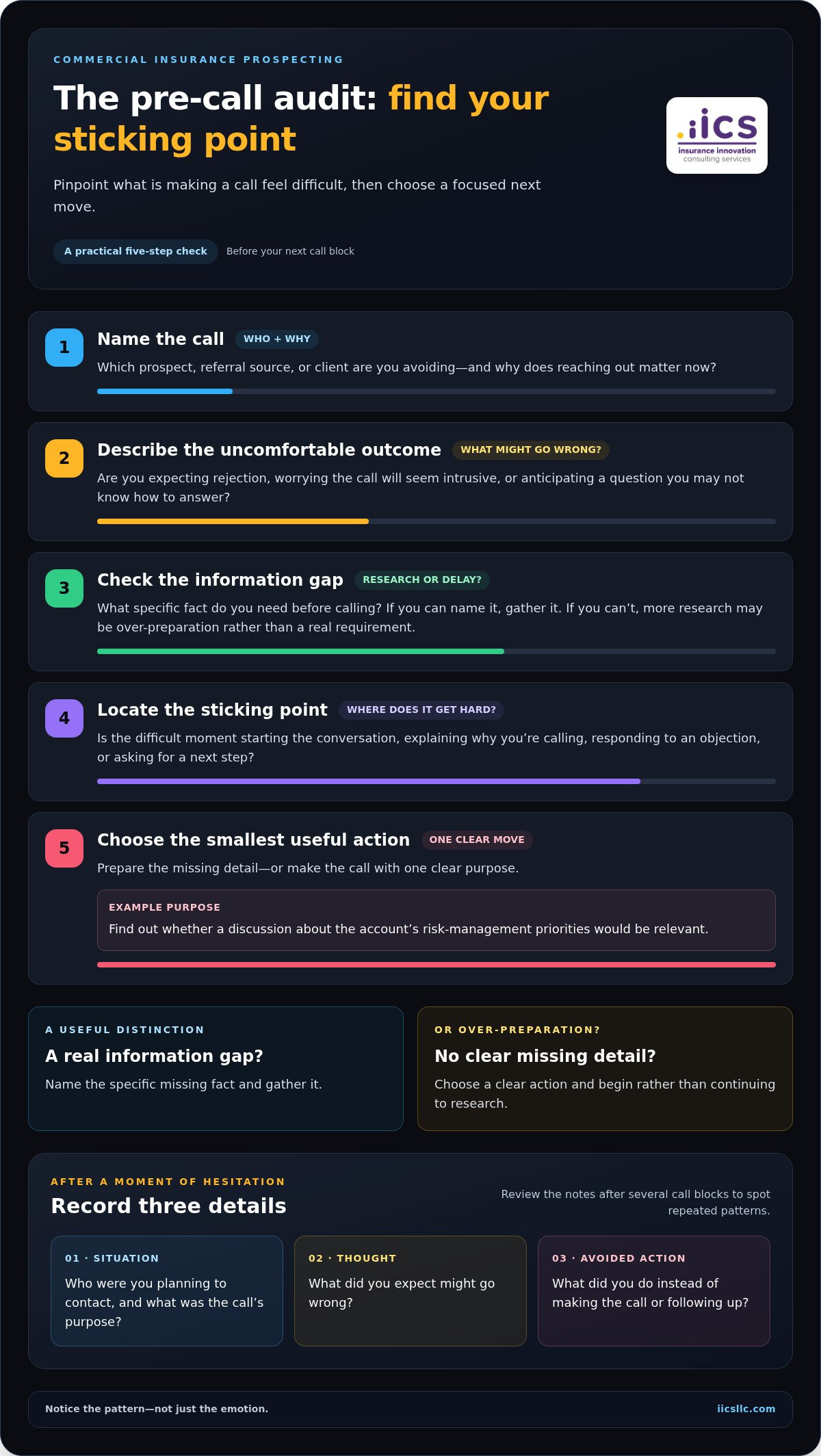
After a moment of hesitation, record three details:
Situation: Who were you planning to contact, and what was the purpose of the call?
Thought: What did you expect might go wrong?
Avoided action: What did you do instead of making the call or following up?
Review those notes after several call blocks. Repeated patterns show you where to focus. That clarity is a practical first step in learning how to overcome call reluctance for insurance producers.
How to identify the trigger behind an insurance sales call
“I need to get ready first” can point to two different problems: a genuine information gap, or preparation that has become a way to delay an uncomfortable conversation. Treat them separately. The first calls for focused research; the second calls for a clear action and a decision to begin.
Commercial insurance prospecting isn’t one uniform task. A producer might feel confident calling a referral but hesitate to approach a new account, or be comfortable discussing coverage but avoid asking for a meeting. The duties of insurance sales agents include contacting prospective clients and discussing their insurance needs, but the exact point of difficulty varies by producer.
Use a pre-call audit to find the moment you hesitate
Before your next call block, choose one call you’ve been putting off. Identify the outcome you’re worried about, then locate the exact moment that feels difficult: the opening, a possible objection, or asking for a meeting. Pinpointing the moment is more useful than telling yourself to “be confident.”
Name the call. Which prospect, referral source, or client are you avoiding, and why does reaching out matter now?
Describe the uncomfortable outcome. Are you expecting rejection, concern that the call will seem intrusive, or a question you may not know how to answer?
Check the information gap. What specific fact do you need before calling? If you can name it, gather that information. If you can’t, more research may be over-preparation rather than a real requirement.
Locate the sticking point. Is it starting the conversation, explaining why you’re calling, responding to an objection, or asking for a next step?
Choose the smallest useful action. Prepare the missing detail or make the call with one clear purpose, such as finding out whether a discussion about the account’s risk-management priorities would be relevant.
Separate a skill gap from an avoidance habit
Unclear prospect relevance is a preparation need, not a confidence defect. If you can’t explain why a business might value a conversation, refine your account research and your reason for calling. If you have a relevant reason and enough information but keep delaying, the issue may be an avoidance habit. Don’t try to solve it by adding another hour of research.
Use a brief reflection log after each hesitation. Record the call situation, the thought that surfaced, the action you avoided, and what you did instead. Review the entries after several call blocks. A recurring concern about sounding pushy may call for practicing a respectful, permission-based opening. Repeated worry about objections may point to a need to rehearse concise responses. Difficulty asking for a meeting may mean you need to practice making a direct, low-pressure request.
This diagnosis is the practical starting point for how to overcome call reluctance for insurance producers: match the response to the trigger instead of applying generic motivation. If you’ve identified a specific call skill to strengthen, structured call practice and coaching can complement your reflection and prospecting routine.
Which call-reluctance strategies work best for insurance producers?
No single tactic addresses every form of hesitation. Preparation helps when you’re unclear about why an account may value a conversation. A script helps when the opening feels uncertain. Small goals and accountability help when you know what to do but keep delaying. Match the tool to the obstacle, then judge it by whether it helps you have more focused, relevant conversations.
Scripts, call goals, and preparation: useful tools with limits
Build a flexible call framework, not a speech to memorize. Keep four elements in view: a natural opening, a clear reason for calling, a risk-focused question, and a specific request for a next step. For example, explain why you’re reaching out to a business, ask how it currently approaches a relevant exposure, then request a brief conversation to explore the issue further.
A full pitch can increase pressure: one unexpected answer and you may lose your place. A framework gives you structure while leaving room to listen, clarify, and adapt. Strong advanced commercial insurance sales techniques depend on that adaptability. Preparation should answer “Why this account, and why this conversation?” It shouldn’t become an excuse to research indefinitely.
Set a small activity goal for a defined call block, such as starting on time and completing the calls you planned. A modest, controllable target can make beginning less daunting. But don’t turn the number into a scorecard that rewards rushed, irrelevant calls. The objective is consistent, purposeful activity, not dialing without listening.
Self-coaching versus feedback from another person
Private reflection helps you spot patterns. After a call, note what worked, where you hesitated, and what you’ll adjust next time. It’s immediate and easy to repeat, but self-review has limits: you may not notice habits that prospects or colleagues hear, such as a rushed opening, an overly broad question, or a missing next-step request.
Observed practice adds another perspective. A manager or coach can listen to a role-play, identify one specific improvement, and give you a chance to try again. Keep feedback narrow and actionable. Trying to fix everything at once can make a producer more self-conscious, not more effective.
AI call coaching can provide a structured way to practice and receive feedback, while the producer remains responsible for judgment, context, and the quality of the conversation. It can complement, not replace, human coaching and thoughtful self-review. For an overview of AI sales coaching for insurance, consider how guided practice might fit into your development routine.
Accountability helps turn practice into action. Agree on a call-block goal with a colleague or coach, then review whether you completed it and what you learned. If you’re deciding how to overcome call reluctance for insurance producers, combine the tools that address your actual barrier: prepare when relevance is unclear, rehearse when a skill feels shaky, and use accountability when delay has become the default.
How to build a repeatable call routine and handle rejection
Confidence doesn’t have to come before action. A consistent routine reduces the number of decisions you make before each call and gives you a clear way to learn from the result. Keep it simple enough to repeat, even on a day when prospecting feels uncomfortable.
A practical call-block sequence for commercial P&C producers
Use this sequence to move from preparation to review without turning the call block into another research project:
Choose a focused window. Set aside a defined period for outreach and protect it from routine interruptions. Pick a process goal, such as completing the calls on your prepared list, rather than measuring the block only by meetings booked.
Prepare relevant contacts. Select prospects, referral sources, or clients and note a concise reason each conversation may be useful. For renewal outreach, organize contacts by policy expiration date so you can plan the conversation ahead of the upcoming renewal.
Make the calls. Keep your opening natural, listen to the response, and ask a relevant question. If the person isn’t available, decide on a reasonable next action rather than treating the attempt as a failure.
Record the outcome immediately. Capture the essential context, what the person said, and the next action you agreed on. A short, accurate note makes follow-up more purposeful than relying on memory.
Review the block. Note whether you completed the planned outreach, where conversations moved forward, and what you’ll adjust next time. Review the process, not just the outcome.
For renewal conversations, timing matters. Reaching out 60-90 days before policy expiration can give a producer an opportunity to begin discussing upcoming needs and plan appropriate next steps. The renewal buying window is often 30-60 days before expiration, so early outreach helps create room for a useful discussion. Use the client’s circumstances and stated preferences to guide the timing and cadence; don’t treat a calendar window as a reason to press for a conversation that isn’t welcome.
Turn rejection and non-response into useful information
A prospect’s decision gives you information about their needs, priorities, or timing. It isn’t a verdict on your professional worth. If someone declines, respond courteously and, where appropriate, clarify whether there’s a better time to reconnect. If they don’t respond, use a respectful follow-up plan that reflects any timing they’ve shared, rather than repeating the same message without purpose.
Not every call should convert. Assess whether you made a relevant opening, asked a useful question, listened to the answer, and agreed on a clear next step when appropriate. Patterns can help you improve: if several conversations stall after the same question, refine how you ask it. Don’t conclude that every objection means your whole approach is failing.
A repeatable call routine is preparation, conversation, follow-up, and review. That sequence turns outreach into a working habit and gives each attempt a useful next step, whether or not it produces an immediate meeting. To strengthen that routine with guided commercial P&C producer development, explore structured sales coaching and practice.
When structured coaching can help overcome call reluctance
Self-directed tactics are a strong place to start. But what if you’ve identified the trigger, set a call routine, and still find yourself postponing outreach or repeating the same uncomfortable moments? That’s a signal to add structure, not a reason to conclude you lack the ability to prospect. Lasting change takes more than knowing what to do. It takes practice, feedback, and follow-through.
Consider guided development if your call blocks keep slipping, you prepare but struggle to begin, or the same objection repeatedly throws you off course. Coaching can help you examine a real skill in context, practice a better approach, and apply what you learn. It isn’t a promise of immediate meetings or sales. The aim is to build capability and consistency over time.
What structured producer development adds to solo practice
Solo practice can be hard to sustain when daily demands compete for attention. Scheduled learning, coaching, and workshops create a rhythm for development and bring accountability to the process. You can work on specific behaviors, apply them in prospecting, and revisit what needs more practice.
IICS’s Sales Academy is a 90-day program for commercial property and casualty producers, with 60 tactical modules. Daily lessons take 2-4 minutes, giving you a way to work on a focused skill in short intervals. Weekly workshops provide a setting for group learning, while 1:1 mentoring offers personal guidance as you develop and apply those skills.
That combination matters because reluctance can have more than one trigger. A producer may need to sharpen an opening, become more comfortable asking for a next step, or build a steady prospecting habit. A structured development program gives those needs a place in ongoing practice rather than leaving improvement to occasional bursts of motivation.
How to decide whether a development program fits your needs
Look for the pattern. If you understand your call process but struggle to execute it consistently, accountability and a regular practice schedule may help. If you make calls but feel uncertain at particular moments, feedback can show you what to adjust. If you aren’t sure what’s holding you back, coaching can help you identify a workable development focus.
The Academy includes unlimited AI call coaching, with feedback scored against nine criteria. Used as a practice and feedback resource, it can help producers review their approach while keeping judgment and context in human hands. Coaching doesn’t remove the need to make calls or guarantee a specific result. It supports deliberate improvement through repeated application.
If a structured approach fits the gap you’ve identified, the IICS Sales Academy offers commercial P&C producer development through daily microlearning, AI call coaching, 1:1 mentoring, and weekly workshops.
Make your next call the start of a stronger habit
You don’t need to wait until every call feels comfortable. Choose one useful conversation to start, then use what you learn to make the next one more purposeful. Consistency grows through action, reflection, and practice, not by expecting nerves to disappear first.
If self-directed changes aren’t sticking, structured development can add a steady framework for continued practice. The IICS Sales Academy is designed specifically for commercial P&C producers. Its 90-day system combines microlearning, AI call coaching, mentoring, and weekly workshops, backed by IICS’s 40-year track record of insurance industry leadership.
Understanding how to overcome call reluctance for insurance producers is a practical first step. The next is choosing support that helps turn that understanding into consistent action. Explore the IICS Sales Academy to see how its structured approach can support your development goals. Start with the next call, and keep building from there.
Frequently Asked Questions
Is call reluctance normal for insurance producers?
Yes, hesitation around prospecting can affect both newer and experienced sales professionals, and it doesn’t automatically mean insurance sales is the wrong fit. The key is whether it’s occasional or repeatedly replaces planned outreach. For a week, note which calls you avoid, what you predict will happen, and what you do instead. If the same situation keeps appearing, that pattern can show whether you need more preparation, practice, or accountability.
Can you overcome call reluctance without making cold calls?
You can practice conversations and make outreach more purposeful, but prospecting still involves initiating appropriate professional conversations. A producer might reach out through a referral, a networking connection, a relevant business introduction, or a renewal-related discussion. No single channel works as a universal substitute. Choose approaches that fit your agency’s process and the prospect’s circumstances, then build a repeatable way to begin those conversations rather than waiting until outreach feels effortless.
What happens if a prospect rejects your call or says no?
A “no” tells you something about that prospect’s interest, timing, or fit; it doesn’t define your capability as a producer. Thank the person, respect their decision, and record any next step they’ve agreed to. For example, if they say the timing is wrong but invite you to reconnect later, note when and why. After the call, review your preparation and listening without pressuring someone who has declined further conversation.
How many prospecting calls should an insurance producer make each day?
There’s no single daily call count that fits every producer, agency, book of business, or prospecting strategy. Set a target that reflects the time you can protect, the quality of the contacts you plan to reach, and your agency’s expectations. Track completed outreach alongside useful outcomes, such as a scheduled follow-up or a clear decision. If a high target makes you avoid starting, begin with a manageable block and build consistency.
Should insurance producers read a script word for word?
No. A script can give you a reliable starting point, but reading every line verbatim can make it harder to respond naturally. Keep prompts for your opening, reason for calling, and one relevant question. For example, if a business owner raises an unexpected concern, pause and ask a clarifying question instead of forcing the next scripted line. Practice the structure until you can use it while staying attentive to the prospect.
How can an agency manager help a producer who avoids calls?
An agency manager can start with a private conversation about which calls feel difficult and what the producer expects might happen. Agree on one practical skill to work on, such as explaining the purpose of outreach or asking for a next step. With the producer’s permission, review a practice conversation or call example, offer specific feedback, then set a brief follow-up check-in. Pressure alone rarely clarifies what needs to change; a supportive process can.