How to Ramp Up Insurance Producers Faster in 2026
Speed isn’t created by cramming more information into a new producer’s first weeks. It comes from shortening the gap between learning, practice, fieldwork, and feedback. If you’re asking how to ramp up insurance producers faster, start by challenging the assumption that faster means less training. It means making training easier to apply.
Agency leaders know new producers need product knowledge and sales discipline. But information without deliberate practice, timely coaching, and accountability rarely turns into a dependable pipeline. When each manager trains differently, skill gaps can stay hidden until results disappoint.
This article lays out a repeatable ramp-up cadence for commercial P&C producers, with practical ways to combine focused learning, live coaching, and field application. You’ll also see which leading indicators can reveal progress before revenue does, and how to make coaching more consistent. IICS’s 90-day Sales Academy, built around 60 tactical microlearning modules, offers one example of structured development in practice. The goal isn’t to rush producers. It’s to help them build the skills and habits that move prospects forward sooner and more consistently.
Table of Contents
How to Ramp Up Insurance Producers Faster Without Rushing the Sale
A faster producer ramp-up is a structured process for building repeatable sales skills, sound judgment, consistent pipeline habits, and measurable contribution while maintaining client-service and coverage standards. The goal isn’t to push a new hire into more conversations before they’re ready. It’s to reduce wasted learning time by connecting what they learn to what they practice, do in the field, and improve through feedback.
That distinction matters. A product presentation or a few days of shadowing can create the impression that onboarding is underway while leaving critical gaps untouched. A new producer may hear how to qualify a commercial prospect but never rehearse the questions, try them in a real conversation, or receive clear feedback afterward. The gap can remain hidden until the producer struggles to build a pipeline or move an opportunity forward.
What does a faster producer ramp-up actually mean?
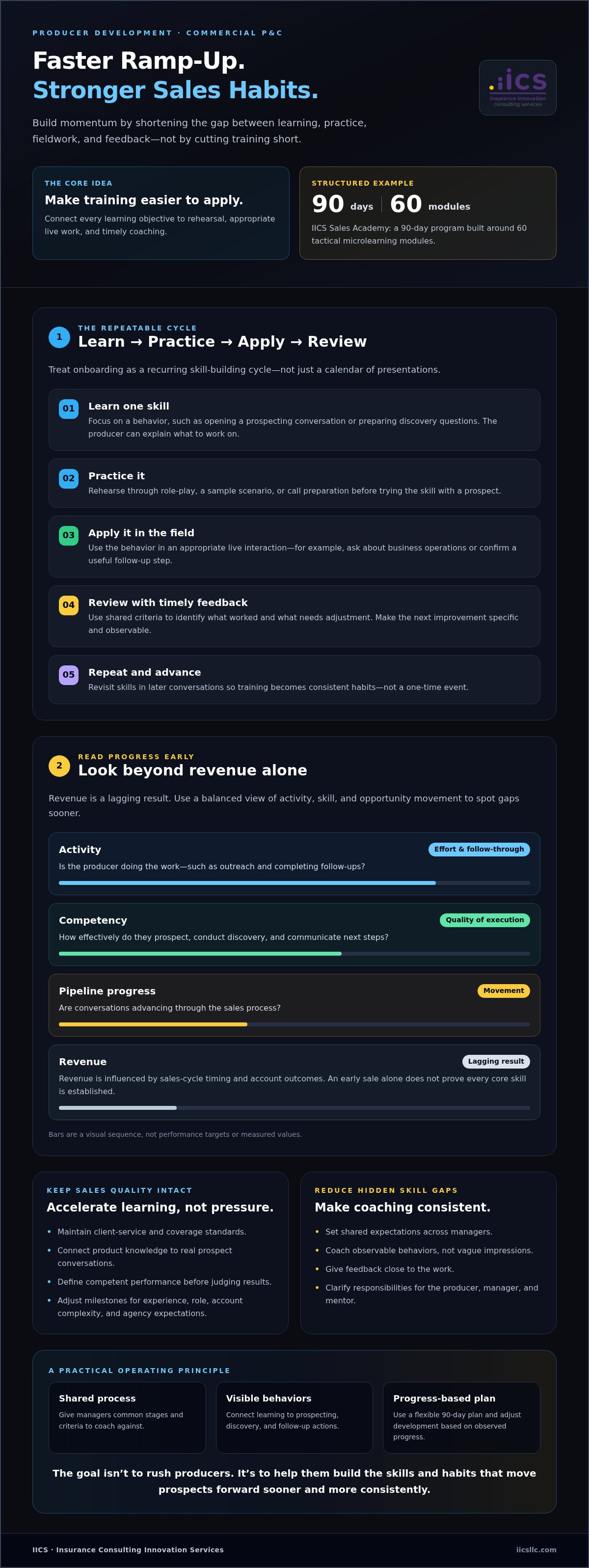
Measure development across several signals, not one headline result. Activity shows whether the producer is doing the work, such as making outreach or completing follow-ups. Competency reflects how effectively they prospect, conduct discovery, and communicate next steps. Pipeline progress shows whether conversations are advancing. Revenue is a lagging result influenced by sales-cycle timing and account outcomes.
A producer can contribute before developing a mature, sustainable book of business. Readiness depends on the person’s experience, role, account complexity, and the agency’s expectations. Set milestones accordingly, and don’t treat an early sale as proof that every core skill is established.
Why does commercial P&C development often lose momentum?
Training loses force when information isn’t tied to actual prospect conversations. A producer might study coverage concepts but be unsure how to open a prospecting call, uncover operational exposures during discovery, or agree on a useful follow-up. Renewal timing can add another challenge: knowing when to start the conversation and what information to gather.
Inconsistent manager feedback compounds the problem. One manager may focus on call volume; another may critique questions or presentation style, leaving the producer unsure which skill to improve next. Establish shared expectations and coach against observable behaviors. A structured sales process can help teams identify the stages producers need to move through, then connect each stage to specific practice and review.
That’s how to ramp up insurance producers faster without lowering the bar: make development visible, give feedback close to the work, and define competent performance before judging results. Speed should come from fewer unproductive learning gaps, not from skipping the judgment and care commercial accounts require.
Build a Producer Ramp-Up System Around Learn, Practice, Apply, and Review
Turn onboarding into a repeatable cycle, not a calendar of presentations. Each lesson should answer one question: what should the producer do differently in the next prospect, discovery, or follow-up conversation? Keep learning focused, then reinforce the skill while it’s fresh.
1. Learn one skill. Introduce a focused topic, such as opening a prospecting conversation or preparing discovery questions. Outcome: the producer can explain the behavior they’re working on.
2. Practice it. Rehearse with a role-play, sample scenario, or call-preparation exercise. Outcome: the producer can try the skill before using it with a prospect.
3. Apply it. Use the behavior in an appropriate live interaction, such as asking about a prospect’s business operations or confirming a follow-up step. Outcome: learning moves into fieldwork.
4. Review it. Discuss what happened using shared criteria, including what worked and what needs adjustment. Outcome: feedback points to a specific improvement.
5. Repeat and advance. Rehearse the next action, then revisit the skill in later conversations. Outcome: the producer builds consistency instead of treating training as a one-time event.
Turn commercial P&C knowledge into observable sales behaviors
Pair technical topics with plain-language questions. A lesson on account exposures might lead to practice asking how the client’s operations, locations, or vehicles have changed. Carrier appetite can prompt the producer to identify what information will help determine whether an account is a fit. The duties of an insurance agent offer useful context for connecting learning to client conversations. Keep producers within their role: when a coverage question requires qualified review, teach them how to flag and route it through the agency’s process rather than speculate.
Create a coaching loop that produces a specific next action
Review a call recording, live conversation, or role-play against consistent, job-relevant criteria. Focus feedback on one or two behaviors at a time, such as asking a follow-up discovery question or confirming the next step. Then assign deliberate practice and set a manager check-in or peer workshop to revisit it. The IICS Sales Academy provides an example of short lessons paired with coaching.
This is how to ramp up insurance producers faster without piling on more content: make each lesson lead to a behavior, and each review lead to a next action. Short, focused learning is useful when the producer has a chance to use it and improve it.
Measure Ramp-Up Progress with Leading Indicators, Not Revenue Alone
Revenue matters, but it arrives after the behaviors that produce it. For a new commercial P&C producer, a quiet sales period may reflect a long sales cycle, account mix, or limited prospect access, not necessarily weak skill. Managers need both leading indicators, which show whether the right work is happening, and lagging outcomes, which show what that work eventually produced.
Use a consistent scorecard. Track the quality and progression of work, not just activity volume.
Metric: Completed outreachReveals: Whether prospecting is happening consistently.Limitation: A high count doesn’t show whether the outreach is relevant or effective.
Metric: Effective-date research and meetingsReveals: Whether the producer is identifying potential timing and creating opportunities for conversation.Limitation: Research and booked meetings don’t confirm a qualified opportunity.
Metric: Discovery quality and documented next stepsReveals: Whether conversations uncover business risks, decision priorities, and a clear follow-up action.Limitation: Documentation alone doesn’t prove the producer listened well or understood the account.
Metric: Qualified pipeline movement, conversion, and revenueReveals: Whether opportunities advance and produce outcomes.Limitation: These measures can be affected by account complexity, market conditions, lead availability, and timing.
Which early indicators show a producer is building momentum?
Look for a connected pattern: outreach is consistent, effective dates are researched, meetings are purposeful, and next steps are recorded and completed. In discovery, assess whether questions uncover relevant exposures and decision-making priorities rather than simply checking boxes. Pair activity volume with account quality and follow-up reliability. That gives you a better view of whether the producer is creating sound opportunities, not just filling a calendar.
For commercial renewals, IICS’s development materials use a 30-to-60-day renewal buying window and recommend outreach 60 to 90 days before policy expiration. These timing guidelines can help producers plan activity around effective dates. The program’s lead-generation guidance also calls for at least 100 leads per month based on expiration dates, with a target of three to five new accounts per month. Treat these as planning targets, then assess the quality of the leads and the producer’s follow-through.
How should managers use revenue and conversion measures?
Compare conversion trends over consistent periods and across similar account types when the data allows. A change in results may reflect producer behavior, but it could also stem from a different mix of accounts, prospect access, or market conditions. Don’t treat one early sale as proof of lasting proficiency, or a slow initial period as proof of failure. Use results alongside call reviews and pipeline evidence to decide what to coach next.
IICS reports training benchmarks of 52% higher sales, 31% more new clients, and 53% higher lead-to-prospect conversion. These are reported benchmarks, not guaranteed outcomes for an individual producer or agency. A disciplined scorecard helps agency leaders see progress sooner while keeping performance claims grounded in evidence. That’s essential to how to ramp up insurance producers faster without confusing early activity with proven capability.
Speed Up Producer Learning While Protecting Sales Quality
Faster development shouldn’t mean earlier independence at any cost. It should mean less delay between a producer trying a skill and receiving useful feedback. Remove the waiting, not the safeguards. Producers still need to demonstrate sound judgment and client-ready communication before taking on more complex conversations without support.
An unmanaged fast start may put a new hire into prospect conversations quickly, but without clear readiness checks, gaps in preparation, discovery, or follow-up can go unnoticed. Structured acceleration sets expectations, provides practice and review, and expands responsibility as competence becomes observable.
Unmanaged fast start: Quick exposure to live work, but unclear standards can lead to inconsistent conversations and missed opportunities to correct errors.
Structured acceleration: Practice and timely feedback support improvement, while readiness checkpoints and escalation paths help protect sales quality.
What should a producer demonstrate before working more independently?
Look for evidence across actual calls, role-play, and manager review, not course completion alone. Can the producer prepare for a conversation, listen closely, ask risk-focused questions, explain information clearly within their role, and follow through on agreed next steps? Use the same criteria across reviews so the producer knows what readiness looks like. If a coverage question exceeds their knowledge or authority, they should involve an experienced colleague or appropriate specialist rather than guess.
Increase responsibility in steps. A producer might first handle a familiar conversation with a mentor available, then take the lead while a manager reviews the interaction, before managing suitable conversations more independently. Match each step to the producer’s demonstrated ability and the account’s complexity.
How can managers coach without creating a bottleneck?
Set recurring, focused coaching windows and use shared criteria to guide each review. Have producers self-review a call and identify one strength and one question before meeting with a manager. Peer practice can build repetition between check-ins, but it shouldn’t replace expert oversight on complex accounts or coverage issues. AI Sales Coaching can provide another structured feedback input; managers should still guide judgment and confirm the right next action.
The IICS 90-day Sales Academy offers an example of a defined development cadence. Its structure combines tactical lessons with coaching and practice, showing how development can be organized without treating a fixed timeline as a guarantee of readiness.
Put a 90-Day Insurance Producer Ramp-Up Plan into Practice
A 90-day framework gives agency leaders a clear cadence for development, not a guaranteed timeline to production. Adjust milestones to the producer’s experience, role, account complexity, and demonstrated readiness. Before training begins, agree on responsibilities: the manager sets expectations and reviews progress, the mentor supports skill development and judgment, and the producer completes learning, practices deliberately, applies skills, and tracks follow-through.
Set milestones across the first three months
Month one: Establish the foundation. Introduce the agency’s sales process, target-account habits, and expectations for preparation and documentation. Observe baseline conversations or role-plays to identify strengths and coaching priorities.
Month two: Build execution. Practice prospecting, discovery, objection handling, and consistent follow-up. Review real or simulated conversations to check whether skills are transferring into the producer’s work.
Month three: Strengthen independence. Assess pipeline quality, follow-through, and execution across suitable conversations. Identify remaining gaps and agree on continued coaching and development priorities.
These are guideposts, not pass-or-fail dates. A producer with relevant experience may progress differently from someone new to commercial P&C, and complex accounts may require more supported practice. Base increased responsibility on evidence of readiness, not simply time served.
IICS’s Sales Academy offers one example of a structured cadence: a 90-day system with 60 short tactical lessons, AI call coaching, veteran 1:1 mentoring, and weekly workshops. Short lessons reinforce concepts; call feedback and mentoring help producers apply them; workshops add opportunities for continued practice. This shows how how to ramp up insurance producers faster can mean creating more consistent learning and feedback, not promising identical outcomes for every hire.
Choose internal coaching or structured outside support
Internal development can work well when managers have protected time, consistent coaching criteria, and enough experience to guide producers through real conversations. If coaching is sporadic, standards vary by manager, or experienced staff lack capacity, structured external development may add a more dependable cadence and specialist support. Consider what the agency can sustain, where accountability breaks down, and which skills need focused coaching before choosing an approach.
For agencies weighing a defined development system, the IICS Sales Academy overview describes one option to consider alongside your coaching capacity and producer needs.
Turn Producer Ramp-Up into a Repeatable Advantage
Commercial P&C producers develop faster when learning leads to practice, field application, and timely feedback. A flexible 90-day plan can give managers and producers clear responsibilities, while leading indicators reveal progress before revenue fully reflects it. The standard stays high: accelerate learning, not client decisions.
That’s the core of how to ramp up insurance producers faster. Build a cadence that strengthens practical skills, reinforces consistent pipeline habits, and expands independence only as the producer demonstrates readiness. It takes commitment from agency leaders, but gives them a clearer path for coaching and development.
IICS founder Ralph J. Blust brings more than 40 years of insurance industry leadership experience. The Sales Academy combines 60 tactical modules with AI call coaching, mentoring, and weekly workshops as part of its producer development approach.
Explore IICS producer development to see whether its Sales Academy or producer development services fit your agency’s needs.
Frequently Asked Questions
How long does it take to ramp up an insurance producer?
There’s no fixed timeline for every producer to become fully productive. Readiness depends on experience, role, account complexity, agency expectations, and how consistently the producer practices and receives feedback. A 90-day plan can establish foundations and make progress visible, but it shouldn’t be treated as a promise of revenue or independent readiness by a set date. Use observed skills and pipeline progress to guide each next step.
What is the fastest way to train a new insurance producer?
The fastest sustainable approach connects focused learning directly to practice, field application, and timely coaching. Teach one practical skill, rehearse it in a role-play, apply it in an appropriate prospect interaction, then review what happened and set a specific next action. This is how to ramp up insurance producers faster without overwhelming new hires or lowering sales standards. Short lessons work best when producers have a clear opportunity to use them.
How can an agency measure producer ramp-up progress before sales come in?
Track leading indicators that show whether the producer is building effective habits and moving opportunities forward. Review completed outreach, preparation, meetings, discovery quality, documented next steps, follow-up reliability, and qualified pipeline movement. Activity counts alone can be misleading, so assess the relevance of outreach and the quality of conversations as well. Compare these indicators with eventual conversion and revenue over consistent periods, while accounting for account mix and timing.
Can AI coaching help insurance producers improve faster?
AI coaching can give producers structured feedback on calls and guidance on possible next steps, helping them review conversations between manager check-ins. IICS AI Sales Coaching provides feedback against nine criteria. Use that input to identify a behavior to practice, not as a substitute for human judgment. Managers and experienced colleagues remain important for interpreting complex client situations, reviewing coverage questions, and confirming appropriate actions.
What should an insurance producer learn first?
Start with the agency’s sales process and expectations for prospecting, preparation, documentation, and follow-up. Then build practical conversation skills: opening outreach, asking discovery questions that explore business risks and priorities, and agreeing on a clear next step. Producers also need to know when a question requires guidance from an experienced colleague. This foundation makes later product and account-specific learning easier to apply in real conversations.
How can an agency ramp up producers without sacrificing sales quality?
Shorten delays between practice and coaching, not the time needed to demonstrate competence. Set shared readiness criteria for preparation, listening, risk-focused discovery, clear explanations, and follow-through. Review role-plays and observed calls, then increase responsibility in stages based on demonstrated skill and account complexity. Give producers a clear path for escalating questions beyond their knowledge. Faster development should improve feedback and repetition while protecting client-service standards.
Is a 90-day producer development program enough?
A 90-day program can provide a defined starting cadence for learning, practice, coaching, and progress reviews, but it won’t establish the same level of readiness for every producer. IICS’s Sales Academy is a 90-day system combining 60 tactical modules with AI call coaching, mentoring, and weekly workshops. Agencies should use milestones to identify skills developed and gaps remaining, then continue coaching as the producer takes on new responsibilities.