How to Structure an Insurance Producer Mentoring Program for Elite Performance
Updated: Sep 10
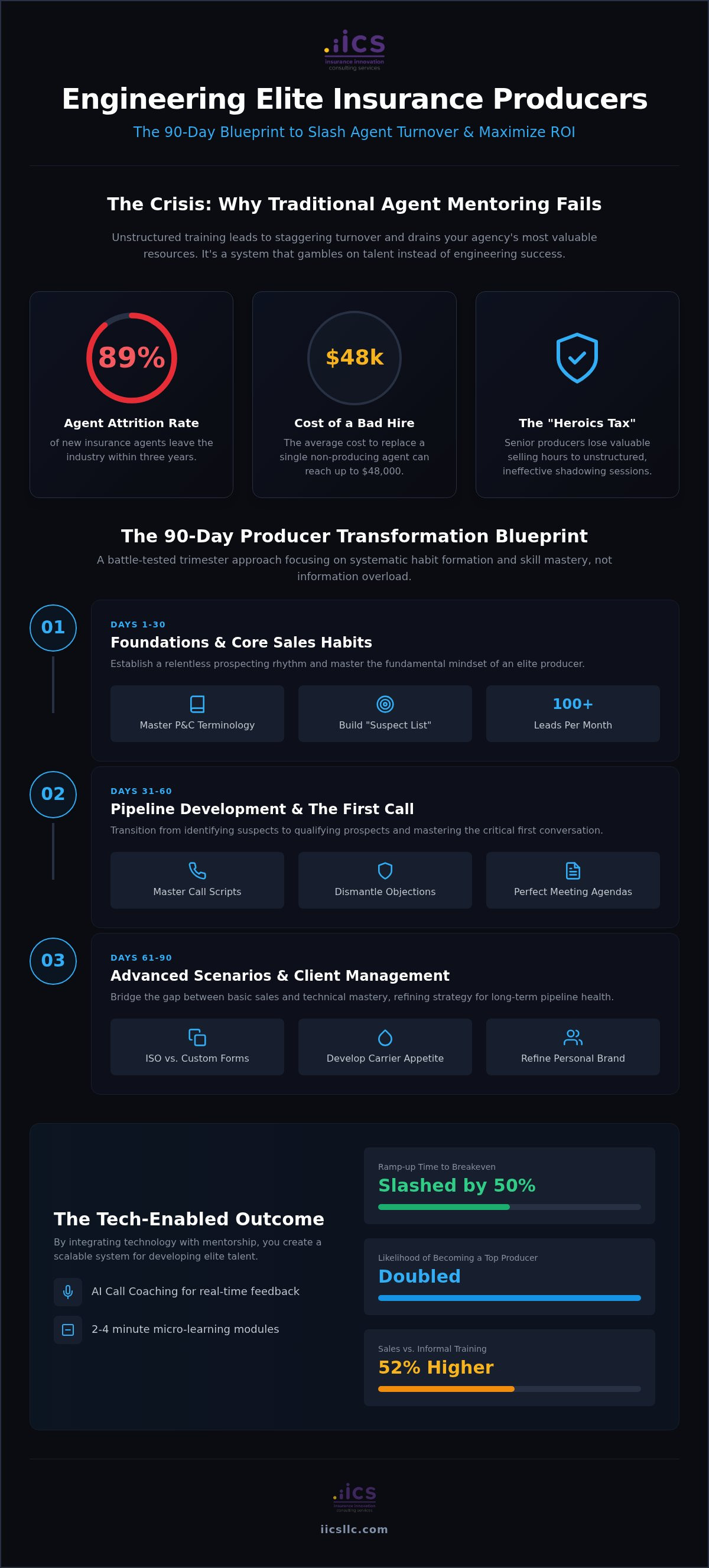
89% of new insurance agents leave the industry within three years. It's a staggering figure that represents millions in lost commissions and wasted recruitment costs. When agency owners ask how to structure an insurance producer mentoring program, they're usually looking for a way to stop this bleeding. You've likely felt the frustration of watching a senior producer lose valuable selling hours to shadowing sessions that yield zero results. You've seen the inconsistent training that leaves raw talent flailing in a softening market where margins are already compressed.
This isn't about hand-holding; it's about high-stakes performance. This guide provides the exact 90-day framework to transform raw talent into top-tier P&C producers. You'll learn how to leverage micro-learning and AI to slash ramp-up time by 50% without draining your veterans' energy. We'll break down the systematic blend of technology and mentorship required to build a repeatable, elite sales culture that doubles the likelihood of your new hires becoming top producers. It's time to stop gambling on talent and start engineering success.
Table of Contents
Stop the Shadowing Trap: Why Your Current Mentoring Program is Failing
Senior producers are your agency's primary revenue engines. Every hour they spend in an unorganized shadowing session is an hour they aren't closing deals. This is the Heroics Tax. It's the hidden drain on your P&L caused by treating your top earners as part-time, untrained teachers. When agencies wonder how to structure an insurance producer mentoring program, they often default to a buddy system. This is a mistake. Shadowing doesn't build elite producers; it creates clones of existing bad habits and outdated shortcuts.
While the basics of workplace mentoring suggest that observation is helpful, it lacks the tactical rigor required for high-stakes Property and Casualty sales. Research shows that 89% of new insurance agents leave the industry within three years; nearly half of that attrition occurs in the first six months. This failure is rarely due to a lack of talent. It's a failure of structure. Without a high-performance mentoring framework, new hires are left to decipher the how of selling through osmosis. It doesn't work.
The Real Cost of a Non-Producing Hire
A producer who takes 18 months or more to break even is a liability. The cost to replace a single agent ranges from $21,500 to $48,000 when you factor in recruiting, onboarding, and lost production. Lack of structure is the primary driver of this turnover. Without a roadmap, new hires feel isolated and ineffective. A high-performance mentoring program is a data-driven system for revenue velocity, ensuring that every hire moves toward profitability with precision. You can see how this structure is built inside the academy.
Mentoring vs. Training: Knowing the Difference
Don't confuse licensing prep with sales development. Training provides the what, covering policy forms and basic insurance code. Mentoring provides the how, focusing on tactical execution and high-stakes negotiation. Your mentors shouldn't be a library of information. They must be high-stakes coaches who refine a producer's ability to convert leads into prospects. Agencies that invest in formal training see 52% higher sales than those that rely on informal systems. By aligning your mentoring approach with the leadership principles advocated by Unashamedly Ethical NPC, you can ensure your agency is built on a foundation of integrity and excellence. Stop treating mentorship as a casual conversation and start treating it as a disciplined investment in your agency's future.
Habits aren't built in a single afternoon. They require a sustained, tactical effort. The 90-day threshold is the industry standard for transforming raw behavior into permanent professional discipline. When considering how to structure an insurance producer mentoring program, you must abandon the "firehose" method of training. Information dumping leads to cognitive overload and retention failure. Instead, elite agencies utilize a trimester approach that favors daily micro-commitments over sporadic, heavy training sessions. This ensures that knowledge is immediately applied to revenue-generating activities.
Trimester 1: Foundations and Core Sales Habits
Trimester 2: Pipeline Development and The First Call
Transition from identifying suspects to qualifying prospects. This stage focuses on the mechanics of the 30-60 day buying window. Producers learn to navigate the high-stakes environment of the first call. They must master scripts that dismantle common objections, such as the classic "I'm happy with my current agent" response. Success here depends on perfecting the agenda for both virtual and in-person meetings. You can explore how these tactical scripts are integrated into a broader system by reviewing the Sales Academy methodology.
Trimester 3: Advanced Scenarios and Client Management
The final phase bridges the gap between basic sales and technical mastery. Producers dive into the nuances of ISO versus Custom forms and develop a sharp intuition for carrier appetite. They refine their personal brand and local networking strategies to ensure long-term pipeline health. By the end of this 90-day cycle, the goal is clear: reach breakeven revenue in half the time it takes the average industry hire. If you want to see this level of performance in your own agency, consider how a structured Sales Academy can accelerate your growth.
The Tech-Enabled Mentor: Integrating AI and MicroLearning
Traditional training methods are a recipe for information overload. When you dump hours of policy knowledge onto a new hire, retention collapses. MicroLearning solves this by delivering tactical insights in 2-4 minute modules. This approach leverages the science of spaced repetition to ensure lessons actually stick. Daily, bite-sized videos prevent training fatigue and keep producers focused on immediate execution rather than theoretical concepts. You can see this methodology in action by looking Inside the Sales Academy. It's about precision, not volume.
AI Call Coaching as a Force Multiplier
AI call coaching is the ultimate force multiplier for a busy agency. These systems score every outbound call against 9 critical criteria in real-time. Is the producer asking for the x-date? Are they handling objections with the correct script? AI provides these answers 24/7, identifying exactly where a producer is "leaking" revenue before it becomes a permanent habit. This data-driven scoring doesn't replace the human mentor; it empowers them. Instead of spending 1:1 time on basic critiques, the mentor can focus on high-level strategy and complex deal structures during their scheduled sessions.
Bridging the gap between data-driven scoring and human coaching creates a feedback loop that's both objective and personal. It allows you to maintain a repeatable, scalable sales culture without burning out your top talent. The result is a producer who learns faster, performs better, and reaches profitability in half the time. Stop relying on luck and start relying on a system that works as hard as your best producers do. By offloading the repetitive aspects of training to AI and MicroLearning, you ensure that every minute of human mentorship is spent on the high-value activities that actually move the needle.
Consistency is the differentiator between a high-performing agency and a revolving door of talent. Vague "personalized feedback" is a recipe for stagnation. When you determine how to structure an insurance producer mentoring program, you must establish a rigid operational cadence. This isn't about checking boxes; it's about creating a predictable heartbeat for sales activity. Elite performance is a byproduct of repetition and rhythm, moving from daily micro-habits to monthly strategic overhauls.
The daily rhythm centers on two non-negotiable activities: 2-4 minute micro-learning modules and aggressive lead generation. By focusing on 60 specific modules over 90 days, producers build a foundation of knowledge that informs their daily outreach. This ensures that the minimum baseline of 100 leads per month is not just a goal, but a logistical certainty. Without this daily pressure, the pipeline withers before it can ever bloom. This daily discipline is what separates those who "try" from those who "produce."
Weekly Workshops and Peer Accountability
Group learning is essential for building a competitive sales culture. Weekly live workshops serve as a tactical arena where producers test their skills against peers. These sessions focus on role-play scripts that actually close deals, specifically targeting the "current agent" objection that stalls most new hires. Peer accountability ensures that no one hides behind a spreadsheet. You can see how this fits into a broader Insurance Agency Sales Performance framework by reviewing our elite producer standards. It's about turning individual effort into collective momentum.
The 1:1 Coaching Deep Dive
Monthly mentor sessions shouldn't be casual chats about "how things are going." They require a strict agenda framed around pipeline health. Mentors use a "Sales Cycle Snapshot" to review risk-focused questions and identify bottlenecks. This is where you track the elite producer metrics: lead-to-prospect conversion and closing rates. Data from formal training systems shows that agencies utilizing this structured approach see a 53% increase in lead-to-prospect conversion. The session concludes with three concrete actions for the next 30 days, ensuring the producer leaves with a battle plan, not just a pat on the back.
Don't leave your agency's growth to chance. If you're ready to implement this cadence without the $50,000 mistake of building it yourself, you should explore the Sales Academy today.
Implementing the IICS Sales Academy: Your Turnkey Mentorship Solution
Attempting to build an internal program from scratch is a $50,000 mistake that most agencies can't afford to make. Between the lost selling time of your senior producers and the inevitable trial and error of curriculum design, the "do-it-yourself" approach is a massive drain on resources. While many agency owners struggle with how to structure an insurance producer mentoring program that actually scales, the answer isn't in more meetings. It's in an outsourced, turnkey system. IICS has distilled a 40-year track record of growth into a precise 90-day framework designed to eliminate the guesswork of producer development.
The results of this structured approach are documented and undeniable. Agencies that leverage the Sales Academy see 52% higher sales for agents in formal training and a 31% increase in new clients. We don't just teach theory; we engineer performance. By utilizing our battle-tested methodology, you double the likelihood of your new hires becoming top producers. This isn't just an educational course. It's a high-stakes investment in your agency's revenue velocity.
What’s Included in the Sales Academy
The Sales Academy provides the technical and tactical infrastructure your agency needs to win. Your producers gain access to 60 MicroLearning modules, unlimited AI coaching for real-time feedback, and 1:1 sessions with veteran mentors. We provide a comprehensive resource library filled with effectiveness tools and workbooks that turn knowledge into action. This system offloads the burden of training from your senior staff, allowing them to focus on high-value deals while we sharpen your raw talent. You can discover more about our history of excellence by reading About IICS.
Getting Started: The First Trimester
Elite performance starts with a commitment to structure. You can enroll your next hire for the first of the month, placing them on a trajectory for immediate impact. The ROI of professional development far outweighs the "cost of doing nothing"—which usually looks like a $48,000 turnover bill. For invited agencies, we've made this transition even more accessible. Use the code Summer2026 to secure this elite development system at a 50% retail reduction, bringing your investment down to $1,500 per month. Stop gambling on the future of your agency and start following a proven path to victory. Apply for the Sales Academy Today and transform your sales culture forever.
Stop Gambling on Talent and Start Engineering Success
Building a high-performance sales culture is not a matter of luck; it is a matter of discipline. You now have the blueprint for how to structure an insurance producer mentoring program that replaces vague shadowing with a tactical, 90-day system. By integrating AI call coaching and micro-learning modules, you preserve your senior producers' time while ensuring your new hires reach breakeven revenue in half the industry norm time. This structured approach isn't just about training. It's about securing your agency's revenue velocity in a tightening market.
The path to elite performance is open to those willing to abandon the status quo. Our academy graduates achieve 52% higher sales by following this exact framework, backed by 40 years of industry expertise. Ready to develop elite producers? Enroll in the IICS Sales Academy and use code Summer2026 for 50% off. You have the tools and the methodology to transform your agency. It's time to stop watching talent walk out the door and start building a team that dominates the marketplace. Success is within your reach.
Frequently Asked Questions
How long should an insurance producer mentoring program last?
A high-performance program should last exactly 90 days. This three-month system provides the necessary window for permanent habit formation and skill mastery. When you determine how to structure an insurance producer mentoring program, you have to prioritize this timeline to avoid the "firehose" effect of information overload. Short-term training fails to stick, while programs longer than 90 days often lose momentum. This specific duration ensures producers reach profitability in half the industry norm time.
What is the difference between insurance sales training and mentoring?
Training focuses on policy knowledge and licensing prep, which is just the "what" of the industry. Mentoring provides the "how," focusing on tactical sales execution and high-stakes negotiation. A mentor acts as a coach who refines a producer's ability to convert leads into prospects. Agencies that invest in formal mentoring see 52% higher sales because they prioritize tactical application over theoretical knowledge. It's the difference between reading a playbook and actually winning the game.
How do you measure the success of a producer mentoring program?
Success is measured by tangible revenue velocity and conversion metrics. You should track lead-to-prospect conversion rates, which typically see a 53% increase in structured programs. Other critical KPIs include the number of new clients added and total sales volume. Ramp-up time is another vital metric; elite programs aim to reduce this by 50%. If a producer isn't hitting a baseline of 100 leads per month, the mentoring structure needs immediate adjustment to ensure growth.
Can AI really replace a human mentor in insurance sales?
AI cannot replace the strategic intuition of a veteran agent, but it acts as a massive force multiplier. It provides 24/7 call coaching by scoring every outbound interaction against nine critical criteria. This objective data identifies revenue leaks that a human mentor might miss during sporadic shadowing sessions. By offloading basic critiques to AI, you allow your senior producers to focus on complex deal structures. It's about using technology to amplify human expertise, not eliminate it.
What are the most common reasons insurance producer mentoring programs fail?
Most programs fail because they rely on informal shadowing, which creates a Heroics Tax on senior staff. This lack of structure leads to inconsistent results and senior producer burnout. Without a repeatable cadence, new hires often flail, contributing to the 89% industry turnover rate within three years. Programs also fail when they prioritize information dumping over daily habit formation. If there isn't a data-driven framework, the mentoring becomes an expensive social hour rather than a revenue engine.
How much time should a mentor spend with a mentee each week?
A mentor should spend approximately 60 to 90 minutes in direct 1:1 sessions each month, supplemented by weekly group workshops. The goal is to maximize impact without draining senior selling time. Daily micro-learning modules handle the repetitive teaching, while AI call coaching provides ongoing feedback. This structure ensures that when the mentor and mentee do meet, the focus is entirely on high-level strategy and pipeline health. It's about quality of interaction over the quantity of hours spent.
Is a structured mentoring program worth the investment for a small agency?
What specific topics should be covered in the first 90 days of mentoring?
The first 90 days should cover three distinct trimesters of development:
Trimester 1: Mindset, prospecting habits, and building a high-volume "Suspect List."
Trimester 2: Pipeline development and mastering scripts for the first call.
Trimester 3: Technical mastery of ISO forms and refining personal branding.
This progression ensures producers move from basic activity to revenue generation in a logical, high-velocity sequence that prioritizes immediate results over long-term theory.