In-House vs. Outsourced Insurance Sales Training Guide
Updated: Sep 23
How much capital are you willing to set on fire while your new producers "shadow" veterans who don't have the time to teach them? The traditional model of internal mentoring is often just a polite term for expensive trial and error. When evaluating in-house vs outsourced insurance sales training, you aren't just choosing a curriculum; you're deciding how quickly your agency reaches profitability. Most owners realize too late that shadowing is not a strategy. It's a bottleneck that keeps your best talent from producing and your new hires from ever reaching their potential.
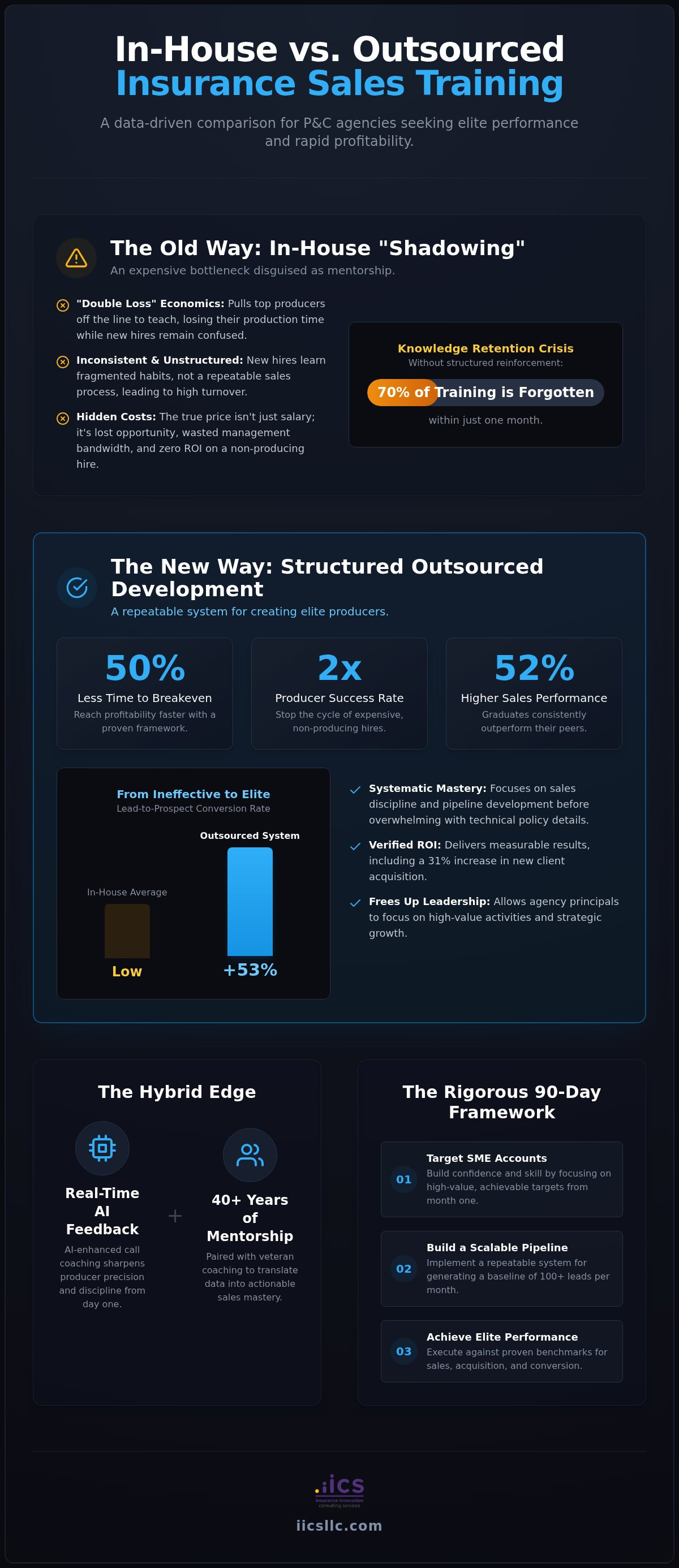
You already know that the first 90 days are critical, yet the industry norm for breakeven remains sluggishly slow. We understand the frustration of watching high-potential hires stagnate because you lack a repeatable system for elite performance. This guide breaks down the critical differences between internal shadowing and professional outsourced development to show you how to double your producer success rate. We'll examine why 70% of training is forgotten within a month without reinforcement and how a structured, AI-enhanced methodology can get your producers to breakeven in 50% less time.
Table of Contents
The Crisis of Internal 'Shadowing' in P&C Agencies
Shadowing is the slow death of a promising producer career. Most agency owners believe that placing a new hire next to a veteran agent for two weeks constitutes a training program. It doesn't. This "look over their shoulder" approach is the primary reason producers fail to reach validation. The debate over in-house vs outsourced insurance sales training often ignores a fundamental truth: your top veterans are paid to sell; they aren't professional educators. When you force a high-performer to mentor a rookie, you create a double loss. You lose the veteran's production time and gain a confused new hire who has only learned a series of disconnected habits.
This leads to the "Firehose Effect." A veteran agent attempts to dump 40 years of nuanced industry knowledge into a rookie's lap in five days. It's impossible. Without a structured curriculum, the new producer is overwhelmed by technical jargon they can't yet apply. Many agencies eventually turn to Sales outsourcing because they realize the opportunity cost is too high. Pulling a producer with a $2M book off the line to explain ISO forms is a catastrophic waste of resources. Statistics show that without reinforcement, sales representatives lose up to 70% of what they learned within just 30 days. This lack of retention is why producer turnover remains a persistent plague for agencies without formal systems.
Why Traditional Onboarding Fails the First 90 Days
Traditional onboarding lacks a repeatable sales cycle snapshot. Instead of a clear roadmap, the new hire gets a different version of the "truth" depending on which veteran they shadow that day. This inconsistency creates a fragmented agency culture where no two producers follow the same process. The cost of a non-producing hire is a silent agency killer that drains your payroll, consumes your management bandwidth, and yields zero ROI.
The Difference Between Product Knowledge and Sales Mastery
Knowing a carrier's appetite for artisan contractors isn't the same as knowing how to close a high-value SME account. Agencies often make the mistake of teaching technical ISO forms and policy language before the foundations of a sales conversation. Technical expertise is worthless if the producer can't get past the first call. You can see how we bridge this gap by looking Inside the Academy. We prioritize sales discipline and pipeline development over dry technical theory. Elite producers are built through systematic mastery, not by watching a veteran handle their own renewals.
In-House vs. Outsourced: A Cost and ROI Comparison
Stop pretending that in-house training is a cost-saving measure. It's often a high-stakes gamble with your agency's capital. When you analyze in-house vs outsourced insurance sales training, you must look beyond the line item on a spreadsheet. The real cost of internal development isn't just the salary of the new hire; it's the invisible drain on your most valuable resources. Every hour a Principal spends acting as a part-time trainer is an hour they aren't closing high-value accounts or steering the agency's growth strategy.
Most internal programs suffer from the disappointing ROI of sales training because they lack the reinforcement necessary for behavior change. Without a systematic approach, you're essentially paying for a revolving door of talent. Professional outsourced development, however, changes the math. Data shows that graduates of structured academies achieve 52% higher sales and a 31% increase in new client acquisition compared to those left to figure it out on their own. This isn't just a marginal gain; it's a fundamental shift in your agency's production capacity.
The Investment Myth: Is In-House Really 'Free'?
If you value a Principal's time at $500 per hour, a mere five hours of weekly coaching costs the agency $10,000 per month in lost opportunity. Add the risk of passing down "bad habits" or outdated tactics through informal mentoring, and the price of "free" training skyrockets. A structured academy mitigates the risk of a $100,000 hiring mistake by providing immediate, measurable feedback. If you aren't sure where your current program stands, evaluating your current training ROI is the first step toward elite performance.
Performance Benchmarks for Elite Producers
Elite producers don't guess; they execute against proven benchmarks. A high-performing rookie should target 100 leads per month as a baseline for pipeline health. In a professional framework, we see a 53% increase in lead-to-prospect conversion rates because the focus shifts from technical jargon to sales discipline. This level of precision is what allows producers to reach breakeven in just 6 months, whereas the industry norm drags on for 12 to 18 months. You can find the full roadmap for this acceleration in our Elite Insurance Producer Development Plan. Outsourcing provides the scalability to hire three producers at once without paralyzing your leadership team, turning your agency into a repeatable growth machine.
The 90-Day Framework: Building Elite Producers Fast
Elite performance demands a battle-tested roadmap. If your onboarding process consists of "sink or swim," you're essentially choosing to drown. The first 90 days determine whether a producer validates or becomes a permanent payroll liability. When choosing between in-house vs outsourced insurance sales training, the most critical factor is the structure of the timeline. A high-stakes environment requires a trimester system that moves from foundational discipline to advanced closing tactics with surgical precision.
Month one is about the SME filter and core sales skills. New producers must learn to disqualify poor leads immediately to protect their most valuable asset: time. By month two, the focus shifts to pipeline development and mastering the "First Call" basics. This is where the discipline of a repeatable system replaces the unpredictability of raw talent. Finally, month three tackles complex selling scenarios and soft-market tactics. This progression ensures that by the time they reach their 90-day milestone, they aren't just licensed agents; they're disciplined producers ready to compete.
Microlearning: 3-Minute Lessons for Maximum Retention
Why do traditional seminars fail? They ignore how the human brain actually learns. Our 60-module curriculum is built on microlearning, utilizing 2 to 4-minute tactical modules that fit into a producer's high-activity schedule. This approach avoids information overload and focuses on habit formation. Instead of a week-long "firehose" session that is forgotten by Friday, producers engage in daily, bite-sized lessons that reinforce elite behaviors. It's the difference between a one-time event and a permanent transformation in performance.
Mastering the Renewal Window (60-90 Days)
The "Window Trigger" is the most overlooked opportunity in commercial P&C. Producers often stall when a prospect says, "I'm happy with my current agent." We provide scripted, battle-tested responses that turn this objection into a strategic entry point. By mapping the renewal window between days 60 and 90, producers can position themselves as the logical alternative before the incumbent even sends a proposal. For those looking to dominate this phase, our Advanced Commercial Insurance Sales Techniques provides the specific blueprint for scaling agency growth through systematic conquest. This level of tactical depth is rarely achieved in general internal training programs.
The Hybrid Edge: AI Call Coaching Meets Veteran Mentorship
Subjectivity is the enemy of growth. In most agencies, coaching is based on a manager's "gut feeling" after listening to a single random call once a month. This inconsistent feedback loop is a primary weakness when comparing in-house vs outsourced insurance sales training. Elite producers aren't built on vague suggestions; they're forged through data-driven precision and seasoned industry wisdom. By 2026, 64% of U.S. insurance agencies have integrated AI into their workflows, yet many still fail to use it where it matters most: the sales conversation.
A hybrid model eliminates the guesswork. It pairs the tireless analytical power of AI with the nuanced strategy of 40-year industry veterans. This combination ensures that every call is an opportunity for refinement, not just another tally on a lead sheet. Weekly live workshops further solidify this by providing peer accountability and high-stakes role-playing environments. You don't just hope your producers are improving; you track their mastery across every critical sales criterion in real time.
AI Coaching: Scoring the Sales Cycle
Our unlimited AI Call Coaching provides immediate feedback on nine critical criteria, from objection handling to carrier appetite alignment. Unlike a human manager, AI never gets tired and never has a "bad day." It identifies specific gaps in a producer's delivery, allowing for 24/7 development that fits a remote or high-activity schedule. This isn't just about increasing call volume. It's about ensuring every minute on the phone is high-quality and high-impact. For a deeper look at how this technology transforms rookies into veterans, explore our pillar on AI Sales Coaching for Insurance.
Veteran Insights: Learning from Ralph Blust
Technology provides the data, but veterans provide the context. Monthly 1:1 sessions with Ralph Blust, a former leader at a major national brokerage, offer producers access to four decades of high-level Commercial P&C experience. This mentorship is vital for navigating the complexities of ISO vs. Custom Forms and understanding various legal impacts that can make or break a deal. Producers learn to build a personal brand in the Excess and Specialty markets, moving beyond the role of a "vendor" to become a trusted advisor. This level of elite mentorship is rarely available in-house, where senior leaders are often too busy managing their own books to provide deep-dive technical coaching. If you are ready to equip your team with this competitive advantage, apply for the Sales Academy today.
Choosing Your Path: Implementing Outsourced Success
Decisions dictate your agency's trajectory. You can continue to tolerate the high cost of non-producing hires, or you can implement a system designed for elite performance. When weighing in-house vs outsourced insurance sales training, the final choice comes down to whether you want to be a trainer or a CEO. Transitioning to an external academy isn't just about offloading work; it's about importing a battle-tested framework that has already proven its worth across the country. Integrating this training into your agency's culture requires a shift in mindset where you stop viewing development as a one-time event and start seeing it as a continuous, high-stakes investment.
For agencies looking to scale leadership alongside their producers, Fractional CRO services offer a strategic advantage. You gain the expertise of a seasoned Chief Revenue Officer without the burden of a full-time executive salary. This allows you to focus on high-level growth while our team manages the mechanics of producer development. Our enrollment follows a structured trimester model, with new cohorts starting every month. This ensures your agency always has a path forward for new talent, regardless of when you make your next hire.
What to Look for in a P&C Training Partner
The path to doubling your producer success rate begins with a commitment to the process. Preparing your producers for the 90-day Sales Academy means setting expectations for daily discipline and active participation in weekly live workshops. It's a rigorous journey, but the results speak for themselves. If you're ready to accelerate your agency's growth, use the discount code Summer2026 when enrolling your next cohort to secure preferred pricing. You can learn more about our leadership's extensive industry background by visiting our About IICS page. Stop settling for the inconsistency of shadowing and start building a scalable onboarding system today.
Stop the Cycle of Non-Producing Hires
Your agency's growth is tethered to the speed and precision of your producers. Shadowing veteran agents is a bottleneck that drains your leadership bandwidth and stalls your revenue. By implementing a systematic, 90-day framework, you replace subjective coaching with a repeatable engine for elite performance. Slashing your breakeven timeline isn't just about training; it's about reclaiming your time as a CEO while ensuring your new hires have the tools to win.
The decision regarding in-house vs outsourced insurance sales training determines how quickly your agency reaches its next production milestone. We provide the stable methodology and high-stakes environment needed to transform rookies into top-tier producers. With 40 years of industry leadership and AI-driven coaching featuring 9-point scoring, our graduates achieve a proven 52% increase in sales performance. Don't let your best talent stagnate under an outdated mentoring model. It's time to build the elite team your agency deserves.
Apply for the IICS Sales Academy and double your producer's success rate
Frequently Asked Questions
Is outsourced insurance sales training worth the investment for small agencies?
Yes. Small agencies often lack the dedicated training staff needed to develop talent without sacrificing the principal's own production. Outsourcing provides a scalable system that prevents the high cost of a non-producing hire. By using a structured academy, a small agency can access 40 years of veteran expertise and AI tools that would be impossible to build internally. This ensures rookies reach profitability faster while the owner focuses on closing high-value accounts.
How quickly can a new producer reach breakeven with professional training?
A disciplined producer can reach breakeven in approximately 6 months through a professional development system. This is a significant improvement over the industry norm of 12 to 18 months. By following a 90-day structured framework, producers master core sales skills and pipeline development early. This accelerated ramp-up period is achieved by replacing the "firehose" method of internal shadowing with consistent, tactical microlearning and daily reinforcement.
What is the difference between generic sales training and a P&C-specific academy?
AI call coaching provides real-time, data-driven feedback by analyzing sales conversations against nine critical criteria. The system scores objection handling, industry insight, and carrier alignment, offering next-step guidance for every call. This 24/7 access allows producers to sharpen their skills between 1:1 mentoring sessions. It replaces the subjective "gut feeling" of traditional managers with objective metrics that track a producer's mastery of the sales cycle over time.
Can an outsourced program handle training for commercial SME accounts?
Yes, the Sales Academy specifically targets the development of producers for small, medium, and enterprise accounts. The curriculum includes dedicated modules on building a book of business within the SME commercial sector. Producers learn how to use focus filters to prioritize suspects and map the "Window Trigger" for renewals. This tactical approach ensures they are hunting high-value targets with the precision required for commercial insurance success.
What happens if a producer fails to complete the 90-day academy?
The academy is designed with accountability at its core to minimize the risk of failure. Weekly live workshops and daily microlearning modules ensure that producers stay on track throughout the 90-day commitment. If a producer consistently fails to engage with the curriculum or AI coaching, it serves as an early indicator of a hiring mismatch. This transparency allows agency owners to make informed talent decisions before wasting additional months of salary on a non-producer.
Do I still need to mentor my producers if I use an outsourced program?
Your role shifts from being the primary technical trainer to being a high-level performance coach. While the academy handles the heavy lifting of sales discipline, carrier appetite, and technical forms, you provide the agency-specific cultural context. This hybrid approach is the most effective way to utilize in-house vs outsourced insurance sales training. You spend less time explaining basics and more time helping elite producers navigate your specific agency's growth goals.
How do trimesters work for enrollment in the Sales Academy?
Enrollment follows a trimester model with new cohorts starting on the first day of every month. The curriculum runs for three months, covering foundational skills in month one, pipeline development in month two, and advanced selling scenarios in month three. This rolling start allows agencies to enroll new hires as soon as they are licensed. It provides a consistent, repeatable onboarding system that ensures no producer is left waiting for a training cycle to begin.