In-House vs Outsourced Training: Scaling P&C Revenue
- 2 days ago
- 12 min read
Your in-house training program isn't an investment; it's a hidden tax on your agency's growth. Every hour you spend teaching a new hire the basics is an hour you aren't closing high-value accounts. Why are you still acting like a school instead of a profit center? You've likely felt the frustration of watching a promising producer struggle for twelve months just to reach breakeven. It's a high-stakes drain on your capital and your patience. You want elite performers, but your current "sink or swim" model is creating a bottleneck that stalls your scale.
We understand the pressure to keep development close to home. It feels safer to control the process yourself. However, the data reveals a different reality. This article explores the critical debate of in-house vs outsourced insurance sales training to show why traditional onboarding methods are failing P&C agencies. You'll discover how a structured, outsourced approach can cut producer ramp-up time in half and build a repeatable factory for elite talent. We'll provide the data-driven proof you need to stop bleeding cash on non-producing hires and start accelerating your revenue.
Table of Contents
The Hidden Cost of Internal Training: Why the "Sink or Swim" Model Fails
What is Outsourced Producer Development? A Strategic Framework for Agencies
Comparing ROI: In-House Training vs. Outsourced Sales Leadership
Modern Pillars of Elite Performance: AI Coaching and MicroLearning
Implementing Outsourced Development: Your Path to an Elite Team
The Hidden Cost of Internal Training: Why the "Sink or Swim" Model Fails
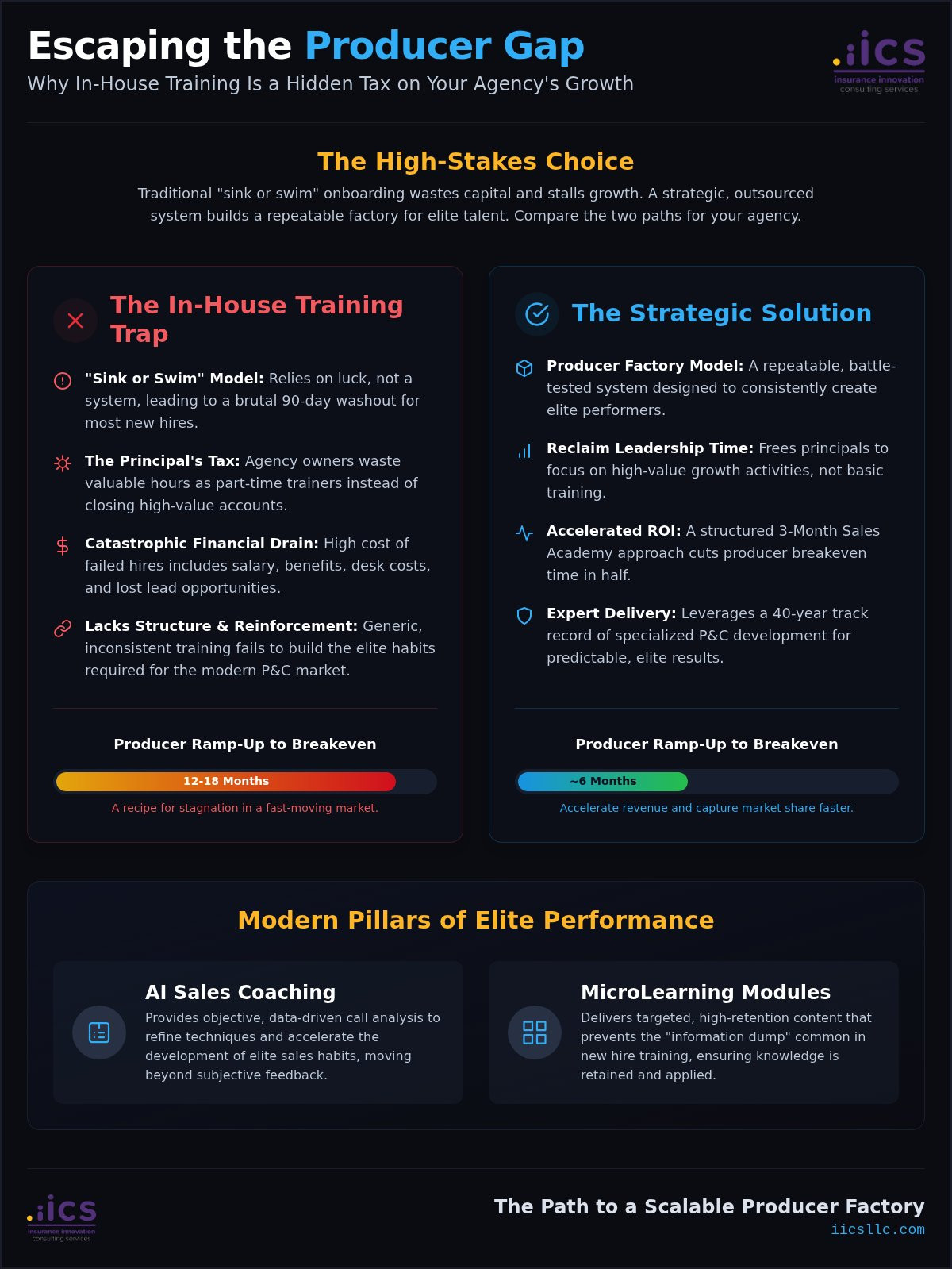
Hiring a new producer is a high-stakes gamble most agency owners lose. They fall into the "Producer Gap," a period of heavy financial drain where the hire consumes resources without generating premium. This isn't just a learning curve; it's a massive revenue leak. Most agencies treat new hires like an experiment. They provide a desk, a phone, and a prayer. Deciding between in-house vs outsourced insurance sales training isn't just a matter of preference. It's a choice between scaling a business or running an expensive vocational school for your competitors.
The reality of the 90-day washout is brutal. Most agency onboarding fails in the first quarter because it lacks the intensity and structure required for the modern P&C market. When you rely on "sink or swim," you aren't testing talent. You're testing luck. Is your agency a school for competitors or a factory for your own growth? If your new hires leave after six months to join the agency down the street, you've effectively subsidized their training for someone else's benefit.
You also have to account for the "Principal’s Tax." This is the hidden cost of an owner acting as a full-time trainer. You are a closer, not a professor. Every hour you spend explaining policy basics to a rookie is an hour you aren't hunting high-value accounts. By leveraging Outsourcing for your producer development, you reclaim your most valuable asset: your time.
The Financial Burn of a Non-Producing Hire
A failed producer hire is a catastrophic financial event. You aren't just losing a salary. You're losing the benefits, the desk costs, and the leads that went nowhere. In 2026, relying on "industry standard" ramp-up times of 12 to 18 months is a recipe for stagnation. The market moves too fast for that kind of patience. Beyond the balance sheet, there is a psychological cost to consider. High turnover among new producers kills the morale of your veteran staff. It creates a culture of transience rather than a culture of elite performance.
The Opportunity Cost of Sales Leadership
Principals cannot effectively mentor while managing a book of business. The "Part-Time Trainer" model is a danger to your growth. There is a massive difference between tactical "checking in" and the elite development required to build a million-dollar producer. In-house vs outsourced insurance sales training comparisons often fail to value the precision of a dedicated system. A non-producing hire represents a total loss of the market share you could have captured with an elite producer in that same seat.
What is Outsourced Producer Development? A Strategic Framework for Agencies
Outsourced producer development isn't just a series of meetings; it's an end-to-end sales leadership system designed for the high-stakes P&C environment. Many agencies confuse this with generic sales seminars that offer vague platitudes. Real development is different. It's a strategic import of expertise that transforms how your agency operates. When evaluating in-house vs outsourced insurance sales training, you must look for a system that provides a repeatable factory for talent.
Effective growth requires more than just product knowledge. Research highlights four components of effective sales training that most internal programs lack: reinforcement, measurement, specialized content, and expert delivery. Generic programs fail because they don't understand the nuances of Property and Casualty. You need a partner with a 40-year track record. Experience is the only valid currency in producer development. It's the difference between guessing and following a battle-tested blueprint.
The 3-Month Sales Academy Model
The first 90 days of a producer's tenure are critical. This is the window where elite habits are forged or where mediocrity takes root. A high-intensity Sales Academy uses MicroLearning to prevent the "information dump" that paralyzes new hires. Instead of drowning in carrier manuals, producers focus on advanced commercial insurance sales techniques that actually move the needle. This structured approach ensures producers spend their time on high-impact activities, not just administrative busywork.
Fractional Sales Leadership vs. Full-Time Hire
Scaling an agency often requires executive-level strategy that a small or mid-sized firm can't afford full-time. A Fractional CRO provides this high-level guidance without the $250k overhead. They implement weekly live workshops that drive accountability and precision. This isn't just about managing a pipeline. It's about building a culture of insurance agency sales performance that thrives even when the principal isn't in the room. If you're ready to stop being the bottleneck, investing in fractional sales leadership can provide the executive oversight your team needs to reach the next level.
Comparing ROI: In-House Training vs. Outsourced Sales Leadership
Return on investment in the P&C world is measured in one metric: speed to revenue. When comparing in-house vs outsourced insurance sales training, the financial delta is staggering. The typical industry norm for a producer to reach breakeven often stretches beyond 12 months. This is a year of pure overhead and lost opportunity. By contrast, a structured academy approach typically halves this time. Reaching revenue-neutral status in six months instead of twelve doesn't just save salary; it fundamentally changes your agency's capital position and allows for faster reinvestment.
Beyond the immediate cash flow, there is the "Double Likelihood" factor. Producers who undergo professional, systematic development are twice as likely to succeed compared to those left to figure it out on their own. This isn't a minor improvement. It's the difference between a growing firm and a stagnant one. Professional training also secures your long-term assets. Producers who feel invested in and equipped with elite skills are significantly less likely to jump ship for a marginal commission increase elsewhere. They stay because they are winning, and winners don't leave environments that facilitate their success.
The Math of Breakeven Acceleration
Acceleration is the key to agency valuation. Every month shaved off the ramp-up period contributes directly to your EBITDA and overall market strength. When a new producer secures early wins, it creates a compounding effect on their career trajectory. They build momentum, confidence, and a pipeline that sustains itself before the first year concludes. Speed to revenue is the ultimate de-risking strategy for an agency.
Consistency and Quality Control
Consistency is the enemy of the "sink or swim" model. Research shows that 87% of sales training content is forgotten within a week if it is not reinforced. Internal programs rarely have the bandwidth for this level of follow-up. When you get busy with a major renewal, your new hire’s development stops. This inconsistency is why most in-house efforts produce mediocre results. You cannot build an elite team on "ride-alongs" and sporadic check-ins that lack a clear objective.
A standardized, data-driven curriculum removes these human variables. It eliminates the dangerous "Hero Producer" dependency by creating a repeatable talent factory. You shouldn't have to pray for a superstar to walk through the door. You need a process that manufactures them. Whether you are onboarding one producer or five, the quality of development must remain uncompromising and scalable.
Modern Pillars of Elite Performance: AI Coaching and MicroLearning
The era of "gut feel" management is dead. Relying on a principal's subjective memory of a ride-along is no longer a viable strategy for scaling an agency. To build an elite team, you need objective, data-backed insights that provide a clear picture of producer activity. This is where AI sales coaching for insurance changes the game. It provides a level of call analysis that no human manager can replicate across an entire team. While evaluating in-house vs outsourced insurance sales training, ask yourself if your internal program can offer real-time sentiment analysis or precise talk-ratio metrics. If the answer is no, you are flying blind.
Combining 1:1 call coaching with automated performance metrics creates a high-accountability environment. It moves the conversation from "I think you're doing well" to "The data shows exactly where you are losing the prospect." This precision is what separates the top 1% of producers from the rest of the pack. You don't need more meetings; you need better data.
AI-Driven Feedback Loops
AI identifies the subtle "closing gaps" that cost your agency revenue. It tracks sentiment and talk-ratios to help producers refine their commercial pitch in real time. Does your producer talk too much? Are they missing key buying signals? AI identifies these patterns across hundreds of calls, identifying trends that a manager might miss during a single "check-in." This data removes bias from performance reviews. You aren't judging a producer based on their personality; you're judging them on their demonstrated effectiveness in the field.
MicroLearning and Habit Formation
Retention is the silent killer of training ROI. Research confirms that 87% of sales training content is forgotten within a week if it isn't reinforced immediately. Eight-hour seminars are an information dump that leads to mental paralysis. In contrast, MicroLearning utilizes 10-minute modules that fit into a producer’s high-pressure schedule. This bite-sized reinforcement is the backbone of a successful insurance producer development plan.
These daily modules must link directly to weekly live workshop participation to ensure new habits "stick" during the critical first 90 days. It is about building a repeatable system, not a one-time event. If you want to see how these tools work in a live environment, book a consultation to see our effectiveness tools in action and start building your talent factory today.
Implementing Outsourced Development: Your Path to an Elite Team
Moving from a chaotic internal training model to a systematic talent factory is a tactical pivot, not a suggestion. It requires a disciplined commitment to a new standard of performance. The decision between in-house vs outsourced insurance sales training isn't just about who delivers the content. It is about who owns the outcome. To build an elite team, you must follow a structured implementation path that replaces "hope" with a data-driven blueprint for success.
Step 1: Audit the current state. Face the brutal facts of your producer ramp-up time and washout rate. If you don't know your numbers, you don't have a business; you have a hobby.
Step 2: Align with a Fractional CRO. Ensure your agency growth goals are supported by executive-level sales strategy. This bridges the leadership gap that prevents most agencies from scaling.
Step 3: Enroll in the Sales Academy. Place new talent into a high-intensity, 3-month Sales Academy. This establishes elite habits before bad ones have a chance to take root.
Step 4: Integrate effectiveness tools. Embed weekly live workshops and AI-driven metrics into your daily operations. Training must be a lifestyle, not an event.
Step 5: Monitor the path to mastery. Use a standardized development blueprint to track progress objectively. Mastery is a destination reached through consistent, measured action.
Selecting the Right Development Partner
Don't trust your agency's future to a generic sales guru who doesn't know the difference between an aggregate limit and a deductible. A P&C-specific track record is non-negotiable. You need a partner who understands the high-stakes world of commercial lines. Look for programs that prioritize 1:1 mentoring over passive, video-only platforms. Ask yourself: Can this partner lead my sales culture, or are they just providing a login? If they can't challenge your producers to reach the top tier, they aren't the right fit.
The First 90 Days: What to Expect
The first quarter of implementation is a period of intense transformation. You will witness your producers shift from passive onboarding to active, high-volume production. This is where the "Producer Gap" begins to close. As the system takes over the heavy lifting of development, your role as the principal fundamentally changes. You stop being the "Part-Time Trainer" and start being the "Strategic Leader." This shift allows you to focus on the high-level acquisitions and carrier relationships that drive true agency value. It's time to stop acting like a school and start operating like an elite firm. Transform your agency revenue with IICS and build the repeatable talent factory your agency deserves.
Accelerate Your Path to a Predictable Revenue Machine
The data is clear. Traditional internal onboarding models are failing because they lack the precision and intensity required to build million-dollar producers. Choosing between in-house vs outsourced insurance sales training is the difference between stagnation and a scalable talent factory. You can't afford to waste another twelve months waiting for a hire to become profitable. Every day spent in the "Producer Gap" is capital that could be used for aggressive market expansion.
By leveraging our 40-year track record of elite P&C growth, you can ensure your graduates reach breakeven in 50% less time than the industry norm. Our methodology utilizes data-driven AI coaching for objective performance, removing the bias and inconsistency of traditional management. It's time to stop acting like a vocational school and start operating like a high-growth firm. You have the tools, the framework, and the proof points to transform your agency's trajectory. Ambition is only useful when it's paired with a battle-tested system for success.
Double your producer success rate with the IICS Sales Academy. Your path to the top tier of the insurance industry starts here.
Frequently Asked Questions
What is the primary benefit of outsourced producer development for P&C agencies?
The primary benefit is the immediate removal of the "Principal’s Tax" while creating a repeatable factory for elite talent. Instead of relying on the owner's sporadic availability, agencies gain a systematic framework that ensures every hire receives the same high-standard development. This shift transforms the agency from a vocational school into a high-performance profit center. It allows leadership to focus on strategic acquisitions rather than teaching basic policy forms to rookies.
How does an outsourced program reduce the time to breakeven for new producers?
Outsourced programs reduce breakeven time by replacing passive onboarding with a high-intensity, 3-month academy. By utilizing a 40-year track record of P&C-specific development, these systems cut the industry-standard ramp-up time in half. Producers engage in daily MicroLearning and weekly workshops that establish elite habits immediately. This structured approach ensures they are closing high-value commercial accounts while in-house hires are still reading carrier manuals.
What is the difference between a Fractional CRO and a traditional sales manager?
A Fractional CRO provides high-level executive strategy and systematic growth planning without the massive overhead of a full-time hire. Traditional sales managers often focus on tactical pipeline reviews and "checking in" on producers. A Fractional CRO implements a battle-tested framework for scaling revenue and building a culture of performance. They act as a strategic partner to the principal, ensuring that the agency’s sales engine runs efficiently without constant owner intervention.
Can outsourced development help experienced producers, or is it only for new hires?
Experienced producers benefit significantly from outsourced development by refining the technical precision of their sales process. Mastery isn't a destination; it's a continuous path. Tools like AI Sales Coaching and 1:1 mentoring help veterans identify subtle closing gaps or inefficiencies in their talk-ratios. Even top performers can find significant growth when they are challenged by high-level workshops and objective performance data that highlights missed opportunities in their existing book.
How does AI sales coaching actually work in the insurance industry?
AI sales coaching works by providing an objective, data-driven analysis of every producer interaction. The software tracks sentiment, talk-ratios, and key buying signals to identify exactly where a pitch succeeds or fails. This removes the bias inherent in traditional management reviews. Managers can see if a producer is talking too much or missing opportunities to cross-sell. It turns every call into a learning moment that accelerates the path to mastery through precise feedback.
Why is a 3-month timeline the standard for the Sales Academy?
The 3-month timeline is established because the first 90 days are the critical window for habit formation. Research indicates that if elite sales behaviors aren't forged in this period, mediocrity takes root. This duration provides enough intensity to move a producer from basic licensing knowledge to high-stakes commercial techniques. It is the optimal timeframe to double the likelihood of producer success while ensuring the agency sees a return on investment quickly.
Will outsourcing my sales training lead to a loss of agency culture?
Outsourcing actually protects and enhances your agency culture by setting a clear, uncompromising standard for elite performance. Culture isn't about who teaches the classes; it's about the results the team produces together. When comparing in-house vs outsourced insurance sales training, remember that a culture of winning is built on competence. Providing your team with world-class development shows you are invested in their success, which increases long-term loyalty and reduces turnover.
What metrics should I track to measure the ROI of outsourced development?
You should track time-to-breakeven, producer washout rates, and the growth rate of new premium compared to the industry norm. Monitor specific effectiveness metrics like talk-ratios and lead conversion percentages to see behavior change in real time. These data points provide an objective look at the ROI of in-house vs outsourced insurance sales training. If your producers are reaching revenue-neutral status in six months instead of twelve, the financial impact on your agency’s valuation is undeniable.