Insurance Producer Academy: 2026 Elite Development Guide
- Jul 25
- 11 min read
Updated: Aug 2
Why are you still betting your agency's growth on a training model that results in a massive failure rate within the first year? You've seen the cycle before. A promising hire starts with high energy, only to drown in outdated manuals and theoretical lectures that don't translate to a single signed policy. The industry norm for producer ramp-up is painfully slow; it costs you thousands in lost opportunity and unearned salary. You know that the traditional "sink or swim" approach is a relic that your bottom line can no longer support.
Understanding how to choose an insurance producer training program is the difference between a stagnant agency and a dominant one. This guide reveals the critical benchmarks of a modern academy designed to transform raw talent into elite producers in record time. We'll show you how to cut the time to breakeven revenue in half while doubling the likelihood of your hires becoming top-tier performers. We are breaking down the shift toward AI-driven coaching and systematic microlearning that turns agency growth from a high-stakes gamble into a predictable, repeatable science.
Table of Contents
What is an Elite Insurance Producer Academy in 2026?
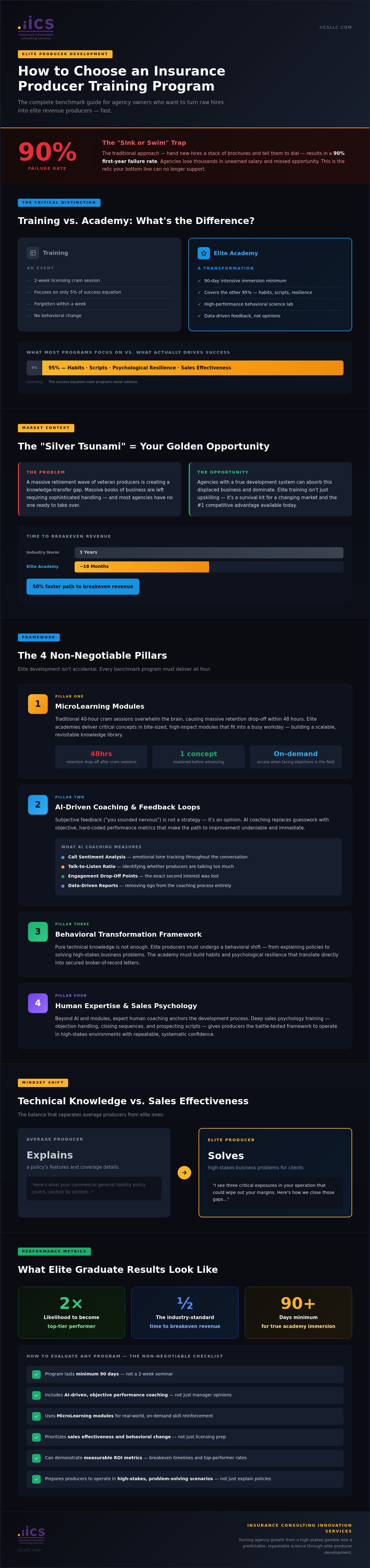
Most agencies are still operating with a 1995 mindset. They hire a new producer, hand them a stack of brochures, and tell them to start dialing. This isn't a strategy; it's a recipe for a 90% failure rate. In 2026, an elite academy isn't a classroom where people go to listen to lectures. It's a high-performance lab where raw talent is forged into revenue machines through behavioral science and data-driven feedback. When you investigate how to choose an insurance producer training program, you have to decide if you want a classroom or a crucible.
The role of the modern producer has shifted. It's no longer about just being a "people person" or having a deep rolodex. While understanding the foundational insurance producer roles and responsibilities is necessary, it's merely the baseline for entry. True elite status requires a battle-tested framework that prioritizes sales effectiveness over simple technical knowledge. You don't need another person who can explain a policy; you need a producer who can solve high-stakes business problems and secure the broker-of-record letter.
Academy vs. Training: Understanding the Difference
Training is an event. An academy is a transformation. Most programs are designed as two-week "cram sessions" that focus on licensing prep. This is a trap. Licensing is only 5% of the success equation. An elite development process requires a 3-month intensive immersion that focuses on the other 95%: the habits, the scripts, and the psychological resilience needed to win. If the program you're looking at doesn't last at least 90 days, it isn't an academy. It's a seminar that your team will forget by next Tuesday.
The Crisis of the 'Silver Tsunami'
The industry is currently facing a massive retirement wave of veteran producers. This "Silver Tsunami" is often framed as a disaster, but for the elite agency, it's a "Golden Wave" of opportunity. The knowledge transfer gap is real. As veterans exit, they leave behind massive books of business that require sophisticated handling. Agencies can no longer afford the traditional three-year ramp-up time for new hires. You need a system that cuts the path to breakeven in half. This systemic urgency is the primary reason why how to choose an insurance producer training program has become the most critical decision an agency owner will make this year. You aren't just buying training; you're buying a survival kit for a changing market.
The 4 Non-Negotiable Pillars of Elite Producer Development
If you are evaluating how to choose an insurance producer training program, you must look past the flashy brochures and high-energy speeches. You need to identify a framework that relies on structural integrity rather than temporary motivation. Elite development isn't accidental; it's the result of four distinct pillars that ensure a new hire doesn't just learn about insurance, but learns how to dominate the market. Without these foundational elements, you are simply throwing capital at a wall and hoping some of it sticks.
The Power of MicroLearning Modules
Traditional 40-hour "cram sessions" are a relic of a failed educational model. They overwhelm the brain, leading to a massive drop-off in retention within 48 hours. Elite academies utilize MicroLearning, delivering critical concepts in bite-sized, high-impact modules that fit into the flow of a busy workday. This approach respects the science of how modern professionals actually consume and retain information. It builds a scalable, repeatable library of knowledge that producers can revisit the moment they face a specific objection in the field. By focusing on one concept at a time, we ensure that every lesson is mastered before moving to the next high-stakes skill.
AI Coaching: The Data-Driven Edge
Subjective feedback is the enemy of rapid growth. In most agencies, sales coaching consists of a manager saying, "I think you sounded a bit nervous." This is an opinion, not a strategy. Modern development requires AI sales coaching for insurance to provide objective, hard-coded metrics. AI analyzes call sentiment, tracks talk-to-listen ratios, and identifies the exact second a producer lost a prospect's interest. It removes the ego from the coaching process. When a producer can see a data-driven report of their performance, the path to improvement becomes undeniable and immediate.
The final two pillars focus on human expertise and psychological shifts. The third pillar is 1-on-1 mentoring from industry veterans who possess a 40-year track record of continuous growth. This isn't theoretical advice from a textbook; it's battle-tested wisdom from the trenches. Finally, the fourth pillar is behavioral transformation. We don't want producers who have merely memorized facts. We want producers whose fundamental habits and mindsets have been rewired for elite performance. This systematic approach is why graduates of high-caliber programs reach breakeven revenue in half the industry norm time. If you're ready to stop the cycle of hiring failure, you can examine our proven development methodology to see how these pillars function in a real-world environment.
Technical Mastery vs. Sales Effectiveness: Finding the Balance
Why do brilliant technical underwriters often starve when they transition into production? They possess deep knowledge of policy language and risk appetite, yet their books of business remain stagnant. The reason is simple. They have mastered the "what" of insurance but have failed to master the "how" of high-stakes negotiation. This realization is central to how to choose an insurance producer training program that actually generates ROI. You don't need a program that teaches your hires how to read a policy; you need one that teaches them how to weaponize that knowledge to win accounts.
An elite academy bridges the chasm between technical "knowing" and commercial "closing." It’s about translating complex Property and Casualty nuances into business solutions that resonate with a CEO or CFO. If a producer spends twenty minutes explaining the intricacies of an aggregate limit instead of discussing the client's total cost of risk, they've already lost the room. The goal is to move beyond jargon and toward a systematic approach that positions the producer as a strategic advisor rather than a mere vendor.
The Coverage Trap
Knowing the policy doesn't mean you can sell the value. Many traditional programs fall into the "coverage trap," where producers become so focused on technical perfection that they lose their sales aggression. They wait for the perfect quote while the competitor is already building the relationship. Developing the soft skills that drive hard revenue-active listening, psychological mirroring, and objection pre-emption-is what separates a top producer from a technical clerk. An Elite Producer is a professional who flawlessly balances high-level technical expertise with an uncompromising drive for sales aggression and market capture.
Advanced Commercial Sales Techniques
Most producers are stuck in a "quote and hope" mentality. They collect data, submit it to the carrier, and pray the price is low enough to win. This is a losing game in a hard market. Elite development focuses on advanced commercial insurance sales techniques that differentiate the agency through risk management strategies. By identifying uninsured exposures and operational inefficiencies, the producer creates a value proposition that makes price irrelevant. When you're researching how to choose an insurance producer training program, ensure the curriculum includes a battle-tested framework for managing the entire sales cycle, from the initial "cold" approach to the final broker-of-record letter. This shift in mindset turns insurance from a commodity into a critical business investment.
Measuring Success: ROI and the Path to Validation
Stop treating development as a soft expense. It's a high-stakes capital allocation. If you can't measure the return on a new hire, you aren't running an agency; you're running a charity. The industry norm for a producer to reach breakeven revenue is notoriously long, often stretching into years of subsidized salary. That timeline is a death sentence for scaling agencies. When you evaluate how to choose an insurance producer training program, you must demand a framework that prioritizes rapid validation. The math is simple. Every month your producer isn't at least covering their own seat cost is a month of eroded profit and wasted potential.
Elite training doesn't just "improve skills"; it doubles the statistical probability that a new hire will reach top-producer status. In 2026, agency owners must track validation ratios with surgical precision. Are your producers hitting their activity targets? Is their closing ratio climbing month-over-month? If the data is stagnant, the training has failed. A systematic approach ensures that you aren't just hoping for a "star" to emerge. Instead, you're building a factory that produces them with predictable regularity.
The Breakeven Benchmark
The first 90 days dictate the trajectory of a producer's entire career. This is the critical window where habits are cemented and the pipeline is either built or neglected. By utilizing a structured development process, you can cut the industry standard ramp-up time in half. You should be looking for specific ROI of insurance producer training metrics that prove a program's efficacy. A producer who doesn't show significant momentum within three months is statistically unlikely to ever become a high-performance asset. Speed is the only metric that matters in the early stages of a career.
The Cost of Inaction
What is the financial burn of a failing hire? It isn't just their base salary. It's the wasted management time, the lost leads, and the massive opportunity cost of the desk they occupy. "Waiting and seeing" if a producer will eventually figure it out is a million-dollar mistake that many agency owners make out of misplaced loyalty. Implementing a rigorous insurance producer development plan allows you to identify failure early and double down on the winners. You need to know exactly when to cut bait and when to invest more resources. If you're ready to stop the financial leak in your recruitment process, explore our performance-based development framework today to see the difference data makes.
Choosing Your Path: Why The Sales Academy by IICS is the Gold Standard
In a market flooded with overnight experts and "maverick" coaches, pedigree matters. When you are deciding how to choose an insurance producer training program, you are essentially choosing the future trajectory of your agency. You need a partner with the scars and the success stories to prove their methodology works. The Sales Academy by IICS isn't just another training course; it's the culmination of a 40-year track record of continuous growth and development across the country. We don't guess what makes a top producer. We've spent four decades refining the exact blueprint that transforms raw talent into elite revenue generators.
The 3-Month Transformation
Real behavioral change doesn't happen in a weekend. Our 3-month intensive format is designed to facilitate a total professional overhaul. The curriculum takes producers through the entire high-stakes lifecycle, from the psychological precision of prospecting to the strategic nuances of closing complex P&C accounts. Weekly live workshops provide the necessary friction to ensure that new skills aren't just understood, but mastered under pressure. This rigorous approach is why our graduates are twice as likely to reach top-producer status compared to those who go through generic industry schools. We aren't interested in participation. We are interested in domination.
What sets this academy apart is the fusion of cutting-edge technology and veteran wisdom. We combine the objective data of AI Sales Coaching with the nuanced, 1-on-1 mentorship of seasoned fractional CROs. This ensures that every producer receives feedback that is both statistically accurate and practically applicable. It's a high-stakes environment designed for those who are uncompromising about their performance standards. If you want a "feel-good" seminar, look elsewhere. If you want a battle-tested system that delivers results, you've found the gold standard. Understanding how to choose an insurance producer training program requires looking at the long-term data, not just the short-term excitement.
Securing the Future of Your Agency
Many agencies are currently trapped in owner-dependent growth. The principal is the only one who can close the big deals, while the producers struggle to find their footing. This is not a scalable business; it's a high-stress job. By implementing our systematic development framework, you transition your agency into a producer-led engine of growth. You create a repeatable path to victory that doesn't rely on your constant intervention. It's time to audit your current development program and identify the leaks that are costing you millions in lost revenue. Are you ready to build an elite team that can carry the torch for the next 40 years? You can start by taking the first step to audit your agency's growth potential with IICS and see exactly where your current training falls short.
Take Command of Your Agency’s Growth
The days of the three-year ramp-up are over. You've seen the data: elite development isn't about sitting in a classroom; it's about a behavioral transformation that cuts breakeven time in half. By prioritizing sales effectiveness over mere technical jargon, you position your agency to capture the massive opportunities left behind by the retiring veteran workforce. When you evaluate how to choose an insurance producer training program, the only metric that matters is the speed and predictability of your return on investment.
Don't settle for outdated seminars that fail to stick. Leverage our 40-year track record of elite performance and the modern precision of AI-driven coaching feedback. With fractional CRO leadership expertise at your disposal, you can finally turn your agency into a self-sustaining engine of revenue. It's time to demand more from your training and your team. Double your producer's likelihood of success-Join the IICS Sales Academy. The path to the top tier starts with a single, high-stakes decision. Let's build your legacy together.
Frequently Asked Questions
What is the typical ramp-up time for a new insurance producer?
The industry standard for a new producer to reach breakeven revenue is typically 24 to 36 months. This timeline is an unsustainable drain on agency capital that often leads to high turnover. Elite development models focus on cutting this duration in half by front-loading high-impact sales habits and technical proficiency within the first 90 days.
How does an insurance producer academy differ from state licensing prep?
State licensing prep is a legal requirement that covers the bare minimum of insurance theory; it's the floor, not the ceiling. An elite academy focuses on the 95% of the job that licensing ignores, such as prospecting, negotiation, and closing. When you consider how to choose an insurance producer training program, don't confuse a certificate with a career.
Is AI sales coaching effective for experienced producers or just rookies?
AI sales coaching is arguably more effective for veterans because it removes the subjective bias of experience. Seasoned producers often develop blind spots or rely on outdated scripts that no longer resonate in a hard market. Data-driven feedback identifies these inefficiencies with surgical precision, allowing veterans to recalibrate their approach based on objective metrics rather than gut feeling.
What are the most important metrics to track during producer training?
You must track effectiveness metrics rather than just activity logs. While dials and meetings are important, the real indicators of success are closing ratios, talk-to-listen percentages on sales calls, and the velocity of the pipeline toward the first broker-of-record letter. An elite program provides the tools to measure these variables in real-time rather than waiting for month-end reports.
Why do most insurance producer training programs fail to produce ROI?
Most programs fail because they are treated as one-time events rather than continuous development processes. Information without reinforcement is forgotten within 48 hours. Without data-driven feedback loops and behavioral transformation, training is just an expensive distraction that provides zero long-term ROI for the agency owner.
What specific Commercial P&C skills are taught in an elite academy?
An elite academy moves beyond basic coverage definitions to focus on strategic risk management and business problem-solving. Producers learn how to identify uninsured exposures, navigate complex workers' compensation issues, and present themselves as strategic advisors to C-suite executives. The focus is on winning high-premium commercial accounts by making price a secondary consideration.
Can a 3-month program really replace years of on-the-job experience?
A structured 3-month intensive can often surpass years of unguided on-the-job experience by eliminating the trial and error phase. By utilizing MicroLearning and AI-driven coaching, producers are exposed to more high-stakes scenarios and expert feedback in 90 days than many veterans see in a decade. It's about the quality of the feedback loop, not just the passage of time.
How much does a professional insurance producer academy typically cost?
The cost of a professional academy should be viewed as a capital investment in your agency's most valuable asset. While prices vary across the industry, the true cost is measured by the ROI generated through faster validation and higher retention. You aren't just paying for a curriculum; you're investing in a repeatable system for agency growth and producer excellence.