Insurance Producer Accountability Metrics: The Elite Performance Framework for 2026
Updated: Sep 20
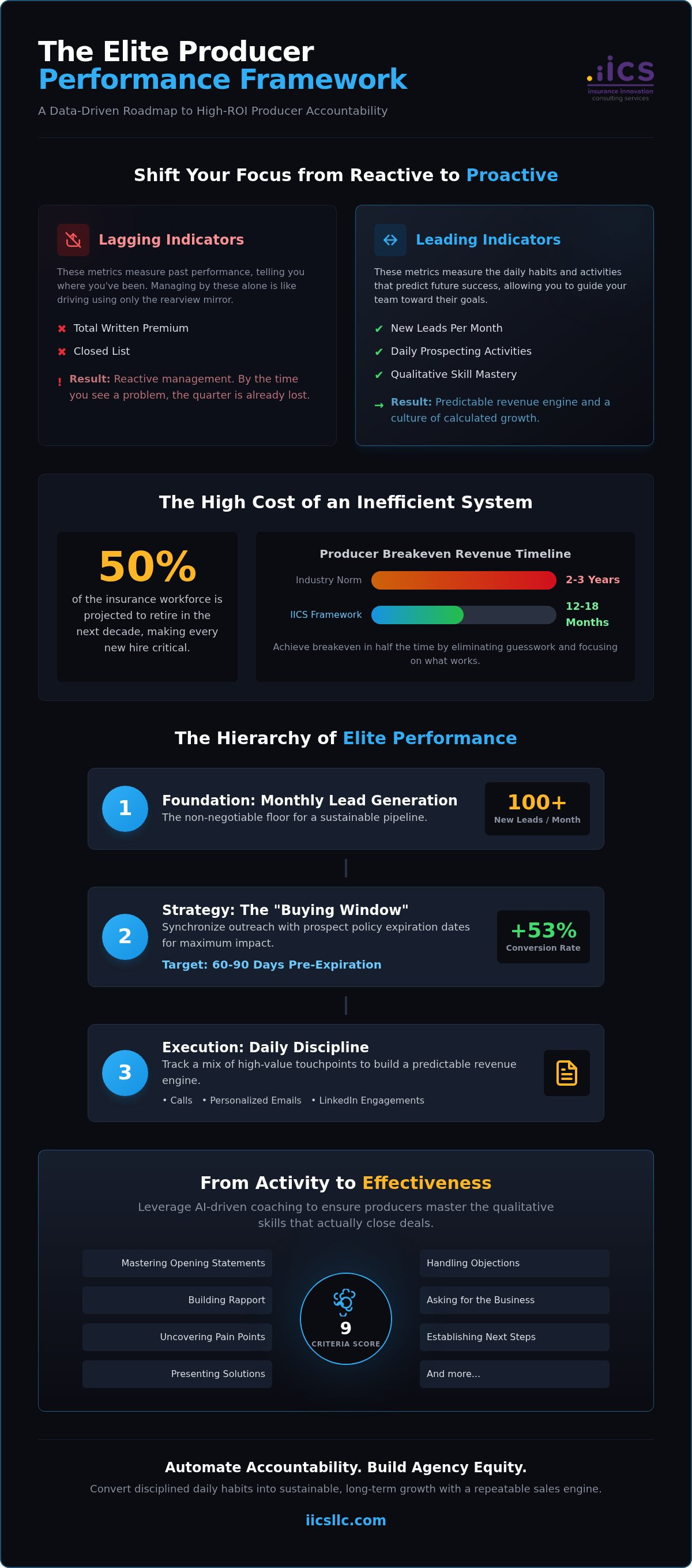
How much capital are you willing to incinerate on a "busy" producer before you admit your tracking system is broken? In a market where 50% of the insurance workforce is projected to retire in the next decade, you can't afford to waste eighteen months wondering if a new hire will ever produce. You've likely felt the sting of a non-producing hire who looked elite during the interview but failed to deliver results. It's a common trap; activity is frequently mistaken for progress when you lack the right insurance producer accountability metrics to see the truth.
This article delivers the elite performance framework for 2026, teaching you to master the specific lead and lag indicators that separate top-tier P&C producers from the mediocre majority. Backed by a 40-year track record of systematic growth, these insights eliminate the guesswork from sales development. We'll provide a clear dashboard for tracking both daily habits and qualitative skill mastery. You'll gain a data-driven roadmap to achieve breakeven revenue in half the industry norm time, ensuring every hire becomes a high-ROI asset rather than a costly liability.
Table of Contents
The Failure of Lagging Indicators in P&C Sales Management
Managing a sales team by looking only at "Total Written Premium" is like trying to drive a car while staring exclusively at the rearview mirror. It tells you exactly where you've been, but it provides zero guidance on the curves ahead. In the world of commercial insurance, premium is a lagging indicator. It's a post-mortem of work done months ago. By the time a sales leader notices a drop in written business, the damage is already done. The quarter is lost, and the revenue gap has widened.
To build a high-performance culture, you must distinguish between lag results and lead activities. True insurance producer accountability metrics focus on the behaviors that predict future revenue. Without this visibility, you're susceptible to the "Invisible Producer" problem. This occurs when a producer spends their day "researching" prospects or tweaking slide decks instead of picking up the phone. They look busy. They feel busy. Yet, their pipeline is a desert. Activity is not progress; only specific, high-value actions move the needle.
The IICS philosophy centers on the belief that developing a producer the right way requires total activity visibility. We use Key Performance Indicators (KPIs) to shine a light on what's actually happening in the trenches. When you track the right data, you stop guessing and start leading. You move from a state of reactive panic to one of calculated growth.
The Cost of the Non-Producing Hire
The industry average for a producer to reach breakeven revenue is often cited as two to three years. If a producer fails at the twelve-month mark, the financial blow is staggering. You aren't just losing a base salary; you're losing the opportunity cost of the hundreds of thousands in premium an elite producer would have captured. The first 90 days represent the critical window for course correction. Data shows that formal, structured training programs can lead to a 31% increase in new clients. If you aren't measuring performance from day one, you're subsidizing failure.
Shifting from Results-Based to Process-Based Management
Elite producers don't just hope for a "Closed List" at the end of the month. They obsess over their "Suspect List" at the beginning of every week. They understand that sales is a volume game played with surgical precision. Building a culture of accountability means viewing metrics as a roadmap rather than a reprimand. It's about providing the tools to succeed. We integrate MicroLearning to reinforce these daily process habits. This ensures that every producer knows exactly what is expected of them and has the tactical skills to deliver. When the process is sound, the results become an inevitability rather than a surprise.
The Lead Indicator Hierarchy: Daily Habits That Drive Revenue
High-volume prospecting without a surgical strategy is just noise. If your producers are making fifty calls a day into a void of random business names, they aren't building a pipeline; they're practicing a hobby. Elite performance requires a rigid hierarchy of insurance producer accountability metrics that prioritize timing and volume. It starts with a non-negotiable floor: the 100-lead minimum. Every month, a producer must identify and qualify 100 fresh leads. Anything less is a slow drift toward a stagnant book of business.
Volume is merely the prerequisite for skill. To maximize ROI, outreach must be synchronized with the "Buying Window." In the P&C world, this window opens 60 to 90 days before a prospect's policy expiration date. Contacting a business six months early is a waste of breath. Contacting them thirty days late means the incumbent has already locked the renewal. By aligning outreach to these specific dates, trained producers often see a 53% increase in lead-to-prospect conversion rates compared to their unguided peers. According to the U.S. Bureau of Labor Statistics, the field remains highly competitive, meaning those who fail to master these timing-based habits will quickly be outpaced by more disciplined agencies.
Activity Targets for the Elite P&C Producer
Discipline is measured in daily touchpoints. An elite producer's dashboard should track a mix of calls, personalized emails, and LinkedIn engagements. We utilize a "Window Trigger Map" to ensure every outreach attempt is relevant to the prospect's current pain points. This isn't just about "checking a box." It's about building a predictable revenue engine. Agencies that struggle with these benchmarks often find that outsourced producer development is the most efficient way to install these habits without micromanaging every minute of the day.
Pipeline Health Metrics
A healthy pipeline is organized by effective dates, not just deal size. If a producer can't tell you exactly which "Suspects" are renewing in the next quarter, they don't have a pipeline; they have a wish list. We track Sales Cycle Snapshots to identify where deals stall. Are they failing at the first call, the data gathering, or the final proposal? By applying a Small Commercial Focus Filter, producers can prioritize high-probability SME accounts that reach breakeven faster. These insurance producer accountability metrics transform a chaotic sales floor into a precision-guided growth machine. When you manage the process with this level of granularity, hitting the benchmark of 3 to 5 new accounts per month becomes a standard expectation rather than a miracle.
Qualitative Accountability: Leveraging AI to Score Effectiveness
Quantitative volume is merely the ante to enter the high-stakes game of commercial insurance. If your producers are making 100 calls but burning every bridge with poor communication, your agency is hemorrhaging potential equity. Effective insurance producer accountability metrics must evolve from "did they call?" to "how well did they sell?" Relying on subjective feedback from a manager who "listens in" once a week is a recipe for inconsistency. It's biased, it's unscalable, and it fails to catch the subtle skill gaps that kill deals.
We've eliminated the guesswork by scoring every interaction against nine specific performance criteria. This isn't about vague "vibes." It's about surgical precision in communication. Real-time AI feedback identifies exactly where a producer loses a prospect's interest. Does their energy dip during the close? Do they sound defensive when challenged? By quantifying these qualitative moments, you accelerate the learning curve from years to months. You transform a raw hire into a disciplined professional who understands that every word spoken is either an investment or a liability.
AI-Driven Skill Assessments
The elite agency uses AI Sales Coaching to strip away the fluff of producer development. Our system identifies verbal tics and pacing issues that destroy rapport before a conversation even begins. We specifically score objection handling for the most common barrier in P&C: "I am happy with my current agent." If a producer can't navigate that pivot with confidence, they're just an order taker. We also track the use of "Plain Language" versus "Insurance Jargon." Elite producers know that complexity is the enemy of the sale. They speak the language of the business owner, ensuring the prospect feels understood rather than lectured.
Mentorship and Peer Accountability
Success in commercial P&C is not a matter of luck. It is a matter of architecture. Most agencies fail because they lack a tactical day-by-day roadmap, leaving new hires to "figure it out" through trial and error. This approach is expensive and ineffective. To reach breakeven revenue in half the industry norm time, you must implement a structured 90-day system that tracks insurance producer accountability metrics with uncompromising rigor. Strategic plans that span years are useless for a producer who needs to be profitable in months.
Our framework breaks the ramp-up period into three distinct phases. Month one focuses on foundations and the first twenty tactical modules. Month two shifts to pipeline development and mastering the "First Call" basics. By month three, producers move into advanced selling scenarios and client management. This progression ensures that skills are built on a solid foundation of daily discipline. For a limited time, you can implement this entire roadmap at 50% of the retail tuition by using the code Summer2026 when you enroll in The Sales Academy.
The First 30 Days: Establishing the Baseline
The initial month is about setting the performance floor. Producers must establish their Suspect List and Lead Source Menu immediately. We don't guess at their potential. We use initial AI coaching scores to establish an objective baseline of their communication skills. A non-negotiable requirement during this phase is the daily three-minute micro-learning habit. This ensures that core concepts are reinforced constantly. If a producer cannot commit to three minutes of development a day, they will never commit to the rigors of building a million-dollar book.
Days 31-90: Scaling Effectiveness
Once the baseline is set, the focus shifts to conversion. Producers master the eight typical objections with scripted, battle-tested responses. They learn to navigate the "I'm happy with my current agent" wall without blinking. This phase is where the 100-lead minimum translates into a predictable pipeline. By the end of day 90, the goal is a final assessment that mirrors the 52% higher sales benchmark seen in our trained agents. This roadmap doesn't just hope for a productive employee. It manufactures one through data-driven discipline and constant feedback. Using these insurance producer accountability metrics ensures that you identify top-tier talent early and course-correct underperformers before they become a sunk cost.
Scaling Success: How the IICS Sales Academy Automates Accountability
Scaling an agency requires more than just better habits; it requires high-level leadership. By integrating our Fractional CRO services, you gain an elite sales architect to oversee your growth strategy without the seven-figure executive overhead. Our graduates don't just finish a program and stop growing. They utilize the IICS resource library as a permanent accountability toolkit to ensure their skills remain sharp. This ongoing access is why our graduates double their likelihood of becoming top-tier producers compared to those left to train themselves. You're building an internal asset that generates equity for decades, not just a temporary spike in premium.
Getting Started with the Sales Academy
Momentum is fragile in a competitive market. To ensure your new hires start on the right foot, we offer trimester start dates on the first of every month. The enrollment process is built for speed, whether you're bringing on a single P&C producer or an entire agency team. The path from tracking to transforming begins with a single decision. Stop settling for producers who are merely "busy" and start demanding producers who are effective. Don't let another quarter slip away with unvalidated activity and stagnant growth. Join the Sales Academy and implement elite accountability metrics today.
Take Command of Your Agency's Growth Engine
The era of managing by hope is over. You've seen how relying on lagging indicators like total premium creates a blind spot that costs you thousands in opportunity. True elite performance requires a shift toward predictive insurance producer accountability metrics that focus on daily volume and qualitative mastery. By implementing our battle-tested 90-day roadmap, you ensure every hire is measured against a 40-year track record of sustained growth. Our AI coaching doesn't just record; it scores every interaction against 9 specific performance criteria to guarantee your team is actually closing, not just talking.
Agencies that embrace this level of data-driven discipline see 52% higher sales than their unguided competitors. You have the framework; now you need the execution. Don't let your firm's future depend on guesswork or the "busy" habits of average producers. Take command of your sales floor and transform your team into a high-ROI engine. Enroll your producers in the Sales Academy for 50% off with code Summer2026 and start building the elite agency you deserve. Success isn't an accident. It's an inevitability for those who demand excellence.
Frequently Asked Questions
What are the most important lead indicators for a new P&C producer?
Lead indicators focus on activities that predict future premium. The most critical include generating 100 fresh leads monthly and timing outreach exactly 60 to 90 days before a policy expires. We also track daily engagement with tactical micro-learning modules. These specific insurance producer accountability metrics ensure your team isn't just busy but is actually building a predictable pipeline through disciplined, daily habits.
How many leads should an insurance producer generate each month?
An elite producer must generate a minimum of 100 leads per month based on specific policy expiration dates. This is the non-negotiable volume required to hit a consistent target of 3 to 5 new accounts monthly. If your team falls below this threshold, your pipeline will inevitably dry up within a single quarter. Discipline in lead sourcing is the only way to avoid the feast-or-famine cycle.
What is a good lead-to-prospect conversion rate for commercial insurance?
While industry averages vary, elite producers aim for the 53% increase in lead-to-prospect conversion rates seen in formally trained agents. This isn't about working harder; it's about working smarter during the 60-day renewal buying window. By mastering scripted responses to the eight most common objections, producers transform cold leads into warm prospects with surgical precision. Consistency in follow-up is the key to maintaining these high conversion benchmarks.
How does AI call coaching help with producer accountability?
AI call coaching provides objective, real-time feedback by scoring interactions against nine specific performance criteria. It identifies verbal tics, pacing issues, and the use of "insurance jargon" that might alienate a business owner. This technology removes manager bias from the equation. It allows for unlimited, scalable training that ensures every producer masters the qualitative skills necessary to navigate high-stakes commercial sales scenarios without requiring your constant supervision.
What is the industry average for insurance producer ramp-up time?
The industry norm for a producer to reach breakeven revenue is typically two to three years. This timeline is often too slow for modern agency growth. Our framework is designed to compress this ramp-up period, aiming for breakeven in half the industry norm time. By implementing strict insurance producer accountability metrics from day one, you identify top talent early and eliminate non-producers before they become a significant financial liability.
How often should a sales manager review accountability metrics?
Sales managers should review activity metrics daily to ensure the 100-lead floor is maintained. Qualitative effectiveness, such as AI coaching scores and workshop participation, requires weekly deep dives. Monthly 1:1 sessions are reserved for strategic pipeline reviews and long-term goal alignment. This tiered approach prevents micromanagement while ensuring that no producer drifts off course for more than a few days at a time, keeping the entire team focused on results.
Can accountability metrics help reduce insurance producer turnover?
Accountability metrics reduce turnover by providing a transparent roadmap for success. Most producers quit because they feel lost or unsupported in their development. When you use data-driven benchmarks, you can provide specific, helpful coaching rather than vague criticism. This clarity builds confidence and ensures that your investment in talent isn't wasted on a producer who simply didn't know how to win. It turns a high-stress environment into a structured path toward elite performance.
What is the difference between a suspect and a prospect in P&C sales?
The definitions are critical for pipeline accuracy:
Suspect: A business name on a list with a confirmed policy expiration date. They are "suspected" of needing coverage at a specific time.
Prospect: A suspect who has been qualified through initial outreach. They have entered the buying window and expressed interest or provided data for a quote.
Moving a name from the suspect list to the prospect list is the primary objective of early-stage pipeline development.