Insurance Producer Accountability Plan: The 2026 Framework for Elite Growth
Why are you still paying for "potential" while your competitors are already profiting from precision? Most agency owners accept the high cost of non-producing hires as a necessary evil, watching talented recruits stall the moment their initial licensing is complete. It's a cycle of wasted capital and missed opportunities. Implementing a modern insurance producer accountability plan isn't about micromanagement; it's about survival in a 2026 market where 64% of agencies are already leveraging AI to outpace the traditional firm. You aren't just looking for activity. You're looking for a predictable, elite sales pipeline.
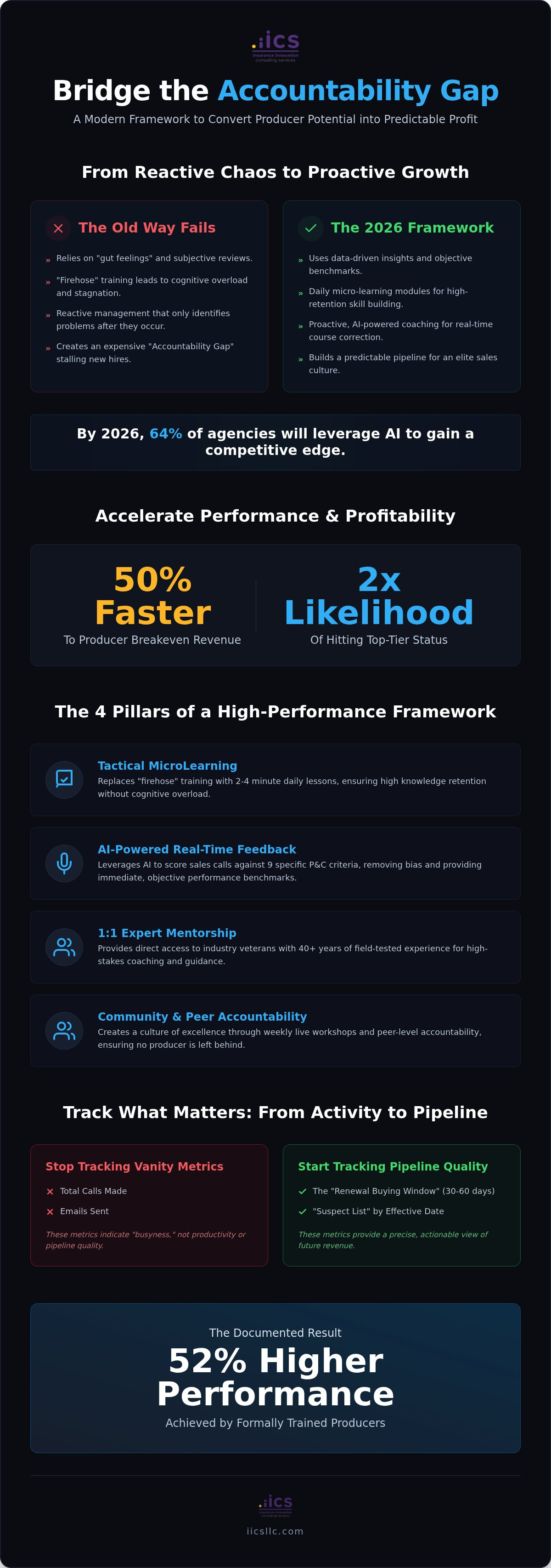
We understand the frustration of having zero visibility into daily sales activities while your overhead continues to climb. This article details the systematic framework required to turn average P&C producers into elite performers in half the industry-standard time. You'll discover how to leverage data-driven feedback loops and micro-learning modules to achieve breakeven revenue 50% faster than the industry norm. We'll preview the exact 2026 methodology that doubles the likelihood of your producers hitting top-tier status through disciplined, high-stakes coaching.
Table of Contents
Why Traditional Insurance Producer Accountability Plans Fail in 2026
The Core Pillars of a High-Performance Accountability Framework
Data Over Gut Feelings: Leveraging AI Coaching for Real-Time Accountability
Building Your 90-Day Producer Development and Accountability Roadmap
Scaling Results with the IICS Sales Academy: Beyond Management Meetings
Why Traditional Insurance Producer Accountability Plans Fail in 2026
Potential is a liability until it's converted into premium. For many agencies, the traditional insurance producer accountability plan is nothing more than a dusty binder or a spreadsheet that everyone ignores. This failure creates what we call the "Accountability Gap." It's the expensive, often fatal distance between the day you hire a producer and the day they finally reach breakeven. Most agencies lose tens of thousands of dollars during this period because they mistake accountability for micromanagement. Real accountability isn't about breathing down someone's neck; it's about providing the clear, data-driven guardrails that elite performers actually crave.
A modern accountability plan is a dynamic feedback loop rather than a static document. It's built specifically to solve the "Firehose" problem. You've likely seen it before. You hire a new producer and spend the first week drowning them in carrier manuals, policy forms, and internal systems. They are overloaded before they even make their first call. This cognitive overload ensures they'll stall the moment they leave the training room. Stagnation isn't a lack of talent. It's a lack of a systematic process.
The High Cost of Non-Producing Hires
A producer who fails to hit breakeven within 12 months isn't just a missed opportunity. They are a massive financial drain. Beyond the direct costs of salary and benefits, you're losing the compounding growth that an elite performer would have generated. When expectations are vague, directives become "optional." This leads to a slow decay of your agency's sales culture. At IICS, we've spent 40 years perfecting the science of producer development. You can learn more about our 40-year history of solving these challenges. We've seen firsthand how a lack of structure turns promising recruits into expensive tax write-offs.
Reactive vs. Proactive Accountability
Waiting for the Friday afternoon meeting to discuss "activity" is a recipe for failure. By the time you see the monthly numbers, the damage is done. The Role of an Insurance Producer in 2026 requires high-speed adaptability. You cannot manage a modern pipeline with 1990s tactics. Reactive management relies on gut feelings and excuses. Proactive accountability uses real-time AI feedback to course-correct in the moment. It's built on daily micro-habits. These are the small, non-negotiable actions that lead to predictable outcomes. Elite growth isn't an accident. It's the result of a system that demands precision every single day.
The Core Pillars of a High-Performance Accountability Framework
An elite insurance producer accountability plan is not a collection of suggestions. It's a rigid structure built on four non-negotiable pillars that demand excellence. First, Tactical MicroLearning replaces the "firehose" training mentioned earlier with 2-4 minute daily lessons. This ensures producers actually retain technical knowledge without suffering cognitive overload. Second, Real-Time Feedback leverages AI to score calls against precise P&C criteria immediately. Why wait for a monthly manager review when the data is available now? Third, Mentorship provides 1:1 access to veterans with 40 years of field-tested experience. Finally, Community creates a culture of peer-level accountability through weekly live workshops. This combination ensures that no producer is left to "figure it out" on their own.
Commercial P&C Specific Metrics
General sales metrics are a trap. Tracking "total calls" or "emails sent" tells you nothing about the quality of the pipeline. In commercial P&C, you must track the "Renewal Buying Window." This 30-60 day period before a policy expires is the only time a prospect is truly motivated to move. An effective accountability framework demands a "Suspect List By Effective Date." If your producer cannot show you exactly who is renewing in the next 60 days, they don't have a pipeline. They have a wish list. This level of precision aligns with the Producer Licensing and Accountability Standards that define true professional conduct in our industry. Without these specific triggers, your producers are just busy, not productive.
Defining Elite Performance Standards
Elite performance isn't a vague feeling. It's a documented result. Formally trained producers achieve 52% higher sales than their untrained counterparts. We set the standard at 3-5 new accounts per month, every month. This isn't a suggestion. It's a requirement for those who want to remain in the top tier of the profession. To hit these numbers, producers use a "Window Trigger Map" to time their outreach perfectly. Stagnation occurs when standards are treated as goals rather than minimum requirements. If you want to see how these standards are enforced in a high-stakes environment, you can explore the internal mechanics of a professional sales academy. High standards attract high performers. Low standards attract overhead.
Data Over Gut Feelings: Leveraging AI Coaching for Real-Time Accountability
Gut feelings are a luxury your agency cannot afford. In most firms, the insurance producer accountability plan relies on a manager's subjective memory of a few overheard phone calls. This is not coaching; it is guesswork. AI Sales Coaching eliminates this bias by providing an objective, high-precision audit of every interaction. By scoring calls against nine specific P&C criteria, from risk identification to closing techniques, you gain a clear view of where your producers are winning and where they are bleeding revenue. You can see the AI interface in action to understand how we turn hours of audio into actionable coaching moments in seconds. No more "I think he's doing okay." Now, you'll know exactly why a deal was lost or won.
AI-Assisted Industry and Risk Insights
Elite producers don't just sell; they advise. AI-assisted insights give your team the ability to translate complex risks into plain language, ensuring they sound like experts even in unfamiliar niches. This ties directly into Topic 36 of our curriculum, where accountability for industry knowledge is non-negotiable. Data-driven feedback isn't just about correction. It's about results. Agencies using this methodology see a 53% increase in lead-to-prospect conversion. This rigorous approach aligns with the high standards often found in State-Mandated Producer Training, where technical competence is the baseline, not the ceiling. If your producers aren't utilizing these insights, they're walking into prospect meetings unarmed.
MicroLearning: The Habit-Formation Engine
MicroLearning is the habit-formation engine that drives long-term success. Why waste a full day in a seminar when you can deliver a high-impact, 3-minute lesson every morning? These daily injections of tactical knowledge ensure that skills are built through repetition, not just exposure. Topic 40: Winning Through Basics serves as the psychological anchor for our 90-day commitment. It forces producers to master the fundamentals before chasing complex deals. A core part of this daily accountability habit is the Lead Source Menu. If your producer isn't identifying where their opportunities are coming from every single day, they aren't following a plan. They are just wandering. Discipline is the difference between a stalling rookie and an elite performer.
Building Your 90-Day Producer Development and Accountability Roadmap
A high-stakes insurance producer accountability plan requires a structured timeline, not a vague set of goals. We break the first 90 days into three distinct trimesters of development. This phased approach prevents the "firehose" effect while maintaining a relentless pace toward breakeven. By the end of Month 3, your producer should be operating as a self-sustaining revenue engine, not a supervised trainee. Success in this framework is measured by the mastery of 60 tactical modules and the consistent execution of daily sales habits.
Month 1: Establishing the Baseline
Month 1 focuses on technical mastery and high-volume habit formation through Topics 1-20. We demand a deep dive into risk and coverage to build immediate technical authority. A producer who doesn't understand the policy cannot defend the price. During this phase, we install the 100-lead-per-month generation habit. We also implement the "Sales Cycle Snapshot" for every suspect. This tool provides an uncompromising look at the pipeline, ensuring no one is "just checking in" without a specific strategy for the renewal window. If the baseline isn't established here, the producer will never scale.
Month 2: Pipeline and Networking Habits
Month 2 shifts the focus to pipeline development and the art of the first call, covering Topics 21-40. Producers must map their "Five Social Circles" to build localized networking accountability. This is not a suggestion; it's Topic 32 of our core curriculum. We also drill the most common friction points, such as mastering the "I am happy with our current agent" objection found in Topic 35. You can see how these habits translate into actual revenue in our latest pipeline growth case studies. By day 60, the producer must demonstrate consistent, documented activity across all five circles to stay on track.
Month 3: Soft-Market Tactics and Mastery
The final trimester covers selling scenarios, renewals, and enterprise-level scaling through Topics 41-60. We teach producers to win on expertise by comparing ISO vs. Custom Forms. In a softening market, price is a race to the bottom. Expertise is the only moat. Producers also begin using "Effectiveness Tools" like the Small Commercial Focus Filter to maintain efficiency while pursuing larger accounts. This is where the transition to an elite producer mindset becomes permanent. They no longer need a manager to tell them what to do. They have the system. If you are ready to stop managing by hope and start managing by design, see how the Sales Academy automates this roadmap.
Scaling Results with the IICS Sales Academy: Beyond Management Meetings
Most agency owners are drowning in operational noise. They want an elite team, but they lack the bandwidth to enforce a rigorous insurance producer accountability plan. This is where outsourced producer development changes the game. By removing the burden from the time-poor manager, we ensure that training is never "optional" or delayed due to a busy schedule. Our methodology doesn't just offer advice. It installs a permanent system of discipline. It's why IICS graduates achieve breakeven revenue in half the industry-standard time. If you're an invited agency, use the discount code Summer2026 to secure immediate ROI and stop the cycle of expensive, stalled hires.
Fractional CRO and CGO Services
Hiring a full-time Chief Revenue Officer is a massive overhead commitment. For many growing agencies, fractional CRO and CGO services provide the same high-level strategic oversight at a fraction of the cost. This isn't just about oversight; it's about elite culture building. Our weekly live workshops act as a catalyst for an agency-wide performance lift. You're leveraging Ralph Blust's 40-year track record of growth to navigate the complex P&C landscape of 2026. Why try to build a sales culture from scratch when you can plug into a battle-tested framework? We provide the leadership your producers need to stay focused on high-value activity.
The ROI of Elite Accountability
Accountability is an investment, not an expense. When you compare the $1,500 monthly investment per student to a potential 31% increase in new clients, the math is undeniable. The Elite Producer Framework is the only standard that matters in 2026. It moves producers from "licensed" to "profitable" with surgical precision. We don't accept average results. Neither should you. The cost of a non-producing hire far outweighs the cost of professional development. It is the difference between stagnation and a scaling enterprise.
The Elite Growth framework is designed for those who are serious about reaching the top tier of the profession. Our next trimester begins on the 1st of every month. It's time to decide if you want a team of order-takers or a roster of elite producers. Stop managing by hope. Start managing by design. Your agency's growth depends on the systems you implement today, not the intentions you have for tomorrow.
Stop Managing by Hope and Start Scaling by Design
The window of opportunity for average performance has closed. In 2026, a static insurance producer accountability plan is a relic of the past; success now demands a systematic approach that integrates real-time AI coaching and high-frequency MicroLearning to eliminate the "Accountability Gap." You've seen how a structured 90-day roadmap removes manager bias and forces the habit formation required for elite results. It's the difference between watching a hire stall and seeing them reach breakeven revenue in half the industry-standard time. We've spent 40 years perfecting the mechanics of P&C growth and know exactly what drains your agency's capital.
Stop settling for "potential" and start demanding precision. For invited agencies, use the discount code Summer2026 to receive 50% off tuition and secure immediate ROI for your next hire. The path to the top tier is documented, battle-tested, and ready for execution. Don't let another trimester pass while your competitors outpace you with superior data and discipline.
Join the next IICS Sales Academy trimester and double your producer’s output. Your agency's elite future starts on the first of the month. We're ready to help you build a legacy of consistent, predictable growth.
Frequently Asked Questions
What is an insurance producer accountability plan?
An insurance producer accountability plan is a systematic framework of micro-habits and data-driven feedback loops designed to drive revenue. It replaces vague expectations with concrete, daily tactical requirements. Unlike traditional management, this plan focuses on leading indicators like the "Renewal Buying Window" rather than just lagging sales numbers. It ensures every producer knows exactly what actions are non-negotiable to reach elite status within your agency.
How long does it take to ramp up a new commercial P&C producer?
While the industry average often stretches to 24 or 36 months, an effective accountability system slashes this timeline significantly. Graduates of the IICS Sales Academy typically reach breakeven revenue in half the industry-standard time. This accelerated ramp-up is achieved through intensive, 90-day development trimesters that prioritize technical mastery and high-volume habit formation. By day 91, producers are no longer trainees; they are self-sustaining revenue engines.
What metrics should I track in a producer accountability plan?
You must move beyond generic call counts. An elite insurance producer accountability plan tracks specific P&C triggers like the "Renewal Buying Window" and "Suspect Lists By Effective Date." You should also monitor the frequency of interactions within the "Five Social Circles" to ensure networking accountability. These metrics provide a clear, forward-looking view of the pipeline rather than reacting to monthly production figures that are already finalized.
How does AI sales coaching improve producer performance?
AI sales coaching improves performance by providing an objective, high-precision audit of every sales interaction. It removes manager bias by scoring calls against nine specific P&C criteria, including risk identification and closing techniques. This allows for real-time course correction rather than waiting for a monthly review. Producers receive immediate, actionable data that helps them refine their pitch and increase lead-to-prospect conversion rates by as much as 53%.
What is the cost of a non-producing insurance producer hire?
The cost of a non-producing hire is a massive financial drain that exceeds simple salary and benefits. It includes the overhead of licensing, internal support, and the significant opportunity cost of lost compounding growth. When a producer stalls, they also damage the agency's sales culture by making standards feel optional. Failing to reach breakeven within 12 months often results in tens of thousands of dollars in wasted capital.
Can I outsource producer development if I don’t have a sales manager?
Yes, you can and should outsource development if you lack internal sales leadership. Many agency owners are too time-poor to manage a rigorous accountability framework. Outsourcing to a Sales Academy or utilizing Fractional CRO services provides elite, battle-tested leadership without the overhead of a full-time hire. This ensures your producers receive consistent, professional coaching and high-level strategic oversight from veterans with a 40-year track record of P&C growth.
What are the first 90 days of producer training like at IICS?
The first 90 days are structured into three intensive trimesters covering 60 tactical micro-learning modules. Month 1 focuses on technical foundations and establishing a 100-lead-per-month habit. Month 2 shifts to pipeline development and overcoming common objections. Month 3 masters advanced selling scenarios and enterprise-level scaling. This relentless pace ensures producers are fully equipped with effectiveness tools and a high-performance mindset before their first quarter concludes.
How do I handle a producer who fails to meet accountability standards?
You must address standard failures immediately using objective data rather than gut feelings. An elite framework makes performance gaps impossible to hide. If a producer fails to meet the non-negotiable daily micro-habits, use AI call scores to identify if the issue is skill-based or effort-based. If coaching doesn't spark immediate improvement, you must make a fast decision. Keeping a non-producer only serves to decay your agency’s culture and drain your resources.