Insurance Producer Breakeven: Agency Growth Guide
Updated: Sep 11
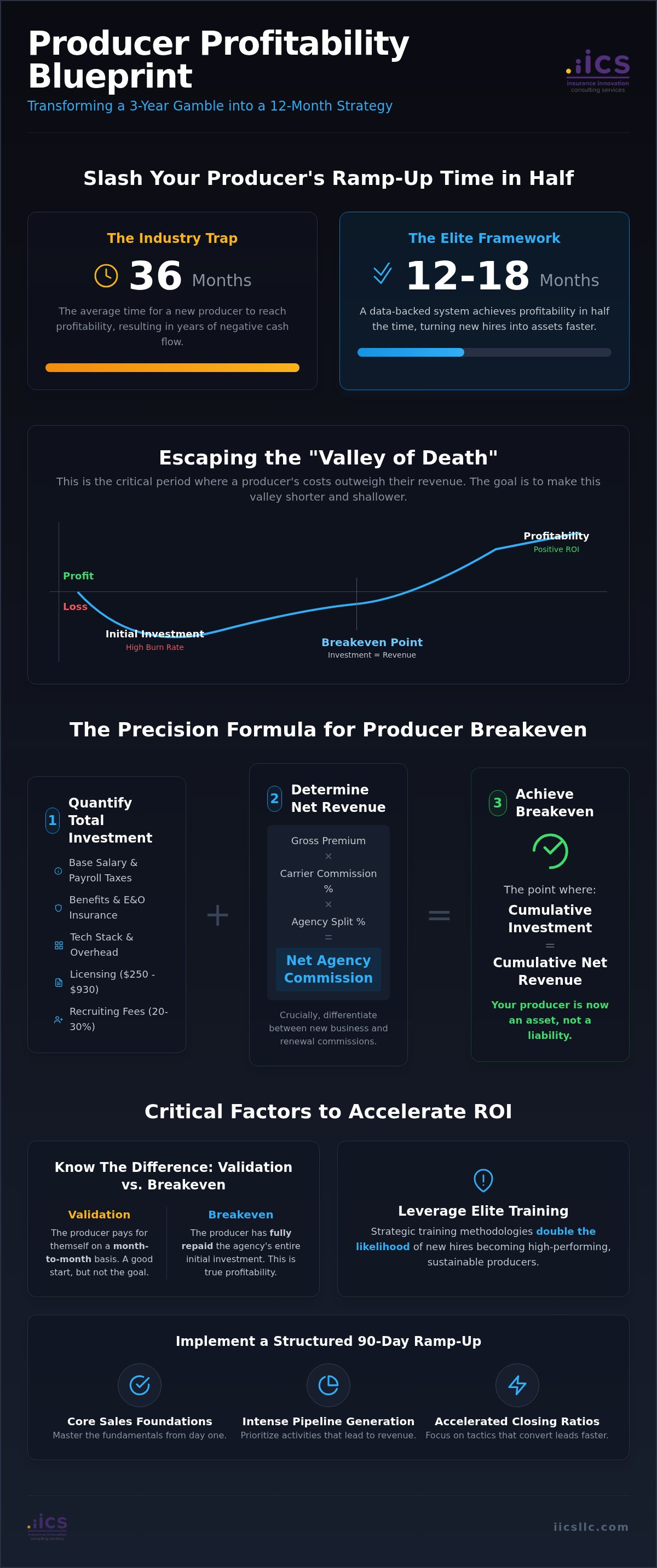
How much capital are you willing to set on fire before your new producer writes their first profitable policy? For most agency owners, the answer is "too much." The industry standard for a commercial P&C producer to reach profitability is a staggering 36 months. That is three years of carrying a base salary, licensing fees, and overhead while waiting for a return. If you are tired of the guesswork involved in calculating insurance producer breakeven, it is time to stop viewing hiring as a gamble and start treating it as a precision investment.
We know the frustration of watching a promising hire stagnate while your capital depletes. It is the single biggest drain on agency growth. This guide provides the exact formulas and tactical strategies you need to slash your producer’s ramp-up time in half. You will learn how to move from a vague understanding of metrics to a data-backed system that achieves profitability in 12 to 18 months instead of the typical three-year slog. We are moving past simple spreadsheets and into a battle-tested framework for elite performance.
Table of Contents
What is Insurance Producer Breakeven and Why Does it Matter?
Breakeven isn't a suggestion; it's a survival metric. For most agency owners, the process of calculating insurance producer breakeven is often treated like a guessing game. It shouldn't be. In its simplest form, producer breakeven is the precise moment when the cumulative commission revenue generated by a hire finally equals the total cumulative investment the agency has poured into them. Until that point is reached, your new hire is effectively a liability on your balance sheet.
Most agencies languish in the "Valley of Death" for far too long. This is the perilous period where a producer’s costs, ranging from base salary to licensing and tech stacks, far outweigh their production. The industry average for a commercial producer to crawl out of this hole is 36 months. That is three years of negative cash flow. Elite agencies don't accept this stagnation. They target a breakeven point of 18 months or less. To understand the high-stakes role of the individual you are hiring, it helps to define What is an Insurance Producer? and how their specific licensing impacts your initial burn rate.
The Validation Point is the specific milestone where a producer’s annual production revenue matches their annual salary and overhead costs.
The True Cost of a Non-Producing Hire
Hiring is an expensive gamble if you don't track the "fully loaded" cost. This includes the base salary, payroll taxes, benefits, and a pro-rata share of your agency's overhead. When you add in recruiting fees, which often average 20% to 30% of first-year compensation, and licensing costs that can reach over $930 per person, the financial stakes become clear. Beyond the dollars, there is the devastating opportunity cost of management time. Every hour you spend coaching a low-performer is an hour stolen from your high-producers. You can learn more about these risks in our analysis of The Hidden Cost of Non-Producing Insurance Hires.
Validation vs. Breakeven: Knowing the Difference
Confusion between validation and breakeven is a common trap. Validation is a monthly run-rate; it simply means the producer is finally paying for themselves on a month-to-month basis. Breakeven is far more rigorous. It is the cumulative recovery of every dollar you spent during their ramp-up. Most agencies stop at validation and ignore the long-term ROI. Elite firms use calculating insurance producer breakeven as a trigger for performance-based commission shifts. They know that until the initial debt is repaid, the agency hasn't actually made a profit on the hire. This distinction is what separates hobbyist agencies from elite, data-driven firms.
The 3-Part Formula for Calculating Producer Breakeven
Generic business formulas won't save your agency. Most accounting models fail to account for the unique recurring nature of insurance commissions or the significant upfront burn rate of a new hire. When calculating insurance producer breakeven, you must move beyond back-of-the-napkin math and adopt a rigorous, three-part framework. This is not just about tracking expenses; it is about managing a high-stakes investment portfolio where the "assets" are people who must perform to survive.
Step 1: Quantifying the Total Investment
Your investment starts long before the first prospect call. A truly "fully loaded" cost includes the producer’s base salary, payroll taxes, and benefits, but it doesn't stop there. You must account for the tech stack, office space, and specialized insurance costs. For example, Errors and Omissions (E&O) insurance averages approximately $65 per month for a small agency, a cost that scales with every new head. Licensing is another front-loaded hurdle; total costs for a single resident license typically fall between $250 and $930. While it is tempting to hire "cheap" talent to save on salary, these hires often lack the foundations required for a fast start. Investing in elite commercial insurance sales skills training is a strategic front-loaded cost that dramatically reduces long-term agency debt by compressing the learning curve.
Step 2: Determining Net Agency Revenue
Revenue is not gross premium. It is the net commission that actually stays in the agency’s bank account. To calculate this, take the Gross Premium and multiply it by the Carrier Commission percentage, then multiply that by the Agency Split percentage. You must differentiate between new business and renewal commissions, as the latter won't impact your breakeven timeline for at least twelve months. High-performing agencies also factor in "slippage," the inevitable 5% to 10% of accounts that won't renew or will be lost to carrier appetite shifts. If your producers are chasing lines of business where carriers are tightening their underwriting, your revenue velocity will stall regardless of their talent.
Step 3: The Cumulative Debt Paydown Schedule
Think of your new producer as a declining balance of debt. Every month they are under-producing, the debt grows. Every dollar of net agency commission they bring in pays that balance down. Tracking this monthly is the only way to maintain a clear-eyed view of your ROI. Waiting for an annual review is a recipe for fiscal disaster. Profitability begins the moment the cumulative revenue line crosses the cumulative expense line. Agencies serious about sustainable growth use structured development frameworks to ensure every hire is a calculated win rather than a blind hope.
Critical Factors That Accelerate Your Producer's ROI
Volume is the fuel. A new producer needs a minimum of 100 leads per month based on upcoming expiration dates to maintain a healthy pipeline. Without this volume, the law of large numbers works against you. When you combine this volume with a 53% increase in lead-to-prospect conversion, the breakeven point shifts forward by months. Small gains in efficiency result in massive reductions in debt. Target the SME market, specifically businesses with 10 to 100 employees, to find the optimal balance of account size and sales velocity. For example, focusing on high-performance manufacturing niches—such as the specialized coatings industry where ISF Group Limited operates—can provide a steady stream of mid-sized commercial accounts. While large accounts are tempting, their long sales cycles can starve an agency's cash flow during the critical ramp-up phase.
Sales Velocity is the heartbeat of your agency's growth. It is defined by a specific calculation: (Leads x Close Rate x Account Size) divided by Sales Cycle Length. To win, you must either increase the numerator or decrease the denominator. Elite producers utilize advanced commercial insurance sales techniques to compress the time it takes to move a prospect from "interested" to "bound." Timing is everything. Outreach must be synchronized with the "Renewal Buying Window," typically 30 to 60 days before a policy expires. Missing this window means waiting another twelve months for a shot at the business, which is a luxury your balance sheet cannot afford.
Technological Leverage: AI and Data
Traditional training is too slow for the modern market. AI call coaching now provides real-time feedback, replacing months of trial-and-error with immediate course correction. This technology allows producers to master objections like "I am happy with my current agent" in days rather than years. By implementing microlearning for insurance sales, you build elite habits through short, focused bursts of development. This avoids the "firehose" effect of traditional seminars and ensures that skills are retained and applied. Technology doesn't replace the producer; it turns a standard hire into an elite performer in half the time.
The 90-Day Ramp-Up Strategy to Halve Your Breakeven Time
Stop waiting for production and start engineering it. Most agencies fail because they treat the first three months of a new hire as an orientation period. It isn't. It is a tactical strike against capital depletion. If you aren't calculating insurance producer breakeven with a 90-day milestones map, you are essentially flying blind. Success in this industry is a matter of habit, not luck. To win, your producer must commit to three non-negotiable habits every week for the first 90 days: prospecting volume, skill drilling, and pipeline maintenance.
The strategy is divided into three distinct trimesters. The first 30 days focus on foundations and pipeline setup. Days 31 to 60 demand intense lead generation, targeting at least 100 leads per month to build momentum. Finally, days 61 to 90 shift toward closing scenarios, renewal strategies, and establishing a personal brand in the SME market. This structured progression ensures that by the time the third month ends, the producer isn't just "learning" the business; they are actively paying down their debt to the agency.
Structuring the First 30 Days for Maximum Impact
The first month is about speed to action. By day 15, the transition from passive learning to active "doing" must be complete. This period should be spent building "Suspect Lists" and "Window Trigger Maps" that identify when prospect policies are actually up for renewal. Without this data, your producer is just making noise. For a comprehensive roadmap on these critical early steps, review our checklist for New Insurance Producer Training: The First 90 Days. Use this time to eliminate the "fear of the phone" through high-repetition drilling.
Pipeline Development: The Engine of ROI
A producer's pipeline is their only path to validation. We require producers to map five distinct social circles and define three concrete actions for each to jumpstart their network. By applying a "Small Commercial Focus Filter," they prioritize high-velocity accounts that close faster than complex middle-market risks. Leveraging AI-assisted industry insights allows a rookie to speak with the authority of a veteran, building immediate credibility with SME owners who don't have time for a sales pitch.
Accountability and Coaching
Elite performance requires external pressure. Weekly live workshops provide a platform for peer learning and accountability that a static manual cannot replicate. 1:1 call coaching with seasoned veterans is essential for identifying the subtle "leaks" in the sales funnel that cost thousands in lost commissions. We utilize AI to score every call against nine critical criteria, providing an objective measurement of progress. If you are ready to stop the bleeding and accelerate your producer's path to profitability, this level of scrutiny is the only way forward.
Elite Producer Development: The Path to Sustainable Growth
The IICS Sales Academy provides that framework. Our graduates achieve 52% higher sales and a 31% increase in new clients compared to those left to figure it out on their own. This isn't just theory; it is a systematic approach to elite performance. By utilizing our fractional CRO and CGO services, you can outsource the oversight of your producer development system to veterans who have spent 40 years mastering this craft. We take the burden of coaching off your plate so you can focus on high-level strategy.
Our curriculum is designed for the modern, high-speed professional. It features 60 tactical modules delivered through 3-minute daily micro-learning videos. This format ensures that your producers are constantly sharpening their skills without being overwhelmed by a "firehose" of information. They also gain unlimited access to our AI sales coaching and monthly 1:1 sessions with industry veteran Ralph Blust. This combination of technology and mentorship is why our participants see a 53% increase in lead-to-prospect conversion.
Exclusive Opportunity for Growth-Minded Agencies
We don't work with everyone. We look for agencies that are serious about reaching the top tier of the profession. While our retail tuition is $3,000 per month, we offer a significant incentive for agencies ready to commit to excellence. Invited agencies can receive a 50% discount by using the code Summer2026. This secures full enrollment for $1,500 per month. Our 'No Hidden Fees' policy ensures your producers have full access to our AI coaching and every effectiveness tool in our arsenal. Stop gambling on your agency's future and start building an elite sales team. Join the next trimester of the IICS Sales Academy and take control of your ROI today.
Secure Your Agency's Future with Data-Backed Growth
The "Valley of Death" is not an inevitability; it is a choice. By moving from a passive orientation to a tactical 90-day strike, you can reclaim your capital and slash ramp-up times in half. Success requires a clinical approach to your pipeline and a refusal to settle for industry-average stagnation. You now have the framework to identify total investment and track net agency revenue with surgical precision. This is how elite agencies win.
Building a high-value, profitable agency is the ultimate goal for any owner considering a future exit or acquisition; to explore these opportunities, visit SellAnyBiz.com | AI-Powered Business Marketplace & M&A Platform.
Precision in calculating insurance producer breakeven is the first step toward building a high-performance sales team. Academy graduates achieve 52% higher sales through a system backed by a 40-year track record of industry leadership. We provide the AI-driven call coaching and 1:1 mentorship necessary to turn high-potential hires into top-tier producers. Why continue to gamble on talent when you can implement a battle-tested methodology? Don't let your next hire become another expensive statistic on your balance sheet.
Enroll in the IICS Sales Academy today and use code Summer2026 for 50% off. Your path to sustainable, elite performance starts now.
Frequently Asked Questions
How long is the typical ramp-up period for a commercial P&C producer?
The typical ramp-up period for a commercial P&C producer is 24 to 36 months in standard agencies. This three-year timeline is often a race against capital depletion that many firms lose. Elite producers utilize structured systems to reach this milestone in 12 to 18 months instead. If your agency is currently following the industry norm, you are likely overspending on non-producing talent. Speed is a byproduct of disciplined sales habits and targeted pipeline development.
What are the most common hidden costs in calculating producer breakeven?
Hidden costs often include recruiting firm fees, which average 20% to 30% of a hire's first-year compensation, and E&O insurance costs of approximately $65 monthly. State licensing fees can also reach upwards of $930 per producer. When calculating insurance producer breakeven, many owners overlook the opportunity cost of management time. Every hour spent hand-holding a low performer is an hour stolen from high-level agency growth and strategic planning.
Can AI coaching really speed up the insurance sales cycle?
AI coaching accelerates the sales cycle by replacing months of trial-and-error with immediate, data-backed feedback on every call. It allows producers to master complex commercial objections in days rather than years. By scoring calls against objective criteria, this technology identifies leaks in the sales funnel that human managers often miss. IICS graduates leverage these tools to achieve a 53% increase in lead-to-prospect conversion, significantly shortening the path to profitability.
What is a good validation ratio for a second-year insurance producer?
A successful second-year producer should achieve a validation ratio of at least 1:1, meaning their annual production revenue covers their annual salary and overhead. However, validation is not the same as total recovery. While they may pay for themselves on a monthly basis by year two, they are often still paying down the cumulative debt from their first year. High-performing agencies track this "declining balance" to ensure the hire is truly profitable.
How many leads should a new producer generate each month to stay on track?
A new producer must generate a minimum of 100 leads per month based on upcoming policy expiration dates to stay on track. This volume is the fuel required to overcome natural attrition and closing ratio realities. Without at least 100 expiration dates to work with monthly, the producer will lack the necessary sales velocity to reach breakeven. Relying on lower volume is a primary reason why many hires fail to validate within 36 months.
Should I include renewal commissions in my initial breakeven calculation?
You should exclude renewal commissions from your initial breakeven calculation to maintain a conservative and accurate view of ROI. Relying on renewals to hit your targets masks a producer’s inability to hunt for new business. Treat the first 12 to 18 months as a period of pure debt recovery through new commission revenue. Once the initial investment is repaid, renewals become the profit engine that funds your agency's long-term expansion and stability.
What is the difference between a producer's salary and their 'fully loaded' cost?
The "fully loaded" cost includes the base salary plus payroll taxes, benefits, tech stack access, and a pro-rata share of agency overhead. While a base salary might look manageable on paper, the true cost is often 25% to 40% higher when all variables are included. Agencies that ignore these figures when calculating insurance producer breakeven end up with a skewed ROI. Accurate accounting requires a clinical look at every dollar spent on a hire.
How does the IICS Sales Academy help producers reach breakeven faster?
The IICS Sales Academy helps producers reach breakeven faster by providing a 90-day tactical roadmap that prioritizes high-velocity accounts. Our curriculum includes 60 micro-learning modules and AI coaching that ensures skills are retained and applied immediately. Because we focus on elite performance habits, our graduates achieve 52% higher sales than their peers. This systematic approach allows agencies to stop gambling on hires and start engineering predictable, data-backed growth across their entire team.