Insurance Producer Breakeven Analysis: The Elite Agency Guide to Faster ROI
Updated: 8 hours ago
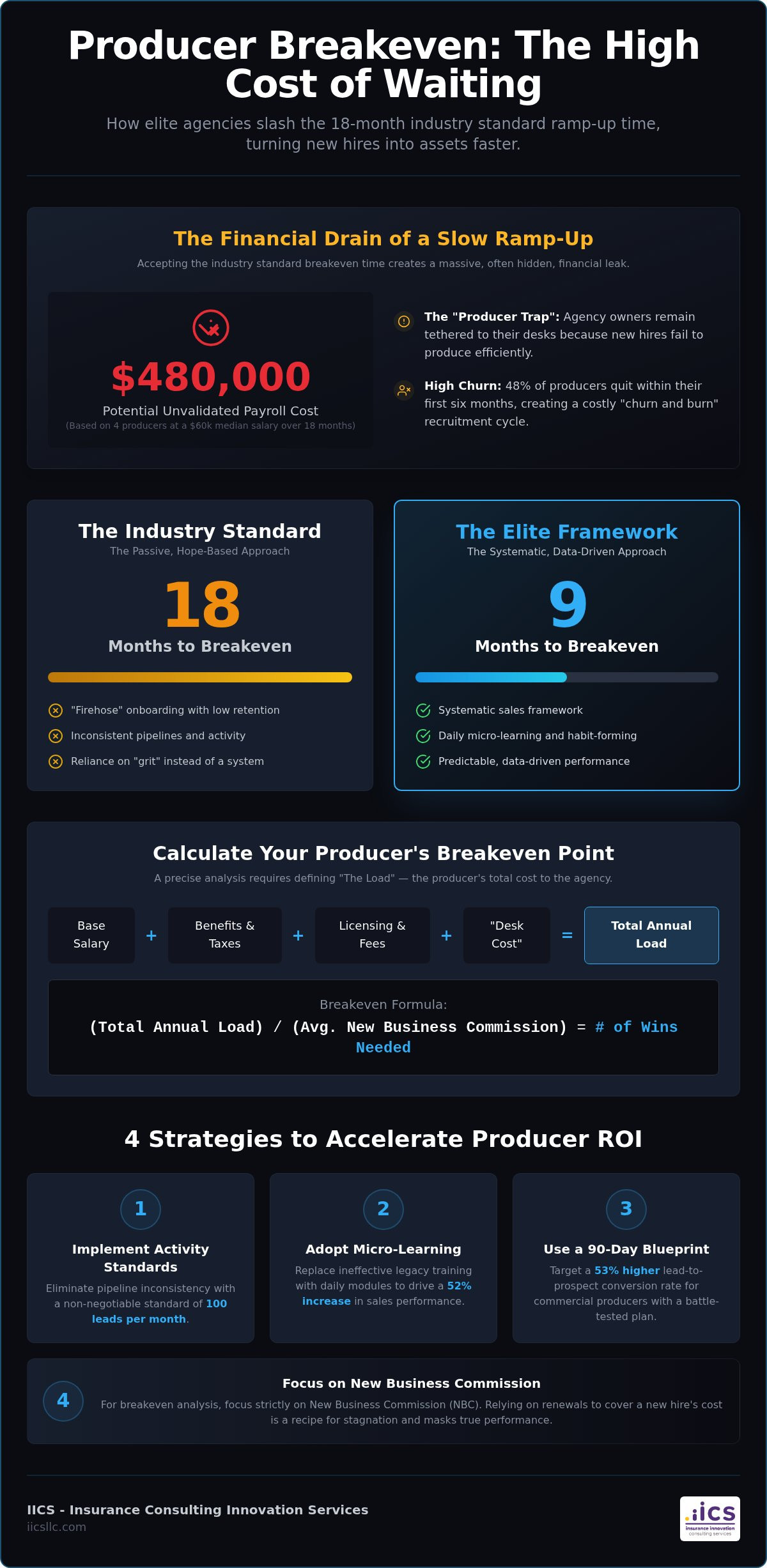
How much of your agency's capital are you willing to set on fire before a new producer finally pays for themselves? Most principals accept the industry standard of eighteen months to reach validation, but this passive approach creates a massive financial drain. If you're carrying four unvalidated producers at a median salary of $60,000, you could be bleeding up to $480,000 in unvalidated payroll costs. Performing a precise insurance producer breakeven analysis isn't just about accounting; it's about survival in a softening P&C market. You likely feel the sting of watching high-potential hires struggle with inconsistent pipelines while your ROI remains a distant hope.
It's time to stop treating producer ramp-up as a gamble and start treating it as a calculated investment. This guide promises to show you how elite agencies achieve breakeven revenue in half the traditional time by replacing the firehose onboarding method with a systematic sales framework. You'll master the financial mechanics required to predict ROI and learn why momentum, not just math, determines success. We're breaking down the exact repeatable framework used by the top tier of the profession to secure faster, predictable results.
Table of Contents
The Financial Drain of the Slow Ramp-Up: Why Producer Breakeven Matters
Relying on legacy books is a death sentence for agency growth. This is the "Producer Trap," a cycle where agency owners remain tethered to their own desks because their new hires fail to produce. When you hire a new producer, you aren't just adding a name to the payroll; you're making a high-stakes capital investment. In 2026, the median base salary for a producer sits near $60,000. When you factor in the average hiring cost of $8,700 and the burden of benefits, a non-producing hire is a massive financial leak. Accepting an 18-to-24-month ramp-up is no longer a sustainable business model. With the P&C market softening, you cannot afford to carry unvalidated payroll while waiting for a distant breakeven point to materialize.
The damage isn't just financial. It's psychological. A producer who spends 12 months bleeding agency cash without seeing a win loses more than just commissions; they lose their professional identity. This stagnation destroys agency culture and leads to a toxic environment of low expectations. If your insurance producer breakeven analysis reveals a two-year runway, you're essentially planning for failure. High-performing agencies know that confidence is fueled by momentum. Without a clear path to ROI, your best talent will likely become part of the 48% of producers who quit within their first six months.
The Opportunity Cost of Failure
Every month a producer fails to validate is a month of lost opportunity. It's not just the $5,000 monthly salary you're losing; it's the $15,000 in new business commission they should have generated. This creates a "churn and burn" cycle that keeps your agency in a state of permanent recruitment. Many principals believe that "grit" will eventually pull a producer through. Grit is not a strategy. Without a systematic sales infrastructure, even the most determined hire will eventually succumb to an empty pipeline. You need a predictable framework that replaces hope with data-driven performance.
Why Traditional Onboarding Fails the Breakeven Test
Most agencies utilize the "Firehose Method" for onboarding. They dump decades of technical knowledge into a new hire's lap in two weeks and expect them to swim. This leads to zero retention and immediate paralysis. Accountability is usually the first casualty. If you aren't tracking daily activity in the first 90 days, you've already lost the battle for ROI. Modern insurance producer breakeven analysis requires a shift toward specialized Commercial P&C training. Generic sales tips won't help a producer navigate a complex mid-market risk. They need tactical, habit-forming development that builds competence and confidence simultaneously.
Calculating the Insurance Producer Breakeven Point: The P&C Formula
Generic business formulas are useless in the high-stakes world of commercial insurance. If you're using a standard "Fixed Costs / Contribution Margin" calculation, you're flying blind. A true insurance producer breakeven analysis requires you to define "The Load" with surgical precision. This isn't just the producer's base salary. It must include payroll taxes, health benefits, licensing fees, and your agency’s "desk cost"-the proportional share of rent, utilities, and support staff required to keep that producer active. Without these variables, your profitability projections are nothing more than a best-case scenario that will never happen.
Understanding the revenue side is equally critical. You must distinguish between New Business Commission (NBC) and renewal overrides. Elite agencies focus on NBC for breakeven because relying on renewals to cover a new hire’s cost is a recipe for stagnation. To find your target, use this formula: (Total Annual Load) / (Average NBC per Account). This tells you exactly how many "wins" are required to stop the bleeding. However, to make this actionable, you must also factor in your conversion rate to determine the necessary lead volume. For a deeper look at these metrics, professional Producer Profitability Analysis can help you benchmark your agency against the top performers.
It's vital to recognize that "Validation" and "Breakeven" are different financial milestones. Validation occurs when a producer’s commission covers their own salary. Breakeven is the point where the agency has fully recovered its total investment, including the months of unvalidated payroll and hiring costs. If you want to shorten the distance between these two points, you need a system that forces high activity from day one. You can explore how to build that momentum by looking inside the academy to see our ROI-driven framework.
Identifying Your Fixed and Variable Agency Costs
Your fixed costs are the baseline requirements: salary, your technology stack, and licensing. These don't change regardless of performance. Variable costs, however, are the levers of growth. This includes marketing spend, travel, and lead generation. The most dangerous hidden cost is the Principal’s time. Every hour you spend "checking in" on a struggling producer is an hour you aren't spending on high-level strategy or your own top-tier accounts. Coaching must be systematic, not a drain on your own productivity.
Factoring in the Sales Cycle
The industry standard for validation is a slow, expensive grind. Most agency owners accept that a new commercial producer will take eighteen to twenty-four months to pay for themselves. This is a failure of leadership, not a market reality. Elite agencies operate on a different timeline, reaching a positive ROI in nine months or less. This acceleration is the direct result of a rigorous insurance producer breakeven analysis that prioritizes speed to market over passive learning. Are you comfortable waiting two years for a return on your capital? If the answer is no, you must change your development model.
The data is clear. Producers who follow a structured development path see 52% higher sales volume compared to those left to figure it out on their own. Scripted objection handling alone can boost lead-to-prospect conversion by 53%. When you combine these efficiencies, you aren't just hitting targets; you're fundamentally changing the agency's financial trajectory. For those looking to benchmark their current staff, a formal Producer Profitability Analysis provides the necessary baseline to identify who is actually contributing to the bottom line and who is simply occupying a desk.
The Impact of Structured Development
The "sink or swim" model is a relic of a less competitive era. Today, you need the Elite Insurance Producer Development Plan to scale. Agencies utilizing this systematic approach report a 31% increase in new client acquisition. This shift drastically compresses the breakeven timeline by front-loading the most profitable activities. Maintaining this level of accountability often requires the oversight of a Fractional CGO. This ensures that executive-level standards are met every single week, preventing the drift into mediocrity that plagues most independent agencies.
The ROI of the First 90 Days
Success is decided in the first quarter of employment. Graduates of a dedicated Sales Academy are twice as likely to become top-tier producers because they build the right habits immediately. Reducing ramp-up time by 50% doesn't just save on unvalidated payroll; it creates a culture of winning that attracts even better talent. At IICS, we've spent four decades perfecting this methodology. You can learn more About IICS and our 40-year track record of transforming producers into high-revenue assets. Stop waiting two years for a return that should take nine months.
4 Strategies to Accelerate Producer Breakeven in 2026
Elite agencies don't wait for the market to dictate their revenue; they engineer it through uncompromising activity standards. If your insurance producer breakeven analysis relies on your hires "finding their way," you've already lost. To compress the ROI timeline from eighteen months down to nine, you must implement a Minimum Activity Standard of exactly 100 leads per month per producer. This isn't a suggestion. It is the baseline requirement for survival. By combining this volume with a Suspect List organized by Effective Date, you ensure your producers are hunting accounts sixty to ninety days before renewal, hitting the outreach window when prospects are most likely to move.
Systematizing the Pipeline
Elite operations like Jacobs Family Insurance demonstrate that maintaining these high standards is essential for protecting the agency's investment and ensuring a predictable path to profitability.
Lowering the cost of lead acquisition requires producers to map five distinct social circles for networking. This systematic approach transforms "cold calling" into warm introductions, drastically reducing the friction of the initial contact. When a prospect inevitably claims, "I am happy with my current agent," your producers shouldn't stutter. They must be armed with thematic scripts designed to pivot the conversation toward technical gaps the incumbent likely missed. We reinforce this through the 6-3-2-1 rule, a rhythmic daily sales protocol that ensures the top of the funnel remains perpetually full. Grit is a myth; rhythm is a reality.
Strategy must be paired with habit formation. Shift your training from the "information dump" of traditional onboarding to Daily Micro-Learning. This methodology delivers tactical, three-minute lessons that are immediately applicable to the day's sales calls. Simultaneously, you must leverage AI Call Coaching to provide real-time, data-driven feedback. In 2026, waiting for a weekly one-on-one to review a failed call is a waste of capital. Your producers need to know what they missed the moment they hang up the phone.
Leveraging AI for Elite Performance
Unlimited AI call coaching allows your agency to score every interaction against nine elite performance criteria. This technology identifies exactly where a producer’s "leak" is occurring, whether it's in the opening hook or the final close. By utilizing AI Industry Insights, producers can build instant credibility with commercial prospects by speaking fluently about niche-specific risks and manuscript forms. For a deep dive into implementing these tools, review our AI Sales Coaching Pillar. Stop guessing why your producers aren't closing and start using data to force the win.
Ready to stop the financial bleed and start scaling? Join the Sales Academy and put these four strategies into immediate action.
The IICS Sales Academy: Your Blueprint for Faster ROI
Your insurance producer breakeven analysis is only as good as the development system behind it. If you're tired of bleeding cash on unvalidated salaries, you need a battle-tested framework that delivers results in months, not years. The IICS Sales Academy is the premier training ground for commercial P&C producers. We don't believe in information dumps. Our 90-day system utilizes 60 tactical modules delivered in precise, three-minute daily lessons. This micro-learning approach ensures your producers spend their time selling, not sitting in a classroom. It's about habit formation and immediate application.
Stop settling for "checking in" with your new hires. Most principals mistake a casual conversation for coaching. Elite performance requires high-stakes 1:1 mentoring from veteran sales experts who have lived in the trenches. Our model is built on transparency. We provide a "No Hidden Fees" structure that includes unlimited AI call coaching and full resource access. Your producers get the feedback they need exactly when they need it. This isn't just training; it's a systematic overhaul of your agency's sales culture.
The Blust Methodology
We leverage 40 years of leadership to move your new hires from a financial deficit to sustained profitability. The Blust Methodology is designed for the modern agency owner who wants to scale without adding massive executive overhead. Our trimester system allows your producers to start their journey on the first of any month. You don't have to wait for a specific enrollment window to fix your ROI problems. Use the Sales Academy to turn your recruits into high-performing assets while you focus on high-level strategy.
Exclusive Agency Offer
We're committed to lowering the barrier to entry for agencies serious about growth. For a limited time, you can access our 50% invited-agency discount. This reduces the tuition to $1,500 per month per student. Use the discount code Summer2026 at checkout to secure this pricing. Don't let another quarter slip by while your producers struggle to find their footing. Enroll your producers now to start their 90-day transformation and finally master your insurance producer breakeven analysis goals.
Stop Bleeding Capital and Start Scaling Your Agency
Accepting an eighteen-month ramp-up isn't just a tradition; it's a financial liability. By utilizing a rigorous insurance producer breakeven analysis, you move from guesswork to precision. You now understand the mechanics of "The Load" and the elite standards required to reach ROI in half the industry-standard time. It's time to stop checking in and start coaching for results. We've proven that formal training leads to a 52% increase in sales for those who commit to the process. With over 40 years of P&C leadership experience, we provide the framework your producers need to validate and win. There are no hidden fees here. You get all the coaching tools and AI insights required to dominate your niche from day one.
The path to an elite agency model is clear. You can continue carrying unvalidated payroll, or you can engineer a high-performance culture today. Download the Producer Breakeven Calculator & Enroll in the Sales Academy - Use Code Summer2026 and begin your agency's transformation. You have the data. Now, take the lead and build the profitable firm you deserve.
Frequently Asked Questions
How do you calculate the breakeven point for an insurance producer?
You calculate the breakeven point by dividing the producer's total load by their average new business commission per account. The total load must include base salary, payroll taxes, health benefits, and agency desk costs like rent and technology. Conducting a thorough insurance producer breakeven analysis helps you identify the exact number of wins needed to recover your investment. Elite agencies focus on new business commission rather than renewals to ensure aggressive growth.
What is the average ramp-up time for a commercial P&C producer?
The industry standard ramp-up time for a commercial P&C producer typically ranges from eighteen to twenty-four months to reach full validation. However, this sluggish timeline is no longer sustainable in a softening market. Producers new to the industry often take up to eighteen months just to become independently productive. Elite agencies aim to compress this timeline to nine months or less through structured development and high-activity standards that force early results.
How does the IICS Sales Academy cut breakeven time in half?
The IICS Sales Academy cuts breakeven time in half by replacing traditional firehose onboarding with a systematic 90-day framework. We use daily three-minute micro-learning modules to build habits without overwhelming the producer. By combining these lessons with unlimited AI call coaching and veteran 1:1 mentoring, we ensure producers are hunting high-value accounts from day one. This structured approach helps graduates achieve breakeven revenue far faster than the industry average.
Is a base salary or commission-only model better for reaching breakeven faster?
A base salary model is standard for new commercial producers, but the pay structure itself doesn't guarantee a faster ROI. Reaching breakeven is a momentum problem, not just a math problem. While commission-only models reduce agency risk, they often fail to attract top-tier talent. The fastest path to profitability is providing a base salary while mandating a minimum activity standard of 100 leads per month to ensure the pipeline stays full.
What activity metrics should I track to ensure a producer hits ROI?
You must track high-impact activity metrics rather than just final sales. We require a minimum of 100 leads per month based on expiration dates to ensure a consistent pipeline. Producers should target three to five new accounts monthly. Tracking the sixty to ninety day outreach window is critical. If a producer isn't hitting these activity benchmarks, your insurance producer breakeven analysis will likely show a significant financial deficit by the end of the year.
How does AI call coaching impact the financial ROI of a producer?
AI call coaching provides real-time, data-driven feedback that scores producers against nine elite criteria. Instead of waiting for a weekly check-in, producers receive immediate guidance on how to handle objections and close gaps. This technology is a primary driver for the 53% increase in lead-to-prospect conversion seen in our graduates. By fixing sales leaks instantly, you drastically reduce the time it takes for a new hire to pay for themselves.
Can a fractional CGO help me manage the breakeven analysis for my team?
A fractional CGO provides the executive-level accountability needed to maintain rigorous standards without the full-time overhead. They help you implement a repeatable sales development framework and monitor your ROI metrics weekly. This outsourced leadership ensures that your development plan doesn't drift into mediocrity. With a 40-year track record of growth, our fractional services help agency owners step away from daily production and focus entirely on high-level strategy.
What is the cost of the IICS Sales Academy for an agency?
The retail tuition for the Sales Academy is $3,000 per month. However, invited agencies can access a 50% discount, bringing the cost down to $1,500 per month per student. This price includes full access to all micro-learning modules, unlimited AI call coaching, and 1:1 mentoring with veteran experts. Use the discount code Summer2026 at checkout to secure this elite-level training at the optimized rate for your agency’s long-term growth.