Insurance Producer Call Coaching: The Elite Framework for P&C Performance
- Jul 30
- 11 min read
You don't have to settle for inconsistent results. We've refined a data-driven methodology that slashes producer ramp-up time in half and transforms average agents into elite revenue generators. This framework moves beyond gut feelings to provide a precision-engineered path to high-ticket P&C success. We'll show you how to leverage AI-driven insights and high-stakes mentorship to double the probability of new hires becoming top producers. It's time to build a self-sustaining sales culture that hits breakeven in record time.
Table of Contents
What is Insurance Producer Call Coaching in the High-Stakes P&C Market?
Most agency owners still rely on hope as a primary strategy. They hire a producer, provide a desk, and wait for the "sink or swim" outcome. This is a recipe for mediocrity. Elite insurance producer call coaching isn't a suggestion; it's a systematic, data-backed architecture designed to accelerate sales mastery. This process moves beyond "listening to tapes" or offering vague encouragement. It's a rigorous analysis of the sales process to identify exactly where revenue is leaking from your pipeline.
General agent coaching fails in the high-stakes Commercial P&C market because the complexity is significantly higher. You aren't selling a commodity; you're selling risk management and specialized coverage. Qualitative "gut feeling" feedback from a busy manager doesn't cut it anymore. You need quantitative performance data that tracks specific behaviors, from the opening hook to the final close. The shift from subjective opinions to objective data is what separates elite agencies from the rest of the pack.
The Financial Reality of the Non-Producing Hire
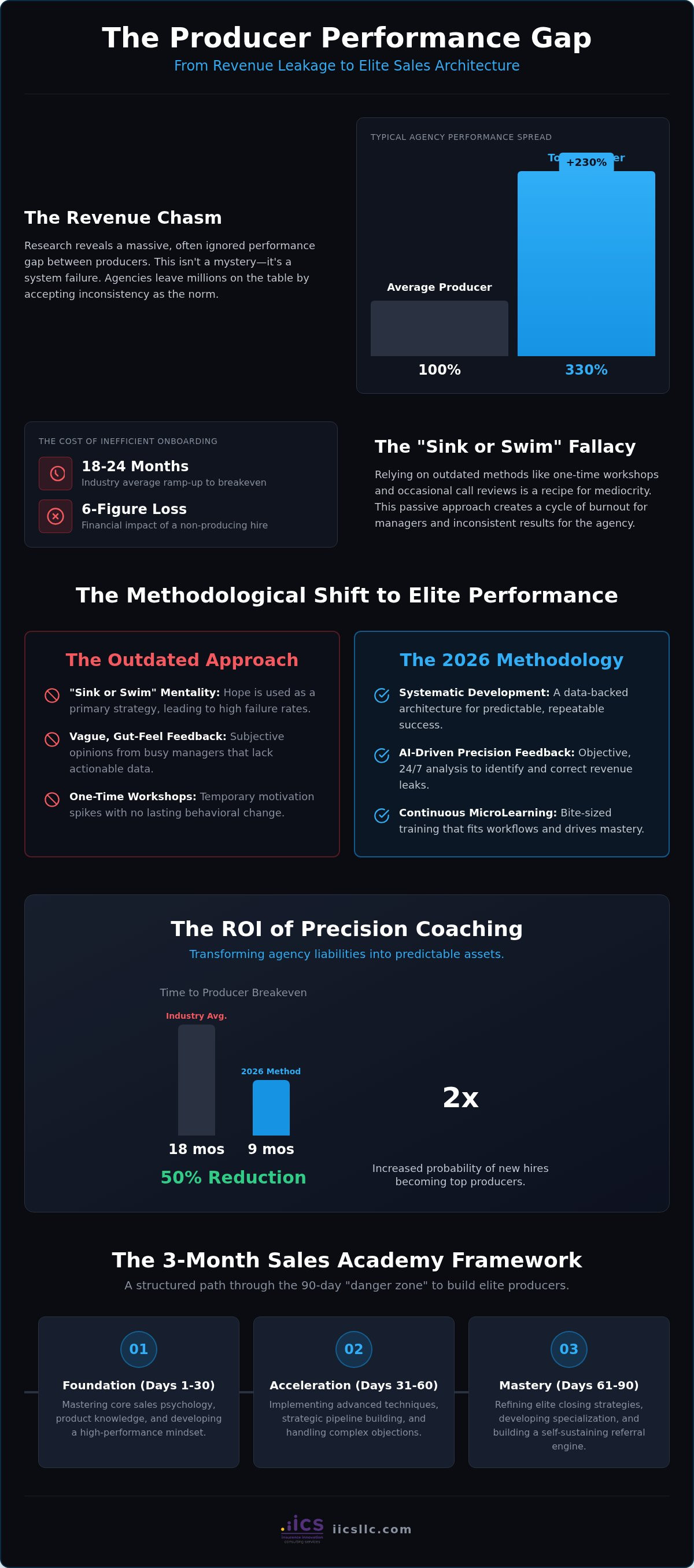
A failed producer is a financial anchor. When you factor in salary, benefits, overhead, and the massive lost opportunity cost, the price of a bad hire often exceeds six figures. In the commercial market, where the 2026 industry average for producer ramp-up still sits at 18 to 24 months, you can't afford to wait two years to see if an agent will stick. Effective insurance producer call coaching directly impacts agency valuation. A team of elite producers is a predictable asset; a team of average agents is a liability. You must move from "managerial oversight," which merely monitors activity, to "elite performance coaching," which drives tangible outcomes.
Call Coaching vs. Traditional Sales Training
One-time workshops are where good intentions go to die. They provide a temporary spike in motivation but fail to create lasting behavioral change. Real mastery requires 1-on-1 insurance sales coaching that addresses the specific psychological and technical hurdles each producer faces. Continuous development is the only path to the top 1% of producers. If you aren't coaching your team every week, you're accepting stagnation. Elite performance is built through precision, repetition, and a relentless focus on the data that separates a closed deal from a lost lead. It's about building a repeatable system that doesn't rely on the principal's constant hand-holding.
The 2026 Methodology: AI, MicroLearning, and Precision Feedback
Modern P&C production demands more than just grit; it requires a precision-engineered system. Relying on outdated training manuals is a liability in a market that moves at the speed of data. Elite insurance producer call coaching has evolved into a high-stakes revenue engine that utilizes real-time analytics to eliminate sales friction. This methodology isn't a theory. It's built on a 40-year track record of P&C leadership and designed to create a repeatable path to the top 1% of earners. By moving away from "gut feeling" management, you provide your producers with a roadmap to mastery that is both objective and relentless.
Integrating AI sales coaching for insurance transforms the training experience from a passive lecture into an active, 24/7 force multiplier. AI doesn't sleep. It doesn't have a "bad day" that skews its feedback. Academic studies on AI in sales training confirm that real-time guidance reduces the cognitive load on agents, allowing them to focus on the human element of the sale. This precision feedback loop ensures that every call is an opportunity for growth, not just another tally on a spreadsheet.
MicroLearning: Training That Producers Actually Use
Why kill a producer's productivity with an 8-hour seminar? Most of that information is forgotten before the lunch break. When evaluating microlearning vs traditional insurance sales training, the difference in retention is staggering. We deliver training in five-minute, "bite-sized" modules that fit into the daily workflow of a busy commercial agency. This ensures that producers spend more time selling and less time sitting in a classroom. It's about high-frequency, low-friction development that sticks. If you're ready to stop guessing and start scaling, our Sales Academy offers the architecture your agency needs.
AI Sales Coaching: The 24/7 Mentor
AI removes manager bias to provide objective, repeatable coaching sessions. It analyzes every interaction for sentiment, objection handling, and closing signals. This level of scrutiny identifies "coachable moments" that humans often miss during a standard review. By automating the technical analysis, managers can focus on high-level strategy rather than correcting basic behavioral errors. Insurance producer call coaching powered by AI provides a level of precision that was previously impossible, ensuring your team is always sharp, prepared, and ready to close high-ticket accounts.
Internal vs. Outsourced Coaching: Escaping the Principal Trap
The "Principal Trap" is a quiet killer of agency growth. It occurs when the most talented producer in the building, the Agency Principal, becomes the bottleneck for everyone else's development. You’ve built your agency on your ability to close complex commercial accounts, but being a high-performer doesn't automatically make you an effective coach. Often, the best producers make the worst trainers because their success is intuitive rather than systematic. They can't explain the "how" because it’s second nature to them. When you attempt to manage insurance producer call coaching internally while also managing a book of business, something eventually breaks. Usually, it’s your growth rate.
Consider the opportunity cost. If an Agency Principal spends 10 hours a week on basic call reviews and administrative hand-holding, that's 40 hours a month stolen from high-level production. The math is simple and devastating. If your hourly value as a producer is five hundred dollars, spending ten hours a week on basic reviews represents a five-thousand-dollar weekly loss in potential revenue. Outsourced producer development provides a neutral, expert perspective that internal staff simply cannot replicate. An external coach isn't influenced by office politics or personal history; they are focused entirely on the data-driven path to revenue.
The Fractional CRO Model for Sales Growth
Elite agencies are increasingly moving toward a Fractional Chief Revenue Officer (CRO) model. This provides you with an outsourced "Head of Coaching" who brings a 40-year track record of P&C leadership to your team. External leadership creates a level of accountability that internal managers often lack. It bridges the gap between the "hiring honeymoon" and real production by implementing a rigorous framework from day one. You don't need to worry about an outside coach "understanding your culture" when the culture you're building is one of uncompromising elite performance.
Role Playing: The Elite Producer’s Gym
Most role-playing is a waste of time because it lacks stakes and structure. To modernize the practice, you must treat it like an elite athlete’s gym. This requires using specialized insurance sales role play scripts designed specifically for high-ticket Commercial P&C. Coaching in this environment isn't just about the "gift of gab"; it’s about navigating complex risk conversations while maintaining strict producer licensing and compliance standards. Moving from scripted practice to intuitive live-call execution is how you turn a new hire into a top-tier revenue generator in half the industry-standard time. Effective insurance producer call coaching ensures your team is ready for the high-stakes reality of the 2026 market.
Metrics of Mastery: Measuring Call Coaching ROI
Stop measuring activity and start measuring outcomes. If you aren't tracking the financial return on your insurance producer call coaching, you're just managing a hobby. Most agency owners settle for "busy" when they should be demanding "profitable." In the high-stakes world of commercial P&C, gut feelings about a producer's "potential" are a liability. You need hard data that predicts revenue. Are your producers securing high-ticket meetings, or are they just making noise on the phone? By analyzing the friction between call-to-meeting ratios and quote-to-bind ratios, we identify exactly where the sales process is breaking down.
We use an "Elite Probability" score to predict long-term success based on coaching data. This isn't about being "nice"; it's about being precise. If a producer isn't showing behavioral improvement in their objection handling or closing signals within the first few weeks, the data tells us they won't hit their targets in year two. This level of scrutiny allows you to make informed decisions about your talent pool before you've sunk six figures into a failing hire. Precision coaching turns the "black box" of sales into a transparent, measurable engine.
Reducing Ramp-Up Time by 50%
The industry average for P&C producer ramp-up is 18 to 24 months, a timeline that many agencies mistakenly accept as an immutable law of physics. We reject that. Through the IICS accelerated path, we slash that timeframe in half. Intensive insurance producer call coaching in the first 90 days is the only way to prevent the common year-two burnout. We set high-stakes benchmarks that producers must hit to remain in the academy. This ensures your resources are only invested in those who demonstrate the discipline required for elite production. If you're ready to stop the bleeding of long-term training costs, apply for our Sales Academy to see the methodology in action.
Data-Driven Accountability Tools
Activity is not production. You must use effectiveness tools to distinguish between sales activities, like dials, and sales outcomes, like signed BORs. Our weekly metrics dictate the specific focus of every coaching session, ensuring we aren't wasting time on skills the producer has already mastered. We track the numbers that actually move the needle for your agency's valuation. Producer Breakeven is the moment cumulative gross margin exceeds total hire cost. If you aren't tracking this date with surgical precision, you aren't truly managing your agency's growth. Every coaching session must be a step toward that breakeven point and beyond.
Implementing the 3-Month Sales Academy Framework
The first 90 days are the danger zone for every new hire. This is the critical window where bad habits calcify or elite behaviors take root. Most agencies lose their producers in year two because they failed to provide a rigorous architecture in month one. Our 3-month Sales Academy is a high-stakes intensive program designed to eliminate that risk. It isn't a passive orientation; it's a systematic transformation. By utilizing a "triple-threat" development plan, we combine the precision of AI coaching with the retention of MicroLearning and the high-level nuance of 1:1 mentorship. This ensures your producers aren't just learning; they're performing.
Elite insurance producer call coaching requires a relentless focus on behavioral change. In the Academy phase, we strip away the fluff and focus on the high-ticket Commercial P&C skills that drive revenue. Once the foundation is solid, the producer transitions into a permanent Growth phase. This isn't the end of their development; it's the beginning of their career as a top-tier revenue generator. Why settle for a "hiring honeymoon" that ends in a six-figure loss? You need a framework that demands excellence from day one and provides the tools to achieve it.
The Path to Elite Producer Status
Maintaining momentum after the initial 90-day sprint is what separates the top 1% from the average. Producer isolation is a silent productivity killer that leads directly to burnout. To combat this, we utilize weekly live workshops that serve as a high-energy environment for skill sharpening and peer accountability. These sessions ensure that the lessons learned during 1:1 coaching are reinforced and expanded upon. Every successful agent needs a roadmap, and linking your team's progress to an elite insurance producer development plan is the only way to scale agency growth predictably.
Taking Action: The Agency Principal’s Next Steps
It's time for a hard truth. Audit your current coaching process right now. Are you actually providing insurance producer call coaching, or are you just "checking in" to see if they're busy? Checking in is management; coaching is transformation. The immediate ROI of professional, outsourced producer development is found in the reclaimed hours of the Agency Principal and the accelerated revenue of the new hire. You can continue to struggle with inconsistent results, or you can implement a battle-tested system. See how IICS transforms producers in 90 days and stop leaving your agency's future to chance.
Seizing the Competitive Edge in P&C Production
Most agencies wait two years to see if a producer pays off. Do you have that kind of time? By moving away from the "Principal Trap" and leveraging modern, data-backed insurance producer call coaching, you reclaim your leadership hours and secure your agency's valuation. This isn't just about training. It's about building a self-sustaining culture of elite performance that hits breakeven in record time.
We provide the definitive architecture for this transformation. With our 40-year track record of Commercial P&C growth and proprietary AI Sales Coaching technology, we don't just offer suggestions; we deliver results. Our methodology is designed to reduce producer breakeven time by 50% compared to industry norms. Why leave your revenue to chance when you can follow a battle-tested framework? It's time to demand more from your team and your training process.
Apply for the IICS Sales Academy and Double Your Top Producer Probability. Your agency's future is waiting for a leader who chooses precision over hope.
Frequently Asked Questions
What is the primary goal of insurance producer call coaching?
The primary goal is to transform average agents into elite revenue generators by identifying and correcting specific behavioral friction points in the sales process. It moves the needle from passive oversight to active mastery. By focusing on data-backed feedback, you ensure that every conversation moves closer to a signed BOR rather than just filling a call log with pointless activity.
How often should a P&C producer receive call coaching?
New producers in their first 90 days require daily touchpoints via AI and MicroLearning, while established agents should have structured 1:1 sessions at least once a week. Consistency is the only way to prevent bad habits from calcifying. High-frequency, low-friction feedback ensures that insurance producer call coaching becomes a natural part of the daily workflow rather than a disruptive or occasional event.
Is AI sales coaching better than human coaching for insurance agents?
They serve different purposes in an elite development plan and are most effective when used together. AI coaching provides 24/7 objective analysis of every call, identifying patterns and objection-handling gaps that a human manager might miss. However, human mentorship is essential for navigating the complex, high-stakes nuances of commercial P&C relationships. The most successful agencies use a "triple-threat" approach that merges both technologies.
How long does it take to see a ROI from producer call coaching?
You should expect to see measurable behavioral shifts within the first 30 days and a significant impact on revenue by the 90-day mark. The objective is to reduce the standard 18 to 24 month ramp-up time by 50%. When you accelerate the path to producer breakeven, the ROI manifests as reclaimed principal time and faster, more predictable agency growth.
What are the best metrics to track for a new insurance producer?
Focus on the metrics that predict revenue: time to breakeven, call-to-meeting ratios, and quote-to-bind ratios. Tracking dials is a vanity exercise if those calls aren't resulting in high-ticket commercial meetings. Use an Elite Probability score to measure how well a producer is applying their insurance producer call coaching to real-world objections and closing signals during live interactions.
Can call coaching help experienced producers, or is it just for new hires?
Experienced producers often have the most to gain because their plateaus are the most expensive for the agency. Even the top 1% of earners develop blind spots or rely on outdated talk tracks that lose effectiveness as the market shifts. Ongoing coaching acts as a performance gym, ensuring that your senior producers stay sharp and continue to grow their books year over year.
How do you handle producers who are resistant to call coaching?
Reframe the conversation around their income rather than their activity. Resistance usually stems from a fear of micromanagement, so you must show them how the coaching data directly correlates to their closing rates and commission checks. When a producer sees that precision-engineered feedback leads to more high-ticket wins and less wasted effort, the resistance usually evaporates in favor of results.
What is the difference between sales training and call coaching?
Sales training is the one-time transfer of information, while call coaching is the ongoing behavioral application of that information to live scenarios. Training tells them what to do; coaching ensures they actually do it when it matters most. Without a systematic coaching framework to reinforce training, most producers will revert to their comfortable, less effective habits within 48 hours of a seminar.