Insurance Producer Retention Strategies: Why Success is the Only Real Perk
Updated: Sep 2
Why are you still trying to protect a $250,000 investment with a ping-pong table and "flexible hours"? The hard truth is that most insurance producer retention strategies fail because they focus on office comfort rather than tactical competence. When a new hire walks out the door, they take more than just their desk; they take a massive chunk of your agency's capital and your personal time. High-performing producers do not stay for the perks. They stay because they are winning, and winning requires a system, not a suggestion.
You have likely felt the exhaustion of coaching ineffective staff who never seem to "get it." It is time to stop the bleeding. We are going to replace your generic onboarding with a rigorous 90-day framework designed to turn new hires into elite P&C professionals. In this guide, you will learn how a structured approach to development ensures early wins, slashes ramp-up time, and builds a culture of elite performance where success is the only perk that actually matters. It is time to build an agency that attracts the best by making them the best.
Table of Contents
The Crisis of Producer Turnover: Why Your $250,000 Investment is at Risk
Most agency owners view turnover as an unavoidable cost of doing business. It isn't. It is a systemic failure. When we talk about insurance producer retention strategies, we are not talking about human resources paperwork or annual reviews. We are talking about the strategic, tactical process of ensuring new hires reach profitability before they succumb to burnout. If your producers are leaving within 24 months, you aren't just losing an employee; you are incinerating capital.
The "70-80% failure rate" cited across the industry is a staggering indictment of traditional onboarding. It is rarely a lack of drive that kills a career; it is a lack of direction. You hire someone with "fire in their belly," but without a map, they simply burn out. This is the "Entry Fee" Fallacy. Many principals believe that because a candidate has a license, they are ready to sell commercial P&C. In reality, a license is merely a permit to learn. It does not equate to the sophisticated technical knowledge required to displace an incumbent agent.
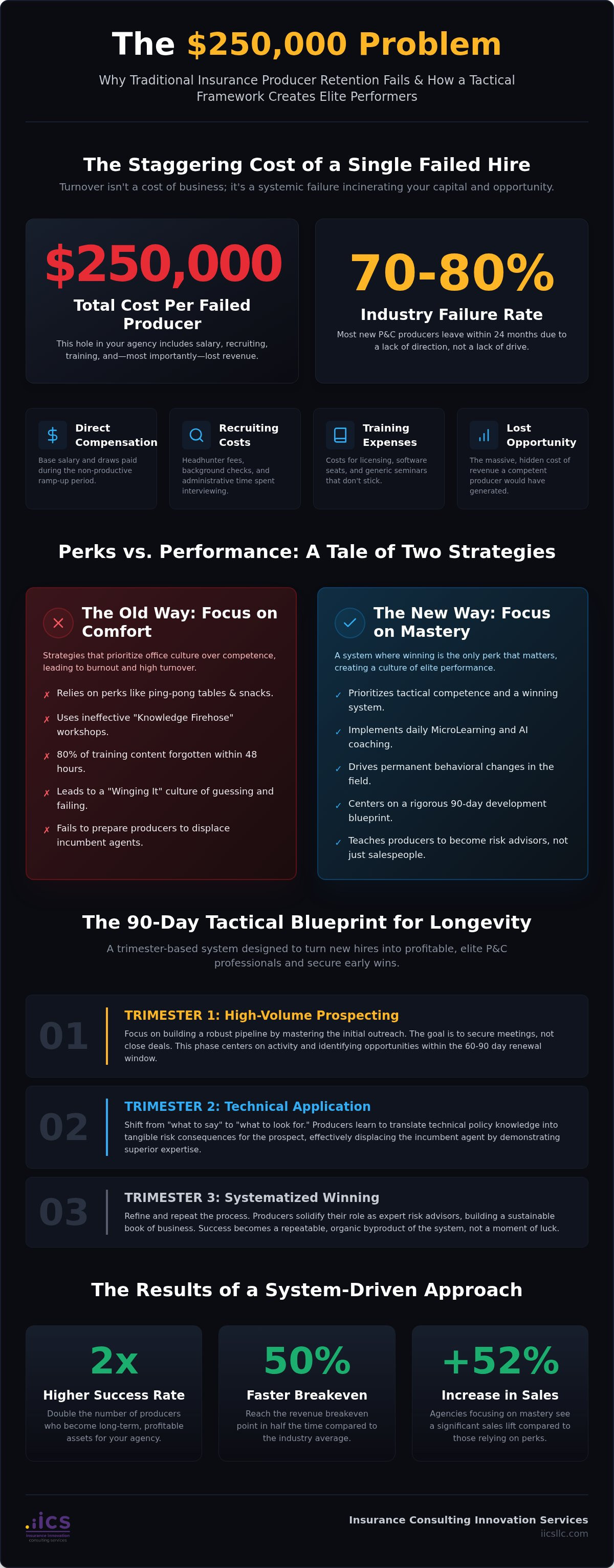
When a producer fails, they leave behind a $250,000 hole in your agency. This figure is not hyperbole. It includes:
Direct Compensation: Base salary and draws paid during the non-productive ramp-up period.
Recruiting Costs: Headhunter fees, background checks, and the massive administrative burden of interviewing.
Training Expenses: The hard costs of licensing, software seats, and external seminars.
Lost Opportunity: The revenue that a competent producer would have generated in that same seat.
The Hidden Opportunity Cost of Failed Hires
The financial loss is only the beginning. Every hour a principal spends coaching a failing producer is an hour stolen from high-level agency growth and carrier relations. This creates a "sinking ship" mentality among your remaining staff. When the revolving door never stops spinning, your elite talent starts looking for the exit. The Breakeven Point is the specific moment a producer's generated revenue exceeds the total cumulative cost of their hire and maintenance. If your current insurance producer retention strategies don't get them there in half the industry norm time, you are subsidizing failure.
Perks vs. Production: The Retention Misconception
Gym memberships, office snacks, and "casual Fridays" won't keep a producer who isn't making money. The psychology of the elite producer is simple: they stay where they are winning. They want to be seen as risk advisors, not order takers. When you provide a system that facilitates high-level wins, retention becomes an organic byproduct of success. Agencies that focus on professional mastery and technical precision see a 52% increase in sales compared to those relying on generic motivation. You don't need better perks; you need a better process.
While a better process is the foundation of success, the human element of management is what sustains it. Developing the interpersonal skills to lead and retain top talent is a continuous process; for those seeking to improve their communication, The Relationship Institute offers coaching and resources designed to strengthen both personal and professional connections.
Why Generic Sales Training Fails to Retain P&C Talent
Most agencies treat training as an event. They send a new hire to a three-day intensive "boot camp" and expect a rainmaker to return on Monday. This is the "Knowledge Firehose" approach. It is expensive, it is ineffective, and it is a primary reason why insurance producer retention strategies fail. By Tuesday morning, 80% of that content is forgotten. Why? Because information without application is just noise. Generic training programs are the antithesis of effective insurance producer retention strategies because they offer no path to mastery.
General sales training focuses on "closing the deal." In commercial P&C, you are rarely closing a deal; you are displacing an incumbent. When a prospect says, "I'm happy with my current agent," a generic salesperson tries to sell a lower price. An elite producer identifies the risk gaps the current agent missed. Without a repeatable process to handle this specific barrier, new hires fall into the "Winging It" epidemic. They guess. They fail. Then, they quit. This cycle is a direct result of a lack of tactical structure.
Product Knowledge is Not a Sales Tactic
Knowing the technical nuances of a CG 00 01 policy form is necessary, but it is not a sales tactic. It won't get you past a gatekeeper. You must translate technical jargon into plain-language risk consequences. If you can't explain how a coverage gap threatens the prospect's personal wealth, you've already lost. Learning to navigate these high-stakes conversations is a core part of what we do at IICS, where we prioritize tactical application over dry theory. We teach producers how to turn the "happy with my agent" objection into a diagnostic opportunity.
The Myth of the 'Natural Born Salesperson'
We need to stop looking for "natural-born salespeople." They don't exist in commercial lines. Success in this industry is a result of discipline and repeatable tactical systems. When a producer has no framework, they invite inconsistency. Inconsistency leads to a dry pipeline. A dry pipeline leads to the exit. Habit formation is the engine of a $1MM book of business. Structure provides the confidence new producers need to stay in the game. Without it, they are just guessing. And guessing is a very expensive way to run an agency. You can explore how a systematic training approach can stabilize your agency's growth and protect your investment.
Retention Through Mastery: The MicroLearning and AI Revolution
Elite producers don't quit because the coffee is cold. They quit because they feel stagnant and ineffective. True insurance producer retention strategies focus on one thing: mastery. If a producer isn't getting better every single day, they are getting ready to leave. The traditional model of mentoring is broken. It is too slow, too biased, and often provides feedback weeks after the mistake was made. This lag time is where doubt creeps in and talent checks out.
MicroLearning changes the equation. Instead of a week-long seminar that overwhelms the brain, we use 2 to 4 minute daily lessons. This approach targets habit change rather than just information storage. It is the difference between reading a book on swimming and actually getting in the water every morning. When the training is bite-sized and constant, it becomes part of the producer's daily workflow rather than an interruption to it.
Building Cognitive Muscle Memory
We deploy 60 tactical modules over a 90-day period. This ensures the training "sticks" by building cognitive muscle memory. Daily 3-minute videos prevent the "Firehose Effect" we discussed earlier. It is about precision. Each module focuses on a single, high-impact skill. This consistent, bite-sized delivery is the only way to ensure permanent behavioral change in a high-pressure sales environment. Success in commercial lines is a game of inches and habits; these daily touchpoints ensure those habits are elite.
Real-Time Feedback Loops for Rapid Growth
The accountability gap in most agencies is a canyon. AI Sales Coaching bridges that gap by providing data-driven scoring across 9 critical criteria. It offers instant, objective feedback after every call. This isn't about "instinct" or a principal's gut feeling. It is about hard data. You can see exactly where a producer faltered and provide "next-step" guidance before their next dial. For a deeper look at this technology, explore AI Sales Coaching for Insurance to see how it accelerates development.
Weekly live workshops add the final layer of protection. They combine peer accountability with veteran expert oversight. When a producer has to present their progress to a group of their peers, they don't slack off. This combination of daily MicroLearning, AI precision, and live workshops creates a culture of elite performance that keeps producers engaged and profitable. They stay because they can see themselves winning.
The 90-Day Tactical Blueprint for Producer Longevity
A producer's first three months determine their next three years. If you don't provide a map, don't be surprised when they get lost. Effective insurance producer retention strategies are built on a foundation of activity, not just theory. We replace the "hope and pray" method with a 90-day tactical blueprint that demands results. It starts with Step 1: Building a 'Suspect List By Effective Date'. We require a minimum of 100 leads per month. This isn't a suggestion; it's the barrier to entry for anyone serious about building a book. Success requires a full pipeline from day one.
Step 2 involves mastering the 60-90 Day Outreach Window. Timing is everything in commercial P&C. If you call too late, the incumbent has already locked it down. Step 3 utilizes our 'Window Trigger Map' to pinpoint specific coverage gaps in SME accounts. We then move to Step 4, focusing on the mechanics of the first call: Agenda Framing and Eye-Contact Pacing. Finally, Step 5 incorporates Daily AI-Assisted Industry Insight. This allows producers to conduct deep risk research and craft plain-language pitches that actually resonate with business owners. They stay because they have the tools to win.
Targeting the 'Strike Zone'
New producers often make the mistake of hunting whales before they can catch minnows. You must prioritize Small to Medium Enterprise (SME) commercial accounts. These are your "early wins." They build the confidence necessary to survive the first year. We use a 'Lead Source Menu' to ensure every producer finds 10 new names every Monday morning. The Renewal Buying Window is the critical 30-60 day period before a policy expiration when a prospect is most likely to consider a change. If your producer isn't in front of them during this window, they don't exist. Keeping the pipeline full in this "strike zone" is the only way to ensure insurance producer retention strategies actually work.
The Mechanics of Displacement
Retention is a byproduct of success. Success comes from knowing exactly what to say when a prospect tries to hang up. We provide scripted responses for the 8 most common first-year objections. Our 'Risk-Focused Question' technique is designed to create immediate doubt in the prospect's current coverage. It moves the conversation away from price and toward protection. When a producer knows they can handle any objection, their anxiety drops and their production rises. This level of tactical preparation is what you'll find when you go Inside the Academy. Stop letting your investment walk out the door and start giving them the tools to win. To stop the revolving door and start building a high-performance team, explore the Sales Academy framework today.
Building an Elite Culture: The Sales Academy Solution
Culture is not created by a mission statement on a breakroom wall. It is forged in the daily, disciplined pursuit of excellence. The most effective insurance producer retention strategies recognize that elite talent stays where they can grow. The IICS Sales Academy provides that environment. We double the likelihood of a new hire becoming a top producer by replacing vague mentorship with a rigorous, trimester-based development plan. This isn't just training; it's a cultural transformation that aligns individual ambition with agency profitability.
Our 3-month trimester system is designed to move producers through a logical, high-stakes progression. Trimester one focuses on Foundations. Trimester two builds the Pipeline. Trimester three achieves Mastery. This structured approach ensures that no one is overwhelmed by the "firehose" effect mentioned earlier. By focusing on tactical execution, our graduates achieve breakeven revenue in half the industry norm time. Agencies utilizing this framework report 52% higher sales for trained agents. For agencies ready to secure their 2026 talent, the 'Summer2026' tuition discount reduces the investment to $1,500 per month for invited agencies.
A 40-Year Track Record of Elite Performance
The Academy is built on the leadership of Ralph J. Blust and a team of veteran sales mentors who have spent four decades in the commercial P&C trenches. We have identified that 90 days is the "Goldilocks Zone" for permanent producer development. It is long enough to cement new habits and short enough to maintain the intense urgency required for a fast start. To understand how this fits into your long-term scaling, review The Elite Insurance Producer Development Plan. We don't just teach producers how to sell; we teach them how to win.
Securing Your Agency's Future
New trimesters begin on the 1st of every month. This allows you to plug new hires into the system the moment they are licensed. We provide a 'No Upsell' guarantee, meaning your tuition covers full access to AI sales coaching, weekly live workshops, and our comprehensive resource libraries. There are no hidden fees or "premium" tiers. You get the full weight of our expertise from day one. You have a choice: continue the cycle of failed hires or invest in a battle-tested framework that turns potential into production. Apply for the Sales Academy and Secure Your Producers today to lock in your agency's path to victory.
Stop Subsidizing Failure: The Path to Elite Performance
The revolving door in your agency isn't a human resources issue; it's a production issue. We've established that high-performing talent won't stay for office snacks when they are losing in the field. Real insurance producer retention strategies require more than a warm welcome. They demand a battle-tested framework that turns a $250,000 risk into a profitable asset. By replacing the "knowledge firehose" with daily MicroLearning and a 90-day tactical blueprint, you give your producers the only perk that matters: the ability to win.
It's time to leverage over 40 years of commercial P&C leadership to secure your agency's future. Our graduates see 52% higher sales because they have the tools to displace incumbents with precision. With unlimited AI call coaching included, the path to mastery is no longer a mystery. Don't let another trimester pass while your investment walks out the door. Double your producer success rate with the IICS Sales Academy and build the elite culture your agency deserves. Your next top producer is waiting for a system that actually works.
Frequently Asked Questions
How much does a failed insurance producer hire actually cost an agency?
A failed hire can cost an agency up to $250,000 when you calculate base salary, draws, recruiting fees, and licensing expenses. This figure also accounts for the lost opportunity revenue that a productive agent would have generated in that seat. Principals lose hundreds of hours in coaching time that could have been spent on high-level growth. This massive drain on capital is why agencies need sophisticated insurance producer retention strategies.
What is the primary reason insurance producers fail in their first year?
Most producers fail because they lack a repeatable tactical system, not because they lack motivation. The industry failure rate of 70% to 80% is driven by a "knowledge firehose" approach where new hires are overwhelmed with technical info. Without structured insurance producer retention strategies, even ambitious hires eventually burn out from inconsistent results. Direction is the missing ingredient in most first-year development plans that fail to keep talent.
How long should it take for a new insurance producer to become profitable?
While industry norms vary, elite development programs aim to reach the breakeven point in half the typical time. Profitability occurs when the producer's generated revenue exceeds their total cost of hire, including salary and overhead. By utilizing a 90-day trimester system, agencies can accelerate this timeline significantly. Producers who follow a tactical blueprint reach self-sufficiency faster, which is the primary goal of any successful insurance producer retention strategies.
What are the most effective retention strategies for insurance producers?
The most effective insurance producer retention strategies focus on tactical mastery rather than office perks. Producers stay when they are winning. You can achieve this through MicroLearning modules that build cognitive muscle memory and AI-driven coaching that provides instant feedback. When you provide a clear 90-day blueprint for displacement and pipeline growth, you remove the uncertainty that causes high-potential talent to leave the industry for other professions.
How many leads should a new P&C producer generate per month?
A new P&C producer should generate at least 100 leads per month based on policy expiration dates. This high volume is necessary to ensure the pipeline remains full enough to support 3 to 5 new accounts monthly. We recommend using a 'Lead Source Menu' to identify 10 new names every Monday morning. This disciplined approach to prospecting ensures that producers are consistently working within the critical 30 to 60 day renewal buying window.
Can AI coaching really improve insurance producer retention?
AI coaching improves retention by providing the immediate, objective feedback that traditional mentoring often lacks. By scoring calls against 9 critical criteria, AI identifies specific technical gaps and offers next-step guidance instantly. This rapid feedback loop accelerates the learning curve and builds the producer's confidence. When a new hire sees measurable improvement in their sales skills daily, they are far more likely to remain committed to their agency and career.
What is the 'Summer2026' discount code for the Sales Academy?
The 'Summer2026' discount code provides invited agencies with a 50% reduction in tuition for the IICS Sales Academy. This brings the monthly investment down to $1,500 per student from the retail price of $3,000. This discount gives agencies full access to our 90-day development system, including MicroLearning modules and unlimited AI call coaching. It is a strategic way for agencies to secure their 2026 talent without any hidden fees or upsells.
What is the difference between a 'suspect' and a 'prospect' in commercial insurance?
A suspect is any business that fits your target industry profile but has not yet been qualified. In our system, we track suspects by their policy effective date to time our outreach perfectly. A prospect is a qualified opportunity where the producer has identified a specific risk gap or renewal trigger. Moving a lead from the suspect list to the prospect phase requires tactical questioning and a clear understanding of the renewal buying window.