Insurance Producer Sales KPIs: 2026 Tracking & Results
Are your producers missing sales goals, or do your reports measure activity without showing progress? Insurance producer sales kpis should show how prospecting moves opportunities through the pipeline and into new accounts. A call count alone can’t explain why an opportunity stalled, and inconsistent definitions of a lead make producer results hard to compare.
Tracking activity matters. The problem is treating activity as the outcome. Without shared definitions and measures for each stage, leaders can reward busywork while missing the follow-up or skill that would help move an opportunity forward.
This guide lays out a focused KPI system for commercial P&C producers, from prospecting and pipeline movement to new business results. You’ll learn how to define measures consistently, connect outreach to account outcomes, and use regular reviews to agree on practical next steps. The goal isn’t more reporting. It’s better coaching, clearer decisions, and sustainable agency growth.
Table of Contents
What Do Insurance Producer Sales KPIs Actually Measure?
Producer KPIs measure sales activity, pipeline progress, and outcomes. Strong insurance producer sales kpis show whether producer-controlled work is moving commercial prospects toward a decision and producing new business. A Key Performance Indicator (KPI) is a measure tied to an important objective, not simply every number a CRM can generate.
Keep three terms distinct. A raw activity count records what happened, such as calls made. A KPI tracks performance that matters to a sales objective, such as qualified prospect meetings held. A target sets the expected level for that KPI over an agreed period. For example, “qualified meetings held” is a measure; the expected number for a month is the target. Without clear definitions, two producers may report the same metric while counting different things.
Leading and lagging indicators in commercial insurance sales
Leading indicators are producer actions or pipeline milestones that can signal future movement. Examples include identifying prospects with an upcoming effective date, completing discovery, and agreeing on a specific next step. They help managers spot stalled work early and coach the producer on what to do next.
Lagging indicators record completed outcomes, such as new accounts or written business. They show what the sales process delivered, but often arrive too late to explain a missed opportunity. A leading indicator shows whether the work is moving; a lagging outcome shows where it landed. Neither tells the full story alone. Activity without outcomes can reward motion that doesn’t convert, while outcomes without leading measures can hide inconsistent prospecting or pipeline friction.
What a producer KPI should, and should not, tell you
Every KPI should support a decision, a coaching question, or a producer-owned next action. If a number changes, a manager should know what to examine. If it can’t prompt a useful question, it may be reporting noise rather than a meaningful performance measure.
Separate measures the producer can influence from results shaped by the wider agency or carrier. Producers can own outreach, qualification, follow-up, and documented next steps. Agency-wide retention or carrier-level underwriting results have broader causes and shouldn’t be treated as direct measures of an individual’s selling skill.
Premium volume and loss ratios need context. Written premium can reflect account size, market conditions, and the mix of business, not just sales execution. A loss ratio reflects claims and underwriting factors, so it shouldn’t be used as a standalone score of producer effectiveness. Track outcomes, but pair them with relevant producer-controlled indicators to understand performance and decide what to coach next.
Which Insurance Producer Sales KPIs Reveal Real Pipeline Progress?
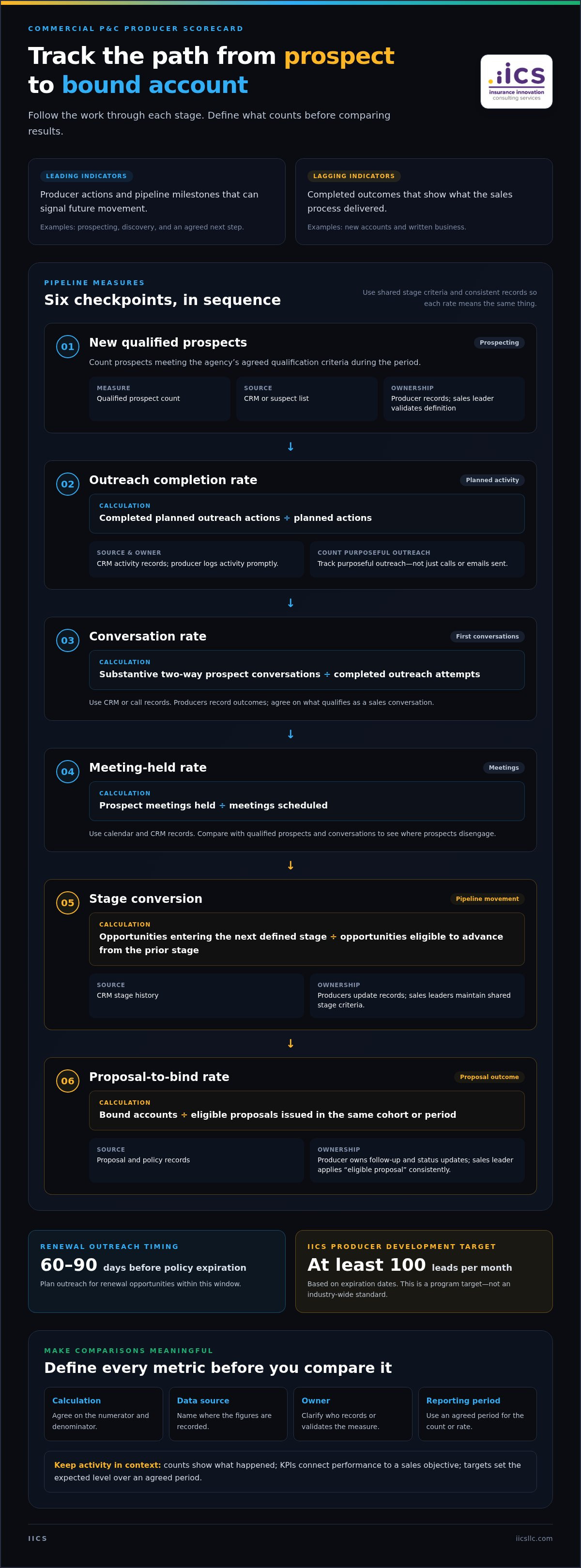
The most useful insurance producer sales kpis follow a prospect from first outreach to a clear business outcome. Organize them by stage, and define the numerator, denominator, data source, and owner before comparing results. For a count metric, the numerator is the completed number of items and the denominator is the agreed reporting period, such as a month.
Prospecting and first conversations
New qualified prospects: Count prospects that meet the agency’s agreed qualification criteria during the period. The reporting period is the denominator. Use the CRM or suspect list as the source, with the producer responsible for recording qualification and the sales leader responsible for validating the definition.
Outreach completion rate: Divide completed planned outreach actions by planned actions. Pull both figures from CRM activity records, and have the producer log activity promptly. Track purposeful outreach, not just calls or emails sent. For renewal opportunities, plan outreach 60 to 90 days before policy expiration.
Conversation rate: Divide substantive two-way prospect conversations by completed outreach attempts. Use CRM or call records, with the producer recording outcomes. Agree on what counts as a sales conversation so every connection isn’t automatically counted.
Meeting-held rate: Divide prospect meetings held by meetings scheduled. Use calendar and CRM records, and have the producer record accurate outcomes. Compare this rate with qualified prospects and conversations to see where prospects disengage.
IICS’s producer development approach uses a target of at least 100 leads per month based on expiration dates. This is a program target, not an industry-wide standard. Its insurance producer performance benchmarks can add context, but agency measures still need consistent definitions and relevant comparisons.
Pipeline, proposal, and new-account measures
Stage conversion: Divide opportunities entering the next defined stage by opportunities eligible to advance from the prior stage. Use CRM stage history. Producers update records, while sales leaders maintain shared stage criteria.
Proposal-to-bind rate: Divide bound accounts by eligible proposals issued in the same cohort or period. Source the figures from proposal and policy records. The producer owns follow-up and status updates; the sales leader ensures “eligible proposal” is applied consistently.
New accounts: Count accounts bound during the reporting period, using agency policy records and producer attribution. IICS uses a target of 3 to 5 new accounts monthly. This is a program target, not a universal quota.
For each opportunity, record its stage, next action, effective date, and proposal status. A sales-cycle snapshot or effective-date suspect list can expose stalled follow-up and make pipeline reviews more specific. Producers building consistent habits can explore the IICS Sales Academy curriculum, which connects sales practice with structured development.
How Should Agencies Compare Producer KPIs Without Rewarding the Wrong Behaviors?
A producer who makes more calls isn’t automatically building a stronger book. Compare insurance producer sales kpis across four layers so activity can be judged alongside quality and results. A compact scorecard makes gaps easier to investigate instead of turning one number into a verdict.
Activity versus conversion: volume is not effectiveness
Pair outreach counts with conversations, qualified opportunities, and completed next steps. A producer can increase calls or emails while reaching poorly matched prospects, rushing qualification, or failing to secure follow-up. The activity total rises, but pipeline quality falls.
Set the denominator before comparing conversion rates. For example, agree whether a meeting conversion rate uses meetings held or meetings scheduled, then apply that definition consistently. A low rate is a prompt to investigate, not automatic proof of poor performance. Review prospect fit, stage definitions, follow-up timing, and sales-cycle conditions before deciding what coaching is needed. Guidance on tracking key performance indicators also emphasizes reviewing performance measures as part of accountability.
No single KPI should determine a producer’s performance assessment; patterns across activity, conversion, pipeline, and outcomes provide a fairer picture. Comparisons also need context. Tenure can affect pipeline maturity, account mix can change the number and size of opportunities, and sales-cycle timing can shift when results appear. Compare like with like where possible, and use trends over an agreed reporting period rather than relying on snapshots alone.
New business versus renewals and account quality
Keep new-business results distinct from retention and renewal-related work. Effective dates help explain timing. A 30 to 60-day renewal buying window is useful context, not a universal rule for every account or sales situation. Outreach may start earlier, with IICS’s producer development approach using a 60 to 90-day lead time before policy expiration.
Premium, commission, and account count each show part of the picture, not the whole. Interpret them alongside prospect fit, stage movement, and the work required to secure and retain accounts. Review the numbers weekly to identify a specific coaching question or next action, rather than rewarding volume for its own sake.
How Can a Producer KPI Scorecard Become a Useful Weekly Management Tool?
A scorecard earns its place when it changes what a producer does next. Keep it focused: a small set of insurance producer sales kpis, clear owners, consistent definitions, and an agreed reporting period. Review patterns, not just this week’s totals. One quiet period may reflect sales-cycle timing; a trend across several reviews can reveal a follow-up or qualification habit that needs attention.
Build a scorecard with reliable definitions and data
For every selected KPI, document its definition, calculation, source, owner, and review cadence. Make sure producers and managers use the same stage criteria and count the same events. Pull activity and pipeline information from the agency’s CRM or agreed records, and assign responsibility for keeping each field current.
Keep the scorecard concise enough to use consistently. A sales-cycle snapshot can add context by showing each opportunity’s stage, effective date, producer-owned next step, and risk-focused questions. That helps managers distinguish a stalled opportunity from one progressing on a longer timeline. For broader context on how performance measures fit into producer development, explore the IICS Sales Academy curriculum.
Turn KPI reviews into coaching and next steps
Use the same sequence each week. It keeps the discussion direct and turns reporting into action:
1. Define: Confirm the measure, its calculation, owner, and reporting period.
2. Inspect: Look for trends across recent reviews and compare activity with pipeline movement and outcomes.
3. Diagnose: Ask what changed, where prospects stalled, and whether the issue is qualification, follow-up, timing, or another part of the sales process.
4. Agree: Set one specific producer-owned next action, such as completing a promised follow-up or clarifying the prospect’s decision process.
5. Revisit: At the next review, check whether the action happened and what changed in the pipeline.
Don’t assume an activity total explains a result. If outreach is steady but opportunities aren’t advancing, review call quality and documented next steps. Structured feedback can help identify a specific skill to practice, while the scorecard shows whether the related behavior appears in the work. The numbers guide coaching; they don’t replace it.
Ready to connect producer development with consistent sales habits? Explore the IICS Sales Academy curriculum for a structured approach to building those habits.
How Does IICS Help Commercial P&C Producers Improve KPI Performance?
KPIs show where performance changes. Producer development addresses what to practice next. IICS connects insurance producer sales kpis to repeatable sales skills and habits, helping producers and agency leaders turn a scorecard finding into a specific development priority. Measures guide coaching; they don’t guarantee outcomes or replace a producer’s judgment in a client conversation.
A structured development system for commercial P&C sales
IICS’s 90-day Sales Academy combines 60 daily microlearning modules with unlimited AI call coaching, veteran mentoring, and weekly group workshops. Short lessons create regular opportunities to practice without requiring every concept to be tackled at once. AI feedback can help identify call behaviors to work on, while mentoring and workshops add human perspective and discussion.
The connection to KPIs is practical. If the scorecard shows a gap between outreach and qualified opportunities, development can focus on prospecting conversations and qualification. If opportunities stall after a proposal, coaching can examine how the producer sets expectations, confirms next steps, and follows up. The KPI helps locate the friction; coaching helps the producer work on the skill behind it. Learn more about the people and experience behind this approach through the IICS team and experience.
Choose a next step based on your team’s KPI gaps
Start with the pattern, not a generic training assignment. Match the development focus to what the measures and pipeline records show:
Prospecting gap: Review the consistency and quality of outreach, then build a routine for identifying and engaging suitable prospects.
Conversion gap: Examine call quality, qualification, and how clearly the producer agrees on a next step with each prospect.
Coaching gap: Use call feedback and mentoring to select a specific behavior to practice, then revisit the relevant KPI and pipeline trend.
Use the scorecard to monitor progress, not to reduce complex selling to a pass-or-fail number. Producer judgment, account fit, and sales-cycle context still matter. IICS brings a 40-plus-year insurance industry leadership track record to its producer development work, with development structured around practice, feedback, and accountable next steps.
If your scorecard is identifying a skill or habit your team needs to strengthen, explore the IICS producer development approach and consider how the Sales Academy can support that priority.
Turn Producer Metrics Into Consistent Growth
Effective insurance producer sales kpis connect producer-controlled activity with pipeline movement and business outcomes. Define measures consistently, then review them together. Outreach without qualification can inflate activity, while outcomes alone may not reveal where opportunities stalled. A focused scorecard helps leaders spot patterns and turn reviews into specific coaching actions.
That discipline works best when paired with development. IICS brings a stated 40-plus-year insurance industry leadership track record and a 90-day Sales Academy that combines 60 daily microlearning modules, AI call coaching, mentoring, and weekly workshops. The goal is to build repeatable skills and habits, not promise a particular result.
Ready to connect your team’s KPI gaps with practical producer development? Explore IICS producer development and take the next step toward more focused coaching and sustainable agency growth.
Frequently Asked Questions
What are the most important sales KPIs for an insurance producer?
The most useful KPIs connect prospecting work to pipeline movement and sales outcomes. A focused set might include qualified prospects added, outreach completion, meaningful conversations, opportunities advancing stages, proposal-to-bind conversion, and new accounts. Choose measures that answer a management question or guide a producer’s next action. Track renewals and retention separately from new business so different types of performance don’t get blurred together.
How do you calculate an insurance producer’s conversion rate?
Divide the number of opportunities that reach the next defined stage by the number eligible to advance from the prior stage, then multiply by 100. For example, proposals bound divided by eligible proposals issued gives a proposal-to-bind rate. Define what counts as an eligible proposal and use the same reporting period or opportunity cohort for both figures. Consistent definitions make comparisons more useful and help pinpoint where prospects stall.
How many sales KPIs should an insurance producer track?
Start with a manageable core of about five to eight KPIs spanning prospecting, conversion, pipeline health, and outcomes. This is a practical starting recommendation, not a universal rule. Add a measure only when it answers a clear question or supports a decision. Too many metrics can make the scorecard hard to maintain and review; too few may hide where the sales process is losing momentum.
What is the difference between a leading and lagging sales KPI?
A leading KPI tracks an action or milestone that may signal future pipeline movement, such as completing discovery or agreeing on a next step. A lagging KPI records a completed result, such as a bound new account. Leading indicators help managers coach while opportunities are active; lagging indicators show what the process produced. Reviewing both provides more insight than relying on activity or outcomes alone.
How often should insurance agencies review producer sales KPIs?
Review activity and pipeline measures weekly so producers and managers can address stalled opportunities and agree on timely next steps. Then examine outcome trends over a longer, consistent reporting period, such as monthly or quarterly, because commercial sales cycles can affect when results appear. Avoid reacting to one reporting snapshot in isolation. A steady review cadence makes it easier to distinguish a temporary fluctuation from a pattern that needs attention.
Should insurance agencies compare producers using the same sales KPIs?
Yes. Use shared definitions and calculations so comparisons are consistent, but interpret results in context. Tenure, account mix, pipeline maturity, and sales-cycle timing can affect individual numbers. Separate new-business results from renewal work, and pair activity counts with conversion and pipeline measures. Fair comparison means applying the same measurement rules while considering relevant differences, not assuming every producer has identical opportunities or a comparable book of business.
How can sales KPIs improve insurance producer performance?
Sales KPIs improve performance when they lead to focused coaching and a clear producer-owned action. For example, if outreach is happening but qualified opportunities aren’t advancing, review prospect fit, conversation quality, and follow-up steps before changing activity targets. Use the scorecard to spot where the process needs attention, then revisit the relevant measure. KPIs guide development and decisions; they don’t replace coaching or producer judgment.
Ready to turn your team’s KPI gaps into focused producer development? Explore IICS producer development.