Insurance Sales Training: 2026 P&C Guide
Updated: 2 days ago
Why are you still tolerating an 18 month wait for your new producers to pay for themselves? Most agency owners accept high turnover and glacial ramp up times as the unavoidable cost of doing business in Commercial P&C. It's a frustrating cycle of hiring talent only to watch them struggle with the technical nuances of ISO forms or carrier appetite. When you're evaluating what to look for in an insurance sales training program, you can't afford to settle for generic motivational speeches that ignore the high-stakes reality of the 2026 market. You need a system that builds technical mastery alongside sales aggression.
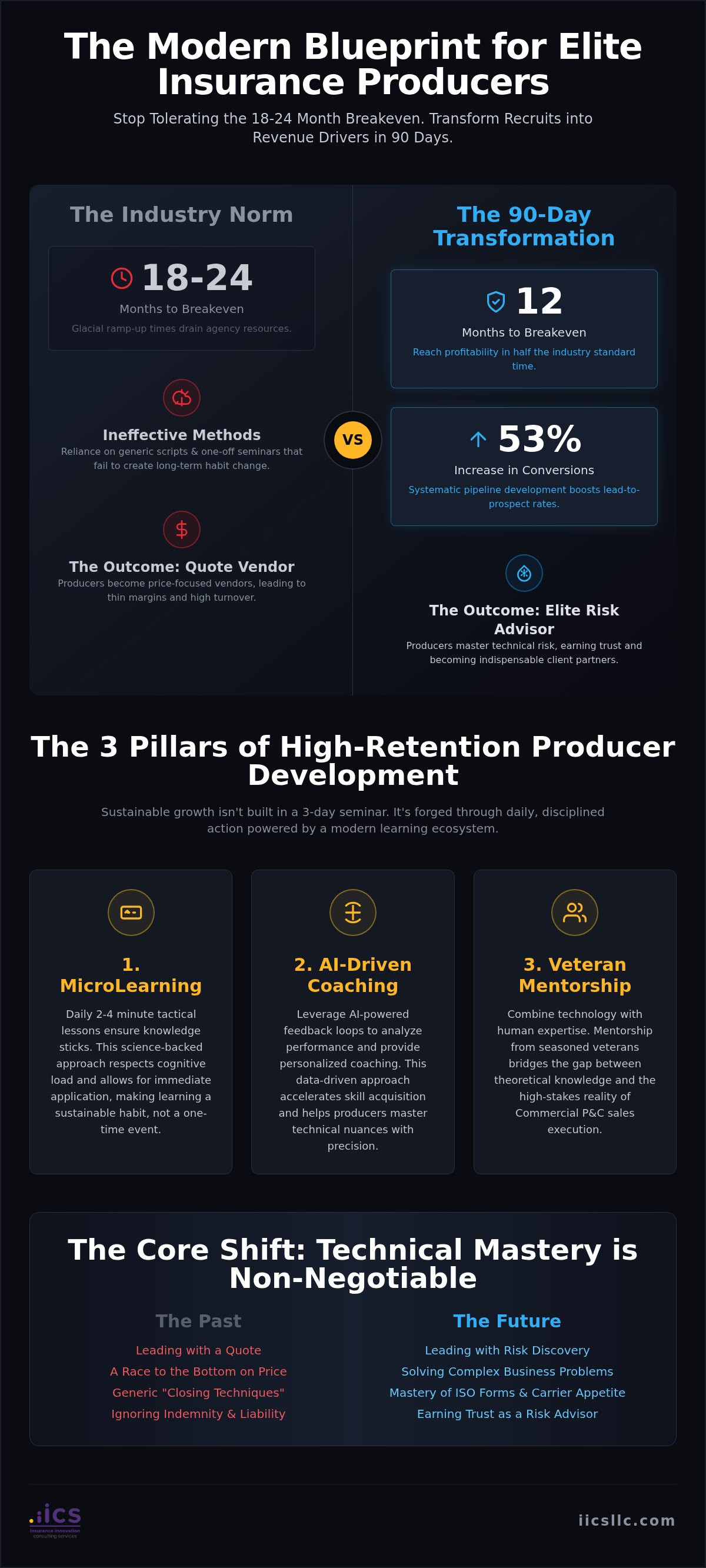
We've spent 40 years perfecting a framework that stops the bleeding. You're about to discover the essential criteria for a training system that transforms raw recruits into elite producers in just 90 days. This guide explores how AI-driven coaching and micro-learning help your team reach breakeven in half the industry norm time. We'll show you how to implement a repeatable sales process that drives a 53% increase in lead-to-prospect conversion rates across your entire agency. It's time to stop guessing and start scaling with precision.
Table of Contents
Beyond Generic Scripts: Why Niche-Specific Sales Training Is Non-Negotiable
Generic sales training is a liability in the high-stakes world of Commercial P&C. Most programs treat insurance like they're selling software or gym memberships, focusing on "closing techniques" while ignoring the foundational mechanics of indemnity and liability. If a trainer doesn't understand the difference between a claims-made and occurrence form, they have no business coaching your team. Identifying what to look for in an insurance sales training program requires a total shift in perspective. You aren't just looking for a motivator. You're looking for a system that bridges the gap between deep technical risk knowledge and tactical execution.
Generic scripts fail because they lack teeth. They ignore the reality of a hard casualty market where underwriters are more selective than ever. When a producer can't speak the language of risk, they're relegated to being a "quote-and-hope" vendor. This approach leads to thin margins and high turnover. True mastery comes from a training framework that integrates technical nuances like ISO forms and carrier appetite directly into the sales conversation. This ensures your producers aren't just talking; they're solving complex business problems.
The P&C vs. Life/Health Divide
The sales cycle in P&C is fundamentally different from life or health lines. In life insurance, you're often selling a need that the prospect doesn't think they have. In Commercial P&C, every prospect already has a policy. The objection isn't "I don't need this," it's "I'm already covered." Your training must focus on the 30 to 60 day renewal window where the buying decision actually happens. Beyond tactical skills, producers must stay current with continuing education requirements to maintain their edge. Elite training ensures that compliance and fair-conduct standards are baked into the sales process, reducing your agency's regulatory risk while building a professional reputation.
Earning Trust Through Risk Discovery
Most producers lead with a quote. This is a race to the bottom. An Elite Producer is a risk advisor, not a policy vendor. They earn the right to ask deep, personal risk questions by demonstrating an understanding of the client's specific industry exposures. This transition from price-quoting to risk-consulting is the hallmark of a high-performing agency. When evaluating what to look for in an insurance sales training program, prioritize frameworks that teach producers how to find the "windows" of opportunity hidden in a prospect's current coverage. Programs like The Sales Academy focus on this technical depth to ensure producers can navigate the complexities of the 2026 market with confidence. You don't need more scripts. You need a repeatable process for discovery that turns technical knowledge into a competitive weapon.
The 3 Pillars of High-Retention Producer Development
Stop sending your producers to three-day "firehose" seminars. They don't work. These high-intensity sessions might provide a temporary surge of motivation, but they fail to create the long-term habit change required for elite performance. Most of that information is forgotten before the producer even gets back to the office. When you are considering what to look for in an insurance sales training program, you must prioritize retention over intensity. Elite producer development is built on three specific pillars: MicroLearning, AI-driven coaching, and veteran mentorship.
MicroLearning: Training That Sticks
Success in Commercial P&C is a game of inches. It's built through daily, disciplined action, not occasional bursts of effort. MicroLearning leverages the science of habit formation by delivering tactical lessons in 2 to 4 minute bursts. Why does this work? It respects the cognitive load of a busy professional. Daily 3-minute lessons outperform weekly 2-hour lectures because they allow for immediate application and reinforcement. This structured 90-day curriculum ensures that core concepts are mastered before moving to complex SME account mapping. Incorporating effective insurance sales training principles into a daily routine is the only way to ensure the knowledge actually sticks.
AI and Data-Driven Feedback
Practice doesn't make perfect; perfect practice makes perfect. How do you ensure your producers are practicing correctly without hovering over every call? This is where AI Sales Coaching for Insurance becomes a force multiplier. AI tools score calls against nine objective criteria, including discovery depth and talk-to-listen ratios. This provides unlimited, real-time feedback that a human manager simply cannot replicate. The ROI is clear: it's better to fail against an AI than to blow a million-dollar lead. Data identifies specific weaknesses, such as poor objection handling or weak closing signals, before they cost your agency a commission. This precision is a critical component of what to look for in an insurance sales training program in 2026.
Finally, Pillar 3 bridges the gap between theory and reality. Veteran mentorship provides the 1:1 coaching necessary to navigate the high-stakes world of complex commercial scenarios. While AI handles the mechanics, a veteran mentor provides the strategic nuance. If you're ready to see how these pillars function in a real-world environment, you can look inside the academy to see the framework in action. This combination of daily habits, objective data, and seasoned expertise is the only way to build a sustainable sales culture that wins.
Evaluating Technical Depth: Does the Program Teach Risk or Just Rates?
If your sales trainer can't explain the nuances of a general liability exclusion, they shouldn't be training your producers. Most programs fail because they treat Commercial P&C like a commodity, focusing on high-volume "closing techniques" while ignoring the technical mechanics that actually win accounts. In the 2026 market, where commercial property premiums have declined by 1.2 percent while casualty lines remain punishingly hard, a "one-size-fits-all" pitch is a recipe for failure. A primary factor in what to look for in an insurance sales training program is whether it teaches your team to pivot between these market dynamics with surgical precision.
Producers must move beyond quoting and start mapping carrier appetite. This means understanding which markets are hungry for specific classes and which ones are pulling back. Elite training doesn't just provide scripts; it provides the industry insights necessary to build instant credibility. When a producer can discuss social inflation or the impact of third-party data on underwriting scores, they stop being a vendor and start being a consultant. This technical depth is the only way to survive in an environment where underwriters are more selective than they've been in decades. For a leading agency like SI Insurance, this level of expertise is what allows them to effectively match individuals and businesses with the right coverage options.
A robust training program must include a deep dive into the "why" behind the coverage. Your producers should be able to navigate a technical checklist that includes:
ISO Form Mastery: Deep understanding of ISO form CG 00 01 and the critical wording differences that create coverage gaps.
Regulatory Nuance: Training on state, county, and municipal legal impacts that affect liability exposures.
Appetite as a Weapon: Using carrier appetite as a sales tool to steer prospects toward the most favorable markets.
Strategic Prospecting Tools
Sales is a math game, but it's also a timing game. Elite producers don't just call names on a list; they use a "Window Trigger Map" to target prospects based on their 30 to 60 day renewal cycles. This ensures your outreach happens when the prospect is most likely to listen. The math of success in Commercial P&C is clear: your team needs to generate roughly 100 leads to land 3 to 5 high-quality new accounts every month. When you're deciding what to look for in an insurance sales training program, ensure it provides the prospecting tools needed to maintain this pipeline. Programs like The Sales Academy focus on this systematic approach, ensuring your producers have a repeatable process for identifying "suspects" by their effective dates. This level of strategic mapping is what separates the top 1% from the rest of the pack.
Measuring ROI: How to Identify a Program That Actually Reduces Ramp Time
How much is a non-producing hire costing your agency right now? If you're following the industry norm, you're likely waiting 24 to 36 months for a new producer to reach breakeven. That's a staggering investment of time and capital with no guarantee of a return. When you're determining what to look for in an insurance sales training program, the primary metric must be the speed to revenue parity. An elite program should slash that ramp time in half, reaching breakeven in 12 months. This isn't just a goal; it's a requirement for a modern, high-growth agency.
The cost of a non-producing hire is more than just a salary. It's the opportunity cost of lost leads and the drain on agency resources. Elite programs offer a clear path to doubling the likelihood of top-producer status by replacing "hire-and-hope" with a data-backed system. You shouldn't settle for vague promises of "better skills." You need a training framework that delivers a 50% or higher improvement in lead-to-prospect conversion rates. If the math doesn't work, the training doesn't either.
The Financial Impact of Formal Training
The numbers don't lie. Data from our 40-year track record shows that graduates of structured development systems achieve 52% higher sales than their untrained counterparts. There's also a 31% increase in new client acquisition for agents who follow a repeatable sales process. When you calculate the lifetime value of an "Elite Producer" versus an "Average Agent," the investment in a 90-day academy becomes the most logical financial decision an agency principal can make. Stop viewing training as an expense and start seeing it as a high-yield investment in your agency's equity.
Reducing the Agency Principal’s Burden
Every hour you spend hand-holding a new hire is an hour you aren't spending on high-level strategy. Outsourced producer development frees up leadership to step into fractional CRO or CGO roles. This shift allows you to focus on growth while the training system handles the daily tactical grind. Weekly live workshops provide the peer accountability and veteran oversight that most internal programs lack. Learn more about the Insurance Agency Sales Performance framework to see how these metrics translate to agency-wide growth. Knowing what to look for in an insurance sales training program means finding a partner that takes the weight off your shoulders. If you're tired of the cycle of turnover, it's time to join the Sales Academy and start building a high-performance team today.
The 90-Day Blueprint: Implementing a Sustainable Sales Culture
90 days. That's the window you have to turn a new hire into a revenue generator or admit the experiment failed. When you're identifying what to look for in an insurance sales training program, you must demand a blueprint that doesn't just teach skills but builds a culture of relentless discipline. A sustainable sales culture isn't born from a weekend retreat. It's forged in the daily grind of the first three months. If your current training doesn't have a clear Day 1 to Day 90 journey, you're just burning capital.
Month 1 is about the engine. Your producers must master the foundations of core sales skills and the nine criteria of a perfect call. If they can't execute a discovery call with precision, they'll never close a complex commercial account. Month 2 shifts the focus to pipeline development and SME account mapping. This is where the math of success becomes reality. By Month 3, your producers are navigating advanced scenarios and renewals. They're building personal brands that resonate in a softening property market while maintaining the technical edge needed for hard casualty lines. The momentum doesn't stop at day 91. An elite program provides the tools to sustain this energy indefinitely.
The First 30 Days: Building the Engine
The first 30 days are the most critical. This is when your producers must master the eight typical P&C objections with scripted, battle-tested responses. The most common hurdle? "I am happy with our current agent." Most producers fold here. An elite producer sees this as a smoke screen. They use a specific response framework to pivot back to risk discovery without sounding like a desperate vendor. You can see how we break this down by going Inside the Academy. This isn't about being pushy; it's about being professional enough to challenge the prospect's status quo and earn the right to a deeper conversation.
Scaling Success with the IICS Sales Academy
Building an elite team requires a repeatable system, not a series of lucky hires. The IICS Sales Academy delivers a comprehensive suite of 60 tactical modules combined with 1:1 veteran mentoring to ensure no producer is left behind. This is the ultimate answer to what to look for in an insurance sales training program in the 2026 market. We've spent 40 years refining this process for Commercial P&C agencies across the nation. Stop gambling on "raw talent" and start implementing a system that guarantees performance. Ready to transform your agency's bottom line? Use the discount code Summer2026 for 50% off tuition. Enroll your next elite producer in the IICS Sales Academy today.
Stop Settling for Average: Build Your Elite Production Engine Today
The era of the "non-producing hire" must end. You now understand that what to look for in an insurance sales training program isn't just a list of scripts; it's a battle-tested system that bridges the gap between technical risk knowledge and tactical execution. Elite performance in Commercial P&C requires more than motivation. It demands the precision of AI coaching that scores against 9 objective criteria and the consistency of daily MicroLearning.
With over 40 years of commercial P&C leadership experience, we've refined a proven 90-day system that transforms raw talent into high-performing risk advisors. Don't let your agency's growth be throttled by lengthy ramp-up times or outdated training methods. It's time to demand a repeatable sales process that delivers measurable ROI and sustainable results. You've seen the blueprint. Now, it's time to execute.
Join the IICS Sales Academy and double your likelihood of becoming a top producer. Use code Summer2026 for 50% off.
The path to the top tier of the profession is open to those willing to commit to a higher standard of excellence. We're ready to help you get there.
Frequently Asked Questions
What is the typical ROI of an insurance sales training program?
Graduates of structured programs achieve 52% higher sales and a 31% increase in new client acquisition compared to those without formal development. The real return on investment comes from slashing the producer breakeven time from 24 months down to 12. These specific financial benchmarks are exactly what to look for in an insurance sales training program to ensure your agency capital is working as hard as your producers.
How long does it take for a new insurance producer to become profitable?
The industry norm for reaching revenue parity is often cited as 24 to 36 months, which is a significant drain on agency resources. However, an elite 90 day development system can slash this ramp up time in half. By focusing on daily micro learning and technical mastery, producers can reach profitability in 12 months. This accelerated timeline is a primary differentiator between average training and high stakes producer development.
What is the difference between generic sales training and P&C-specific training?
Generic training focuses on broad psychological triggers that fail when faced with technical P&C nuances like ISO forms or carrier appetite. Niche specific training bridges the gap between risk knowledge and tactical execution. It teaches producers to navigate the 30 to 60 day renewal cycle rather than just using generic closing scripts. You need a program that understands the difference between an occurrence form and a claims made policy to win accounts.
Can AI coaching really replace human sales managers?
AI coaching doesn't replace managers; it acts as a force multiplier by providing unlimited, real time feedback that humans can't replicate. While a manager might review one call a month, AI scores every practice session against nine objective criteria. This allows leadership to focus on high level strategy and fractional CRO roles while the technology handles the repetitive tactical refinement. It's about precision and scalability, not just substitution.
How many leads should a new P&C producer generate per month?
A high performing producer should generate at least 100 leads per month based on specific policy expiration dates. This volume is necessary to land the 3 to 5 new high quality accounts required to build a sustainable book. Success in Commercial P&C is a math game that relies on a consistent pipeline. Any program worth its salt will provide the prospecting tools and lead source menus needed to maintain these numbers.
What should be included in a 90-day insurance producer onboarding plan?
An effective plan must cover foundations and core sales skills in the first month, followed by pipeline development and SME account mapping in the second. The final 30 days should focus on advanced selling scenarios, renewals, and personal branding for the current market. This structured blueprint ensures that habits are formed through daily MicroLearning rather than forgotten after a single weekend seminar. It's the difference between a hire and an investment.
Is microlearning effective for experienced insurance agents?
Yes, because even veterans can fall into stagnant routines or struggle with shifting market dynamics like the 2026 casualty hard market. Daily 2 to 4 minute modules provide tactical updates on carrier appetite and technical wording differences without disrupting a busy producer's schedule. It's about continuous improvement and precision. MicroLearning keeps experienced agents sharp by reinforcing the basic habits that often slip as a book of business grows.
How do you handle the "I am happy with my current agent" objection?
You treat it as a smoke screen rather than a rejection. Elite producers use a scripted response framework to pivot the conversation back to risk discovery and potential coverage gaps. Instead of arguing, you acknowledge their loyalty and then ask a risk focused question that their current agent might have missed. This approach challenges the status quo and demonstrates your value as a consultant rather than just another policy vendor.