Mastering the Insurance Sales Follow Up Process: The Elite Producer’s Guide to Automation
- Aug 10
- 11 min read
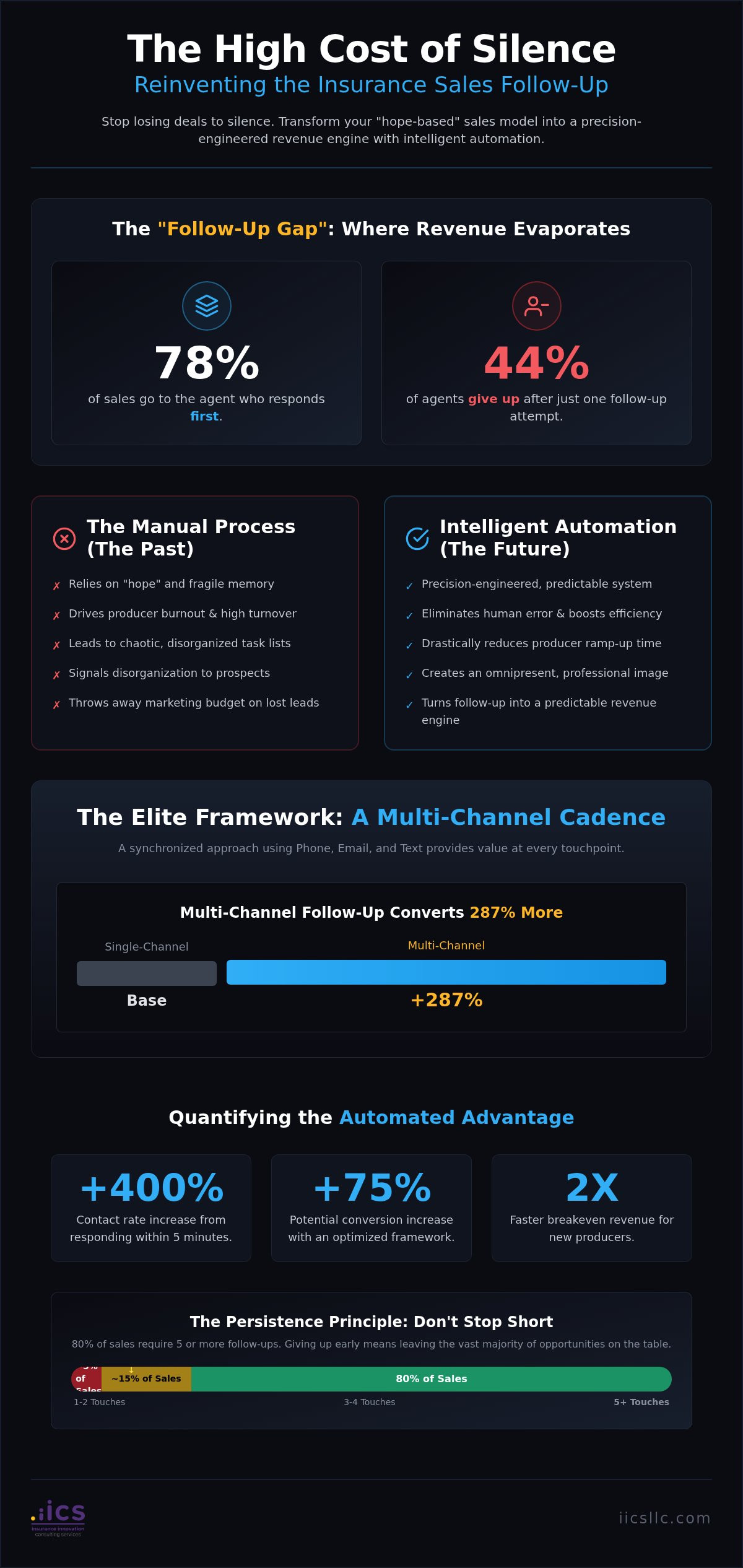
Did you know that 78% of insurance sales go to the agent who responds first? Despite this reality, 44% of agents give up after just one attempt. You likely feel the weight of these numbers every time a high-value lead goes cold because your team was buried in manual paperwork. The traditional, manual insurance sales follow up process is a relic that's costing you renewals and new business. It isn't a lack of talent; it's a failure of the system. You already know that your producers should spend their time closing, not chasing ghosts through a disorganized task list.
This guide will show you how to stop losing deals to silence by building a precision-engineered automation system. We'll move beyond generic templates to create a predictable revenue engine that keeps your agency top-of-mind without burning out your elite talent. You'll learn the exact framework for multi-channel touches that can increase conversion rates by 75%. From reducing ramp-up time for new hires to mastering the data-driven feedback of AI coaching, we're detailing the battle-tested methodology used by the top tier of producers to dominate the market.
Table of Contents
Why Your Current Insurance Sales Follow Up Process is Costing You Millions
Architecting a High-Performance Automated Follow Up Framework
The Elite Advantage: Comparing Manual Persistence to Intelligent Automation
How to Implement an Automated Follow Up System That Doesn’t Feel Like a Robot
Scaling Your Agency: Turning Follow Up Into a Predictable Revenue Engine
Why Your Current Insurance Sales Follow Up Process is Costing You Millions
The "hope-based" sales model is a cancer in your agency. It relies on the fragile memory of producers and the assumption that prospects will call back when they're ready. They won't. Data from March 2026 reveals that 44% of insurance agents give up after only one follow-up attempt. This creates a massive "Follow-Up Gap" where millions in potential premium evaporate simply because no one stayed in the game. An elite insurance sales follow up process isn't about being annoying; it's about being omnipresent. It is the difference between a struggling local shop and a dominant national agency.
Manual follow-up is the primary driver of producer burnout. When your team spends their morning staring at a chaotic list of "to-dos" rather than engaging in high-value conversations, they stagnate. They feel like glorified administrative assistants. This friction is why turnover remains high and growth remains flat. Elite producers don't rely on sticky notes. They rely on systems that eliminate the need for memory.
The Psychology of the Modern P&C Prospect
Speed to lead is merely the entry fee in 2026. While responding within five minutes can increase contact rates by 400%, high-value clients are looking for more than a quick quote. They want a professional advisor. Inconsistent messaging signals that your agency is disorganized. If you can't manage a simple lead management process, how can a prospect trust you to manage their complex risk portfolio? Reliability in the chase predicts reliability in the claim.
Quantifying the Leak: Where Your Revenue is Escaping
Every missed touchpoint is a withdrawal from your agency's future valuation. Since 80% of sales require five or more follow-up touches, stopping at two or three is effectively throwing away your marketing budget. A disciplined approach is a core pillar of a successful insurance producer development plan. By increasing follow-up consistency by just 10%, you create a compounding effect on your bottom line. You aren't just losing the initial commission; you're losing the lifetime value and the referral network of that client.
The elite follow-up process replaces human whim with data-driven automation. It ensures your agency remains the obvious choice, even when your producers are focused on closing other deals. It's time to stop "checking in" and start leading the conversation. Precision is the only path to the top tier.
Architecting a High-Performance Automated Follow Up Framework
Automation is not a replacement for talent. It is a force multiplier. While basic software might trigger a generic email, elite producers architect a system that mirrors advanced commercial insurance sales techniques by providing value at every intersection. A precision-engineered insurance sales follow up process relies on a 12-touch multi-channel cadence. This isn't a suggestion; it's a requirement for those who refuse to leave revenue on the table. Research indicates that multi-channel follow-up converts 287% more than single-channel efforts. If you aren't using phone, text, and email in a synchronized dance, you're invisible.
The framework begins with integrating triggers for specific Commercial P&C milestones. These include x-dates, quote delivery, and policy issuance. In an environment where responding to a lead within five minutes can increase contact rates by 400%, your system must act when you cannot. Producers who master this framework often see their breakeven revenue arrive in half the industry norm time, a core focus of The Sales Academy.
The 5 Pillars of Elite Automation
Success requires an omni-channel approach that combines automated touches with high-impact human intervention. Your content must be dynamic. A message sent to a construction firm should never look like one sent to a retail client. Use data to tailor the risk profile messaging automatically. Strategic timing is the final pillar. You must know when to let the machine handle the "speed to lead" and when a producer must step in to provide the professional advisory that high-value accounts demand.
Building Your Follow-Up Tech Stack
Your CRM is the single source of truth. If a lead isn't in the system, it doesn't exist. To ensure these automated messages don't sound like a machine, use AI sales coaching for insurance to audit and refine your scripts. This technology provides data-driven feedback that humans often miss. Complement this with MicroLearning modules to keep your producers sharp on execution. Automation handles the volume; your tech stack ensures the quality remains elite. Establishing a feedback loop ensures that as the market shifts, your process evolves rather than stagnates.
The Elite Advantage: Comparing Manual Persistence to Intelligent Automation
Manual persistence is a slow death for your agency. It relies on the "to-do list" trap, where high-potential leads die in the gaps between human error and producer fatigue. When you force your team to manage their own reminders, you're asking them to be administrative assistants rather than revenue generators. It’s an expensive mistake. Basic automation isn't the answer either. We’ve all seen the robotic, "just checking in" emails that scream laziness and destroy rapport. These systems might be fast, but they lack the sophistication required for high-stakes Commercial P&C accounts.
Intelligent automation is different. It uses data to trigger the right conversation at the precise moment a prospect is ready to engage. This is the core philosophy of the Sales Academy. We don't aim to replace the human element; we create "Augmented Producers." By using technology to handle the heavy lifting of the insurance sales follow up process, your producers can focus entirely on high-value advisory work. They become more present, more prepared, and significantly more lethal in the closing room.
Efficiency vs. Effectiveness: The Producer’s Dilemma
Doing more of the wrong thing won’t fix your revenue. Many agencies confuse activity with progress. If your producers are making 50 manual calls a day but reaching only three people, they aren't being effective. Automation frees up 10 or more hours every week by handling the initial chase and the long-term nurture. This time is better spent on high-value prospecting and technical risk analysis. Tracking these shifts through insurance agency sales performance metrics allows leadership to see exactly where the system is outperforming human effort.
Case Study: Manual vs. Automated Ramp-Up
The numbers don't lie. Producers who utilize an automated framework reach breakeven in 50% less time than those stuck in manual workflows. There is a massive psychological benefit to this. A producer who walks into the office to a pipeline full of warm, automated responses feels successful before they even pick up the phone. It eliminates the "empty desk" syndrome that leads to early turnover. Intelligent automation is a force multiplier that allows elite talent to scale their expertise without sacrificing the personal touch that defines high-stakes insurance advisory.
How to Implement an Automated Follow Up System That Doesn’t Feel Like a Robot
Personalization tokens are not a strategy. Adding a first name to a template is the bare minimum, and in the high-stakes world of Commercial P&C, your prospects can smell a generic mail-merge from a mile away. To master the insurance sales follow up process, your automation must mirror the voice of a professional advisor. It requires a "Human-in-the-Loop" architecture where technology handles the cadence, but the producer steps in for critical deal stages. This ensures your agency remains efficient without sacrificing the elite status that closes million-dollar accounts.
Before any sequence goes live, use AI to role-play the follow-up scenarios. This data-driven feedback identifies where your tone shifts from authoritative to robotic. Once the system is running, your team must be trained to "catch" the leads it generates. Automation creates the opportunity; your producers must possess the skill to convert it. If they aren't prepared for the specific context of the automated touchpoint, the friction will kill the deal.
The Anatomy of a High-Converting Follow-Up Email
Ban the phrase "just checking in" from your agency immediately. It signals that you have nothing of value to offer and are merely begging for attention. Elite producers lead with a "Value-First" subject line strategy. Every email must provide a specific risk-mitigation insight or a piece of market intelligence that proves your expertise. For example, rather than asking for a meeting, share a brief update on how a recent regulatory change affects their P&C coverage. This builds authority while the machine handles the delivery.
Integrating SMS and LinkedIn into the Cadence
Multi-channel engagement is non-negotiable. However, texting commercial prospects requires strict rules of engagement. Use SMS for high-urgency logistics or confirming scheduled calls, not for complex technical discussions. On LinkedIn, your automated sequence should leverage social proof. Share a case study or a testimonial that aligns with the prospect's industry. Maintaining a consistent brand voice across these channels is vital. Whether it’s a text or a long-form email, the tone must remain professional, disciplined, and results-driven. To see how these systems integrate into a complete growth strategy, explore the curriculum within the IICS Sales Academy.
Execution is everything. A precision-engineered system only works if your producers are sharp enough to handle the transition from automated nurture to human negotiation. This is why we focus on creating "Augmented Producers" who can leverage technology to dominate their territory.
Scaling Your Agency: Turning Follow Up Into a Predictable Revenue Engine
Scaling isn't about pouring more leads into a leaky bucket. It's about ensuring every opportunity is handled with surgical precision. If your insurance sales follow up process relies on the individual motivation of twenty different producers, you don't have a business. You have a collection of independent contractors. True agency transformation occurs when leadership implements a unified, automated framework that mandates excellence across the board. This shift moves the agency from a reactive state to a proactive revenue engine that doesn't blink when producers are out of the office.
The transition from individual producer development to total agency transformation requires a shift in perspective. You aren't just looking for better sales; you're looking for a better system. By standardizing the chase, you create a baseline for performance that allows you to identify exactly where a deal stalls. This data-driven approach removes the guesswork from management and replaces it with a clear path to victory.
The Role of the Fractional CRO in Process Excellence
Most agencies fail at automation because they lack the high-level oversight required to maintain it. A fractional CRO or CGO provides the external leadership necessary to audit the system and hold the team accountable to elite standards. They don't just look at final production numbers. They set KPIs that reward follow-up discipline and pipeline velocity. Are your producers engaging with the triggers? Is the automated cadence being effectively "caught" by human intervention at the critical moment? This level of scrutiny builds a culture of elite performance where stagnation is identified and eliminated immediately.
From Academy to Agency: Sustaining the Momentum
The 3-month Sales Academy is designed to build permanent habits rather than temporary spikes in activity. We use continuous AI coaching and weekly live workshops to prevent the process decay that often follows initial training. These workshops serve as a high-stakes environment where producers refine their scripts based on real-world data and role-play complex follow-up scenarios. It ensures the insurance sales follow up process remains sharp as market conditions and buyer behaviors shift. You aren't just training producers; you are installing a growth engine that runs long after the initial implementation.
Stop accepting mediocre conversion rates as an industry standard. The path to the top tier requires a total commitment to systematic success and the elimination of friction. If you're ready to move beyond "hope-based" sales and build a predictable, scalable revenue machine, the next step is clear. Apply for the Sales Academy today and transform your agency into an elite powerhouse.
Dominate Your Territory with a High-Performance Pipeline
The cost of a broken follow-up system is measured in millions of lost premiums and talented producers who burn out chasing ghosts. You now have the blueprint to bridge the gap between manual chaos and intelligent automation. By implementing a multi-channel insurance sales follow up process, you ensure your agency remains the obvious choice for high-value prospects. You've learned that elite performance isn't a result of working harder; it's the result of working with a precision-engineered system that removes friction from every deal stage.
It's time to stop settling for industry-average results. Backed by a 40-year track record of leadership, we've helped graduates reach breakeven revenue in half the industry norm time. You have the opportunity to double your likelihood of becoming a top producer by mastering these battle-tested frameworks. Don't let your competition outpace you through sheer efficiency. Transform your producers into elite closers with the Sales Academy and secure your place at the top tier of the profession. Your future revenue engine is waiting for you to build it.
Frequently Asked Questions
How many times should an insurance producer follow up before giving up?
Elite producers follow up at least five to twelve times. Since 80% of insurance sales require five or more touches, stopping early is effectively handing business to your competitors. A multi-channel approach using email, text, and phone calls ensures you remain top-of-mind. Persistence isn't about being a nuisance; it's about demonstrating professional commitment to a prospect’s specific risk management needs.
Will automating my follow-up make my agency seem impersonal?
Automation only feels impersonal if you use generic, low-value templates. By integrating high-level advisory insights and industry-specific market updates, you build authority automatically. The goal is to handle the "speed to lead" instantly while allowing producers to step in for high-stakes human negotiations. High-quality automation signals professionalism and reliability, not a lack of care or attention to detail.
What is the best CRM for automating insurance sales follow-up in 2026?
The right platform depends on your agency's scale and specific lines of business. As of March 2026, popular options include Momentum, starting at $99 per month, and AgencyZoom, which starts at $149 for independent agencies. Specialized tools like GloveBoxCRM or Assembly also offer robust features for the insurance sales follow up process. Choose a system that integrates seamlessly with your existing tech stack to ensure total data accuracy.
How do I train my producers to use an automated follow-up system?
Training should focus on the transition from automated nurture to human closing. Use MicroLearning modules to teach producers how to "catch" the warm leads the system generates. Rather than teaching them how to send emails, teach them how to leverage the data the system provides. AI sales coaching can provide the data-driven feedback needed to refine their approach and improve their close ratios in real-time.
Can automation help with commercial P&C insurance renewals?
Renewals are the lifeblood of agency valuation and automation is the perfect tool for managing them. By setting triggers based on policy expiration dates or "x-dates," you can start the renewal conversation months in advance. This prevents last-minute scrambles and protects your book from aggressive competitors. Automated renewal cadences ensure that your clients feel prioritized without overwhelming your service team with repetitive manual tasks.
What is the difference between a drip campaign and a sales cadence?
A drip campaign is a passive marketing tool that sends a series of pre-written emails over time. In contrast, a sales cadence is an active, multi-channel insurance sales follow up process designed to elicit a specific response. Cadences include calls, LinkedIn touches, and SMS alongside emails. While drips nurture general interest, cadences drive high-stakes sales outcomes through disciplined, synchronized activity across all communication channels.
How much time can a producer save by automating their follow-up process?
Producers typically reclaim 10 or more hours every week by automating the initial chase and long-term nurture phases. This time is better invested in technical risk analysis and high-value prospecting. Automation eliminates the "to-do list" fatigue that leads to early burnout. By removing the administrative burden of manual reminders, your elite talent can focus entirely on high-impact advisory work that moves the needle.
What are the most important metrics to track in an automated sales process?
Focus on contact rates, lead-to-close ratios, and pipeline velocity. You must know how many automated touches it takes to get a response and how quickly those leads move to a closed-won status. Tracking these metrics allows you to identify exactly where the process is leaking revenue. Data-driven feedback ensures your agency stays agile and continues to outperform the industry standard for annual growth.