Microlearning vs. Traditional Insurance Sales Training: Building Elite Producers in 2026
- Jul 23
- 12 min read

Your current producer training program is likely a liability. While you pour resources into "firehose" seminars, your new hires are struggling for 12 months just to break even, often quitting before they ever write a meaningful policy. It's a calculated risk that rarely pays off. When evaluating microlearning vs traditional insurance sales training, the evidence is clear: the old way is built for a world that no longer exists. Traditional methods fail because they ignore how the human brain actually retains complex P&C risk assessments, leading to a cycle of high turnover and stagnant growth.
Elite performance isn't an accident; it's the result of a precise, data-backed methodology. Microlearning offers a path to dominance by delivering knowledge in high-stakes increments that actually stick. We'll show you how to cut your producer ramp-up time in half and increase knowledge retention by up to 60 percent. You'll discover a battle-tested framework for building producers who don't just survive the first year but lead the market. It's time to stop gambling on outdated seminars and start investing in a scalable sales engine that delivers results in 2026.
Table of Contents
The 'Firehose' Failure: Why Traditional Insurance Sales Training Stalls Producer Growth
What is Microlearning for Insurance Sales? (And Why Retention Matters)
Microlearning vs. Traditional Training: A Direct Comparison for Agency Leaders
Implementing Microlearning: Building an Elite 90-Day Ramp-Up Strategy
Beyond the Module: How IICS Integrates Microlearning with AI Coaching
The 'Firehose' Failure: Why Traditional Insurance Sales Training Stalls Producer Growth
Traditional insurance training is an anchor on your agency’s growth. It is a relic of a slower era, characterized by multi-day seminars, manuals the size of phone books, and a "sink-or-swim" onboarding philosophy. You are essentially asking a new hire to drink from a high-pressure firehose and then wondering why they are drowning. This approach doesn't just stall growth; it actively dismantles the potential of your new producers. It forces them into a cycle of confusion that leads to mediocrity rather than excellence.
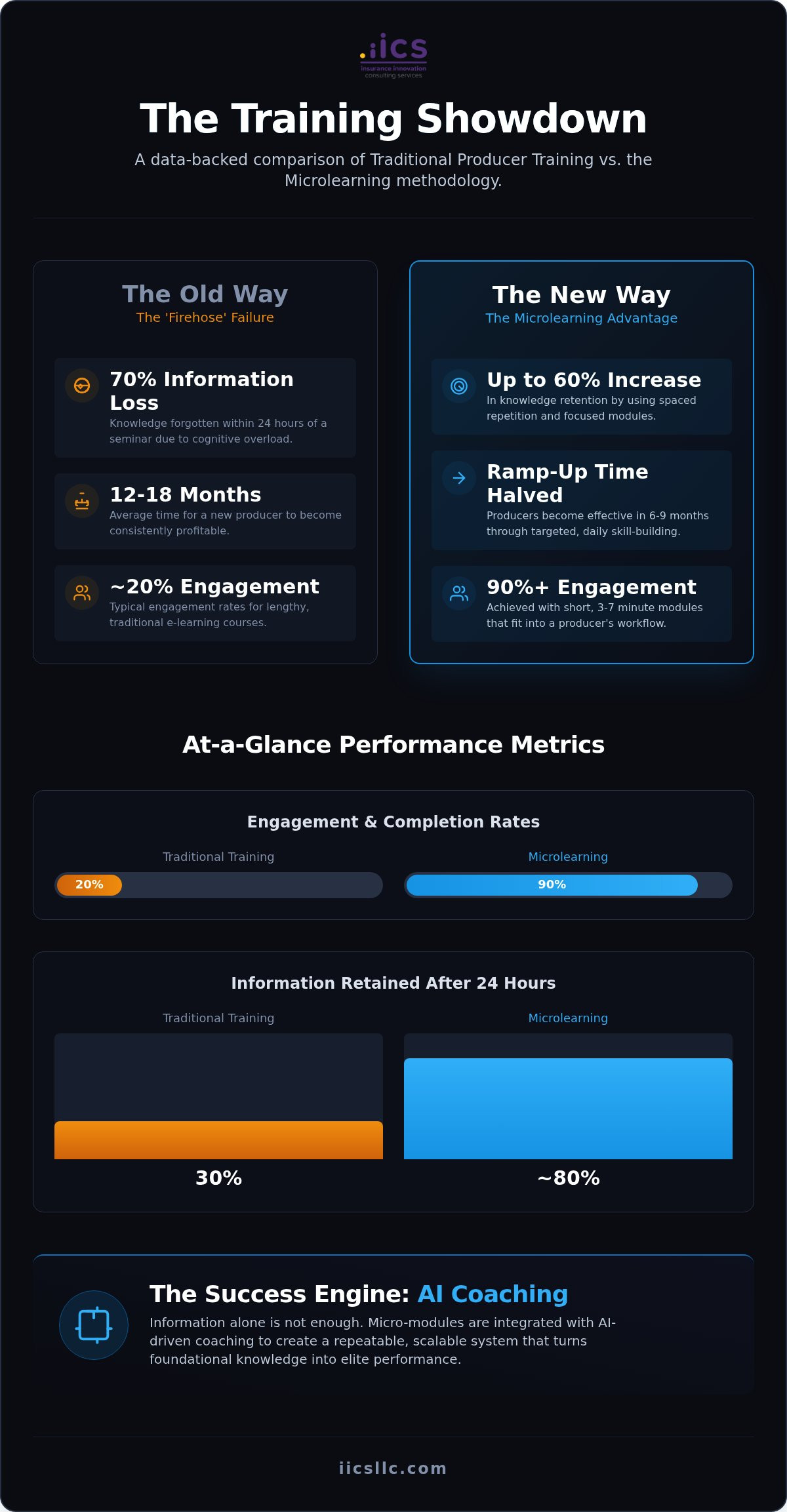
When evaluating microlearning vs traditional insurance sales training, the results are stark. The human brain is not designed to absorb eight hours of technical P&C complexity in a single sitting. Cognitive load theory suggests that without immediate application, producers forget 70% of seminar content within 24 hours. You aren't investing in their future; you're paying for a temporary distraction that leaves them exactly where they started. The definition of microlearning offers a necessary alternative, breaking skills into focused, actionable units that align with how we actually learn and retain information.
The Reality of the Forgetting Curve in P&C
Complex policy knowledge evaporates the moment the seminar ends. If a producer learns the nuances of Business Interruption on a Tuesday but doesn't apply it in a sales call until the following month, that knowledge is gone. It’s a waste of capital. Many agencies make the fatal error of over-training on technical details before the producer has even mastered basic sales skills. Passive listening in a classroom creates a "professional student" who is terrified of the phone. Elite performance requires active reinforcement, not a dusty binder on a shelf. Without a system to fight the forgetting curve, your training is just a box-ticking exercise.
Opportunity Cost: The Real Price of Slow Onboarding
What is the actual cost of a 12-month "learning" period? It isn't just the salary and the benefits. It is the hundreds of thousands in lost commission revenue that a competent producer would have generated. Traditional methods often extend the ramp-up period to 18 months or more, creating a massive financial drain. This stagnation kills agency morale and forces leadership to spend their time on remedial coaching rather than high-level strategy. When you compare microlearning vs traditional insurance sales training, you see that the old way is the primary reason producers fail in their first year. They don't lack talent; they lack a system that respects their cognitive limits and demands immediate application.
What is Microlearning for Insurance Sales? (And Why Retention Matters)
Microlearning is not just a shorter version of a lecture. It is a tactical intervention. In the high-stakes debate of microlearning vs traditional insurance sales training, the winner is determined by who actually applies the knowledge in the field. Microlearning consists of bite-sized, 3-7 minute modules focused on a single, actionable sales skill. It is the difference between reading a textbook on risk and actually managing it. You can enhance sales skills with microlearning by providing producers with exactly what they need, exactly when they need it. This isn't just about convenience; it's about completion. While traditional eLearning sees completion rates as low as 30%, micro-courses frequently hit 80% to 90% because they respect the producer's time.
Consider a producer with a high-stakes prospect call in fifteen minutes. They don't need a 400-page manual or a generic seminar recording. They need a 4-minute refresher on "Handling the Price Objection for Middle Market Manufacturing." This is just-in-time learning. It shifts the focus from "knowing" to "doing" with surgical precision. It builds long-term neural pathways through small, frequent "pokes" rather than overwhelming the brain with a cognitive firehose. If you want to see how this translates to revenue growth, look at how our Sales Academy structures these daily tactical touchpoints to ensure producers are always ready to execute.
The Anatomy of a High-Impact Sales Module
Every module must solve a specific problem. If it doesn't address a prospect objection or a technical P&C hurdle, it is noise. High-impact modules utilize interactive elements like scenarios and quizzes to force engagement. This is how you bridge the gap between theory and advanced commercial insurance sales techniques. When a producer is forced to make a decision in a simulated environment, they are far more likely to repeat that successful behavior during a live prospect meeting. You aren't just giving them information; you are building a reflex.
Spaced Repetition: The Secret to P&C Mastery
Mastery is a product of frequency, not duration. Elite performance requires daily 5-minute drills rather than monthly 5-hour lectures. Microlearning defeats the forgetting curve by scheduling reinforcement at critical intervals, improving knowledge retention by 25% to 60% compared to legacy methods. These "small wins" build a producer's confidence incrementally. A producer who masters one small skill every day is unstoppable by month three. When you look at microlearning vs traditional insurance sales training, the choice is between a permanent, scalable sales engine or a training program that is forgotten by Friday.
Microlearning vs. Traditional Training: A Direct Comparison for Agency Leaders
Your agency’s trajectory is a direct reflection of your training infrastructure. Are you building a scalable engine or a bottleneck? When you analyze microlearning vs traditional insurance sales training, you are looking at the difference between a high-yield investment and a sunken cost. Traditional training is a black hole for capital. You pay for travel, lodging, and registration, only to have a producer return with a binder they will never open. Microlearning is a precision instrument. It achieves engagement rates exceeding 90 percent, while traditional classroom settings struggle to hit 20 percent. This isn't just about attention. It's about revenue.
Time-to-competency is the only metric that truly matters for a new hire. In the P&C world, the industry norm for a producer to reach breakeven revenue is often 12 to 18 months. Our methodology, centered on micro-bursts of high-impact learning, cuts that time in half. Producers aren't waiting for a quarterly seminar to learn how to close a manufacturing account. They learn the skill on Monday and apply it on Tuesday. This accelerates your ROI and ensures your new hires aren't part of the high turnover statistics that plague the industry.
Scalability is the final piece of the puzzle. A principal's time is the most expensive resource in the agency. If you are the only person who can train new producers, you have created a permanent bottleneck. Microlearning platforms allow you to scale your expertise without sacrificing your own production time. You move from being a full-time teacher to a high-stakes coach. It’s the only way to grow an agency in 2026 without burning out the leadership team.
Side-by-Side Performance Metrics
The numbers don't lie. Research shows that microlearning can improve knowledge retention by up to 60 percent compared to traditional methods. Consider the cost-per-producer. A traditional seminar might cost $350 per completion when factoring in downtime and travel. A microlearning module delivers the same tactical outcome for a fraction of that investment. More importantly, the "Time to First Sale" drops significantly when producers have just-in-time access to closing scripts and risk assessment tools. You are paying for results, not attendance.
When Traditional Methods Still Have a Place (And Why They Fail Sales)
Traditional long-form training is acceptable for complex licensing or deep regulatory dives where a "sit-and-study" environment is required. However, sales is a performance art. It requires muscle memory and immediate feedback loops. The elite producers of 2026 use a hybrid model. They leverage microlearning for tactical skills and 1 on 1 insurance sales coaching for high-level strategy and accountability. This combination ensures that producers don't just know what to do; they possess the discipline to execute every single day.
Implementing Microlearning: Building an Elite 90-Day Ramp-Up Strategy
Survival in the 2026 P&C market depends entirely on speed. If your new producer isn't generating meaningful activity within their first 90 days, your investment is likely a sunk cost. This is where the debate of microlearning vs traditional insurance sales training becomes a matter of agency survival. A structured 90-day ramp-up strategy replaces the aimless "ride-along" with a rigorous, data-driven progression that demands immediate results. You aren't just teaching them about insurance; you are training them to hunt.
The first 30 days must focus on the "Why." Producers need to internalize the P&C landscape and master core scripts. They don't need a history lesson; they need to know why a business owner should care about their specific risk profile. Days 31 to 60 transition to the "How" through active prospecting. During this phase, micro-modules refine the pitch in real-time, allowing the producer to adjust based on the objections they encountered that very morning. By days 61 to 90, the focus shifts to "Results." This is the closing phase, where we integrate feedback loops and AI coaching to polish the final delivery. The entire journey is governed by a comprehensive insurance producer development plan to ensure every skill gap is identified and crushed.
If you are ready to stop guessing and start scaling, you need a battle-tested framework. You can launch your elite producer ramp-up with the Sales Academy and see the difference that structured micro-coaching makes to your bottom line.
Curating Your Micro-Content Library
Generic content is a waste of time. To build an elite team, identify the "Top 10 Objections" your agency faces and create 3-minute tactical solutions for each. Use your insurance sales role play scripts as the foundation for these micro-videos. Ensure every piece of content is mobile-first. Your producers are in the field. They need answers in the prospect's parking lot, not at a desk three days later. High-stakes sales require high-speed information.
The Role of the Principal as a 'Micro-Coach'
Stop holding hour-long sales meetings that accomplish nothing but collective boredom. Transition to 5-minute weekly debriefs. Use the data from your microlearning platform to identify exactly where a producer is struggling. Are they failing at the hook or the close? When you compare microlearning vs traditional insurance sales training, the biggest shift is in your own role. You must move from being a lecturer to an elite performance coach who uses data to drive precision strikes on skill gaps. This is how you build a repeatable, scalable sales engine.
Beyond the Module: How IICS Integrates Microlearning with AI Coaching
Microlearning is a foundation, not a finish line. Information without application is a hollow investment. In the high-stakes debate of microlearning vs traditional insurance sales training, the missing link is almost always the feedback loop. You can provide a producer with a perfect 4-minute module on identifying coverage gaps in manufacturing risks, but if they fail to articulate that value during a prospect meeting, the training has failed. Elite performance requires more than just content consumption; it demands a system of continuous, high-speed refinement.
This is where AI sales coaching for insurance changes the trajectory of your agency. While traditional methods leave a new hire alone until their next quarterly review, AI provides objective feedback on every interaction. It identifies tone, pacing, and objection-handling precision with a level of detail no human manager can maintain across an entire team. It turns every prospecting call into a laboratory for growth, ensuring the lessons learned in micro-modules are actually translated into closed business. Static training tells them what to do. AI coaching shows them how they actually performed.
The IICS 3-Month Sales Academy Framework
The IICS Sales Academy is a 3-month intensive that bridges the gap between theory and revenue. We leverage a 40-year track record of growth to deliver a framework that produces results, not just certificates. By combining bite-sized modules with 1:1 call coaching and weekly live workshops, we ensure that knowledge is permanent. Our data confirms that this integrated approach allows producers to reach breakeven revenue in half the time of the industry norm. You aren't just training; you are doubling the likelihood of your new hires becoming top producers. It is a systematic path to dominance.
The Future of Producer Development
The talent war in 2026 will be won by agencies that treat development as a primary competitive advantage. If you are still relying on thick manuals and "sink-or-swim" onboarding, you will lose your best people to firms that offer a modern, data-driven path to success. The shift toward continuous development models is inevitable. Traditional training is a snapshot in time; microlearning integrated with coaching is a permanent evolution. The only question is whether you will lead that transition or be left behind. Are you ready to stop managing mediocrity and start building an elite sales engine?
Secure Your Competitive Advantage in 2026
The era of the multi-day seminar is over. You cannot expect elite results from a training model that ignores how the human brain actually functions. When you weigh the merits of microlearning vs traditional insurance sales training, the winner is the system that delivers actionable skills exactly when they are needed. Mastery is built through daily discipline and high-stakes feedback; it's not the product of a single weekend of passive listening.
Your agency deserves a repeatable engine for growth. By moving beyond the "firehose" approach and adopting a structured 90-day ramp-up, you protect your capital and empower your talent. We've spent 40 years perfecting this methodology to ensure your producers don't just survive; they dominate. Our graduates reach breakeven revenue in half the industry norm time by leveraging integrated AI Sales Coaching and 1:1 mentoring.
Stop letting your training budget evaporate into forgotten lectures. It's time to implement a battle-tested framework that scales your expertise and doubles your likelihood of creating top-tier producers. You're one decision away from a more profitable future.
Transform your agency with the IICS Sales Academy and build the elite team your agency requires.
Frequently Asked Questions
Is microlearning enough to teach complex Commercial P&C insurance?
Microlearning provides the tactical building blocks, but complex Commercial P&C requires a layered approach. While bite-sized modules master individual coverage nuances, elite performance stems from combining these modules with real-time feedback loops. You aren't just memorizing policy language; you're learning how to deploy that knowledge in high-stakes negotiations. It serves as the foundation for "what" to do, while coaching provides the refinement for "how" to win.
How much time should a new producer spend on microlearning daily?
A new producer should dedicate 15 to 20 minutes daily to structured microlearning. This isn't about clearing a schedule; it's about high-frequency, low-duration drills that build muscle memory. When comparing microlearning vs traditional insurance sales training, the goal is consistency over intensity. Short bursts ensure the brain remains in a state of active retention rather than slipping into the passive fatigue common in long-form seminars.
Can microlearning replace the need for a sales manager or principal?
Microlearning does not replace leadership; it weaponizes it. By outsourcing the foundational skill-building to a digital platform, the principal is freed from the burden of repetitive lecturing. You shift from being a primary information source to an elite performance coach. You use the data generated by the modules to identify specific skill gaps, making your 1:1 sessions surgical and results-oriented rather than generic.
What is the typical ROI of switching from traditional seminars to microlearning?
The ROI is measured in accelerated "time to first sale" and reduced producer turnover. Agencies typically see producers reach breakeven revenue in half the industry norm time when they move away from legacy methods. You eliminate the thousands spent on travel and downtime for seminars that yield a 70% information loss. Instead, you invest in a scalable system that produces a predictable, high-performing sales engine.
Does microlearning work for veteran producers or just new hires?
Microlearning is exceptionally effective for veteran producers who need to pivot into new niches or refresh specific closing techniques. Experienced producers often resist long seminars but value "just-in-time" modules they can access minutes before a prospect meeting. It allows them to sharpen their edge without disrupting their production schedule. Elite veterans understand that even the best athletes never stop practicing the fundamentals.
What tools are needed to implement a microlearning strategy in a small agency?
Small agencies need a mobile-first learning management system and a structured content library, such as the IICS Sales Academy. Implementation doesn't require a massive IT department; it requires a commitment to a 90-day ramp-up schedule. The most critical tool is the integration of AI-driven role-play platforms. These provide the objective feedback and repetition necessary to turn information into a closed policy without draining the principal's time.
How do you measure the effectiveness of microlearning in sales?
Effectiveness is measured through a combination of engagement data and real-world activity metrics. You track module completion rates and quiz scores to ensure foundational knowledge is sticking. However, the ultimate litmus test is the correlation between training and prospecting activity. When analyzing microlearning vs traditional insurance sales training, you look for a direct increase in the number of qualified appointments and a decrease in the "stalled proposal" rate.
Why do most insurance producer training programs fail within the first 90 days?
Most programs fail because they overwhelm producers with technical details before they've mastered the art of the pitch. This "firehose" approach leads to immediate burnout and a total loss of confidence. Without a structured 90-day roadmap that demands daily application, the producer becomes a professional student rather than a professional hunter. They quit because they don't see a clear path to their first commission check.