P&C Insurance Agent Coaching: A Practical Guide for 2026
Updated: 2 days ago
What if the coaching meant to sharpen your producers leaves them no better prepared for their next commercial prospecting call? P&C insurance agent coaching works when it reflects the realities of the job: opening conversations, uncovering business risks, discussing coverage, and following through. Generic sales advice won’t bridge the gap between a training session and a client conversation.
Agency leaders know producers need feedback. The harder question is whether it’s consistent, specific, and applied in the field. Without a repeatable system, coaching can become an occasional conversation, and progress is difficult to assess.
This guide explains what effective P&C coaching looks like, how to build a steady rhythm of practice and feedback, and which activity and performance measures can help you assess development. It compares call review, experienced mentoring, and group learning, then shows how to connect coaching to observable producer behavior. The goal is a development process your team can repeat and refine.
Table of Contents
What P&C Insurance Agent Coaching Should Improve in Commercial Sales
P&C insurance agent coaching is a recurring process that helps producers improve observable sales behaviors through focused practice, evidence-based feedback, and follow-through. The aim isn’t simply to motivate a producer. It’s to strengthen how they prospect, lead discovery, discuss coverage, plan renewals, and follow up with clients.
Coaching is distinct from related forms of development. Product instruction builds technical knowledge. Training introduces information or skills, often in a structured session. Mentoring draws on an experienced professional’s perspective. Performance management evaluates results against expectations. Coaching can complement all of these, but its focus is specific: identify a behavior, practice it, review what happened, and decide what to do next. This aligns with the broader concept of coaching, while making it practical for commercial insurance sales.
How P&C coaching differs from generic sales coaching
Commercial insurance conversations involve business operations, exposures, and coverage considerations. A producer needs to ask relevant discovery questions, explain options in plain language, and guide renewal conversations without overpromising. Generic advice such as “build rapport” doesn’t show a producer how to uncover changing business operations or clarify what information is needed for a useful coverage discussion.
Effective coaching uses real producer tasks as practice material. A coach might help a producer prepare open-ended questions for a prospect, review whether a coverage explanation was clear, or plan a renewal conversation that surfaces changes early. The goal is better communication and sales discipline, not replacing technical coverage expertise or carrier guidance. Producers still need appropriate subject-matter support when interpreting coverage or underwriting requirements.
Who benefits from a structured coaching approach
New producers benefit from repeated practice with core activities, such as initiating prospect conversations, asking follow-up questions, and confirming next steps. They need feedback they can apply on the next call, not just a broad reminder to “be more confident.”
Experienced producers can use coaching to refine a specific behavior, such as improving discovery, handling a difficult pricing conversation, or planning renewal follow-up. Agency leaders benefit, too. A shared coaching approach can help managers give clearer, more consistent feedback without treating every producer as if they have the same development needs.
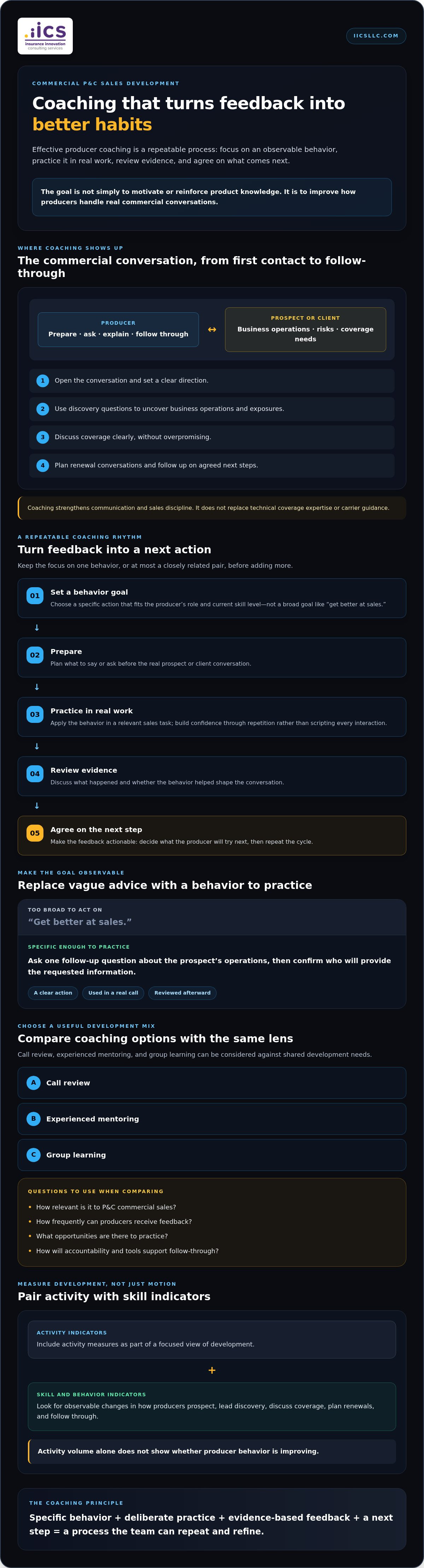
Set priorities according to each person’s experience, responsibilities, and current work. Start with an observable behavior, such as whether a producer confirms the prospect’s next step before ending a call. Then give that behavior room to improve through practice and review. “Get better at sales” is too broad to act on. “Ask one follow-up question about the prospect’s operations, then confirm who will provide the requested information” gives the producer something specific to practice.
How a P&C Insurance Coaching Cycle Turns Feedback into Better Habits
Feedback only matters if a producer can use it in the next client conversation. A practical coaching cycle keeps development focused: set one behavior goal, prepare, practice, review evidence, and agree on a next action. Then repeat. That structure helps P&C insurance agent coaching move from good intentions to changes a manager and producer can observe.
Feedback becomes useful when it leads to a specific next action the producer can practice and review. “Improve discovery” doesn’t explain what to do differently. A clear next step might be to prepare one additional question about a prospect’s operations, ask it during the next discovery call, then review how the answer shaped the conversation.
Start with a specific commercial P&C behavior
Choose a behavior that fits the producer’s role and current skill level. For a newer producer, that could mean opening a discovery call with a concise agenda. Another goal might be asking follow-up questions to understand a business exposure, or confirming who will provide information and by when. An experienced producer may focus on making a coverage discussion easier to follow or creating a deliberate renewal plan.
Keep the practice target realistic. Work on one behavior, or at most a closely related pair, before adding more. The aim isn’t to script every interaction. It’s to help the producer prepare, apply a skill in real work, and build confidence through repetition.
Use practice and feedback without creating a firehose
Prepare with a short lesson or focused prompt, then practice through role-play or an appropriate call review. Review the evidence together: What did the producer do well? Which question was missed? What response could have moved the conversation forward? Agree on one next action. For actual client material, follow agency procedures and protect confidentiality. Use only information and review methods the agency has approved, and remove identifying details when appropriate.
Different development methods serve different needs. Microlearning can introduce one skill at a time, while role-play platforms such as Georgia allow agents to rehearse soft-skill conversations in a realistic setting. AI call feedback can help identify patterns in a conversation. Mentoring adds experienced perspective, while workshops give producers a chance to discuss and practice approaches together. Keep each method tied to the same behavior goal so development doesn’t become a firehose of disconnected advice.
IICS brings daily microlearning, AI call coaching, 1:1 mentoring, and workshops into its 90-day Sales Academy, which includes 60 tactical modules. If you’re assessing how a structured program might support this cycle, review the 90-day Sales Academy structure.
How to Compare P&C Agent Coaching Options and Address Common Concerns
The right coaching format depends on the skill gap, the producer’s needs, and how consistently the agency wants to support its team. Compare options on more than convenience or technology. Strong P&C insurance agent coaching connects to commercial workflows, gives producers opportunities to practice, provides useful feedback, and makes follow-through clear.
Which coaching format fits the producer or agency?
Choose individual coaching when the goal is specific or a producer needs a private setting to discuss call performance. Workshops can help a team rehearse common situations and align on prospecting, discovery, or follow-up. A blended approach may suit agencies that want both individual attention and shared practice. If the need extends beyond individual skills to broader producer development or sales leadership, consider whether outsourced development or fractional leadership is a better fit than coaching alone.
Protect selling time by scheduling short, focused sessions around live work. A brief conversation before a prospect call or a review afterward can make practice relevant without turning development into an open-ended meeting. Keep the goal narrow, and agree on when the producer will apply it.
What to ask before choosing a coach
Ask how the coach understands commercial P&C sales and the producer’s day-to-day responsibilities. Find out how goals are set, what feedback is based on, how confidentiality is handled, and how often progress is reviewed. Ask what practice looks like and which tools producers can use between sessions.
Don’t choose on technology, testimonials, or bold outcome promises alone. Look for a clear method and a credible connection between coaching activity and the behavior being developed. For an example of a blended approach, review the 90-day Sales Academy structure.
How to Build a Measurable P&C Producer Coaching Plan
A coaching plan needs a baseline, a small number of relevant measures, and regular reviews. Without them, it’s hard to tell whether coaching is changing producer behavior or simply adding meetings to the calendar. Start with a conversation about the producer’s role, strengths, current challenges, and the agency’s sales process. Then choose one or two behaviors to develop and decide how you’ll observe progress.
Set goals and measures producers can influence
Separate leading indicators, which show whether development activities are happening, from lagging outcomes, which reflect business results over time. A producer can influence preparation, questioning, and follow-through directly. Results such as new business or conversion can also be affected by other factors, so activity volume alone doesn’t prove that coaching is working.
Participation: Did the producer complete agreed practice or feedback activities?
Behavior: Did the producer use the targeted skill in a relevant prospect, discovery, or renewal conversation?
Outcome: What happened to appropriate sales-process measures the agency already tracks, such as qualified opportunities or progress to a next step?
Choose measures that fit the producer’s responsibilities and can be reviewed consistently using available agency reporting or call evidence. Avoid universal benchmarks and fixed promises about when production will improve. The useful question is whether the producer is applying the behavior more effectively, with business measures providing context.
Create a practical weekly and monthly cadence
Keep the rhythm manageable. Schedule brief practice or feedback around active producer work, such as preparing for an upcoming prospect conversation or reviewing an appropriate call. Record the behavior being developed, the evidence discussed, and the next action. Each touchpoint should have a purpose and give the producer a clear opportunity to apply the feedback.
Use a monthly review to assess patterns, not just count completed activities. Is the target behavior showing up more consistently? Are the selected measures moving in a useful direction? If not, check whether the goal needs adjustment or a process barrier, such as unclear expectations or limited access to relevant information, is getting in the way. Reset priorities based on evidence.
Technology-supported feedback can be one input in this system, alongside manager observation and producer reflection. For a structured development example, explore the 90-day Sales Academy and consider how its components could fit your coaching priorities.
How IICS Connects P&C Coaching with a 90-Day Development System
Once you know which behaviors need work and how you’ll assess progress, consider whether a development program supports that plan. IICS’s Sales Academy is a 90-day program for commercial P&C producers, built around repeated learning, feedback, and guidance rather than a one-time training event. Its curriculum includes 60 tactical modules and combines daily microlearning, AI call coaching, 1:1 mentoring, and weekly group workshops.
What the IICS coaching and development mix includes
Each component serves a different purpose. Daily microlearning gives producers focused lessons to apply in their work. Unlimited AI call coaching provides feedback on sales conversations. One-to-one mentoring offers individual guidance, while weekly workshops create a setting for group learning and practice. Used together, these elements support a consistent development rhythm for P&C insurance agent coaching.
The curriculum is designed exclusively for commercial P&C producers, keeping development relevant to their sales work. IICS founder Ralph J. Blust has more than 40 years of insurance industry leadership experience.
IICS also offers outsourced producer development and fractional sales leadership. These options may be worth considering when an agency’s need extends beyond coaching individual producers to broader development or sales leadership support.
How agency leaders can take the next step
Before choosing a path, define the need. Identify which producers the development effort is intended to support, which commercial sales behaviors they need to strengthen, and which business priorities the agency wants to address. Then discuss program fit and implementation, including how learning, call feedback, mentoring, and workshops would connect to producer responsibilities and existing agency processes.
A structured system makes sense when its components match the work and development goals. Review the program details, consider how you’ll assess progress, and decide whether the approach fits your producers and agency priorities. Explore IICS producer development options and assess whether the Sales Academy is a fit for your team.
Turn Producer Development into a Repeatable Advantage
Strong P&C insurance agent coaching is a disciplined cycle: choose a relevant behavior, practice it against real producer work, review evidence, and agree on a next step. Measure participation and behavior alongside business outcomes, then adjust the plan when evidence points to a new skill gap or process barrier.
IICS’s 90-day Sales Academy combines 60 tactical modules with AI call coaching, 1:1 mentoring, and weekly workshops. Founder Ralph J. Blust brings more than 40 years of insurance industry leadership experience. IICS states benchmarks of 52% higher sales, 31% more new clients, and 53% higher lead-to-prospect conversion. These are IICS’s stated benchmarks, not guaranteed results for an individual producer.
Ready to assess whether a structured development approach fits your team? Explore IICS producer development options and identify a practical next step toward stronger, more consistent producer performance.
Frequently Asked Questions
What does a P&C insurance agent coach do?
A P&C insurance agent coach helps a producer improve specific sales behaviors through practice, feedback, and follow-through. That may include preparing for a prospecting call, asking stronger discovery questions, explaining coverage in plain language, or planning client follow-up. A coach reviews observable actions and agrees with the producer on a practical next step. Coaching supports technical expertise and carrier guidance; it doesn’t replace them.
How is P&C agent coaching different from insurance sales training?
Insurance sales training typically teaches concepts, information, or skills in a structured learning session. Coaching focuses on applying a skill to the producer’s work, reviewing what happened, and identifying what to practice next. For example, training might cover discovery techniques, while coaching helps a producer prepare questions for an upcoming commercial conversation and review how effectively they used them.
Can coaching help a new commercial insurance producer ramp up?
Yes. Coaching can give a new producer regular opportunities to practice prospecting, discovery, and follow-up, with feedback tied to actual responsibilities. Start with foundational behaviors and realistic practice goals, then build as the producer gains experience. A structured program can combine short lessons, call feedback, mentoring, and workshops. Coaching supports development, but it can’t guarantee a particular production result or timeline.
How often should insurance producers receive coaching?
Set a cadence the producer and agency can maintain, rather than relying on occasional, unplanned feedback. Brief touchpoints tied to active work can help producers prepare for or reflect on sales conversations, while regular progress reviews give leaders a chance to revisit goals and remove obstacles. The right frequency depends on the producer’s experience, development needs, and available management capacity.
What should an agency look for in a P&C sales coach?
Look for a coach who understands commercial P&C sales workflows and can connect feedback to observable producer behaviors. Ask how coaching goals are set, how practice and feedback work, how confidentiality is handled, and how progress is reviewed. Consider whether the format fits the need, such as individual coaching for a targeted skill or workshops for shared practice. Don’t rely on technology or outcome claims alone.
How do you measure whether insurance producer coaching is working?
Track coaching participation alongside evidence of behavior change and relevant business outcomes. For example, note whether a producer completes planned practice, applies a targeted discovery behavior, and advances appropriate opportunities through the agency’s sales process. Use measures that fit the producer’s role and available reporting. Activity volume alone doesn’t prove coaching is effective, and results can be influenced by factors beyond the producer’s control.
Can AI coaching replace a human insurance sales coach?
AI coaching can support call review and provide feedback, but it doesn’t have to replace human coaching. A human coach can help interpret feedback, discuss context, and guide the producer’s next practice step. A blended approach may pair AI call coaching with 1:1 mentoring and group workshops. Agencies should evaluate how each element supports their goals and handle call material according to their confidentiality practices.