P&C Insurance Cross-Selling Techniques: The Elite Producer’s Tactical Playbook for 2026
Updated: Sep 14
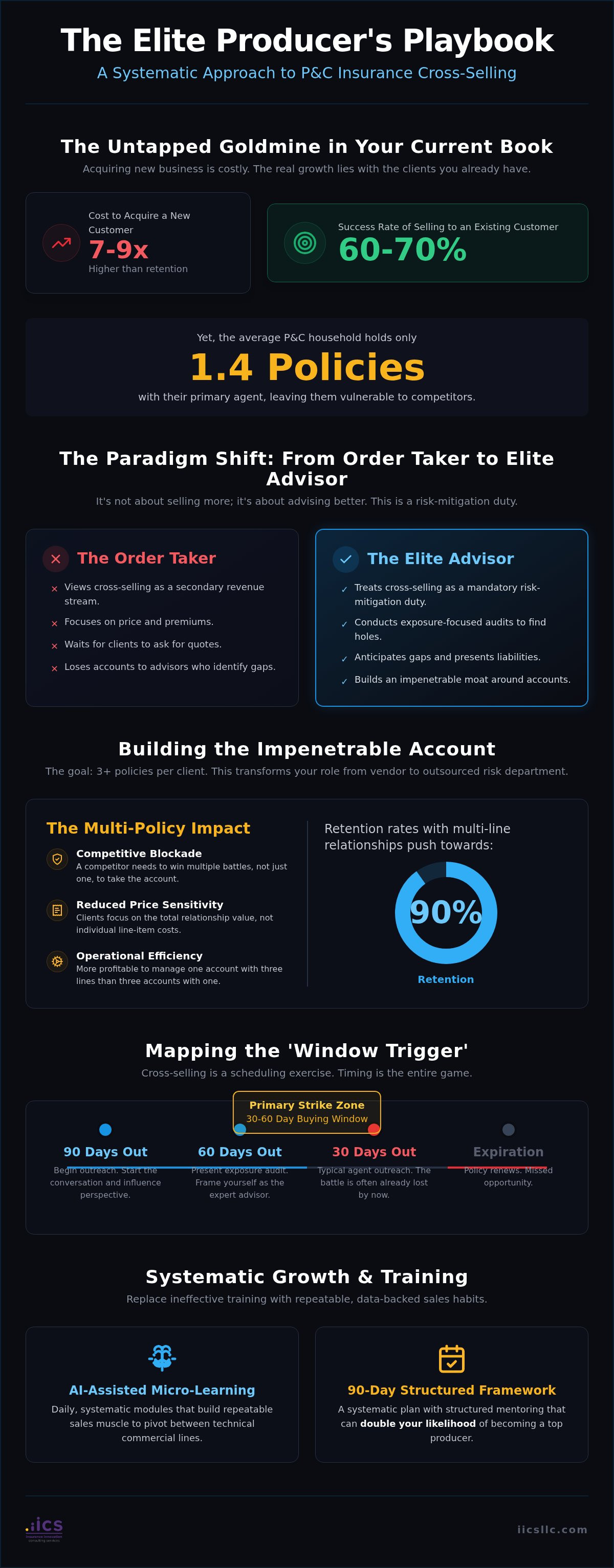
Why are you spending seven times more to acquire new business while your current book sits untapped? The success rate of selling to an existing customer is 60 to 70 percent, yet the average P&C household holds only 1.4 policies with their primary agent. If you're stuck in the order-taker trap, you're not just losing commissions; you're leaving your clients vulnerable to competitors who actually act as advisors. Mastering P&C insurance cross-selling techniques is no longer a suggestion. It's a systematic risk-mitigation duty that separates elite producers from the stagnant middle.
We understand the frustration of seeing revenue per account stall because your team lacks the technical confidence to pivot between commercial lines. This guide promises to hand you the tactical frameworks used by the top 1 percent to double policies per client and push retention north of 90 percent. We'll explore the proprietary Window Trigger Map and the repeatable habits required to build an impenetrable moat around your most valuable accounts. It's time to stop hoping for renewals and start engineering growth.
Table of Contents
The Paradigm Shift: Why Elite Producers Stop 'Selling' and Start Advising
Elite producers don't view additional lines as a bonus. They view them as a requirement. If you're only managing a single commercial auto policy for a client, you aren't their partner; you're just another line item on a spreadsheet. This order-taker mindset is the fastest way to lose your book. Industry data shows that retention rates drop sharply once a household has fewer than two policies. By contrast, achieving a multi-line relationship pushes retention toward the 90 percent mark. Effective P&C insurance cross-selling techniques aren't about being pushy. They're about building a competitive moat that makes it impossible for another agent to pivot into your account. Acquiring a new customer costs seven to nine times more than retaining one. Why waste your capital on acquisition when you're ignoring the gold mine you already own?
The Duty to Disclose: Risk-Based Selling
Stop talking about premiums. Start talking about holes. When you fail to mention a missing professional liability policy or an inadequate umbrella limit, you're failing your client. This is a professional failure in risk management. Elite advisors use exposure-focused audits to move the needle. You must frame the conversation around accountability rather than commission. Transitioning from price-focused conversations to exposure-focused audits changes the dynamic. Use a simple frame: "It's my job to ensure you know where you’re exposed, regardless of who writes the policy." This shift from selling to disclosing removes the salesperson's stigma and positions you as the expert. An elite advisor doesn't wait for the client to ask for a quote. They anticipate the gap and present it as a liability that needs to be addressed immediately.
Defining the Impenetrable Account
What does a secure account look like? For the top 1 percent of producers, the gold standard is three or more policies per client. At this level, the psychological impact on the commercial client is profound. They no longer see you as a vendor. They see you as their outsourced risk department. Consolidation creates ease for the client and complexity for your competitors. When you are the single point of accountability for all risk, you become indispensable. Consider the following benefits of the multi-policy account:
Reduced Price Sensitivity: Clients focus on the total relationship value rather than individual line items.
Operational Efficiency: Managing one account with three lines is more profitable than managing three accounts with one line.
Competitive Blockade: A competitor needs to win three battles to take the account, not just one.
This systematic approach to P&C insurance cross-selling techniques ensures that when a competitor calls, your client doesn't even bother to pick up the phone. You've built a fortress, not just a book of business.
Mapping the 'Window Trigger': Identifying Commercial Cross-Sell Opportunities
Most producers fail because they treat cross-selling as a reactive event. It's actually a scheduling exercise. If you wait for the client to ask about Cyber or Workers Comp, you've already lost the account to a specialist who was paying attention to the calendar. Elite producers use P&C insurance cross-selling techniques rooted in timing and predictability. You don't need a higher volume of leads; you need a better map of the expiration dates you already have. Timing isn't just a factor; it's the entire game.
The Window Trigger Map Framework
Standard quote requests are the "front door," but renewal cycles are the "windows." The IICS Window Trigger Map identifies the exact moment a client is psychologically ready to pivot. While most agents start their outreach 30 days before expiration, the battle is usually over by then. You must begin your outreach 60 to 90 days before the policy expires. This allows you to influence the client's perspective before the incumbent agent anchors them with a renewal price. By mapping five critical renewal windows across your book, you can build a consistent pipeline of 100 high-quality leads per month without spending a dime on external marketing. The 30 to 60 day buying window is your primary strike zone for maximum impact.
SME Commercial Focus: The Sweet Spot
The most lucrative opportunities for expansion live in the 10 to 100 employee range. These Small to Medium Enterprise (SME) accounts are often underserved by large brokers but have complex needs that go beyond a simple Business Owners Policy. You can predict their growth trajectory with precision. A company scaling its workforce will move from General Liability into an immediate need for Workers Comp and Employment Practices Liability Insurance (EPLI). Use the following triggers to identify gaps:
Employee Milestones: Crossing the 10 or 50 employee mark often triggers new regulatory requirements and liability exposures.
ISO vs. Custom Forms: Highlight where standard ISO forms leave the client naked compared to the custom endorsements your carriers offer.
Revenue Jumps: Increased revenue usually signals a need for higher umbrella limits and professional liability coverage.
Mastering these triggers is a core component of the 90-day Sales Academy, where we teach you to hunt by the calendar rather than by luck. This systematic application of P&C insurance cross-selling techniques transforms you from a vendor into a strategic advisor who anticipates risks before they become claims.
Overcoming the 'I’m Happy with My Current Agent' Wall
"I'm happy with my current agent." This is a reflex, not a reasoned business decision. It's a psychological shield used to avoid the perceived work of a transition. Elite producers recognize that comfort is the precursor to catastrophe. If you accept this response at face value, you're abandoning your duty as an advisor. The most effective P&C insurance cross-selling techniques involve dismantling this comfort by introducing the reality of modern risk. You don't need to be offensive. You just need to be more informed than the competition. Are they happy with the person, or are they happy with the protection? Those are two very different metrics.
Tactical Response Scripts for Elite Producers
When a prospect mentions a multi-decade relationship, they're signaling loyalty to a person, not a policy. Your response must pivot immediately to the technical reality of the 2026 market. Try this: "Loyalty is rare in this business, and I respect that. However, has your agent updated your cyber exclusions since the NAIC adopted the Model Bulletin on AI governance? The regulatory landscape changed significantly in 2024 and 2025." This one question introduces doubt without attacking the character of the incumbent. Use plain-language explanations to win trust. If you can explain a complex exclusion in three sentences while your competitor hides behind "insurance-speak," you've already won the intellectual high ground.
The Risk and Coverage Deep Dive
Stop asking if you can provide a quote. Instead, ask if they have a specific, common exclusion. Most commercial clients are unaware that proprietary forms often contain wording differences that leave them exposed to social inflation and nuclear verdicts. These are not hypothetical threats. In 2026, liability lines remain hardened because of rising litigation costs. You must provide three simple loss examples to create immediate urgency:
Social Inflation: Explain how a standard general liability limit is no longer sufficient in an era of nuclear verdicts.
AI Liability: Detail how the use of generative AI agents for customer responses can trigger new professional liability exposures.
Employment Practices: Highlight how recent state-level regulatory shifts have changed the definition of a "wrongful act" in EPLI policies.
By highlighting these legal impacts, you justify the need for a second opinion. You aren't asking them to fire their friend; you're asking them to protect their balance sheet. This systematic application of P&C insurance cross-selling techniques transforms the conversation from a personality contest into a professional audit.
Leveraging AI Sales Coaching and MicroLearning for Systematic Growth
Most agencies treat training like a firehose. They drench producers in technical information once a year and wonder why their P&C insurance cross-selling techniques never actually improve. Knowledge without habit is useless. Elite performance requires precision, not volume. Traditional seminars fail because they ignore the biological reality of how habits are formed. If your team isn't practicing the pivot every single day, they'll default to the path of least resistance during a live call. You don't need more information; you need better reps.
MicroLearning: The 90-Day Habit Formation
Annual seminars are expensive distractions. They don't build sales muscle; they just provide a temporary high. True growth happens in the 2 to 4 minute daily modules of MicroLearning. This is where habit formation takes root. Within the Sales Academy, topics 21 through 40 specifically target the mechanics of pipeline development and account expansion. By committing to three basic sales habits every week, producers transform from erratic hunters into systematic advisors. It's about the discipline of the daily rep. This structure ensures that producers retain what they learn and, more importantly, apply it when the pressure is on.
AI Sales Coaching: The Data-Driven Advantage
How do you know if your producers are actually executing your strategy? You can't listen to every call, but AI can. AI call coaching provides real-time scoring against nine critical sales criteria. It identifies missed opportunities to pivot into secondary lines before the call even ends. During the 90-day ramp period, this data-driven feedback allows for immediate course correction. You aren't guessing why a producer isn't cross-selling; you have the transcript and the score to prove it. These recordings then become an agency-wide resource library, turning one producer's win into a team-wide blueprint for success.
Scaling these efforts across an entire agency requires a framework that works while you're focused on high-level strategy. Whether through fractional CRO services or outsourced development, the goal is to build an elite culture that views every interaction as a chance to secure the account. Stop leaving your revenue growth to chance and start engineering it with a structured system. Apply for the Sales Academy to start building your data-driven sales machine today.
Mastering the Elite Producer Path: The IICS Sales Academy Framework
Knowledge is a start. Execution is the finish line. You've learned about mapping windows and dismantling reflexes, but reading isn't doing. Elite producers aren't born; they're built through high-stakes training and relentless feedback. The IICS Sales Academy provides the only 3-month intensive system designed exclusively for Commercial P&C producers who want to dominate their markets. This isn't a theory-based course. It's a tactical deployment. Participants double their likelihood of becoming top producers because they move past "tips" into a battle-tested framework. Why settle for stagnant revenue when you can engineer a 31 percent increase in new clients?
Inside the 90-Day Development System
The Academy is structured into three distinct trimesters to ensure total mastery. We begin with Foundations, establishing the mindset of the elite advisor. We then move into Pipeline Development, where you'll master the mechanics of the Window Trigger Map. Finally, we tackle Advanced Scenarios, refining your P&C insurance cross-selling techniques against the most difficult commercial objections. You aren't doing this alone. You receive 1:1 mentoring from veteran experts like Ralph Blust. This direct access to decades of high-level experience is what allows our graduates to achieve breakeven revenue in half the industry norm time. Discover what's Inside the Academy and see how our curriculum turns order-takers into risk advisors.
The ROI of Elite Producer Development
Investing in your team isn't a cost; it's an investment with a documented return. Statistics show that agents achieve 52 percent higher sales through our formal training. While the retail tuition is $3,000 per month, we prioritize partnerships with agencies committed to growth. Invited agencies can access a 50 percent discount for their teams using the code Summer2026. This brings the investment down to $1,500 per month. When you consider that academy participants see a significant jump in production, the math is simple. Stagnation is expensive. Growth is a choice. Learn more About IICS and our 40-year track record of developing the nation's most successful producers. Stop settling for average retention and start building an elite book that competitors can't touch.
Secure Your Book: The Transition from Vendor to Advisor
Elite producers don't leave their growth to chance; they engineer it through systematic timing and a relentless focus on risk mitigation. By mastering P&C insurance cross-selling techniques, you move past the "order taker" label and become the single point of accountability for your clients' protection. You've seen how identifying the 30 to 60 day renewal window and leveraging AI-driven insights can dismantle even the most stubborn loyalty to a competitor. Now, it's time to decide if you'll remain stagnant or join the top 1 percent of producers nationwide.
The IICS Sales Academy offers a 40-year track record of turning potential into performance. Our graduates achieve 52 percent higher sales through AI-driven coaching and real-time feedback that sharpens every interaction. This isn't just a training module; it's a total transformation of your agency's sales DNA. Stop letting single-policy accounts leave your book vulnerable to poaching. Enroll your producers in the IICS Sales Academy today and save 50% with code Summer2026. The path to elite production is open. It's time to take it.
Frequently Asked Questions
What is the best way to introduce a new commercial line to an existing client?
Introduce new lines by shifting the conversation from premium costs to exposure audits. Elite producers act as risk advisors who have a professional duty to disclose coverage gaps. Instead of asking for a quote, present a specific risk, such as inadequate professional liability limits, that leaves their balance sheet vulnerable. This approach reframes the cross-sell as a protective measure rather than a sales pitch, establishing you as the single point of accountability.
How do I handle the 'I'm happy with my current agent' objection in commercial P&C?
View this objection as a reflex rather than a final decision. You must pivot to technical realities that the incumbent agent likely missed. Ask if their current coverage accounts for recent regulatory shifts in AI governance or social inflation. By introducing doubt through specific, plain-language risk examples, you justify a second opinion. You aren't attacking their agent; you're auditing their protection against modern liability threats.
When is the ideal time to start a cross-sell conversation before a renewal?
The ideal time to initiate outreach is 60 to 90 days before the current policy expires. This proactive timing allows you to influence the client's perspective before they enter the 30 to 60 day renewal buying window. If you wait until 30 days out, the incumbent has likely already anchored the client with a renewal price. Starting early ensures you lead the conversation and define the criteria for the account's protection.
How many policies should an elite producer aim for per commercial account?
An elite producer should aim for a minimum of three policies per commercial account to build an impenetrable moat. Data shows that retention rates climb toward 90 percent once a client moves beyond a single-policy relationship. This consolidation turns you into an indispensable risk department rather than a replaceable vendor. Accounts with three or more lines are significantly more profitable and far more difficult for competitors to poach.
Can AI really help me improve my insurance sales calls?
AI call coaching provides objective, real-time scoring against nine critical sales criteria. It eliminates the guesswork of producer development by identifying exactly where a cross-sell pivot was missed. Within the Sales Academy, this technology allows producers to receive immediate feedback and course-correct their P&C insurance cross-selling techniques. It turns every call into a data-driven coaching opportunity, ensuring consistent habit formation across the entire agency.
What are the most common commercial P&C cross-selling mistakes?
The most common mistake is the "order taker" mindset, where producers only respond to specific requests rather than anticipating needs. Many agents also fail to track effective dates, leading to reactive and poorly timed outreach. Another critical error is relying on "firehose" training that doesn't build repeatable habits. Without a systematic framework like the Window Trigger Map, producers leave revenue on the table and keep their accounts vulnerable to specialists.
How long does it take to see results from a formal producer development program?
You should expect measurable results within the first 90 days of a structured development program. IICS Sales Academy graduates typically double their likelihood of becoming top producers and achieve 52 percent higher sales compared to untrained peers. By replacing annual seminars with daily micro-learning and 1:1 mentoring, producers build the sales muscle required for long-term growth. This intensive ramp period is designed to reach breakeven revenue faster than the industry norm.
What is the 'Window Trigger Map' and how does it help with cross-selling?
The Window Trigger Map is a proprietary IICS tool designed to identify five critical windows for common commercial renewal cycles. It allows producers to move beyond standard quote requests and target specific expiration dates. By using this map, you can build a consistent pipeline of at least 100 leads per month. It transforms P&C insurance cross-selling techniques from a game of luck into a disciplined, calendar-based strategy for account expansion.