P&C Insurance Referrals: A Guide for Producers
Updated: 11 hours ago
What if your referral pipeline depended less on luck and more on a repeatable process? Generating referrals for P&C insurance can feel unpredictable: introductions arrive in bursts, asking clients or business contacts may feel awkward, and broad networking can fill your calendar without producing qualified prospects. That isn’t a strategy. It’s a gamble.
Referrals are more likely when you connect the right people at the right moment. For commercial P&C producers, that means building trusted relationships, watching for business and renewal signals, and following up with purpose. You don’t need a bigger contact list. You need a clear reason to reach out and a specific, natural way to ask.
This guide shows you how to build several dependable referral channels and turn introductions into qualified conversations. You’ll learn how to identify strong referral partners, make focused requests without pressure, and track prospects so follow-up aligns with real business needs and renewal timing. The result is a disciplined approach you can practice and improve, not a pipeline left to chance.
Table of Contents
Generating Referrals for P&C Insurance Starts With Trust, Not a Script
Build a Repeatable Referral System Around Commercial Renewal Signals
Compare P&C Referral Channels by Trust, Fit, and Follow-Through
Use a Practical Outreach Plan to Turn Referral Conversations Into Next Steps
Measure Referral Quality and Develop the P&C Producer Habits That Sustain It
Generating Referrals for P&C Insurance Starts With Trust, Not a Script
A referral isn’t just a name handed over. For commercial P&C producers, it’s a permission-based introduction to a prospective client with a relevant business risk and a reasonable fit for the producer’s expertise. That distinction matters. A purchased lead may offer contact details, and an unsolicited name may offer no context at all. Neither guarantees an introduction, a conversation, or an appointment.
Trust makes a referral useful. The source is willing to connect two people, and the prospect has some context for why the conversation could be relevant. The producer must then honor that trust by responding professionally, listening before pitching, and following through on agreed next steps. A recommendation is a vote of confidence, not a license to pressure someone.
What makes a P&C insurance referral qualified?
Start with account fit: the prospect’s business type, potential risk needs, and your ability to serve that account. A contact who owns a contracting business and is reviewing coverage may be a more relevant introduction for a producer experienced with contractor risks than a name with no stated business need. Fit doesn’t mean you already know the prospect needs a policy. It means there’s a sensible reason to explore the conversation.
Permission and context make the first conversation more useful. The referral source can ask whether the prospect is open to an introduction, then share only the relevant context the prospect agrees to pass along. Clarify what prompted the connection instead of treating an unfamiliar name as a sales-ready opportunity. The Insurance broker overview provides background on the intermediary role. In practice, a producer earns confidence by understanding the client’s needs and communicating clearly.
A qualified referral is a permission-based introduction to a business with a relevant risk need that fits the producer’s expertise.
Why do clients and professional contacts make introductions?
People are more comfortable connecting others when they trust the producer to be useful, clear, and respectful. For independent agencies like All Insurance LLC, that confidence grows through dependable service and communication: explain what happens next, keep commitments, and make it easy for the referral source to understand whom you can help.
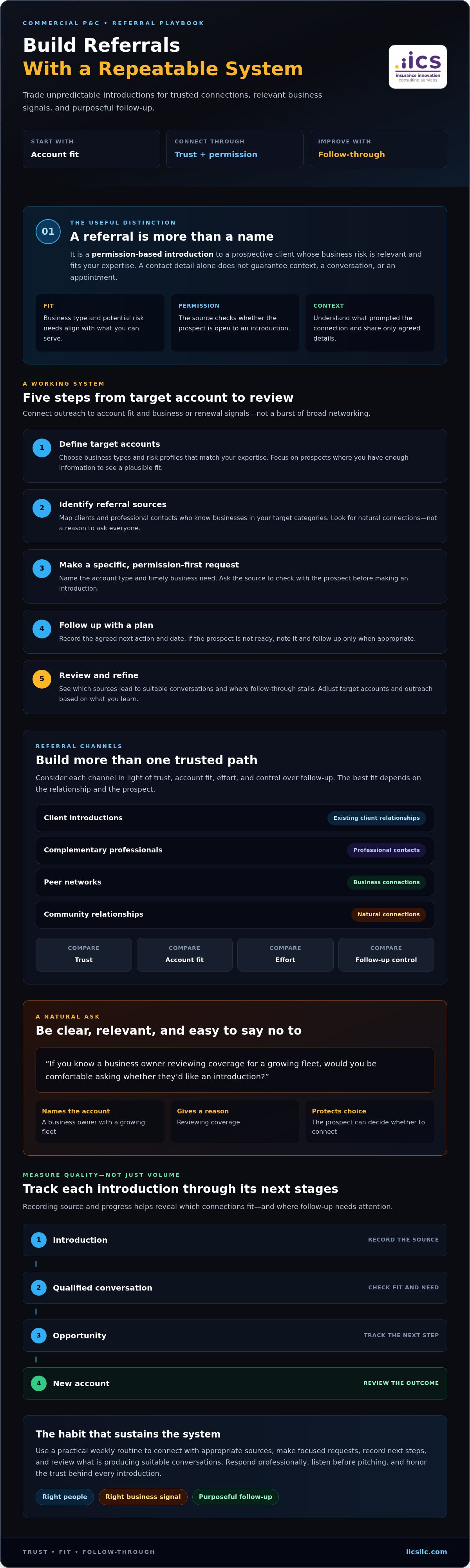
Make the source feel helpful, not pressured. Instead of asking, “Who else can you send me?” explain the type of business you serve and invite an introduction only if someone comes to mind. For example: “If you know a business owner reviewing coverage for a growing fleet, would you be comfortable asking whether they’d like an introduction?” The request is specific, gives the prospect a choice, and protects the relationship if the answer is no.
That’s the foundation of generating referrals for P&C insurance with discipline: earn the introduction, qualify the fit, and follow through without treating every connection as a sale.
Build a Repeatable Referral System Around Commercial Renewal Signals
Consistency comes from a process, not a burst of networking. Connect referral activity to account fit and renewal timing, then record what happens next. A simple workflow keeps generating referrals for P&C insurance focused on prospects who may have a relevant need, rather than names collected without a plan.
Define target accounts. Set a small-commercial focus by business type, risk profile, and the expertise you can bring. Prioritize prospects where you have enough information to identify a plausible fit.
Identify referral sources. Map clients and professional contacts who know businesses in those categories. Look for natural connections, not a reason to ask everyone for names.
Request a specific introduction. Explain the account type you can help and the business signal that makes the connection timely. Ask whether the source is comfortable checking with the prospect before making an introduction.
Follow up with a plan. Record the agreed next action and date. If the prospect isn’t ready to talk, note that and follow up only when appropriate.
Review and refine. Assess which sources produce suitable conversations and where follow-through stalls. Adjust your target accounts and outreach based on what you learn.
How should producers identify referral prospects?
Use a focused suspect list, not a contact dump. Build it around target business types and available account information, including policy effective dates when you can verify them. Public state filings may help identify business names, depending on what information is available, but a filing alone doesn’t establish an insurance need or permission to contact. Research the account, assess fit, and assign a clear next action before outreach.
IICS training uses a target of 100 leads monthly based on expiration dates. Treat that as a training target, not a universal benchmark or a guaranteed result. Track the source, business name, effective date, contact details, next action, and outcome so each prospect has a clear place in your workflow.
When should producers make contact and follow up?
Use outreach 60-90 days before expiration as a planning guide, allowing time to learn about the account and establish a conversation. That’s distinct from the 30-60-day renewal buying window, when a prospect may be actively evaluating renewal options. These periods don’t mean every prospect will be ready on schedule.
Outreach timing tells you when to start the conversation; the buying window indicates when a prospect may be ready to evaluate options. Follow up based on what the prospect says, the effective date, and the next step they agree to. A disciplined calendar helps you stay relevant without turning every renewal signal into pressure.
These habits can be developed through practice and coaching. IICS offers producer development and training to support sales performance.
Compare P&C Referral Channels by Trust, Fit, and Follow-Through
The best referral channel isn’t automatically the one with the most contacts. Choose sources based on whether they know your target businesses, can make a trusted introduction, and allow you to follow up appropriately. Use this comparison to decide where your time is most likely to build relevant commercial conversations.
Which professional relationships can lead to commercial P&C introductions?
How can client and peer networks support referrals?
Map five circles, then choose three actions for each. Keep actions specific and relationship-led:
Current clients: Share a relevant risk insight, check in after a service interaction, and ask a satisfied client for a fitting introduction when the relationship supports it.
Complementary professionals: Identify shared account types, schedule a conversation, and offer a useful introduction where appropriate.
Community relationships: Attend a relevant business event, contribute expertise, and follow up with contacts you genuinely connected with.
Personal network: Explain your commercial focus, share a concise example of a business need you address, and invite a connection only if someone comes to mind.
Reciprocity doesn’t require a payment. Useful insights, responsiveness, and professional follow-through help sustain trust. If considering any incentive or compensation, first verify applicable requirements; don’t assume it’s permitted or necessary. Dedicated referral organizations like Network In Action can help facilitate structured connections, but every channel still needs a clear fit and a respectful handoff.
Use a Practical Outreach Plan to Turn Referral Conversations Into Next Steps
A referral conversation only creates value when someone owns the next step. Set a weekly rhythm for reviewing suitable accounts, reaching out to referral sources, and recording agreed actions. Keep the routine manageable and consistent. A focused request followed through is stronger than a long list of contacts you never revisit.
Identify: Review target businesses and relevant signals, such as an upcoming effective date or a change in operations.
Connect: Contact referral sources who know that type of business. Lead with a useful, specific conversation rather than a broad request for names.
Record: Log the source, prospect, permission status, contact date, and agreed next step.
Review: At week’s end, check open introductions, complete promised follow-ups, and schedule the next appropriate action.
How can a producer ask for an introduction without sounding pushy?
Be precise about whom you can help and why the introduction may be relevant. Avoid asking, “Do you know anyone who needs insurance?” Instead, try: “I work with businesses in [account type] that are reviewing [relevant risk or coverage need]. If a business owner you know is considering that, would you be comfortable asking if they’d like an introduction?”
This gives the source a clear profile to consider without asking them to diagnose the prospect’s insurance needs. Describe the value you can offer, such as helping the business review its risk exposures or understand its options. Don’t promise savings, particular coverage, or a specific outcome. Make declining easy, and ask the source to get permission before sharing the prospect’s contact details or connecting you.
What should a simple referral follow-up routine include?
Once an introduction is made, respect both people’s time. A practical sequence is:
Thank the source and confirm whether the prospect has agreed to connect.
Contact the prospect through the agreed method, briefly explain the reason for reaching out, and offer a clear next step.
If there’s no response, follow up appropriately without repeated pressure. Record the attempt and pause if the prospect declines or asks for no further contact.
Close the loop with the source at an appropriate point, sharing only information you’re authorized to share.
In your record, capture the introduction, source, permission status, contact date, and next action. That simple discipline turns generating referrals for P&C insurance into a repeatable producer habit rather than a series of disconnected conversations.
Producers looking to strengthen these habits can explore the inside the Sales Academy, which supports commercial P&C sales development through structured training and coaching.
Measure Referral Quality and Develop the P&C Producer Habits That Sustain It
A referral channel isn’t successful just because it produces names. Measure what happens after the introduction, then use the results to improve account selection, outreach, and follow-through. Referrals can create opportunities, but they don’t guarantee appointments, quotes, or sales.
Which referral metrics should an agency review?
Track each source through the sales process so you can see where introductions turn into meaningful conversations and where they stall. Review these measures by referral channel:
Introductions: How many prospects did each source connect you with?
Qualified conversations: How many had a relevant business profile, potential need, and permission to talk?
Appointments and opportunities: How many progressed to a scheduled discussion or a defined sales opportunity?
New accounts: Which introductions ultimately became clients?
Follow-through: How promptly were prospects contacted, and were agreed next steps completed?
Look beyond totals. If a source sends several names but few fit your target account profile, the channel may need clearer expectations. If qualified prospects don’t proceed, record the reason where known, such as timing, lack of interest, or a mismatch in needs. That context helps distinguish a channel problem from a follow-up gap.
Referral volume shows how many introductions you receive; channel quality shows whether they fit, progress, and receive consistent follow-through.
The target of 3-5 new accounts monthly is an IICS training target, not a promised result for every producer. Use your own source-level tracking to set expectations and assess progress rather than treating any target as guaranteed.
How can coaching make referral activity more consistent?
Measurement identifies the weak point. Practice helps address it. Producers can rehearse specific introduction requests, review calls for clarity and listening, and use mentoring or workshops to refine their approach. Daily practice makes it easier to repeat sound habits: explain account fit, respect permission, record next steps, and follow through. IICS draws on more than 40 years of insurance industry leadership experience.
IICS’s 90-day Sales Academy combines daily microlearning, AI call coaching, mentoring, and weekly workshops to support producer development. It develops sales habits; it isn’t an insurance lead-generation service, and it doesn’t promise individual sales outcomes. If you want structured development in prospecting and referral conversations, review the Sales Academy.
Make Referral Growth a Producer Discipline
Generating referrals for P&C insurance becomes more consistent when it’s built on trust, relevant commercial account fit, and deliberate follow-through. Choose referral channels based on the businesses they can connect you with, ask for introductions clearly and respectfully, and track progress beyond the number of names received. Qualified conversations, completed next steps, and account outcomes reveal whether your approach is working.
These habits take practice. IICS brings more than 40 years of insurance industry leadership experience to producer development. Its 90-day Sales Academy combines 60 tactical modules with AI call coaching, mentoring, and weekly workshops to help producers develop their skills and routines. Training supports growth, but individual results depend on each producer’s work and circumstances.
Ready to strengthen your commercial P&C sales habits? Review the Sales Academy for commercial P&C producers. Start with one focused introduction request, follow through, and build from there.
Frequently Asked Questions
How do I generate referrals for P&C insurance?
Build a repeatable process around a clear account profile, trusted relationships, and timely follow-up. Identify commercial businesses that fit your expertise, then ask clients or professional contacts for permission-based introductions to prospects with a relevant business need. Record the referral source, prospect, permission status, and next action. Review which introductions become qualified conversations so you can improve your approach without treating every name as a sales opportunity.
Who are the best referral partners for commercial P&C insurance?
The strongest referral partners serve businesses that match your target account profile. Depending on your specialty, that may include satisfied clients, accountants, attorneys, lenders, commercial real estate professionals, or peer producers with complementary expertise. Mortgage and real estate contacts can be useful around property transactions, but they aren’t a fit for every commercial account. Prioritize partners who understand the businesses you serve and can make relevant, permission-based introductions.
How should an insurance producer ask a client for a referral?
Make a specific, low-pressure request tied to the business you can help. For example: “I work with businesses reviewing risk as they grow. If you know an owner in that situation, would you be comfortable asking whether they’d like an introduction?” Explain the kind of guidance you can offer without promising savings or coverage outcomes. Make it easy to decline, and ask the client to get the prospect’s permission before connecting you.
When should a P&C producer contact a referral prospect?
Contact the prospect promptly after the source confirms they’re open to an introduction, and use the communication method they agreed to. For renewal prospecting, 60-90 days before expiration is a planning guide for starting outreach; the 30-60-day renewal buying window is a distinct period when a prospect may be evaluating options. Follow the prospect’s stated timing, log each next step, and avoid repeated contact if they decline.
Can networking generate commercial insurance referrals?
Yes, networking can create commercial introductions when it’s focused on relationships and account fit. Map clients, complementary professionals, peer producers, community connections, and your personal network. Then choose concrete actions, such as reconnecting with a contact or sharing a useful risk insight. Don’t rely on attendance alone. Explain which businesses you serve, listen for relevant needs, and follow up on agreed connections so networking leads to purposeful conversations rather than a larger contact list.
How many referral leads should an insurance producer aim for each month?
There isn’t a universal monthly referral quota that guarantees results. IICS uses a training target of 100 leads per month based on expiration dates, but that is a prospecting target, not a promise or a required number of referrals. Track introductions separately from qualified conversations, appointments, opportunities, and new accounts. Use your own results and account-fit criteria to set a realistic activity goal and adjust it as you learn which sources are productive.
Do referral programs need incentives to work?
No. Incentives aren’t the foundation of a dependable referral channel. Clear communication, useful service, relevant introductions, and professional follow-through can give clients and business contacts a reason to recommend you. If you’re considering compensation or gifts, don’t assume they’re allowed or necessary. Requirements can vary, so check applicable state rules with the relevant insurance department or qualified counsel before offering anything tied to a referral or sale.