The $250,000 Grave: The Real Cost of a Failed Insurance Producer in 2026
- Jul 31
- 12 min read
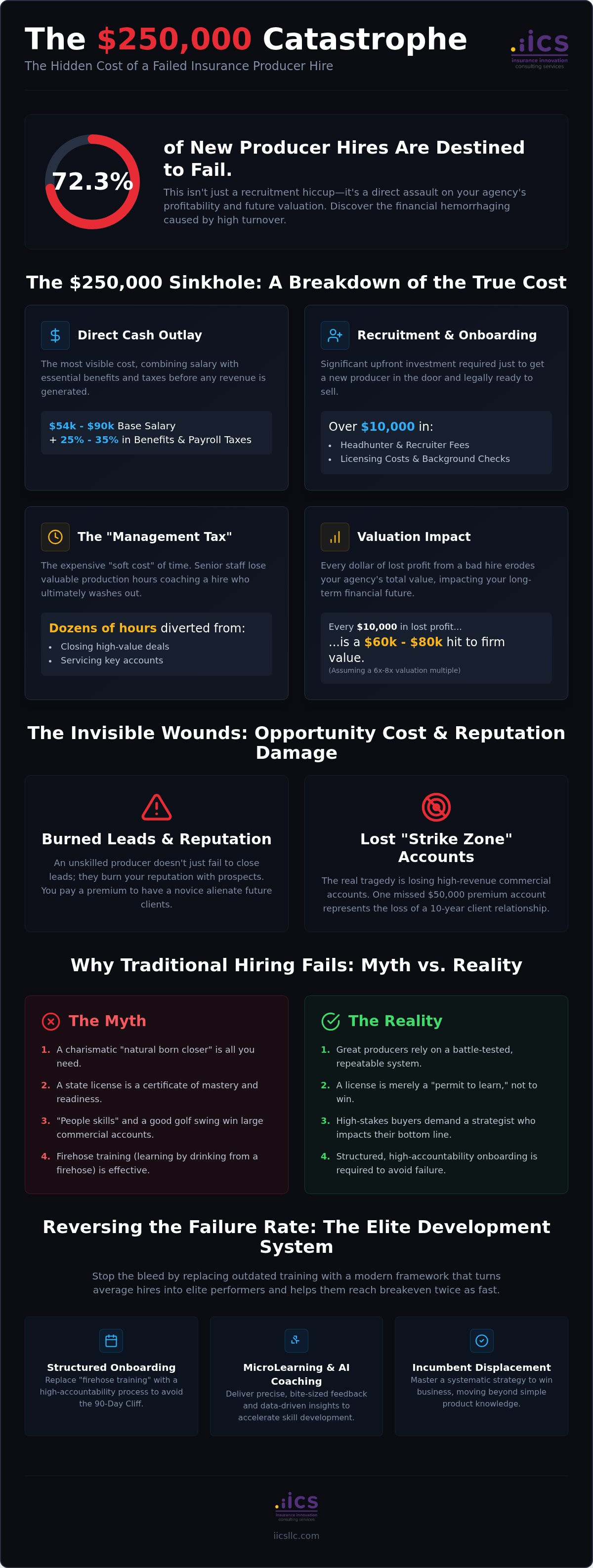
Did you know that 72.3% of new producer hires are destined to fail? This is not just a recruitment hiccup. It is a $250,000 catastrophe. By the time you realize a hire is not going to cut it, you have already sunk a fortune into salary, benefits, and training. The total cost of a failed insurance producer in 2026 includes the massive lost opportunity in large commercial accounts that your competitors are now winning instead. Is your agency's growth being buried in a grave of bad hires?
You are likely tired of the constant cycle of retraining and the management burnout that follows every turnover. It's frustrating to watch capital vanish while your recruits struggle to hit basic numbers. We are going to uncover the hidden financial hemorrhaging caused by this turnover and provide the elite framework used to stop the bleed. You will gain a clear understanding of the financial stakes and learn a repeatable system that ensures new hires actually produce. We will show you how to reduce ramp-up time and reach breakeven twice as fast as the industry norm.
Table of Contents
The $250,000 Hole: Calculating the Real Cost of a Failed Insurance Producer
Most agency owners look at a failed hire and see a lost salary. They're wrong. The true cost of a failed insurance producer is a financial sinkhole that can swallow up to $250,000 of your agency's capital. This isn't just a rounding error; it's a direct assault on your firm's profitability and future valuation. When you factor in recruitment fees, base salary, and the invisible drain of employee turnover, the numbers become staggering. You aren't just losing money. You're losing momentum.
The financial wreckage breaks down into several critical categories:
Direct Cash Outlay: Base salaries ranging from $54,000 to $90,000, plus another 25% to 35% in benefits and payroll taxes.
Recruitment and Onboarding: Headhunter fees, licensing costs, and background checks that easily exceed $10,000 before the producer even makes their first call.
The Management Tax: This is the most expensive "soft" cost. Think about the dozens of hours your principals and senior producers spend coaching a washout instead of closing their own high-value deals.
Valuation Impact: If your agency is valued at a 6x or 8x multiple, every $10,000 of profit lost to a bad hire represents a $60,000 to $80,000 hit to your total firm value.
Direct vs. Indirect Financial Hemorrhaging
A twelve month runway with zero ROI is a death sentence for agency growth. Beyond the salary, you're paying for a technology stack, office overhead, and marketing leads that go nowhere. Consider the leads you've purchased; whether they are $30 shared leads or $120 exclusive commercial transfers. An unskilled producer doesn't just fail to close them; they burn your reputation with those prospects. You're essentially paying a premium to have a novice alienate your future clients. It's an expensive way to stay stagnant.
The Opportunity Cost of the 'Strike Zone'
The real tragedy of the cost of a failed insurance producer is the "Strike Zone" accounts that got away. These are the high-revenue commercial accounts that represent your agency's ideal client profile. When a producer fails to displace an incumbent agent on a $50,000 premium account, you aren't just losing this year's commission. You're losing the ten year lifetime value of that relationship. An unpolished producer acting as the face of your brand can cause lasting damage. Once a major prospect views your agency as "amateur hour," that door stays locked for a long time.
Myth vs. Reality: Why 'Natural Talent' and Licensing Aren't Enough
Too many agency principals operate on hope. They hope a charismatic candidate with a fresh license will magically transform into a top-tier producer. This is a dangerous gamble. In 2026, the marketplace is too sophisticated for "personality" to be a viable sales strategy. When you rely on gut feelings instead of systems, you inflate the cost of a failed insurance producer. You are essentially paying for a very expensive experiment that rarely yields a return. Talent is the starting line; it is not the finish line.
The Licensing Trap
A license is a permit to learn, not a certificate of mastery. Most licensing exams focus exclusively on compliance and basic product knowledge. They teach a producer how to stay out of jail, not how to win a $100,000 commercial account. There is a massive chasm between passing a multiple-choice test and executing advanced commercial insurance sales techniques. In personal lines, you might get away with being an order-taker. In the commercial world, you must be a strategist who can displace an incumbent agent who has held the account for a decade. Without a repeatable process, your new hire is just a licensed amateur.
The 'Natural Born Closer' Delusion
The "natural born closer" is a myth that keeps agencies small. High-stakes commercial buyers don't care about a producer's golf swing or their "gift of gab." They care about risk mitigation and bottom-line impact. Even the most talented salesperson will eventually hit a wall if they don't have a system to follow. This is the core difference in the Good Sales Person vs Great Sales Person framework. Good producers rely on their instincts. Great producers rely on a battle-tested methodology. If you are managing by "gut feeling," you are likely overlooking the data-driven coaching that actually drives production.
The "hire five to keep one" strategy is not a business model. It is a sign of operational failure. There are significant business costs to replacing employees, and in the high-stakes world of P&C, those costs are magnified by lost commissions. You cannot simply churn through talent and expect to build an elite firm. Modern commercial sales also require a collaborative approach. The "Lone Wolf" who refuses to share data or follow agency workflows is a liability, not an asset. If you want to stop the cycle of turnover, you need to transition from hiring personalities to building producers through the Sales Academy for property and casualty Insurance Producers.
The 90-Day Cliff: Where Traditional Onboarding Falls Short
The 90-day mark is where most producer careers go to die. We call it the "90-Day Cliff." You spend months recruiting and thousands in upfront costs, only to watch your new hire lose momentum before they've even finished their first quarter. This isn't a hiring problem. It's an architecture problem. Most agencies treat onboarding like a firehose. They dump two years of technical knowledge into a two-week orientation and wonder why the producer is paralyzed by the time they need to make a cold call. When you consider the median annual wage for insurance sales agents, every day of non-production is a leak in your agency's bucket. This inefficiency is a massive driver in the total cost of a failed insurance producer. If they aren't producing by day 91, they're likely never going to.
The Failure of One-and-Done Training
The Ebbinghaus Forgetting Curve proves that humans lose roughly 70% of new information within 24 hours if it isn't reinforced. Traditional "event-based" training sessions are essentially expensive theatrical performances. You can't expect a one-week seminar to create permanent behavioral change. Elite producer development isn't an event; it's a continuous journey. Without constant reinforcement, your producers revert to comfort zones the moment they face their first "no." They practice bad habits for months in a feedback vacuum before management even notices the trajectory is off.
The Accountability Gap
Why do producers stop prospecting? Because they're allowed to. Most agencies manage by looking at monthly revenue reports. That's like trying to drive a car while only looking in the rearview mirror. By the time you see the revenue is missing, it's too late to fix the behavior. You need daily metrics that track activity before it becomes a result. Producers fail when they don't have a clear "strike zone" or a specific strategy for incumbent displacement. Without a roadmap, they wander. This is where insurance producer development plans become non-negotiable. They set clear expectations for activity, not just results. Are you tracking dials, appointments, and technical submissions daily? If not, you're just waiting for the cost of a failed insurance producer to hit your balance sheet.
Stop wasting senior leadership time on inefficient "ride-alongs." If your top producers are acting as glorified babysitters, they aren't closing their own high-value deals. You're doubling your losses by taking your best players off the field to watch a novice struggle. You need a system that coaches the producer without cannibalizing your principals' time. Elite agencies don't just hope for success; they engineer it through systematic accountability.
Reversing the Failure Rate: Building an Elite Development System
If you want to stop paying the cost of a failed insurance producer, you must stop using 20th-century training methods. Hope is not a strategy. An elite development system replaces guesswork with precision. It moves beyond "quote and hope" and focuses on the high-stakes reality of incumbent displacement. You aren't just teaching them to sell. You're teaching them to win business away from established competitors who have held accounts for years. This requires a fundamental shift in how you cultivate talent. The first 90 days must be an elite bootcamp designed for long-term survival, not a slow crawl toward mediocrity.
Data-Driven Feedback Loops
Subjective mentoring is dead. It's too slow, prone to bias, and lacks the granularity needed to move the needle. By integrating AI coaching for insurance producers, your agency gains an objective lens on every prospect interaction. AI role-play allows new hires to fail in a safe environment rather than in front of a high-value commercial prospect. It identifies performance gaps in real-time, allowing for instant course correction. This transition from "gut feeling" management to objective data analysis ensures that every coaching minute is spent on the specific behaviors that drive revenue.
The Power of MicroLearning and Mentorship
Why do intensive, week-long seminars fail? They ignore the mechanics of human retention. MicroLearning delivers training in bite-sized, actionable modules that producers can consume and apply immediately. This consistent, small-scale learning beats infrequent seminars every time. When you layer this with 1:1 executive coaching and weekly live workshops, you create a synergy that sticks. This structured mastery is the only proven path for how to become a top P&C producer in a hyper-competitive market. It turns the development process into a repeatable science rather than a roll of the dice.
The 3-month intensive is the filter that separates the elite from the average. It demands discipline and high-level execution from day one. By providing your recruits with effectiveness tools and outsourced development, you free up your senior leadership to focus on agency growth. You don't have to choose between coaching and closing. If you are serious about scaling your firm without the $250,000 risk, it is time to leverage the Sales Academy for property and casualty Insurance Producers. Stop the bleed and start building a roster of producers who actually produce.
The IICS Sales Academy: Doubling Success in Half the Time
You've seen the math. You know the cost of a failed insurance producer is a liability your agency can no longer afford to carry. The $250,000 grave is dug by agencies that refuse to evolve their development architecture. At IICS, we don't just offer suggestions; we provide a battle-tested framework for P&C excellence refined over a 40 year track record of continuous growth. Our 3-month Sales Academy for property and casualty Insurance Producers is the definitive solution to the turnover crisis. We turn recruits into elite producers who dominate their strike zone from day one.
A Proven Track Record of Elite Performance
The industry average for a producer to reach breakeven often stretches between 24 and 36 months. That is a lifetime in a high-stakes business environment. It's a period of extreme vulnerability for your agency's capital. Our graduates reach breakeven twice as fast as the industry norm. This isn't a result of luck. It's the product of a precise methodology that integrates AI Sales Coaching, MicroLearning, and weekly live workshops. We provide the data-driven feedback and 1:1 call coaching necessary to eliminate bad habits before they become permanent. By investing in this elite development, you aren't just training a hire. You're protecting your agency's valuation and ensuring a massive ROI on every desk you fill.
Next Steps for Agency Principals
It is time to audit your current onboarding process for failure points. Does your current system rely on the "firehose" method? Does it lack daily accountability? If you're still managing by gut feeling, you're leaving your agency's future to chance. Outsourcing your producer development is the most scalable growth strategy for 2026. It allows your senior leadership to focus on high-level strategy while we handle the heavy lifting of talent cultivation. For firms ready to institutionalize a high-performance culture, our Fractional CRO and CGO services provide the executive-level oversight needed to maintain momentum. We don't just help you hire; we help you win.
Don't let another quarter pass with stagnant production or mounting losses from the cost of a failed insurance producer. Stop the bleeding and start scaling with a partner who has 40 years of experience developing elite individuals across the country. The path to victory is structured, disciplined, and systematic. Are you ready to reach the top tier of your profession? Schedule a strategy session to stop the producer turnover bleed and secure your agency's future today.
Stop the Bleeding and Build Your Elite Roster
The $250,000 grave is a choice. You can continue to gamble on "natural talent" and watch your capital vanish, or you can implement a battle-tested architecture for growth. We have established that the cost of a failed insurance producer is far more than a lost salary; it is a direct hit to your agency's total valuation and market reputation. By moving away from "firehose" onboarding and embracing continuous, data-driven feedback, you transform your agency from a revolving door into a powerhouse of elite performance.
Our 40-year track record of continuous growth proves that systematic success is repeatable. With AI-driven performance feedback and a methodology that helps graduates reach breakeven in 50% less time than the industry average, the risk of failure becomes a relic of the past. It's time to stop the cycle of management burnout and start scaling with precision. You have the tools to ensure your next hire doesn't just survive, but dominates the market.
Stop the $250k bleed. Enroll your next hire in the IICS Sales Academy today.
Your agency deserves a roster of producers who actually produce. Take the first step toward building your elite team today.
Frequently Asked Questions
Why is the insurance producer failure rate so high?
The failure rate is high because most agencies rely on hope rather than a systematic sales architecture. Without a repeatable process for incumbent displacement, even talented hires struggle to navigate the complexities of commercial risk. When you hire for personality instead of system-fit, you are gambling with your agency's capital. Data shows that 72.3% of new hires fail when they lack a structured development framework.
How much does it really cost an agency when a producer fails?
The total cost of a failed insurance producer can reach $250,000 when you calculate the full impact. This includes direct expenses like base salary, benefits, and recruitment fees. It also accounts for the "management tax" of senior leadership time spent on a washout and the massive opportunity cost of high-value commercial accounts your competitors won instead.
How long should it take for a new P&C producer to reach breakeven?
The industry average typically ranges from 24 to 36 months, but this is an inefficient standard that drains agency resources. Elite development systems can cut this time in half. By focusing on high-activity metrics and technical mastery from day one, producers can become profitable assets in 12 to 18 months. Reaching breakeven twice as fast as the norm is the hallmark of a superior training system.
What are the most common reasons insurance producers fail in their first year?
Most producers fail due to the "90-Day Cliff" and a lack of prospecting discipline. They get overwhelmed by "firehose" training and stop making calls the moment they face significant rejection. Without a daily accountability framework, new hires revert to comfort zones and stop the activity required to build a pipeline. They often focus on technical policy forms instead of mastering sales displacement strategies.
Is it better to hire for experience or for 'grit' and coachability?
Grit and coachability are far more valuable than raw experience in the modern P&C landscape. Experienced hires often bring bad habits or a "lone wolf" mentality that resists agency systems. A coachable recruit with high discipline can be molded into a top producer using a battle-tested methodology. You can't teach grit, but you can teach a disciplined hire how to displace an incumbent agent.
How can AI coaching help reduce producer turnover?
AI coaching provides instant, data-driven feedback that human mentors often lack the time to deliver. It allows producers to practice high-stakes commercial interactions in a safe, controlled environment. This objective analysis identifies specific behavioral gaps before they impact your revenue. By catching bad habits early, you reduce the frustration that leads to turnover and ensure the producer stays on a winning trajectory.
What should a 90-day insurance producer onboarding plan include?
An effective 90-day plan must include MicroLearning modules, specific "strike zone" targeting, and daily activity tracking. It should focus on incumbent displacement strategies rather than just basic policy knowledge. The goal is to build a repeatable sales engine that emphasizes prospecting discipline. If your onboarding is just a two-week orientation, you are setting your producers up for the 90-Day Cliff.
Can outsourced producer development really replace internal training?
Outsourced development is often more scalable and effective because it removes the coaching burden from your top producers. It allows your senior leadership to focus on closing deals while ensuring recruits follow a framework backed by a 40 year track record. You avoid the massive cost of a failed insurance producer by leveraging a specialized system that produces consistent, elite results across the country.