The Agency Principal’s Guide to Hiring a Fractional Chief Revenue Officer for Insurance
- Jul 21
- 13 min read
Is your agency a scalable enterprise or just a high-stress job you've created for yourself? You're likely spending more time fixing messy files than building a legacy. The hard truth is that promoting your best producer to management usually results in losing a top biller and gaining a mediocre leader. When you calculate the ROI of fractional CRO for insurance, you stop paying for "potential" and start investing in a systematic revenue engine. Why settle for a full-time executive salary commitment when you can secure elite leadership for a fraction of the overhead?
You already know that the high cost of non-producing hires is the fastest way to bleed your margins. It's frustrating to watch new talent stagnate while you're stuck in the weeds of daily operations. This guide reveals how to transform that stagnation into elite growth, doubling the likelihood of your producers becoming top performers. You'll discover how to achieve breakeven revenue for new hires in half the industry norm time. We are going to break down the mechanics of a repeatable revenue engine that allows you to finally work on the business instead of just in it.
Table of Contents
The Stagnation Trap: Why Insurance Agencies Hit a Revenue Ceiling
Most agency principals believe they have a lead problem. They don't. They have a process problem. You can pour an endless stream of leads into a bucket, but if the bucket is full of holes, you're just wasting capital. This is the dangerous myth of volume. Many agencies hit a revenue ceiling not because they lack opportunities, but because they lack a systematic way to capture them. When growth stalls, the instinct is to buy more leads or hire more bodies. Without a strategic architect, you're just scaling your inefficiencies.
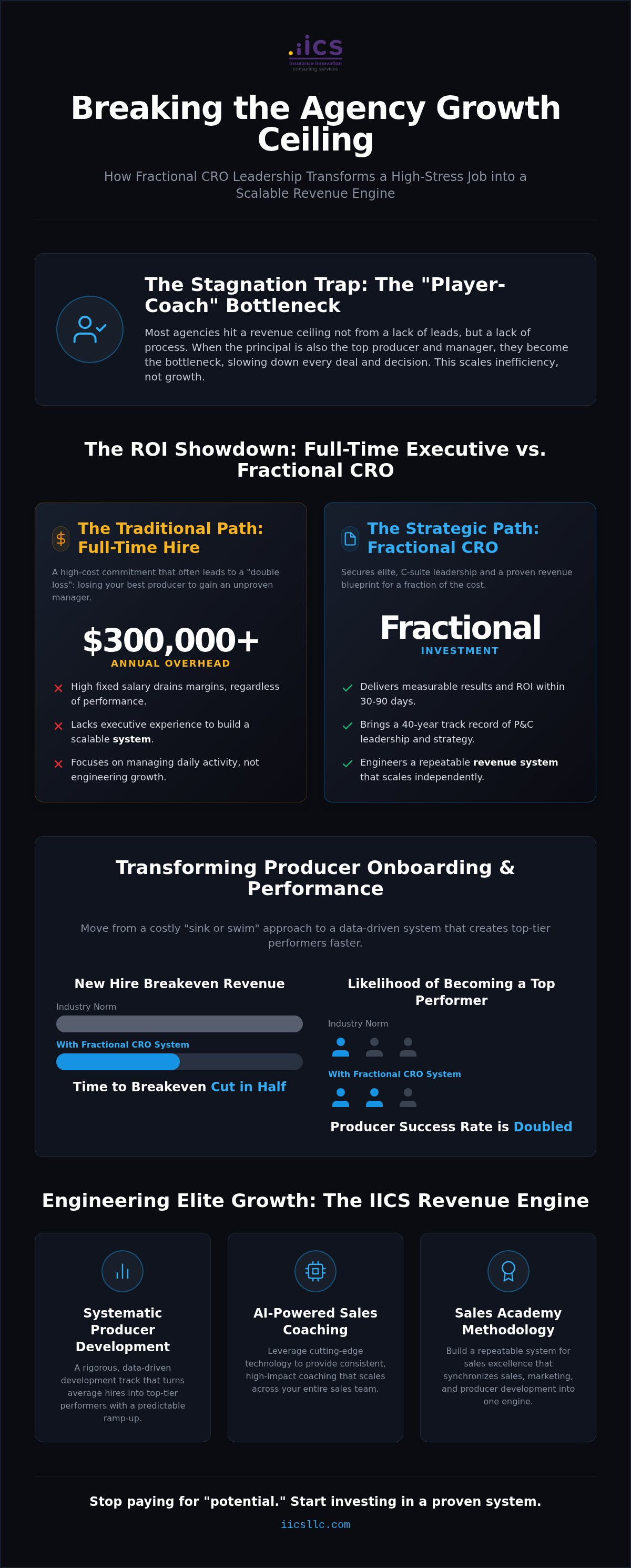
The "Player-Coach" model is the primary culprit behind this stagnation. As the principal, you're likely the top producer, the chief visionary, and the de facto sales manager. It's an impossible trifecta. You become the bottleneck. Every decision, every deal, and every producer roadblock must pass through you. This doesn't just slow down growth; it kills it. True scaling requires a shift from managing individual transactions to engineering a repeatable revenue system. Understanding the ROI of fractional CRO for insurance starts with recognizing that a sales manager monitors activity, while a Chief Revenue Officer (CRO) synchronizes sales, marketing, and producer development into a single, high-performance engine.
The High Cost of Onboarding Failure
Most agency onboarding is a disaster. It's usually a "sink or swim" approach that leaves new hires drifting for months. If a producer doesn't show significant traction within the first 90 days, the likelihood of them ever becoming an elite performer drops off a cliff. This slow ramp-up time is a silent killer of agency valuation. Every month a new hire isn't producing is a month of bleeding cash and missing market share. To fix this, you must identify the Traits of a Successful Insurance Producer early and pair them with a rigorous, data-driven development track. The cost of a non-producing hire isn't just their draws; it's the millions in lost premiums they failed to write while occupying a seat in your office.
The Management Gap in Mid-Sized Agencies
Promoting your top producer to sales manager is a classic mistake. It's a double loss. You lose your best revenue generator and gain a manager who likely lacks the executive training to build a system. Managing a book of business is entirely different from managing a sales culture. Mid-sized agencies often find themselves in a "no man's land" where they are too big for the principal to do everything, but too small to justify a $300,000 full-time executive. This management gap leads to producer churn. Talent leaves because there is no roadmap for their growth. A fractional CRO fills this void, providing the elite strategy needed to turn a collection of individual producers into a scalable revenue machine.
What is a Fractional CRO for Insurance, and Do You Need One?
What exactly is a Fractional Chief Revenue Officer? It isn't a glorified consultant or a part-time sales manager. A fractional CRO is an elite sales architect who provides high-level strategy and executive leadership on a contract basis. They don't just "check in" on your team; they build the infrastructure required to scale. If your agency is generating between $2M and $20M in revenue, you've likely hit a management wall. You need C-suite expertise to break through, but your balance sheet doesn't need a $300,000 executive salary dragging down your EBITDA.
This is where the ROI of fractional CRO for insurance becomes undeniable. You are essentially securing a 40-year track record of P&C leadership for a fraction of the cost of a full-time hire. The core mission of this role is total alignment. They synchronize your sales, marketing, and producer development into a single, high-performance engine. Why settle for a junior manager who is still learning the ropes when you can have a veteran who has already climbed the mountain? You aren't just buying time; you're buying a battle-tested blueprint for elite performance.
Revenue vs. Risk: Clarifying the CRO Role
In the insurance world, the term "Risk Officer" is common, but don't confuse it with a Revenue Officer. While a Risk Officer focuses on compliance and underwriting integrity, the CRO is purely focused on the Go-To-Market (GTM) strategy. Their job is to accelerate producer ramp-up and maximize the lifetime value of every client. By delegating this high-level strategy to a fractional expert, you finally reclaim your time. You can stop being the "closer-in-chief" and start acting as the visionary leader your agency requires. To see how this leadership translates into tangible growth, explore our fractional CRO services designed specifically for the P&C space.
Core Responsibilities of an Insurance CRO
A fractional CRO doesn't just offer advice; they implement systems. Their primary responsibility is designing an Elite Producer Development Plan that works for both green talent and seasoned veterans. This involves more than just a few pep talks. It includes:
Tech Stack Optimization: Integrating CRM data with AI Sales Coaching and Effectiveness Tools to ensure every producer is working on high-value tasks.
Data-Driven Accountability: Moving beyond "gut feelings" to track the leading indicators of success.
Continuous Training: Implementing weekly live workshops and microlearning modules that keep the team sharp in a shifting market.
The goal is to create a repeatable revenue engine. When your tech stack, training, and strategy are aligned, growth becomes a mathematical certainty rather than a stroke of luck. Are you ready to stop guessing and start engineering your agency's success?
Evaluating the ROI: Fractional CRO vs. Full-Time Executive
Hiring a full-time Chief Revenue Officer is a high-stakes gamble that most mid-sized agencies simply cannot afford to lose. When you factor in a base salary of $225,000, plus benefits, payroll taxes, and potential equity, the true Total Cost of Ownership (TCO) often rockets toward $320,000 per year. That is before you consider the catastrophic cost of a "wrong hire" who burns through six months of runway before you realize they lack the grit for the P&C world. The ROI of fractional CRO for insurance is found in the elimination of this waste. You get the same level of strategic firepower without the permanent weight on your balance sheet.
Speed to impact is the other half of the equation. A full-time executive typically requires 90 to 180 days to "onboard" and understand the agency culture. A fractional leader is an expert by trade, not a trainee. They are hired to deliver results within the first 30 days. They don't need to be taught the nuances of Commercial P&C; they arrive with the systems already built. This creates a "Multiplier Effect" where the output of your existing producers begins to climb immediately. You aren't just adding a leader. You are upgrading the performance of every individual already on your payroll.
The Financial Breakdown
The contrast is stark. While a full-time executive demands a massive, long-term commitment, a fractional leader operates on a scalable, results-driven basis. In 2026, the typical investment for a fractional CRO ranges from $10,000 to $22,000 per month, allowing you to deploy capital into other growth areas. This flexibility is vital for agencies learning how to scale an insurance agency without overextending their cash flow. You pay for execution, not for a seat in the office. If your growth trajectory changes, you can scale the engagement up or down without the legal and financial headaches of a C-suite termination.
Operational ROI: Beyond the Dollars
The most significant return on investment isn't found on a spreadsheet; it's found in your calendar. We call this the "Principal’s Tax." It is the 20 to 30 hours per week you currently lose to managing underperformers and chasing down data that should be at your fingertips. A fractional CRO pays for themselves by reclaiming your time and refocusing your energy on high-level vision and M&A opportunities. You stop being the bottleneck.
Beyond time, there is the issue of "sellability." An agency that relies entirely on the Principal to drive revenue is worth significantly less to a buyer than one with a repeatable, non-dependent sales process. By implementing a systematic engine, you are essentially building an asset that is ready for exit at a premium multiple. This external perspective is often the catalyst needed to identify bottlenecks you've become blind to over years of "doing things the way we've always done them." You are buying the ability to double the output of your existing producers and achieve breakeven revenue for new hires in half the industry norm time. This is how ROI of fractional CRO for insurance is truly measured.
The Buying Guide: 5 Non-Negotiable Qualities in an Insurance CRO
A generalist CRO is a liability in the Commercial P&C space. You don't need someone who "knows sales" in a broad, abstract sense. You need a leader who understands the technical nuances of middle-market risks and the multi-layered decision-making process of commercial buyers. To maximize the ROI of fractional CRO for insurance, you must demand a leader who has lived in the trenches of our specific niche. Generalists fail because they don't respect the complexity of the insurance sales cycle. They try to apply software-as-a-service (SaaS) metrics to a relationship-heavy industry, and the results are predictably disastrous.
The right hire is a provocative high-stakes coach, not a passive consultant. They shouldn't just offer suggestions; they should provide a battle-tested framework for success. This requires five non-negotiable qualities: deep P&C industry roots, a proven system for developing elite talent, a tech-forward methodology, a track record of cutting breakeven times, and a demanding cultural fit. If they can't prove they've achieved breakeven in half the industry norm time before, why would you trust them with your agency's future? Results are the only currency that matters at this level.
The P&C Litmus Test
How do you separate the veterans from the pretenders? Start by asking hard questions about the commercial insurance sales cycle. A true expert won't talk about "Sales Training" in isolation. They'll talk about Sales Leadership. They should be able to articulate how they manage the gap between a lead and a bound policy in a hard market. Look for a 40-year track record in the specific P&C niche. This depth ensures they aren't practicing on your dime. They should already know the bottlenecks that are strangling your growth. If they don't understand the difference between managing a transaction and engineering a revenue system, keep looking.
The Methodology Audit
You must audit their tools before you sign a contract. Elite growth isn't an accident; it's the result of a precise methodology. Does their approach include AI Sales Coaching and MicroLearning modules for continuous development? If they're still relying on once-a-year seminars, they're obsolete. Demand a blend of 1:1 call coaching and weekly live workshops that keep producers sharp. They should provide a clear roadmap for the first 90 days that focuses on data-driven feedback and accountability. Secure your agency's future by partnering with a fractional CRO/CGO who understands the high stakes of insurance and has the tools to win. You aren't looking for a friend; you're looking for an architect who will build a repeatable revenue engine.
Engineering Elite Growth: The IICS Approach to Fractional Leadership
You've seen the financial logic. You understand the management gap. Now, you need the engine. IICS doesn't just offer suggestions; we integrate the Sales Academy methodology directly into your agency’s DNA. This isn't a surface-level coaching program that producers forget by Friday. It is a fundamental rewiring of your revenue process. We act as the strategic architect, building a framework where elite performance is the only acceptable standard. When you look at the ROI of fractional CRO for insurance, you're looking at the difference between an agency that survives and one that dominates.
How much is a "gut feeling" worth in a hard market? Not much. We eliminate the guesswork by leveraging AI Sales Coaching for insurance to provide producers with continuous, data-driven feedback. This technology allows us to analyze actual sales calls and identify the exact moments where a deal is won or lost. It's like having a high-stakes coach in the room for every prospect interaction. By combining this data with our MicroLearning modules, we ensure training sticks. Your producers stay in the field, closing deals, while receiving bite-sized, actionable insights that improve their craft every single day.
Our promise is simple and uncompromising. We aim to double the likelihood of your producers becoming top-tier performers. We don't wait for "potential" to manifest. We engineer it through discipline and precision. The ROI of fractional CRO for insurance is found in this transformation. You stop paying for the hope of growth and start investing in a repeatable system that delivers it.
The IICS Fractional CRO Framework
We lead from the front. Our framework includes weekly live workshops and 1:1 call coaching led by 40-year industry veterans. These aren't generalist trainers; they are P&C experts who have built massive books of business. We customize the Elite Insurance Producer Development Plan for your specific lines, ensuring your team isn't just busy, but effective. This high-touch leadership ensures that the strategy we design actually gets executed in the trenches. We don't just hand you a roadmap; we drive the vehicle until the destination is reached.
From Stagnation to Scalability
The industry norm for producer breakeven is far too slow. We help your graduates reach breakeven revenue in half the industry norm time. This rapid ramp-up drastically reduces your financial risk and accelerates your agency’s valuation. By creating a culture of elite performance, you also solve your recruiting problems. Top talent wants to work in a laboratory of success, not a library of stagnation. A fractional CRO from IICS provides the stable, data-backed methodology you need to scale without the overhead of a full-time executive. Stop being the bottleneck in your own business. Secure your agency’s growth with elite fractional leadership from IICS.
Secure Your Legacy with Elite Revenue Leadership
Stagnation isn't just a phase; it's a symptom of a broken system. You can continue to play the role of the bottleneck in your own agency, or you can finally install a framework that scales independently of your daily effort. We've detailed how the ROI of fractional CRO for insurance is measured in reclaimed hours, faster ramp-up times, and doubled producer output. By leveraging a 40-year track record of P&C growth leadership, you transition from maintaining a high-stress job to owning a high-value asset.
Our proprietary AI Sales Coaching and MicroLearning modules provide the data-driven precision required to dominate a complex market. Why gamble on the massive overhead of a full-time executive when elite methodology is available on a fractional basis? The path to the top tier of this profession is narrow, but it's clearly marked for those willing to commit to a systematic approach. Stop guessing and start scaling—explore IICS Fractional CRO services today. You've already built the foundation; now it's time to build the engine that takes you to the finish line.
Frequently Asked Questions
What is the typical cost of a fractional CRO for an insurance agency?
The investment for a fractional CRO in 2026 typically falls between $10,000 and $22,000 per month. This represents a massive reduction in overhead compared to the $320,000 total cost of a full-time executive hire. You are paying for senior-level strategy and execution without the burden of long-term benefits or equity. This flexibility allows you to deploy capital into marketing or technology while still securing elite sales leadership.
How many hours a week does a fractional CRO actually work for my agency?
A fractional CRO typically dedicates between 10 and 20 hours per week to your agency. However, counting hours misses the point of executive-level leadership. You aren't paying for someone to sit in a cubicle; you're paying for 40 years of expertise and a battle-tested methodology. The focus remains entirely on high-impact activities like Go-To-Market strategy, producer development, and tech stack optimization that drive immediate revenue growth.
Can a fractional CRO help with hiring and recruiting new producers?
Absolutely. A fractional CRO is the architect of your talent pipeline. They don't just help you find bodies; they design the specific criteria for elite performers. By implementing a systematic vetting process, they ensure you stop wasting draws on non-producing hires. They oversee the transition from recruitment to the Sales Academy, ensuring every new producer has a data-driven roadmap for success from day one.
What is the difference between a sales consultant and a fractional CRO?
A sales consultant provides advice, while a fractional CRO provides accountability and infrastructure. Consultants often leave you with a thick binder of suggestions that never get implemented. A CRO integrates into your leadership team to engineer a repeatable revenue engine. They own the results. They don't just tell you what's wrong; they build the systems, like AI Sales Coaching, to fix it.
How long does it take to see a return on investment from fractional leadership?
You should expect to see strategic impact within the first 30 days of the engagement. The long-term ROI of fractional CRO for insurance is demonstrated when your producers achieve breakeven revenue in half the industry norm time. By doubling the likelihood of your team becoming top-tier performers, the financial return usually outpaces the investment within the first six months. It's about accelerating the velocity of your agency's cash flow.
Does my agency need to be a certain size to benefit from a fractional CRO?
Agencies generating between $2M and $20M in revenue are in the sweet spot for this service. At this stage, the Principal is usually the primary bottleneck and can no longer manage every producer personally. You need C-suite strategy to break through the revenue ceiling, but you don't yet have the scale to justify a $300,000 full-time salary. Fractional leadership bridges this gap perfectly.
How does a fractional CRO integrate with my existing sales manager?
They act as the strategic architect to your sales manager's foreman. If you already have a sales manager, the fractional CRO provides them with the tools and methodology they need to be effective. This includes implementing MicroLearning modules and data-driven feedback loops. The CRO focuses on high-level revenue strategy, while the sales manager focuses on the daily execution of that battle plan.
What specific insurance lines does IICS specialize in for fractional leadership?
IICS specializes exclusively in Property and Casualty (P&C) insurance. We don't dilute our expertise by chasing life and health lines or generic sales training. Our 40-year track record is built on understanding the complex risks and multi-layered decision-making processes inherent in commercial insurance. We provide the technical depth required to develop elite producers who can navigate a hard market and win middle-market accounts.