The Elite Action Plan for Underperforming Insurance Producers in 2026
- Aug 7
- 13 min read
Is your underperforming producer a victim of bad habits or a symptom of your agency's broken systems? Every month a seat remains filled by a stagnant P&C producer, you aren't just losing commissions; you're hemorrhaging capital and culture. You likely feel the burnout of constant micromanagement and the nagging uncertainty of whether a hire is "fixable" or a total lost cause. Most agency owners wait too long to implement a rigorous action plan for underperforming insurance producer recovery, hoping a sudden "lightbulb moment" will solve the problem. It won't. Success in 2026 requires more than hope; it requires a systematic intervention.
We've spent 40 years proving that underperformance is usually a diagnostic failure, not a character flaw. You don't have to guess about your team's potential when you have a battle-tested framework to rely on. This article delivers a 90-day roadmap to transform stagnant producers into high-performing assets using AI sales coaching and precise metrics. We'll show you how to reach breakeven in half the industry norm time and establish a self-sustaining sales culture. By the end of this guide, you'll have the data-driven tools to justify either a total performance transformation or a swift, justified termination.
Table of Contents
Diagnosing the Root Cause: Is it a Skill Gap or a Will Gap?
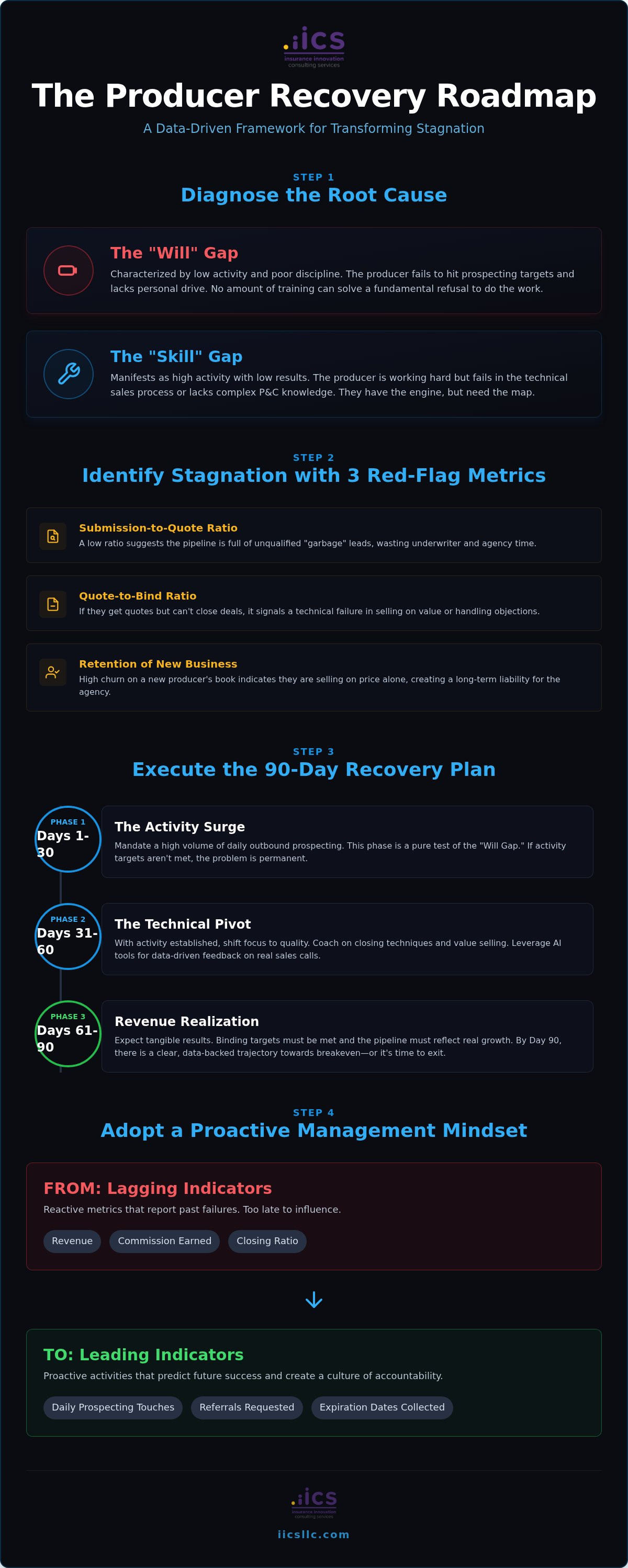
Stop throwing "motivation" at a technical problem. Misdiagnosing the reason behind a producer's failure is one of the most expensive mistakes an agency principal can make. If a producer lacks the fundamental mechanics of a P&C coverage analysis, a high-energy pep talk won't fix their closing ratio. Conversely, the most polished technical expert will still fail if they refuse to pick up the phone. The first step in any effective action plan for underperforming insurance producer recovery is a brutal diagnostic audit of their daily output versus their technical aptitude.
Analyzing the "Will Gap" requires looking at the raw data of discipline. Is the producer hitting their daily prospecting targets? Are they showing up to meetings prepared, or are they coasting on the agency's existing reputation? A Will Gap is often a cultural misalignment or a lack of personal drive that no amount of training can solve. On the other hand, a "Skill Gap" manifests as high activity with low results. This producer is working hard but failing in the technical sales process or struggling with complex P&C knowledge. They have the engine; they just don't have the map.
You must conduct a "Breakeven Audit" to quantify the damage. Most agencies accept a slow burn, but IICS data shows that high-performing producers should reach breakeven in half the industry norm time. While formal Performance Improvement Plans (PIPs) provide a necessary legal paper trail, they often fail because they don't address these specific root causes. If your producer is 18 months in and still hasn't validated their seat, you aren't managing a "slow starter." You're subsidizing a hobbyist.
The 3 Critical Metrics of Producer Stagnation
Submission-to-Quote Ratio: A low ratio here suggests the pipeline is full of "garbage" leads. The producer is chasing anything with a pulse rather than qualifying high-value prospects.
Quote-to-Bind Ratio: If they can get the quote but can't close the deal, the problem is a technical pivot failure. They likely don't know how to sell on value or handle sophisticated objections.
Retention of New Business: High churn on a new producer's book indicates they are selling on price alone. This creates a long-term liability for your agency's loss ratios and service capacity.
The "Red Flag" Checklist for Agency Principals
A non-producing hire is any individual whose validation schedule costs the agency more in overhead and lost opportunity than the annualized commission they generate. Don't fall into "The Busy Trap." Activity does not equal revenue. If a producer spent eight hours "organizing their CRM" but didn't ask for a single referral or expiration date, they didn't work; they performed administrative theater. You must decide when to stop coaching and start the exit process. If the 90-day action plan for underperforming insurance producer doesn't yield an immediate spike in leading indicators, the decision has already been made for you. Cut the cord before the stagnation becomes contagious.
Constructing the 90-Day Elite Producer Recovery Plan
Ninety days. That is the non-negotiable window for a performance improvement plan to yield definitive results or justify an immediate exit. Hope is not a management strategy; it is a financial liability. If you can't see a trajectory toward breakeven within one fiscal quarter, you're no longer coaching; you're subsidizing. Our action plan for underperforming insurance producer recovery is built on three aggressive phases designed to strip away excuses and reveal true potential.
In Phase 1 (Days 1-30), we focus exclusively on the Activity Surge. We re-establish the baseline of daily prospecting by mandating a high volume of outbound touches. If the producer can't hit activity targets when their job is on the line, the "will gap" is permanent. Phase 2 (Days 31-60) introduces the Technical Pivot. Here, we shift focus to closing techniques and coverage expertise, ensuring that the increased activity translates into quality submissions. Finally, Phase 3 (Days 61-90) is about Revenue Realization. We expect to see specific binding targets met and a pipeline that actually reflects the agency’s growth standards. This structured approach ensures that every action plan for underperforming insurance producer development is rooted in reality, not optimism.
Setting 'Elite' Expectations vs. 'Average' Goals
Stop telling producers to "make more calls." It's vague, it's lazy, and it's easily ignored. Elite expectations require moving to specific, granular targets, such as a set number of qualified appointments per week. These individual goals must align directly with broader insurance agency sales performance benchmarks. We utilize a dedicated Effectiveness Tool to track daily discipline. This tool removes the "he said, she said" from performance reviews, providing a cold, hard look at whether the producer is actually doing the work required to succeed. If you're ready to stop guessing and start measuring, you can explore our Effectiveness Tools to see how we verify daily production discipline.
The Weekly Accountability Cadence
Accountability isn't a monthly event; it's a daily rhythm. Every Monday morning kickoff must define the "Big 3" objectives for the week. These aren't just tasks; they're high-impact activities that move the needle. The Friday Review is equally critical. We analyze the "Win/Loss" data from the week's calls to identify patterns of failure or success. During these sessions, we use "Provocative Coaching" to challenge the status quo. We don't ask, "How do you feel about your week?" We ask, "Why did you let that $50,000 premium walk out the door?" This confrontational dynamic demands an internal response and forces the producer to own their outcomes.
Leveraging AI Sales Coaching and MicroLearning for Rapid Correction
Manual coaching is a relic of a slower era. If you're relying on a monthly check-in to save a sinking hire, you've already lost. Traditional role-play is often nothing more than comfortable theater where producers perform for their managers rather than practicing for the market. To execute a successful action plan for underperforming insurance producer recovery, you need objective, data-driven feedback that doesn't rely on a manager's mood or memory. You need to see the truth of what is happening on the front lines, and you need to see it now.
Implementing AI sales coaching for insurance allows you to audit real sales calls with surgical precision. It removes the guesswork. We've spent 40 years refining our methodology, and the data is clear: our framework doubles the likelihood of a producer reaching the top tier of their profession. By analyzing real-time interactions, you identify exactly where the friction exists in the sales process. Is it the opening? Is it the pivot to value? AI doesn't guess; it measures. It provides the cold, hard data required to make a "fix or fire" decision with total confidence.
MicroLearning is the antidote to the ineffective day-long seminar. Most producers forget 80 percent of what they learn in a workshop within 48 hours. We fix specific skill gaps in 10-minute bursts, ensuring the information is consumed, retained, and immediately applied. This rapid-fire correction is essential during a 90-day recovery window where every hour counts. If a producer can't master a single concept in a ten-minute module, they certainly won't master a million-dollar book of business.
The Power of 1:1 Call Coaching
We use call recordings to find the "Closing Gap" that separates a quote from a bound policy. By applying advanced commercial insurance sales techniques, we help producers navigate complex objections that usually stall a deal. AI identifies critical nuances like tone, objection-handling speed, and talk-to-listen ratios. If a producer is talking 80 percent of the time, they aren't selling; they're lecturing. We convert these "failed" calls into targeted training modules, turning every lost opportunity into a lesson that prevents the next one. This isn't just coaching; it's an autopsy of the sales process.
MicroLearning Modules for P&C Mastery
Stagnation often stems from a lack of confidence in specific P&C lines. We target coverage gaps in areas like Cyber, General Liability, or Workers Comp that frequently stall sales cycles. By building a library of Effectiveness Tools for the underperformer, we provide them with a digital "cheat sheet" for success. We ensure long-term retention through spaced repetition and AI-driven testing. This systematic approach ensures that once a skill is learned, it stays learned. It builds a self-sustaining sales culture where the action plan for underperforming insurance producer development becomes a blueprint for every new hire in the agency.
The Accountability Loop: Weekly Workshops and Performance Tracking
Transparency isn't cruel. It's clear. Most underperformers survive in the shadows of an agency because their lack of activity is hidden behind "administrative theater" and vague promises of a "big deal in the works." Any action plan for underperforming insurance producer recovery must transition from private coaching to public accountability. When performance data is made transparent within the sales team, the psychological pressure of peer-to-peer accountability does what a manager's nagging never could. It forces a choice: improve or exit.
We implement a "No-Hiding" Policy. This isn't about shaming; it's about accuracy. If a producer is failing, the entire team should see the metrics that led to that result. This creates a self-policing culture where elite performers set the pace and underperformers are forced to confront their own stagnation. To facilitate a weekly workshop that inspires rather than demoralizes, you must focus on the solution, not just the shortfall. The goal is to build a roadmap out of the hole, provided the producer is willing to pick up the shovel.
Leading vs. Lagging Indicators: What to Watch
Revenue is history. If you only track commissions, you're looking at the results of work done three months ago. To save a producer today, you must track "Leading Indicators" like outbound calls, expiration dates gathered, and qualified appointments set. While high activity is a pro because it ensures the producer is actually working, it carries a significant con: high activity without skill correction just leads to faster failure. We solve this by measuring the "Efficiency Metric," which is the revenue generated per hour of prospecting. If this number doesn't climb as activity increases, the skill gap hasn't been closed. If you are tired of being the only one holding your team accountable, enroll your team in the IICS Sales Academy and let us drive the discipline for you.
Facilitating High-Stakes Role Play
The backbone of our methodology is the "Hot Seat" method used in our Weekly Live Workshops. We don't use canned scripts or generic scenarios. We use real-world P&C challenges that your producers are facing right now. This high-stakes role play tests whether a producer has actually attained "Elite" status or is simply reciting lines. Providing immediate, direct feedback in a group setting accelerates the learning curve. It strips away the ego and focuses entirely on the mechanics of the win. This peer-reviewed environment is why our Sales Academy consistently outperforms traditional, isolated training methods. It turns the action plan for underperforming insurance producer from a document in a drawer into a living, breathing standard of excellence.
When Training Isn't Enough: Fractional Leadership and Systematic Solutions
The "Owner's Dilemma" is a trap that keeps successful agencies small. You're likely the top producer in your firm, yet you spend half your week trying to resuscitate a hire who lacks the drive to succeed. This is a catastrophic waste of your human capital. Every hour you spend micromanaging an action plan for underperforming insurance producer is an hour you aren't closing high-value commercial accounts. You must decide if you want to be a rainmaker or a developmental coach; trying to be both usually results in being mediocre at both.
Professionalizing the sales desk requires a shift from accidental management to intentional leadership. If you don't have the time or the desire to coach, you don't have to. The "Outsourced Producer Development" model allows you to delegate the heavy lifting of skill correction to experts who live for results. By the end of the 90-day window we've established, the data will be undeniable. You'll have the justification needed to protect your agency's bottom line. Use the action plan for underperforming insurance producer metrics to either celebrate a total performance transformation or execute a swift, data-backed termination. Your agency's culture depends on your willingness to enforce high standards.
The Role of a Fractional CRO in Sales Recovery
A Fractional CRO provides high-level sales strategy and leadership without the burden of a $250,000 plus full-time salary. They offer an objective, third-party perspective on your talent that you simply cannot have while being in the weeds every day. This leader builds the systems that prevent future underperformance, ensuring your next hire doesn't fall into the same traps as the current one. They don't just fix the producer; they fix the environment that allowed the producer to fail. This systematic approach ensures that your agency's growth is never dependent on a single individual's motivation. It turns your sales desk into a predictable revenue engine.
The IICS Sales Academy: A Systematic Solution
Our Sales Academy acts as the elite "rehab" for underperformers. This 3-month program replaces the need for internal, half-hearted recovery plans that rarely yield a return on investment. With our 40-year track record of continuous growth, we double the likelihood of a producer becoming a top-tier asset. We reach breakeven in half the industry norm time by using the AI coaching and microlearning tools discussed earlier. Stop guessing if your team has what it takes. Is your producer fixable? Request a consultation with IICS to find out.
Stop the Revenue Leak and Reclaim Your Agency's Growth
The window for indecision has closed. You've seen how a structured action plan for underperforming insurance producer recovery separates high-performers from permanent liabilities. By diagnosing the root cause of stagnation and enforcing a 90-day surge of activity and technical mastery, you reclaim control of your agency's future. You don't have to guess if a producer is fixable when you have the data-driven precision of AI-driven coaching technology and the pressure of weekly live workshops at your disposal.
Stagnation is a choice you make every day you allow an underperformer to occupy a seat. With our 40-year track record of P&C leadership and the Elite Producer framework used nationwide, we provide the stability and methodology your agency needs to scale. It's time to stop the burnout and professionalize your sales desk with systems that work. Enroll your producer in the IICS Sales Academy to stop the revenue leak today.
The road to an elite sales culture is demanding, but the results are undeniable. Take the first step toward a self-sustaining agency today.
Frequently Asked Questions
How long should I give an underperforming insurance producer before letting them go?
You should allow a maximum of 90 days for a formal recovery process. If leading indicators like prospecting activity don't spike within the first 30 days, the producer likely lacks the necessary drive to succeed. Waiting longer than a quarter only increases your sunk costs and damages agency culture. A rigorous 90-day window provides enough data to confirm if they can reach breakeven or if they remain a permanent liability to your agency's capital.
What are the first signs that an insurance producer is going to fail?
The earliest indicator of failure is "administrative theater," where a producer prioritizes CRM organization or "research" over outbound calls. You'll notice a distinct avoidance of high-rejection activities like cold calling or asking for expiration dates. If their pipeline consists of small, low-commission accounts rather than qualified commercial prospects, they're hiding a lack of sales discipline behind a facade of being busy. Activity without quality is just a slow path to failure.
Is it better to retrain an underperformer or hire a new producer?
You should only retrain an underperformer if they possess a high "will" but a low "skill." If a producer is hitting activity targets but failing to close, they're a prime candidate for a structured action plan for underperforming insurance producer development. However, if the issue is a lack of discipline or cultural misalignment, hiring a new producer is the only logical choice. You can't coach desire, and you shouldn't waste agency resources trying.
How do I calculate the 'breakeven' point for a P&C producer?
Calculate the breakeven point by totaling the producer's salary, benefits, and proportional share of agency overhead, then comparing that to the annualized commission they generate. A producer reaches breakeven when their net revenue equals their total cost of seat. IICS data shows that elite producers reach this milestone in half the industry norm time through systematic development. If they aren't on a clear trajectory toward this number by month six, your investment is at risk.
What should be included in a Performance Improvement Plan (PIP) for an insurance agent?
An effective PIP must include non-negotiable daily activity quotas, specific technical mastery milestones, and a hard deadline for revenue results. It shouldn't be a vague document about "improving attitude" or "teamwork." Focus on leading indicators such as expiration dates gathered and appointments set to ensure the action plan for underperforming insurance producer recovery is based on objective data. This removes the ego from the conversation and focuses entirely on the mechanics of the win.
Can AI sales coaching really improve an experienced agent's closing ratio?
AI sales coaching is often more effective for experienced agents because it reveals ingrained blind spots that human managers miss. By analyzing talk-to-listen ratios and the speed of objection handling, AI provides objective feedback on real sales calls. This allows veteran producers to refine their technical pivot and close sophisticated commercial accounts they previously would've lost. It turns every call into a training module, ensuring that even seasoned pros don't become stagnant.
What is the difference between a 'Will Gap' and a 'Skill Gap' in sales?
A "Will Gap" is a fundamental lack of effort, discipline, or desire to perform the necessary prospecting activities. A "Skill Gap" occurs when a producer is doing the work but lacks the technical knowledge or sales mechanics to close the deal. You can fix a skill gap with targeted microlearning and 1:1 call coaching. A will gap is usually a permanent character trait that requires termination rather than training. Know the difference before you invest.
How much does it cost an agency to keep a non-producing producer for one year?
The cost includes their direct compensation, benefits, and a share of agency overhead, but the "opportunity cost" is the true killer. You're losing the commissions from the accounts a high-performer would've closed in that same seat. When you factor in the drain on management time and the negative impact on team morale, a stagnant producer costs an agency significantly more than their base salary. Keeping a failure is an expensive choice that limits your agency's overall valuation.